
Free and Open-Source LaunchDarkly Alternative: What FeatBit Offers in 2026
If you are looking for a free and open-source LaunchDarkly alternative, the useful question is not "which product copies every LaunchDarkly feature?" The useful question is:
Which release-control model fits our team, traffic, data boundary, cost model, and governance requirements?
LaunchDarkly is a mature commercial platform for feature flags, experimentation, observability, release automation, and AI runtime control. It is not realistic or fair to describe a free alternative as a full one-for-one replacement for every LaunchDarkly plan, workflow, and enterprise add-on.
FeatBit is a strong alternative when your team wants an open-source, self-hosted feature flag platform that covers the core release-control loop: create flags, target users or segments, roll out progressively, run experiments, inspect flag activity, integrate with automation, and keep the control plane in infrastructure you can operate.
Short Answer
Choose FeatBit when the buying requirement is:
- free or open-source feature flag infrastructure;
- self-hosted deployment for data control or compliance posture;
- predictable cost instead of usage variables that grow with traffic, service count, or client-side monthly active users;
- progressive rollout, targeting, rollback, and experimentation in one release-control workflow;
- engineering-owned automation through APIs, SDKs, webhooks, CLI, MCP, or OpenFeature-style integration paths.
Choose LaunchDarkly when your team wants LaunchDarkly's managed platform, plan-specific enterprise features, built-in observability and release automation, AgentControl workflows, commercial support model, and the surrounding ecosystem as a single vendor surface.
This article is a decision guide, not a ranking. It focuses on where FeatBit is a credible LaunchDarkly alternative and where a team should verify requirements directly before migrating.
What Changed Since the 2023 Version
The original version of this article argued that large language models would reduce the functional gap between developer tools. That prediction is too broad for a serious buyer in 2026.
The feature flag category has moved in a more specific direction:
- AI features, prompts, model routes, and agent behavior now need runtime controls, not only deployment controls.
- Feature flag platforms increasingly connect rollout, experimentation, observability, governance, and rollback.
- Pricing evaluation is less about "free versus paid" and more about which usage meters, enterprise add-ons, and operating costs scale with your product.
- Self-hosting matters when feature flag data, audit history, targeting rules, or customer identifiers should stay inside a private infrastructure boundary.
So the better FeatBit angle is not "LLMs will make every tool equivalent." It is "open-source, self-hosted release control is a different operating model."
The Evaluation Criteria That Matter
Use these criteria before deciding whether FeatBit can replace LaunchDarkly for your team.
| Criterion | What to verify | Why it matters |
|---|---|---|
| Deployment model | SaaS only, self-hosted, private cloud, Kubernetes, Docker Compose, Terraform, or hybrid | A feature flag system becomes part of production infrastructure. The deployment boundary affects security, latency, operations, and procurement. |
| Cost model | Seats, service connections, client-side MAU, AI runs, events, add-ons, support, infrastructure, and operations | A "free" developer tier is not the same as predictable cost at scale. |
| Targeting and rollout | Individual targeting, segments, rules, percentage rollout, environments, and rollback | Release control depends on exposing risk gradually and reversing quickly. |
| Experimentation | Whether flag exposure can connect to metrics and decision evidence | Feature flags become more valuable when rollout produces learning, not only on/off state. |
| Governance | RBAC, audit logs, approvals, policies, SSO, and lifecycle cleanup | Enterprise teams need to know who changed what, why, and how temporary flags are retired. |
| Automation | REST API, SDKs, webhooks, CLI, MCP, OpenFeature providers, and CI/CD integration | Platform teams need repeatable workflows, not only manual dashboard changes. |
| AI release control | Prompt, model, retrieval, agent-tool, and fallback behavior controlled at runtime | AI behavior changes faster than traditional releases and needs staged exposure, observability, and rollback. |
If your must-have list is mostly managed observability, AI-agent configuration UI, enterprise release automation, or LaunchDarkly-specific integrations, FeatBit should be evaluated as part of a proof of concept rather than assumed to be a drop-in replacement.
Why FeatBit Is a Serious Alternative
FeatBit's core advantage is control ownership. It is open-source, can be self-hosted, and is designed around feature flags, progressive rollout, targeting, experimentation, and operational release control.
For teams evaluating self-hosted feature flag infrastructure, start with FeatBit's self-hosted feature flags hub. The hub frames self-hosting around four cost levers: license, infrastructure, operations, and governance. That is the right way to compare alternatives because the cheapest monthly subscription is not always the lowest total cost.
1. Open source and self-hosted control
FeatBit is published as an open-source project on GitHub, and the repository includes deployment assets such as Docker Compose files and Kubernetes-related directories. That matters when a platform team wants to inspect the product, run it in its own environment, or avoid routing all flag metadata and targeting data through a third-party control plane.
Self-hosting is not automatically better for every company. It adds operational responsibility. But it becomes attractive when the team already operates platform infrastructure, has data residency requirements, wants private networking, or needs tighter control over feature flag data.
For a structured cost view, use FeatBit's self-hosted feature flags TCO model rather than comparing only list prices.
2. Predictable cost planning
LaunchDarkly's public pricing and billing documentation now makes several scaling variables visible: service connections, client-side MAU, AI runs, observability, experimentation, plan tiers, and overage behavior. That is a normal SaaS model, but it means a buyer should forecast usage instead of comparing the first month only.
FeatBit's self-hosted model is different. The cost discussion shifts toward infrastructure, operations, governance, and any commercial support or enterprise license the team chooses. FeatBit's predictable cost planning page is the relevant internal link for buyers who are trying to avoid usage-based surprise bills.
The right question is not "which one is cheaper today?" It is:
What happens to cost when we add environments, services, client-side traffic, AI evaluations, experiments, audit requirements, and more teams?
3. Release control instead of simple toggles
Feature flags are not just if statements. A production flag should have:
- a clear owner;
- a default fallback;
- a target audience;
- a rollout path;
- a rollback rule;
- metric evidence;
- a cleanup expectation.
FeatBit fits teams that want deployment and release to be separate decisions. You deploy code when it is technically ready, then release behavior through targeting, segments, percentage rollout, and experiments.
For implementation context, FeatBit documents targeting rules, percentage rollouts, flag insights, and the Track Insights API.
4. Governance, RBAC, and auditability
Enterprise feature flag risk is often governance risk. A dangerous release is not always caused by bad code. It can come from a targeting rule changed by the wrong person, an experiment expanded too quickly, a stale flag left behind, or an undocumented emergency toggle.
FeatBit's self-hosted content treats governance as a cost and risk lever. The most relevant follow-up page is self-hosted governance with RBAC and audit logs. Pair that with product documentation for audit logs, IAM overview, and RBAC when you build a proof of concept.
5. Data residency and private infrastructure
Some teams cannot treat feature flag data as a low-risk SaaS detail. Targeting rules may reference tenants, regions, plans, regulated workflows, or internal operational state. Audit logs may be part of incident review. Experiment events may connect to product and customer behavior.
If those records need to remain within a specific infrastructure boundary, FeatBit's data residency and compliance guidance is the right next step. It does not remove the need for your own legal, security, and compliance review. It gives the platform team a clearer deployment posture to evaluate.
Where LaunchDarkly Is Still the Better Fit
A fair alternative article should say where the alternative is not the obvious choice.
LaunchDarkly may be the better fit when:
- your organization already standardizes on LaunchDarkly;
- you need a managed platform more than infrastructure ownership;
- you want plan-specific enterprise workflows, approvals, release automation, observability, and support as one vendor package;
- AgentControl is a central requirement for managing prompts, model settings, agent behavior, monitoring, and experiments in LaunchDarkly's product surface;
- your procurement team prefers a commercial SaaS contract over operating another self-hosted production system.
FeatBit can still be considered in these cases, but the proof of concept should be concrete. Pick the exact LaunchDarkly workflows you rely on, implement the equivalent release-control path in FeatBit, and document gaps instead of assuming parity.
AI Changes the Alternative Discussion
AI does not make feature flag platforms interchangeable. It makes runtime control more important.
AI product behavior often changes through prompts, model routes, retrieval profiles, tool permissions, guardrail modes, fallback behavior, and agent autonomy. Those changes can affect cost, latency, safety, user experience, and downstream systems without looking like a traditional code release.
FeatBit's strength is that it can treat those AI behavior changes as release decisions:
- use boolean flags for enablement and kill switches;
- use string or JSON variations for model routes, prompt profiles, retrieval modes, or fallback profiles;
- target internal users, beta tenants, regions, plans, or risk tiers;
- expand with percentage rollout;
- record exposure and outcome events;
- roll back without redeploying.
For deeper context, read FeatBit's AI control layer, safe AI deployment, and AI experimentation pages.
A Practical Proof-of-Concept Plan
Do not evaluate an alternative with a generic demo flag. Use a real workflow that matters.
- Pick one production feature or AI behavior currently controlled by deployment.
- Define the fallback behavior and rollback owner.
- Create a FeatBit flag with typed variations.
- Target internal users first.
- Expand to a small beta segment or percentage rollout.
- Connect exposure to one primary metric and two guardrails.
- Review audit history after each change.
- Decide whether to continue, pause, roll back, or clean up.
If the pilot is part of a migration from LaunchDarkly, use FeatBit's self-hosted migration playbook. A migration should include parallel evaluation, validation, rollback, and cleanup. It should not be a same-day flag export followed by hope.
Decision Checklist
FeatBit is likely a good LaunchDarkly alternative when most answers are "yes":
| Question | Yes means FeatBit is a stronger fit |
|---|---|
| Do we need a free or open-source starting point? | Yes |
| Do we want to self-host the feature flag control plane? | Yes |
| Do we already operate Docker, Kubernetes, cloud infrastructure, or platform services? | Yes |
| Do we need predictable cost as services, traffic, or environments grow? | Yes |
| Do we care about data residency or private deployment? | Yes |
| Do we need targeting, rollout, experiments, audit logs, and API automation more than a managed all-in-one SaaS surface? | Yes |
| Are we willing to run a real proof of concept before migration? | Yes |
LaunchDarkly is likely the better fit when most answers are "yes":
| Question | Yes means LaunchDarkly may remain the better fit |
|---|---|
| Do we want a managed commercial platform first? | Yes |
| Do we need LaunchDarkly-specific enterprise workflows or integrations? | Yes |
| Do we want AgentControl as an AI-specific vendor workflow? | Yes |
| Do we prefer vendor-operated infrastructure over self-hosted responsibility? | Yes |
| Do our current usage and contract terms already fit the budget? | Yes |
Bottom Line
FeatBit is not a free clone of LaunchDarkly. It is a different operating model: open-source, self-hosted release control for teams that want to own feature flag infrastructure, cost planning, data boundaries, rollout governance, experimentation, and automation.
If your main requirement is a managed enterprise platform with LaunchDarkly's full product surface, stay with LaunchDarkly or compare it directly against other managed vendors. If your main requirement is open-source and self-hosted control over feature flags, FeatBit deserves a serious proof of concept.
Source Notes
- LaunchDarkly vendor context: pricing, billing calculation, AgentControl overview, and AgentControl experimentation.
- FeatBit product context: self-hosted feature flags, FeatBit GitHub repository, Docker Compose installation, deployment options, and AWS Terraform deployment.
- FeatBit release-control context: targeting rules, percentage rollouts, audit logs, RBAC, and Track Insights API.
Image and Open Graph Notes
- Cover and body image:
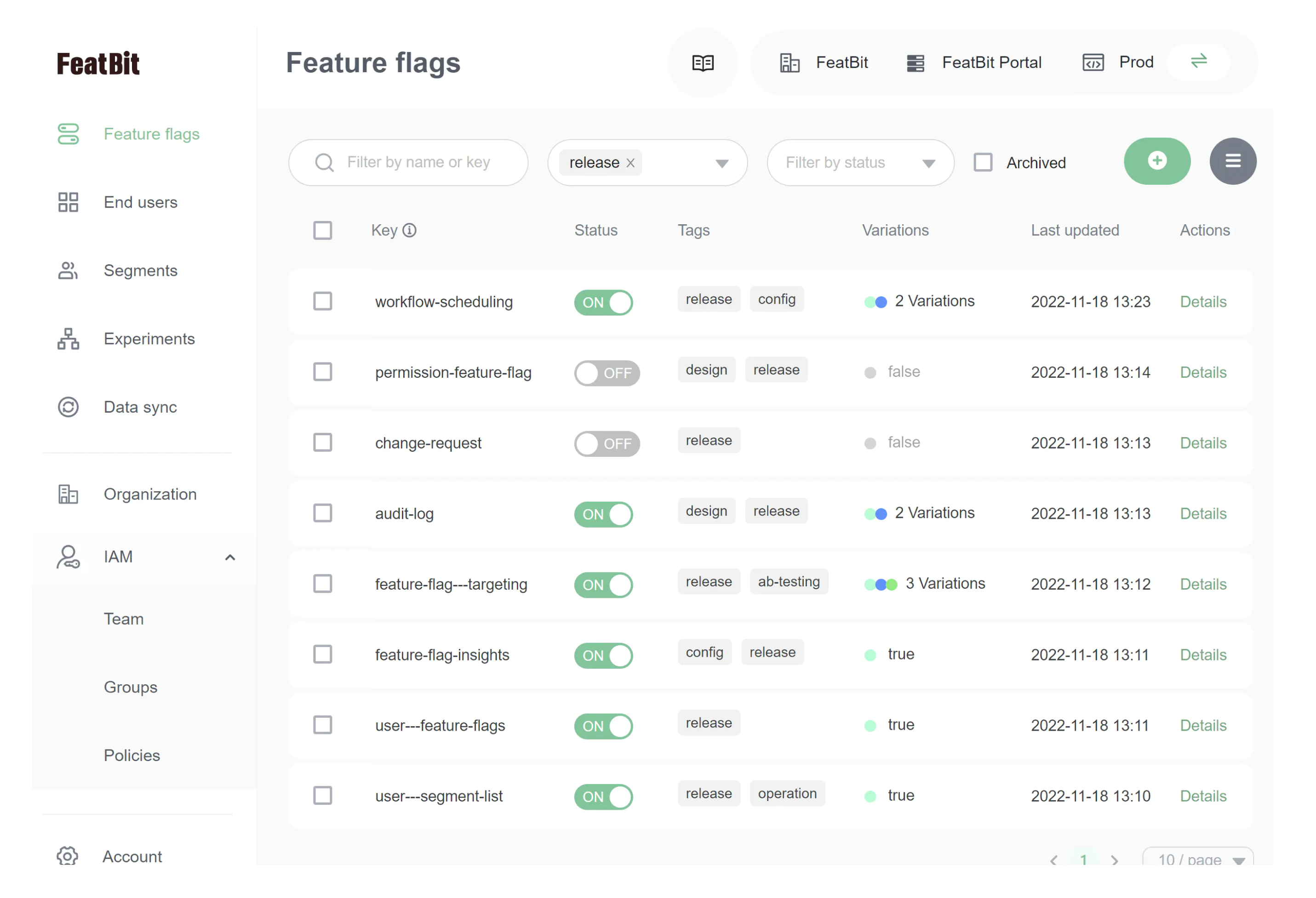
/images/home/flag_list.png. - The image is an existing FeatBit product screenshot from this website, used to show the actual feature flag management surface rather than an invented third-party comparison graphic.
- Open Graph should use the same image unless a dedicated FeatBit product screenshot is created later.