
Prompt Experiments: How to Compare Prompt Performance Without Guesswork
A prompt experiment compares two or more prompt variants against a defined task, population, metric, and guardrail set. The point is not to decide which prompt sounds better in a playground. The point is to decide which prompt should run for a real product workflow, under what conditions, and with what rollback path if performance degrades.
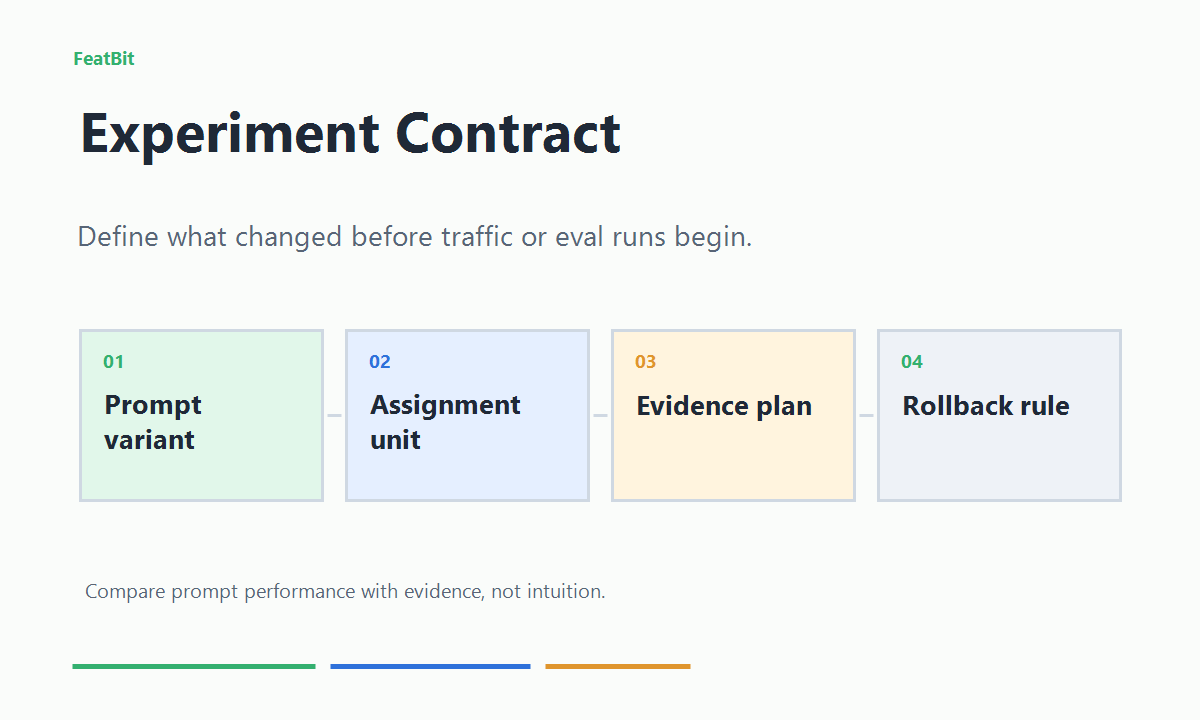
For AI product teams, a useful prompt experiment has three parts:
- a variant contract that says exactly what changed;
- an evidence plan that separates offline quality from live product performance;
- a release control that can target, ramp, pause, or roll back the winning or losing prompt without redeploying the application.
That is the distinct job behind the search for "prompt experiment": the reader needs a practical way to compare prompt performance, not another list of prompt-writing tips.
What A Prompt Experiment Should Decide
Start by writing the release question in one sentence:
Should prompt B replace prompt A for support answer drafting because it increases accepted AI drafts without increasing correction rate, escalation rate, latency, or token cost?
That question is stronger than "is prompt B better?" because it names the workflow, the baseline, the candidate, the primary outcome, and the tradeoffs. It also makes the experiment falsifiable. A prompt can win on answer style and lose on cost. It can improve aggregate completion while hurting a high-value segment. It can pass an offline rubric and still fail when real users provide messy context.
Use a prompt experiment when the prompt affects one of these production decisions:
| Prompt decision | What the experiment compares | Why it matters |
|---|---|---|
| Answer generation | current prompt versus candidate prompt | Measures usefulness, grounding, trust, and downstream user action. |
| Classification | current routing prompt versus revised rubric prompt | Measures correct routing and high-risk false positives. |
| Summarization | concise prompt versus structured evidence prompt | Measures accepted drafts, correction load, and latency. |
| Agent instruction | conservative tool-use prompt versus expanded instruction prompt | Measures task completion, intervention rate, and unsafe action attempts. |
| RAG response | baseline answer prompt versus citation-first prompt | Measures citation acceptance, no-answer rate, and source mismatch. |
If the prompt, model, retrieval profile, temperature, and tool policy all change together, call it a route experiment. That can still be valuable, but the result should not be attributed to the prompt alone.
Build A Variant Contract Before Testing
The most common prompt experiment failure is vague variation design. Teams compare two prompts, look at a dashboard, and later realize the treatment changed the prompt text, output format, retrieval instruction, model parameters, and fallback behavior at the same time.
Write a small contract before the experiment starts:
prompt_experiment:
  key: support_answer_prompt
  owner: ai_platform_team
  release_question: should_prompt_b_replace_prompt_a_for_support_answers
  assignment_unit: conversation_id
  control:
    prompt_version: support_answer_v3
    model_route: current_support_model
    retrieval_profile: baseline_kb_search
  treatment:
    prompt_version: support_answer_v4_citation_first
    model_route: current_support_model
    retrieval_profile: baseline_kb_search
  primary_metric: accepted_ai_draft_rate
  guardrails:
    - human_correction_rate
    - escalation_rate
    - p95_latency
    - estimated_token_cost
    - complaint_rate
  rollback_when:
    - severe_quality_issue
    - guardrail_breach
    - missing_exposure_or_outcome_events
  cleanup:
    after_decision: remove_losing_prompt_branch_or_promote_winner
The contract does not need to be long. It needs to make interpretation possible. If a reviewer cannot tell what changed, who was eligible, what metric decides the result, and how rollback works, the experiment is not ready.
OpenAI's Evals API reference describes evals as a way to manage and run evaluations with testing criteria and data sources. That is useful for pre-production comparison. A prompt experiment contract extends the same discipline into the release path: what offline evidence makes the candidate eligible, and what live evidence makes it worth shipping.
Separate Offline Checks From Live Performance
Offline evaluation and online experimentation answer different questions.
| Evidence stage | What it can prove | What it cannot prove |
|---|---|---|
| Offline eval | Candidate handles representative examples, regression cases, format rules, and rubric checks. | Real user behavior, business impact, or production traffic shape. |
| Human review | Output is acceptable for known cases and policy-sensitive examples. | Whether users will trust or act on the answer at scale. |
| Shadow test | Candidate can run on production inputs without changing the user-visible answer. | Whether the candidate improves visible user outcomes. |
| Canary exposure | Limited real users can receive the candidate without obvious guardrail harm. | Final product value across the target population. |
| A/B experiment | Candidate changes a defined user or business outcome under controlled assignment. | Whether temporary experiment code has been cleaned up. |
Statsig's AI Evals documentation separates offline evals on fixed test sets from online evals that grade production model output on real-world use cases. LaunchDarkly's experimentation best practices also emphasize connecting feature flags, metrics, and product behavior questions. Those category signals point to the same operating principle: prompt performance needs both quality evidence and controlled production evidence.
For FeatBit, the flag is the release-control boundary. It does not grade the prompt by itself. It controls who receives which prompt, records the variation, supports staged exposure, and keeps rollback available while the evaluation and analytics systems explain what happened.
Choose Metrics That Match The Prompt Job
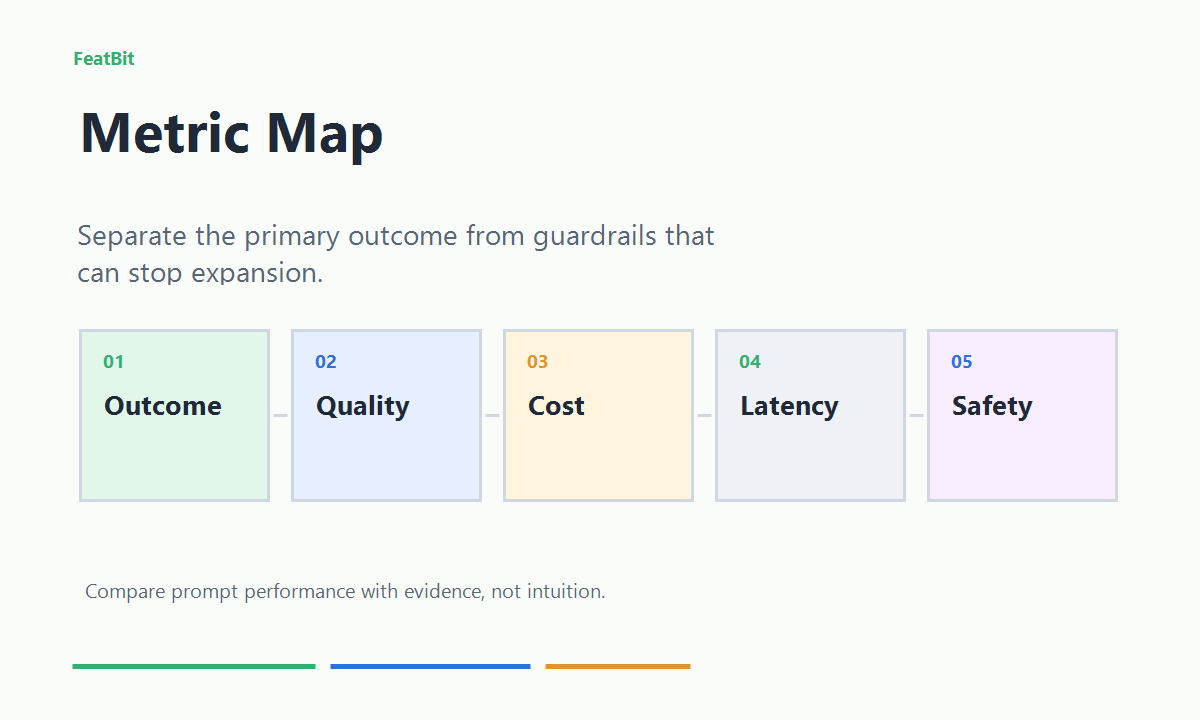
"Better answer" is not a metric. A prompt experiment should use one primary outcome and several guardrails.
| Prompt workflow | Primary performance metric | Guardrail metrics |
|---|---|---|
| Support answer drafting | accepted AI draft rate | correction rate, escalation rate, complaint rate, p95 latency, token cost |
| Knowledge-base answer | successful self-service session | missing citation rate, source mismatch, no-answer rate, retrieval cost |
| Ticket classification | correct downstream queue | manual reroute rate, high-risk false positives, confidence drift |
| Sales assistant summary | rep-approved summary | edit distance, missing required fields, CRM save failure, latency |
| Agent instruction prompt | completed workflow without takeover | wrong-tool call rate, approval queue, tool error rate, rollback count |
The primary metric decides whether the candidate is worth expanding. Guardrails decide whether to pause or roll back even when the primary metric improves.
This is especially important for prompts because performance is multi-dimensional. A prompt can make answers more detailed and also slower. It can reduce escalations by sounding more confident while increasing correction load. It can improve a judge score while hurting the user action that the product actually needs.
Keep Assignment Stable
Prompt experiments need stable assignment. If one conversation receives prompt A for the first answer and prompt B for the follow-up, the user experience becomes inconsistent and the metric readout becomes hard to trust.
Choose the assignment unit based on the workflow:
| Workflow shape | Better assignment unit | Why |
|---|---|---|
| Single support ticket | ticket ID or conversation ID | Keeps the thread coherent. |
| Multi-session user assistant | user ID or account ID | Keeps the assistant behavior consistent across sessions. |
| Team workspace behavior | account ID or workspace ID | Avoids mixed experiences inside one organization. |
| Stateless classification | request entity ID | Works when each item is independent. |
| Internal operator workflow | operator ID or queue ID | Keeps review load and behavior comparable. |
OpenFeature's evaluation context specification gives a vendor-neutral model for passing a targeting key and custom fields into flag evaluation. In a prompt experiment, that context might include account ID, conversation ID, workflow, environment, risk tier, locale, or plan. The important part is deterministic assignment and clear eligibility.
FeatBit can model this as a multivariate flag that returns a prompt version:
const promptVariant = await flags.getString(
  'support_answer_prompt',
  {
    key: conversation.id,
    accountId: conversation.accountId,
    workflow: 'support_answer',
    environment: 'production',
  },
  'support_answer_v3'
);

const prompt = promptVariant === 'support_answer_v4_citation_first'
  ? supportAnswerPromptV4
  : supportAnswerPromptV3;
The exact SDK shape depends on your application. The operating requirement is stable: evaluate the flag at the server-side decision point, run the selected prompt, and attach the variation to telemetry only when the AI behavior actually runs.
Join Exposure, Output, And Outcome Events
A prompt experiment is only analyzable when exposure and outcomes can be joined.
At minimum, record these fields:
| Event field | Why it matters |
|---|---|
flagKey |
Names the release-control object. |
variation |
Identifies the prompt variant that ran. |
promptVersion |
Connects the metric to the exact prompt artifact. |
assignmentUnitId |
Joins exposure and outcome without mixing units. |
workflow |
Separates support, search, classification, agent, or other prompt jobs. |
modelRoute |
Prevents prompt results from being confused with model-route changes. |
latencyMs and cost fields |
Support guardrail analysis. |
| outcome event fields | Connect the prompt to user or business performance. |
OpenTelemetry's generative AI semantic conventions define common telemetry concepts for GenAI events, metrics, exceptions, and spans. The conventions are still marked as development, so teams should treat them as a useful naming reference rather than a frozen contract. The practical lesson is stable instrumentation: do not let each prompt experiment invent a new event vocabulary.
FeatBit's Track Insights API supports sending feature flag variation results and custom metrics for analytics and experimentation. For prompt experiments, that means the runtime variation and the metric event should be connected to the same user, account, conversation, or workflow unit.
Read The Result As A Release Decision
Before the experiment starts, define how the result will be interpreted:
decision_rule:
  promote_when:
    - primary_metric_improves_enough_to_matter
    - no_guardrail_breach
    - no_priority_segment_harm
    - exposure_and_outcome_events_are_joinable
  roll_back_when:
    - severe_correctness_or_safety_issue
    - latency_or_cost_guardrail_breach
    - telemetry_missing_or_inconsistent
  iterate_when:
    - treatment_helps_one_segment_and_hurts_another
    - offline_review_finds_repeatable_failure_mode
    - primary_metric_movement_is_too_small_to_decide
The phrase "enough to matter" should become a numeric threshold for the team running the experiment. The threshold depends on traffic volume, risk, cost, and the business value of the workflow. Do not invent a universal threshold in the prompt experiment template.
After the readout, record one of four actions:
| Result | Release action |
|---|---|
| Candidate wins and guardrails hold | Promote the candidate and remove the losing branch after the rollback window. |
| Candidate loses | Keep the control, stop treatment exposure, and archive or delete the experiment flag. |
| Candidate is mixed | Narrow the eligible segment, revise the prompt, or design a follow-up experiment. |
| Guardrail fails | Roll back immediately and inspect the failure mode before more exposure. |
FeatBit's feature flag lifecycle management model matters here. Prompt experiments create temporary release logic. If the team chooses a winner and leaves old prompt branches in production indefinitely, the experiment becomes technical debt.
Where FeatBit Fits
FeatBit is useful in a prompt experiment because prompt choice is a runtime decision. The application can evaluate a flag, select the prompt variant, expose only eligible traffic, ramp by percentage, emit variation evidence, and roll back to the baseline without redeploying.
That release-control role connects several FeatBit paths:
- Use AI experimentation to frame prompt, model, retrieval, and agent changes as controlled experiments.
- Use AI control layer to keep prompt behavior targetable and reversible at runtime.
- Use safe AI deployment when the prompt needs internal targeting, canary exposure, staged rollout, or rollback.
- Use FeatBit docs for targeting rules, percentage rollouts, A/B testing, flag insights, and the Track Insights API when implementing the measurement path.
FeatBit does not replace prompt engineering, offline evals, LLM observability, or human review. It connects the prompt experiment to production release control, so the team can decide who sees the candidate, how evidence is attributed, when to stop, and what gets cleaned up after the decision.
Prompt Experiment Checklist
Before exposing a prompt variant, confirm:
- The release question names the prompt job, baseline, candidate, population, and outcome.
- The variant contract isolates the prompt change or clearly names the broader route change.
- Offline checks cover regression cases, format rules, and severe failure modes.
- The assignment unit matches the workflow.
- The primary metric and guardrails are written before the result is visible.
- Exposure events fire only when the selected prompt actually runs.
- Outcome events can be joined to the same assignment unit and variation.
- Rollback returns users to the baseline without redeploying.
- Segment review is planned for priority cohorts.
- The cleanup rule says what happens to the losing prompt branch and experiment flag.
The bottom line: a prompt experiment is a release decision with evidence. Treat it that way, and prompt performance becomes measurable, reversible, and easier to learn from.
Source Notes
- OpenAI evaluation context: the OpenAI Evals API reference describes evals as managed evaluations with testing criteria and data sources.
- Prompt and agent evaluation context: OpenAI's agent evals guidance notes that repeatable datasets and eval runs are useful when comparing prompts or running larger evaluations over time.
- Category context: Statsig's AI Evals overview distinguishes offline evals, online evals, feature gates, experiments, analytics, and LLM-as-judge workflows. LaunchDarkly's experimentation best practices are cited for the flags-plus-metrics category pattern. This article uses both sources as category context, not as a vendor ranking.
- Feature flag standard context: the OpenFeature evaluation context specification supports the targeting-key and context model used for stable assignment.
- Telemetry context: OpenTelemetry semantic conventions for generative AI systems are cited as a naming reference for GenAI telemetry; they are currently marked as development.
- FeatBit implementation context: AI experimentation, AI control layer, safe AI deployment, feature flag lifecycle management, A/B testing, targeting rules, percentage rollouts, flag insights, and the Track Insights API support the workflow described here.
Image And Open Graph Notes
- Use
cover.pngas the Open Graph image because it summarizes the central decision path for a prompt experiment. - Use
experiment-contract.pngnear the opening because it visualizes the required contract before comparing variants. - Use
metric-map.pngin the metrics section because it separates the primary outcome from quality, cost, latency, safety, and segment guardrails.