
Best Feature Flag Tools for 2027: Build the Right Shortlist
The best feature flag tool for 2027 is the one that fits your release operating model—not the one that wins a generic feature-count table. A platform team optimizing for private deployment has a different shortlist from a product team optimizing for experimentation, or a small engineering team that wants a managed service with minimal setup.
This guide compares six credible shortlist candidates: FeatBit, LaunchDarkly, Statsig, ConfigCat, Harness Feature Flags/Feature Management and Experimentation, and Unleash. FeatBit is included because it combines open-source self-hosting with progressive rollout, experimentation, and enterprise release controls. It is evaluated by the same criteria as every other product.
The product facts below were checked against official documentation on July 13, 2026. This is a guide for teams planning a 2027 buying cycle, not a claim to know future prices or packaging. Reconfirm SDK support, plan limits, licensing, and roadmap status during procurement.
Best Feature Flag Tools by Primary Fit
| Tool | Put it on the shortlist when… | Main tradeoff to test |
|---|---|---|
| FeatBit | You want open-source self-hosting, progressive rollout, experimentation, and release governance in one platform | Your team owns the selected deployment topology and must verify the open-core feature boundary |
| LaunchDarkly | You want a mature managed feature management platform with broad enterprise workflows and integrated experimentation | Managed-service cost, data path, plan packaging, and vendor coupling must fit your organization |
| Statsig | Experimentation and product analytics are central to how the team ships and measures features | Confirm that release governance and platform operations fit an experimentation-led product model |
| ConfigCat | You want a focused managed flag service, broad SDK choice, local evaluation, and straightforward targeting | Confirm governance depth, data-delivery architecture, and analytics integrations for your scale |
| Harness | Feature flags should connect directly to pipelines, approvals, service health, and a broader software delivery platform | Validate the current FF-to-FME product path, licensing, and how much of the wider Harness platform you need |
| Unleash | You want an open-source or commercial feature management platform with strong developer workflows and local evaluation | Review AGPL obligations, self-hosting work, and which governance features require commercial editions |
These are “best fit” labels, not an ordinal ranking. The shortlist should change when requirements change.
If open source or infrastructure ownership is mandatory, start with the dedicated open source feature flag tools for 2027 comparison. If you are still deciding between SaaS and self-hosting, FeatBit’s SaaS cost comparison provides a fuller total-cost frame.
Use Seven Criteria, Not a Giant Feature Checklist
Most credible platforms can toggle a boolean, target a user, and roll out to a percentage. The buying decision appears in the harder edges.
| Criterion | Decision question | Evidence to request |
|---|---|---|
| Deployment and data control | Is the control plane managed, self-hosted, private, or hybrid, and where do context and event data travel? | Architecture diagram, data-flow documentation, backup and residency options |
| Evaluation delivery | How do applications receive configuration and evaluate flags during network or control-plane failure? | SDK docs, relay/proxy design, cache and bootstrap behavior, outage test |
| Rollout control | Can teams target contexts, use deterministic percentages, schedule progression, and roll back safely? | Live POC with the same identifiers and environments used in production |
| Governance and lifecycle | Who can change production, approve changes, audit history, assign owners, and remove stale flags? | Role matrix, approval flow, audit export, code references, cleanup workflow |
| Experimentation and evidence | Can exposure be connected to trustworthy outcome and guardrail metrics? | Exposure schema, metric definitions, experiment method, data export |
| Ecosystem and portability | Are required SDKs, APIs, OpenFeature providers, observability hooks, and delivery integrations maintained? | Versioned compatibility matrix and one real integration per critical stack |
| Total operating cost | What will software, traffic, seats, environments, events, infrastructure, and operator time cost at expected scale? | Written three-year scenario using your volume and support requirements |
Do not assign weights after product demos. Weight these criteria first, then score evidence from the same POC tasks. This prevents a memorable UI or a long integration catalog from silently changing the decision.
1. FeatBit: Best Fit for Open-Source, Self-Hosted Release Control
FeatBit’s official repository describes an open-core, self-hostable feature flag platform whose bulk code is under MIT. It publishes SDKs for common server, web, mobile, and OpenFeature use cases and documents targeting, percentage rollout, segments, experimentation, audit logs, workflows, APIs, SSO, relay deployment, integrations, OpenTelemetry, Docker, and Helm-based deployment.
FeatBit belongs on a broader “best tools” shortlist because it covers more than a basic open-source toggle service. It is designed for teams that want to own the release-control plane while retaining a route to governance, experimentation, and higher-scale architecture.
Choose FeatBit when: self-hosting or private infrastructure is a primary requirement; engineers and product teams need the same rollout system; cost predictability and infrastructure control matter; or OpenFeature and API automation are part of the platform standard.
Test before choosing: the exact open-core versus commercial boundary, high-availability topology, event and experiment data services, backup and upgrade process, and operator workload.
2. LaunchDarkly: Best Fit for Managed Enterprise Feature Management
LaunchDarkly’s feature management documentation describes feature flags, contexts, segments, experiments, live events, change history, integrations, and organization controls. Its server SDKs cache configuration and evaluate flags locally after initialization. LaunchDarkly also documents progressive and guarded rollouts, code references, approvals and governance features, and experimentation linked to user or system metrics.
LaunchDarkly is a logical benchmark when an organization wants a managed service with an established enterprise feature management model. The key procurement question is not whether it has advanced capabilities; it is whether your teams will use enough of them to justify the operating and commercial model.
Choose LaunchDarkly when: a managed control plane is preferred; many teams need standardized governance; broad SDK and integration support matters; and experimentation should live beside feature delivery.
Test before choosing: projected cost at your contexts, seats, projects, environments, experimentation, and support level; data residency and private-attribute behavior; change latency; and an exit plan for rules, segments, and history.
3. Statsig: Best Fit for Experimentation-Led Product Teams
Statsig’s official overview presents a unified platform for feature flags, A/B testing, and product analytics, with hosted or warehouse-native data paths. Statsig calls flags “feature gates.” Its server SDK documentation describes downloading rules at initialization, evaluating gates and experiments locally, and logging exposure when checks occur.
Statsig is strongest on a shortlist when shipping and measurement are one workflow. Product organizations can connect gates, dynamic configuration, experiments, analytics, and metric readouts without assembling a separate experiment stack.
Choose Statsig when: controlled experiments are routine; product analytics and feature delivery should share identifiers and metrics; warehouse-native analysis is important; or product teams need a tight ship-measure-learn loop.
Test before choosing: assignment and exposure semantics, metric governance, environment controls, audit and approval needs, data-warehouse permissions, and how operational flags are handled when no experiment is involved.
4. ConfigCat: Best Fit for Focused Managed Feature Flags
ConfigCat’s SDK overview lists a broad set of server, browser, mobile, game, and edge runtimes. Its evaluation documentation explains that SDKs download configuration, evaluate targeting locally, return caller-provided defaults on unexpected errors, and use deterministic hashing for sticky percentage allocation. It also states that user attributes used for local evaluation are not sent back to ConfigCat through the evaluation path.
ConfigCat is a strong candidate for teams that want feature flags as a focused managed service rather than a broad experimentation or delivery suite. Its SDK coverage and locally executed rules make it especially relevant for heterogeneous application stacks.
Choose ConfigCat when: low platform overhead, many SDK targets, deterministic percentage rollout, and a managed configuration service are more important than a large integrated experimentation suite.
Test before choosing: configuration-delivery failure behavior, client-side rule exposure, team and approval controls, code references and stale-flag workflow, analytics integrations, and plan limits at expected usage.
5. Harness: Best Fit for Flags Inside a Delivery Platform
Harness’s Feature Flags documentation connects flags with pipelines, approvals, monitored services, policies, relay proxy deployment, SDKs, and delivery automation. Its February 2026 overview notes that newer roadmap work is tracked under Feature Management and Experimentation (FME), which extends the earlier Harness Feature Flags capability.
Harness is worth evaluating when feature flags are not a standalone purchase. A team already using Harness for continuous delivery, service reliability, or policy workflows may benefit from connecting rollout changes to the same platform and approvals.
Choose Harness when: flags must participate in CI/CD pipelines, policy checks, approvals, and service-health workflows; or consolidating software delivery tooling has clear organizational value.
Test before choosing: the current FF and FME product relationship, migration path, SDK roadmap, relay architecture, required Harness modules, and the cost or complexity of adopting the surrounding platform.
6. Unleash: Best Fit for Open-Source Developer Feature Management
Unleash’s official repository documents an AGPL-3.0 open-source control plane, Docker self-hosting, official client and server SDKs, activation strategies, gradual rollouts, kill switches, audit history, stale-flag insights, integrations, and an API-first workflow. Commercial editions add managed or self-hosted enterprise capabilities such as advanced access controls, change requests, SSO, and SCIM.
Unleash is a practical bridge between open-source adoption and commercial support. It is especially relevant to platform teams that want local evaluation and well-defined rollout strategies without committing only to a SaaS control plane.
Choose Unleash when: developer-owned feature management, self-hosting choice, activation strategies, and a large SDK ecosystem are priorities.
Test before choosing: AGPL implications, commercial feature boundaries, multi-environment governance, proxy or edge topology, upgrades, and the support model.
Build the Shortlist with a Decision Funnel

Gate 1: Non-negotiable constraints
Remove products that cannot meet mandatory deployment, residency, license, identity, SDK, accessibility, procurement, or support requirements. Do not award points for a product that fails a hard constraint.
Gate 2: Operating-model fit
Decide whether you want to own the control plane, buy it as a service, or use a hybrid. Clarify who will be on call for configuration delivery and who owns experiment analysis.
Gate 3: Two or three POC finalists
Use the same flag schema, user contexts, rollout steps, metrics, outage tests, and lifecycle task for every finalist. A POC should exercise the normal path and the failure path.
Gate 4: Commercial and exit review
Model three years of growth. Include traffic, seats, environments, event volume, experiment usage, support, infrastructure, and operator time. Export flags and use the API before signing so portability is tested rather than assumed.
A Production-Shaped POC Scenario
Use one candidate feature that is meaningful but reversible. For example, replace a search ranking algorithm for a subset of business accounts.
- Create
search-ranking-versionwithbaselineandcandidatevariations. - Default to
baselineif configuration is missing, late, or invalid. - Target employees, then two test accounts, then 5% of eligible accounts using a stable account identifier.
- Record which variation actually ran, not only which rule was configured.
- Measure a primary outcome plus latency, error rate, support contacts, and infrastructure cost as guardrails.
- Require approval before expanding production exposure.
- Simulate a control-plane outage, stale cache, missing context attribute, and unavailable event endpoint.
- Roll back, verify audit history, then promote the winner and remove the temporary branch.
The rollout sequence should be written before the POC. FeatBit’s progressive rollout patterns guide provides reusable internal, canary, ring, and percentage patterns. The measurement design guide helps keep the primary metric separate from guardrails.
Feature Delivery Is a Control Loop
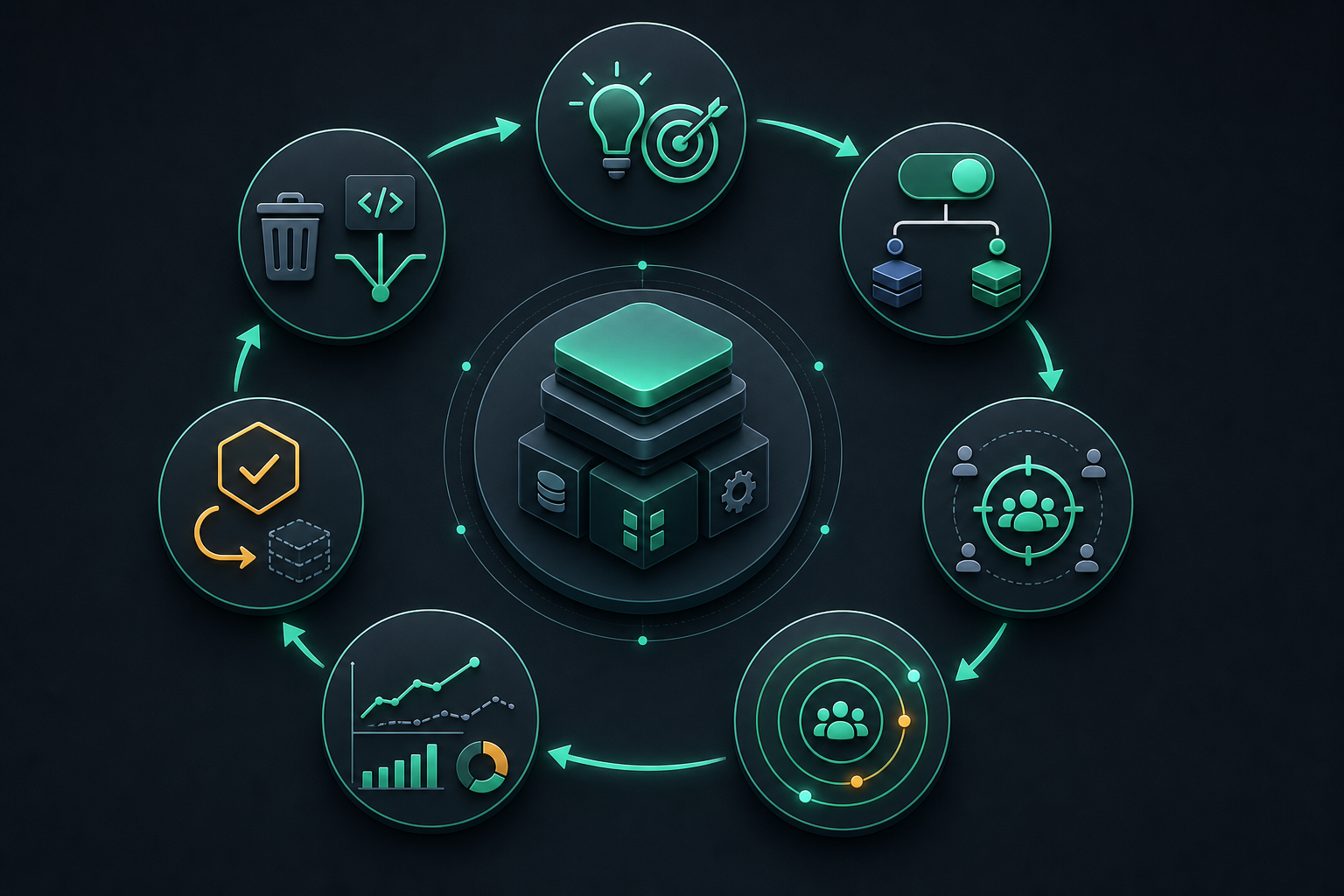
A platform should support the whole loop:
- Define the decision. State the user or business outcome and the guardrails.
- Make the change reversible. Keep the baseline path available and define a safe fallback.
- Target deliberately. Start with employees or a named cohort before random percentage exposure.
- Observe the evaluated variation. Connect runtime assignment to technical and product evidence.
- Decide explicitly. Continue, pause, roll back, expand, or call the result inconclusive.
- Clean up. Remove losing code and temporary rollout controls, or document why a long-lived operational flag remains.
This is why governance and lifecycle belong in the buying criteria. A platform that makes flags easy to create but hard to retire accelerates release debt. FeatBit’s feature flag lifecycle management page covers ownership, review, evidence, and cleanup after the rollout decision.
Questions to Ask Every Vendor
- What happens when an SDK starts without a network connection or cached configuration?
- Can server-side evaluation continue locally, and how old can cached rules become?
- Which context attributes leave our process, and which are stored in events or logs?
- How is deterministic assignment preserved across languages and configuration changes?
- Which governance features are available in the plan or edition we are evaluating?
- Can approvals and roles differ by project and environment?
- How are experiment exposure events deduplicated and joined to outcomes?
- Can we export flags, segments, audit history, and experiment metadata through an API?
- Which OpenFeature providers are vendor-maintained, community-maintained, or unsupported?
- What is the lifecycle workflow for owners, stale flags, code references, and removal?
- What limits or charges apply to contexts, requests, events, seats, environments, relays, and support?
- What product or license transitions are planned before our 2027 renewal?
Common Buying Mistakes
Choosing by logo count. An integration page does not prove that your exact version, event schema, and failure mode work. Test one critical integration end to end.
Treating percentage rollout as experimentation. Traffic splitting is assignment. Experimentation also needs exposure integrity, metric definitions, guardrails, statistical analysis, and a written decision.
Ignoring client-side visibility. Browser and mobile SDKs may receive flag keys, values, or rules. Sensitive eligibility logic often belongs in server-side evaluation.
Comparing license cost with SaaS price. Self-hosting adds people and infrastructure. SaaS adds subscription and vendor constraints. Compare total operating cost on both sides.
Skipping the exit path. OpenFeature can reduce code coupling, but segments, rules, approvals, audit history, and experiments still require migration work.
Leaving every flag in place. A winning variation should usually become normal code. Keep long-lived operational flags intentionally, with an owner and review schedule.
FAQ
What is the best feature flag tool for 2027?
There is no evidence-based universal winner. FeatBit is a strong fit for open-source self-hosting and integrated release control; LaunchDarkly for managed enterprise feature management; Statsig for experimentation-led product teams; ConfigCat for focused managed flag delivery; Harness for delivery-platform integration; and Unleash for open-source developer feature management.
Is FeatBit a LaunchDarkly alternative?
Yes, for teams whose requirements align with FeatBit’s self-hosted feature management, targeting, rollout, experimentation, audit, and automation capabilities. It is not a claim of feature-for-feature identity. Run a requirements-weighted POC and compare the exact editions, data paths, and support models.
Should a startup buy or self-host feature flags?
Use a managed service when limited platform capacity and fast adoption outweigh infrastructure control. Self-host when data placement, customization, cost shape, or platform ownership is a real requirement and the team can operate it reliably.
Do we need experimentation in the feature flag platform?
Not always. Operational kill switches and infrastructure migrations may only need safe rollout and telemetry. Product changes with an uncertain user outcome benefit from controlled experiments or a reliable integration with an existing experimentation system.
How many tools should reach the POC?
Usually two or three. Eliminate candidates using hard constraints first. More finalists increase implementation effort without necessarily improving the decision.
Source Notes
- FeatBit license, deployment, SDK, targeting, workflow, experimentation, audit, relay, and observability context: FeatBit official repository and FeatBit deployment options.
- LaunchDarkly feature management, local SDK evaluation, rollout, and experimentation context: feature management overview, feature flags, and experimentation.
- Statsig flags, experiments, analytics, warehouse-native, and local server evaluation context: Statsig overview, feature flags, and server SDKs.
- ConfigCat SDK coverage, local evaluation, privacy, targeting, and percentage rollout context: SDK overview, feature flag evaluation, and percentage options.
- Harness feature flags, pipelines, policies, relay, service monitoring, and FME transition context: Harness Feature Flags documentation and Harness FF overview.
- Unleash license, deployment, SDK, rollout, governance, and edition context: Unleash official repository and Unleash hosting options.
Bottom Line
Build the shortlist around your release system: where the control plane runs, how SDKs fail safely, who can change production, how rollout evidence is measured, what the platform costs to operate, and how temporary flags are removed. FeatBit, LaunchDarkly, Statsig, ConfigCat, Harness, and Unleash can all be credible choices—under different constraints.