
Open Source Feature Flag Tools for 2027: An Operator’s Guide
The right open source feature flag tool is not simply the repository with the most stars or the longest feature list. It is the system your team can legally adopt, reliably operate, integrate with its application stack, and keep healthy after the first rollout.
This guide compares five actively maintained options for teams planning a 2027 evaluation: FeatBit, Unleash, Flagsmith, GO Feature Flag, and GrowthBook. The focus is ownership—license boundaries, deployment shape, runtime evaluation, data flow, governance, experimentation, and the work your team must absorb when it self-hosts.
Vendor facts in this article were checked against official repositories and documentation on July 13, 2026. Licenses, product packaging, and enterprise boundaries can change, so verify them again before a 2027 procurement or production rollout.
The Short Answer
There is no universal winner. Start with the operating model that matches your constraints:
- Evaluate FeatBit when self-hosting, broad SDK coverage, progressive delivery, experimentation, and enterprise release controls need to live in one open-core platform.
- Evaluate Unleash when you want an established developer-focused feature management platform and your organization is comfortable operating AGPL-licensed software or buying its commercial offering.
- Evaluate Flagsmith when feature flags and remote configuration, identity traits, and a choice between hosted and private deployment are central to the design.
- Evaluate GO Feature Flag when you prefer a lightweight, OpenFeature-oriented system with file-based flag definitions and a relay proxy instead of a full database-backed control plane.
- Evaluate GrowthBook when warehouse-connected experimentation and product analytics are as important as feature flag delivery.
If infrastructure ownership is the first decision, use FeatBit’s self-hosted feature flags guide before comparing individual products. If the project is specifically for prompts, models, or agents, the separate open source AI feature flags guide covers the extra runtime-control questions AI releases introduce.
What “Open Source Feature Flag Tool” Actually Means
“Open source” can describe several different product boundaries:
- The control plane source is available under an OSI-approved license.
- The SDKs are open source, but the control plane is a managed service.
- A community edition is open source while governance or scale features use a commercial license.
- Most of a repository is permissively licensed, with named enterprise directories under separate terms.
- The evaluation engine is open, while the hosted management experience is commercial.
Those models are not interchangeable. Before a proof of concept, record the exact repository, version, license file, container image, and features you intend to run. “The project uses MIT” is not sufficient if the production image also includes separately licensed code.
License choice also changes operational and distribution obligations. MIT and BSD-3-Clause are permissive. AGPL-3.0 has network-use copyleft conditions that deserve review by your legal team. Open-core projects may place SSO, advanced permissions, change approvals, or support under commercial terms. This guide describes public product boundaries; it is not legal advice.
Evaluation Criteria That Matter in Production
Use the same questions for every candidate so a polished demo does not hide an unsuitable operating model.
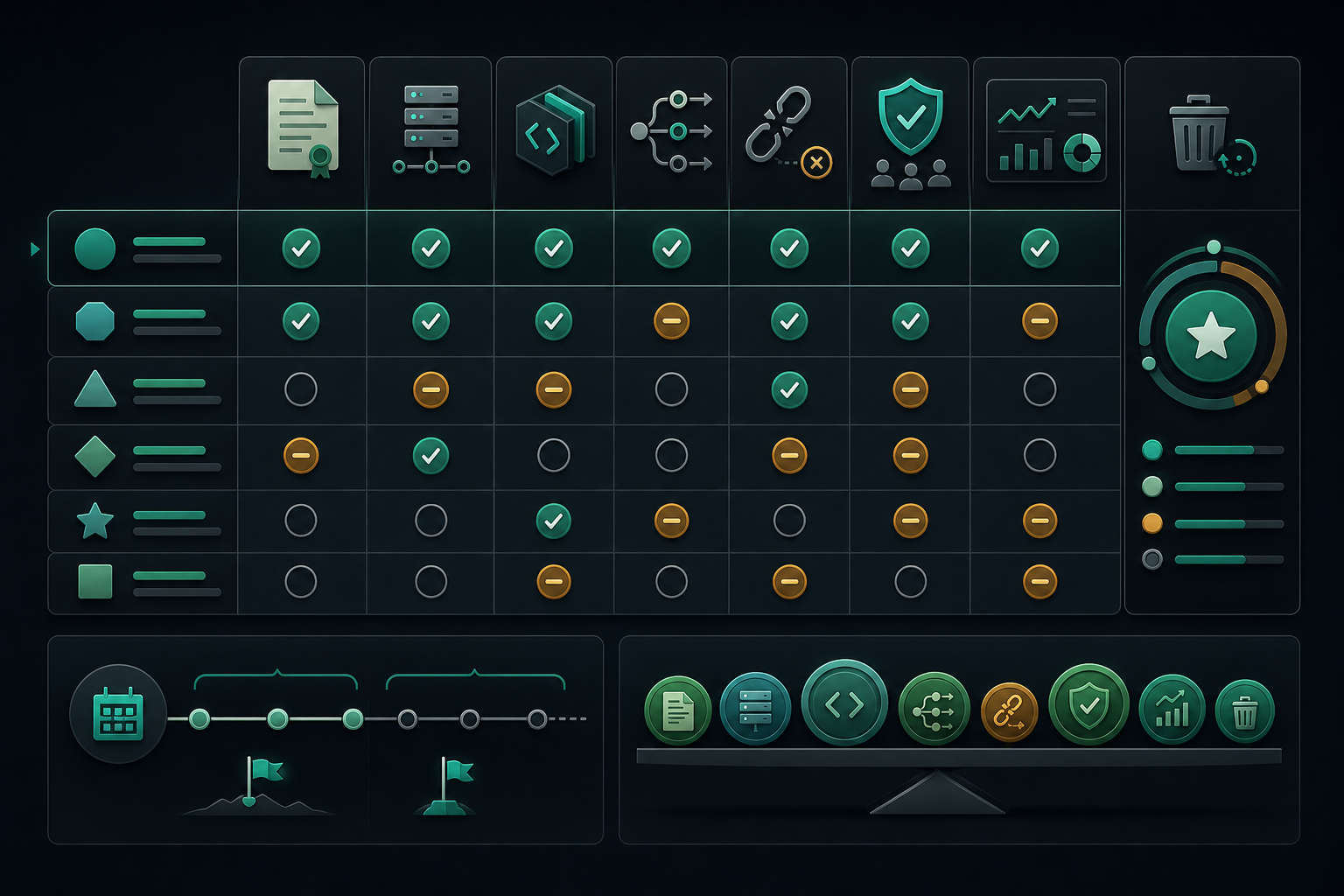
| Criterion | What to verify in a proof of concept |
|---|---|
| License boundary | Which source, images, SDKs, and enterprise modules are covered by which licenses? |
| Deployment ownership | Which databases, caches, queues, proxies, certificates, backups, and upgrades will your team own? |
| Runtime path | Are flags evaluated locally, through a relay or proxy, or by a remote API? What happens during an outage? |
| Targeting and rollout | Can the tool provide deterministic assignment, segments, percentage rollout, prerequisites, and safe defaults? |
| Governance | Are audit history, roles, approvals, environment separation, and API automation available in the edition you will run? |
| Experimentation | Does the tool only split traffic, or can it connect exposure to metrics and statistical analysis? |
| Portability | Is there an official or maintained OpenFeature provider for every language you need? |
| Lifecycle | Can owners find stale flags, review them, and remove temporary branches after a decision? |
| Operability | Can you observe configuration delivery, evaluation health, event pipelines, and failed dependencies? |
| Cost | What is the combined software, infrastructure, on-call, upgrade, security, and support cost? |
The data residency and compliance guide expands the questions around evaluation context, event data, backups, logs, and third-party dependencies. Self-hosting a UI does not automatically prove that every data path stays inside the required boundary.
Comparison Snapshot
| Tool | Public source and license model | Typical deployment shape | Strongest evaluation angle | Verify during the POC |
|---|---|---|---|---|
| FeatBit | Open core; the bulk of the repository is under MIT | Docker Compose or Kubernetes-based self-hosting, with SDKs and optional relay components | Self-hosted feature management, rollout, experimentation, and release governance | Which enterprise capabilities and data services your production topology needs |
| Unleash | Main repository under AGPL-3.0; commercial Pro and Enterprise options | Open-source self-hosting or managed/self-hosted commercial editions | Developer-focused feature management, activation strategies, and local evaluation | License obligations and which governance features require a paid edition |
| Flagsmith | Most of the platform under BSD-3-Clause; enterprise governance under commercial terms | Hosted SaaS, Docker self-hosting, private cloud, or on-premises | Feature flags plus remote config, identity traits, and multiple hosting choices | Edge architecture, enterprise feature boundary, and upgrade process |
| GO Feature Flag | MIT-licensed open source | File-backed configuration plus relay proxy and pluggable storage/export paths | Lightweight OpenFeature-native delivery without a database control plane | Authoring workflow, change governance, and operational ownership around config files |
| GrowthBook | Open core; bulk of the code under MIT with enterprise-licensed directories | Cloud or Docker-based self-hosting connected to existing data systems | Feature flags combined with warehouse-native experimentation and analytics | Data-source access, experiment workflow, and exact community/enterprise boundary |
This table deliberately avoids a numeric score. A database-backed control plane may be an advantage for a large platform team and unnecessary weight for a small service. A warehouse-native experiment system may be decisive for a product organization and excessive for infrastructure kill switches.
FeatBit
FeatBit’s official repository describes an open-core feature flag platform whose bulk code uses the permissive MIT license. The project supports self-hosting with Docker Compose, publishes Helm charts, provides server and client SDKs across common languages, and lists feature targeting, reusable segments, experimentation, audit logs, workflows, APIs, SSO, relay deployment, integrations, and OpenTelemetry among its capabilities.
FeatBit is a strong candidate when the same platform must support developer release flags, targeted product rollouts, experiment exposure, and private deployment. Its breadth is also the reason to test a realistic topology: a quick local Docker setup does not represent the databases, caches, event services, observability, backups, or availability design a larger production deployment may require.
Best fit: teams that want an open-source, self-hosted release-control plane with a path from simple flags to progressive rollout and experimentation.
POC question: can your team operate the chosen FeatBit tier and data path at the required availability while keeping evaluation latency and failure behavior predictable?
Unleash
Unleash’s official repository currently lists AGPL-3.0 for the main project. It documents Docker-based open-source self-hosting, official frontend and backend SDKs, gradual rollout, activation strategies, kill switches, audit history, stale-flag insights, integrations, and an API-first workflow. Commercial editions add capabilities such as advanced access control, SSO, change requests, and additional environment or security options.
Unleash is a mature choice for teams that prioritize developer-facing feature management and local evaluation. Its current license is an important change from older comparisons that still call the project Apache-2.0. Confirm the version and terms you plan to use instead of relying on an old article or cached marketplace description.
Best fit: teams seeking a well-established open-source feature management workflow and willing to assess AGPL or a commercial agreement.
POC question: which required governance controls are in the open-source edition, and does the selected license and support model fit your distribution and network-use scenario?
Flagsmith
Flagsmith’s official repository says the majority of the platform uses BSD-3-Clause, with a small number of MIT-licensed repositories and enterprise governance features available commercially. The product combines feature flags and remote configuration with user identities and traits, segmentation, A/B or multivariate use cases, hosted service, and self-hosted deployment.
Flagsmith is worth evaluating when remote config and identity-aware targeting are first-class requirements. Its multiple deployment choices let teams start hosted and move toward private infrastructure, or start with self-hosting. As with any open-core platform, build the POC around the exact edition and topology you expect to operate.
Best fit: teams that want one system for flags, remote configuration, and identity-driven segmentation with hosted or private deployment choices.
POC question: can the selected architecture deliver flags to all client, server, and edge workloads while preserving the intended privacy and failure model?
GO Feature Flag
GO Feature Flag’s official documentation describes an MIT-licensed, OpenFeature-oriented system that stores flag definitions in files rather than a database. Applications can use OpenFeature providers with the GO Feature Flag relay proxy, while configuration retrieval and data export are connected through pluggable components.
That architecture can be attractive when Git, object storage, or another existing configuration workflow should remain the source of truth. It reduces control-plane weight, but it moves authoring, review, promotion, access control, and rollback design into the surrounding delivery system. Lightweight does not mean zero operations; it means the responsibilities are distributed differently.
Best fit: platform teams that prefer declarative flag configuration, OpenFeature APIs, and a compact relay-based runtime.
POC question: can your GitOps or configuration workflow provide the review, audit, environment promotion, secret handling, and emergency-change path operators need?
GrowthBook
GrowthBook’s official repository describes an open-core platform for feature flags, experimentation, and product analytics. The bulk of its code is under MIT, while named enterprise directories use a separate commercial license. GrowthBook documents local SDK evaluation, advanced targeting and gradual rollouts, Docker self-hosting, numerous SDKs, warehouse-native analysis, SQL-backed metrics, and several statistical methods.
GrowthBook deserves a place on the shortlist when the organization already treats its warehouse as the source of truth for experiment metrics. Teams that only need operational release toggles should still test whether the analytics-oriented platform and data connections are justified by their use case.
Best fit: product and data teams that want feature delivery and serious experimentation connected to existing warehouse metrics.
POC question: can analysts reproduce the metric definitions and experiment results while engineers maintain reliable flag delivery independently of warehouse availability?
Three Architecture Patterns Behind the Products
The products look similar in a checklist, but their runtime shapes differ.
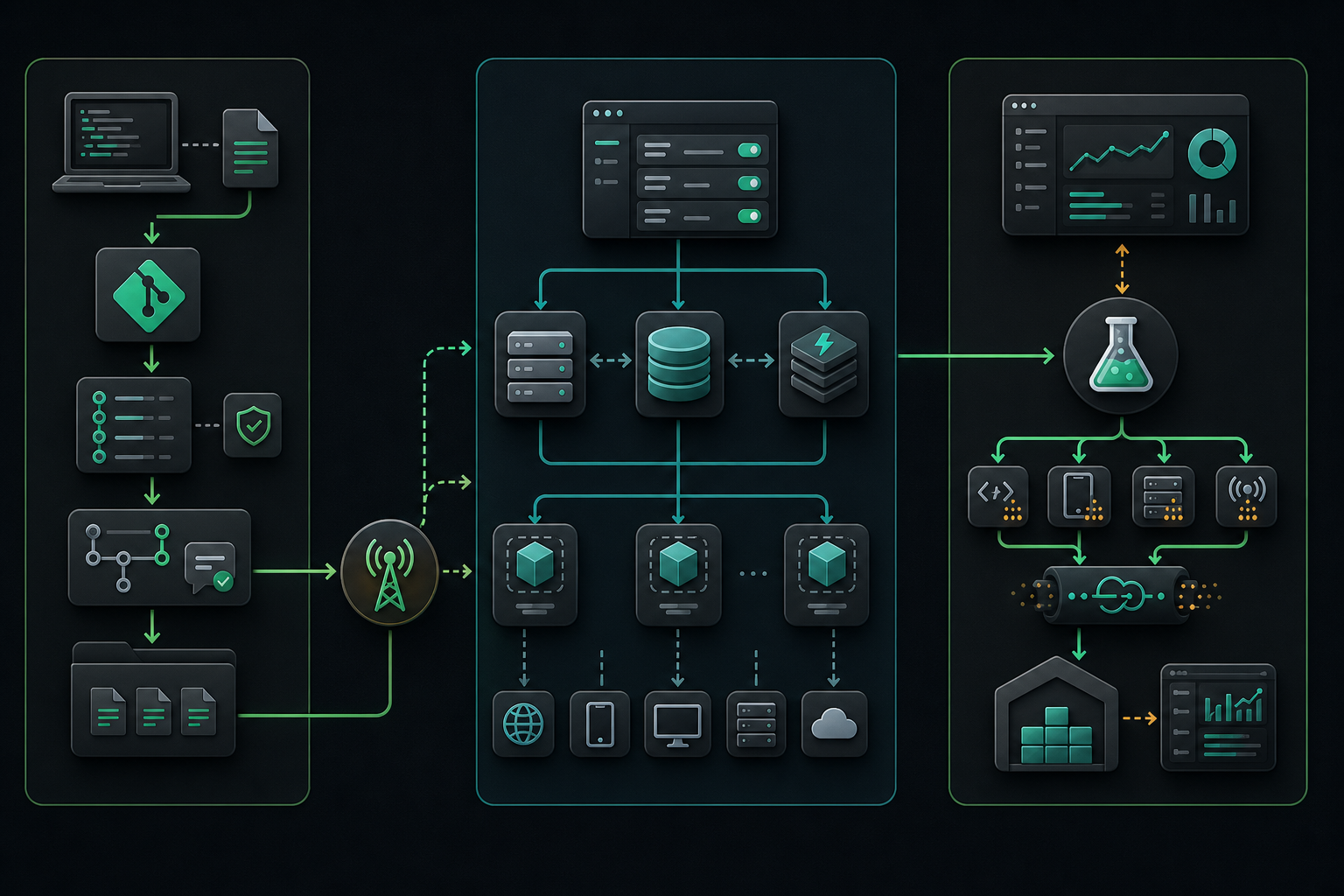
1. Database-backed control plane with local SDK evaluation
An operator changes a flag in a management service. SDKs or relay components receive the configuration and evaluate users locally. This pattern can keep evaluation fast and resilient after initialization, but teams must test bootstrap, cache age, streaming or polling failure, and event delivery separately.
2. File-backed definitions with a relay proxy
Flag configuration lives in a file or external store. A relay normalizes access for OpenFeature providers and may export usage data. This pattern fits GitOps well, but the team must supply a safe authoring and promotion workflow.
3. Experimentation platform with flag delivery
The flag decides exposure while an analysis layer joins assignments to product metrics. This can shorten the path from rollout to evidence, but introduces metric governance, data permissions, identity joins, and statistical review.
None is inherently best. Draw the request path, configuration path, event path, and outage behavior for each candidate. FeatBit’s low-maintenance stack guide is a useful companion when the main goal is to minimize moving parts rather than maximize feature breadth.
OpenFeature Helps, but It Does Not Make Backends Identical
OpenFeature defines a vendor-neutral API, evaluation context, providers, hooks, and events for feature flagging. It can reduce code-level coupling and make a multi-vendor proof of concept more realistic.
It does not standardize every control-plane concept. Vendors can still differ in segment semantics, rule ordering, prerequisite behavior, variation metadata, configuration propagation, event schemas, audit workflows, and experiment attribution. Before migration, test the flags you actually use—not only a boolean hello-world flag.
A practical portability test should include:
- boolean, string, number, and structured values where supported;
- missing flag and type-mismatch fallbacks;
- targeting with absent or private attributes;
- deterministic percentage rollout;
- provider initialization and stale-cache behavior;
- evaluation reason and variant metadata;
- hooks or telemetry;
- an outage of the control plane, relay, and event endpoint.
A 14-Day Proof-of-Concept Plan
Days 1–2: Freeze the decision criteria
Write down required languages, environments, traffic shape, data boundaries, availability target, governance controls, experiment needs, and support expectations. Assign weights before anyone sees a vendor demo.
Days 3–5: Deploy the production-shaped minimum
Use the same database class, network boundaries, identity provider, ingress, certificates, backup policy, and observability path you expect in production. A laptop-only Docker demo answers the usability question, not the operability question.
Days 6–8: Implement one real release
Create a multivariate flag, target internal users, expose a deterministic percentage, record the evaluated variation, and roll back. Use at least one server workload and one client or edge workload if your architecture has both.
Days 9–10: Break dependencies
Stop the control plane, block configuration updates, delay the event endpoint, expire credentials, and restart an application with an empty cache. Record what users receive and what operators can see.
Days 11–12: Test governance and lifecycle
Try environment promotion, role restrictions, approval, API automation, audit review, owner assignment, stale-flag detection, and flag removal. FeatBit’s feature flag lifecycle management guidance explains why cleanup belongs in the evaluation rather than after rollout.
Days 13–14: Calculate total ownership
Estimate software subscription, infrastructure, backups, upgrades, security work, observability, incident response, and support. Compare that figure with the cost and constraints of a managed product—not with a zero-dollar license line.
How to Choose by Team Shape
| Team situation | Start the shortlist with | Reason to start there |
|---|---|---|
| Private infrastructure plus release governance and experiments | FeatBit | Broad self-hosted release-control scope |
| Developer platform standardizing on activation strategies | Unleash | Mature feature management model and SDK ecosystem |
| Remote configuration plus identity traits | Flagsmith | Flags and remote config share one operating model |
| GitOps-first platform with minimal control-plane state | GO Feature Flag | File-based definitions and OpenFeature-oriented relay |
| Warehouse-centered product experimentation | GrowthBook | Experiment analysis and metrics are core to the platform |
Treat this as a starting order, not a verdict. The winning product is the one that passes your weighted POC with acceptable legal, operational, and lifecycle risk.
For teams that also want to compare managed services, continue with the broader best feature flag tools for 2027 guide.
FAQ
Is an open source feature flag tool free?
The license may permit free use, but production ownership is not free. Include infrastructure, upgrades, backups, monitoring, security response, support, and engineer time. Open-core enterprise features may also require a subscription.
Is self-hosting always more private?
No. It gives your team more control over placement, but privacy depends on every data path: SDK context, configuration delivery, event export, logs, backups, integrations, support access, and analytics systems.
Does OpenFeature prevent vendor lock-in?
It reduces application-code coupling by providing a common API and provider model. It does not automatically translate control-plane rules, audit history, segments, experiments, or lifecycle workflows.
Which tool is best for experimentation?
GrowthBook is explicitly experimentation- and analytics-centered. FeatBit also combines flags with experimentation in a self-hosted release platform. The right choice depends on where metrics live, how exposure is recorded, which statistical workflow the team trusts, and whether flag delivery must operate independently from analytics.
Which tool is easiest to self-host?
“Easy” depends on the production target. A file-and-relay architecture can have fewer platform services; a Docker Compose control plane can be faster to start. Test upgrades, backups, failure recovery, and observability before calling either one easy.
Source Notes
- FeatBit product, deployment, SDK, feature, and license context: FeatBit official repository and FeatBit Helm charts.
- Unleash license, open-source setup, SDK, feature, and edition context: Unleash official repository and Unleash hosting options.
- Flagsmith license, self-hosting, hosted service, feature, and enterprise-boundary context: Flagsmith official repository and Flagsmith documentation.
- GO Feature Flag license, file-based configuration, relay proxy, exporters, and OpenFeature context: GO Feature Flag official documentation.
- GrowthBook license, self-hosting, local evaluation, feature flag, warehouse, and experimentation context: GrowthBook official repository and GrowthBook documentation.
- Vendor-neutral flag API and provider context: OpenFeature introduction and OpenFeature Remote Evaluation Protocol.
Bottom Line
Choose an open source feature flag tool by the system you are prepared to own. Verify the license boundary, model the runtime and data paths, test failures, prove governance, and include cleanup in the POC. Source availability is valuable; operational fit is what turns it into a dependable release platform.