
Are AI Code Review Tools Better Than Human Reviewers?
The short answer is no, not overall.
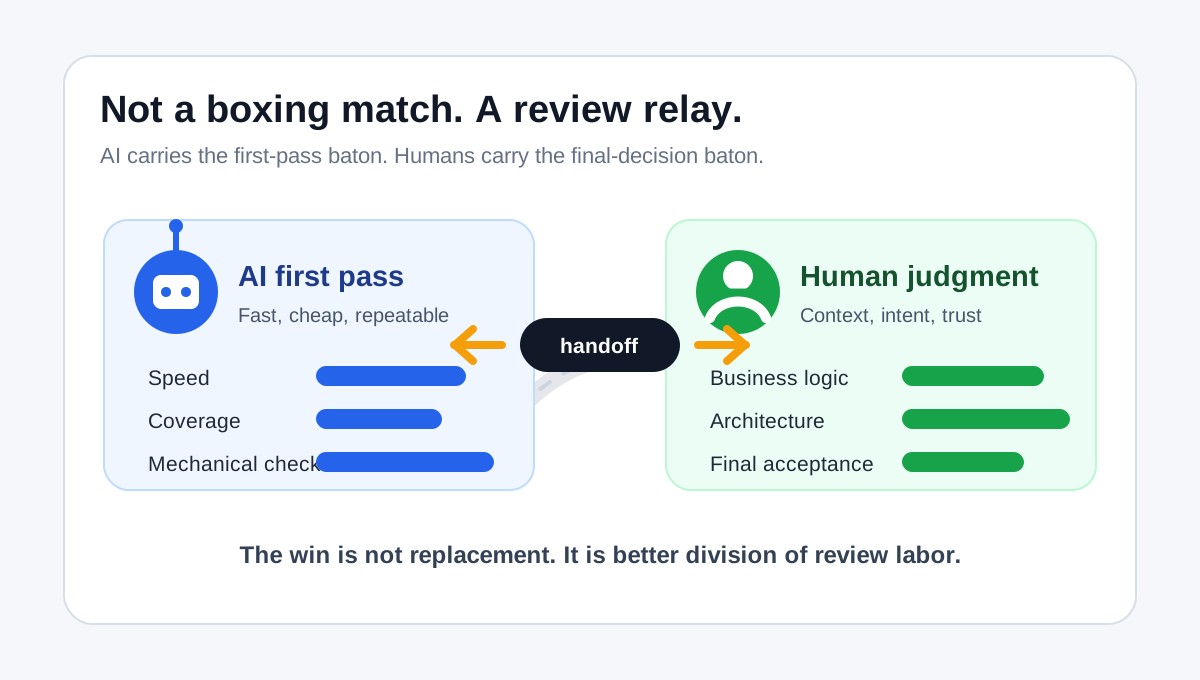
AI code review tools are better as a fast, scalable first-pass screening layer. Human reviewers are still better as final reviewers for product intent, architecture, ambiguous trade-offs, mentoring, and risk acceptance.
Most teams are not deciding whether to use AI review—they are deciding where it belongs in the workflow, which comments to trust, and whether it can reduce review pressure without letting more defects through.
Download the full research report behind this article, including the complete tool comparison, evaluation methodology, source links, and limitations.
What The Evidence Says
AI wins on speed, coverage, consistency, and parallelism. Human reviewers win on actionability, context, trust, and final judgment.
| Question | Evidence |
|---|---|
| Does AI review faster? | Yes. GitHub Copilot code review usually returns feedback in under 30 seconds, CodeRabbit says reviews appear within minutes, and GitLab Code Review Flow is designed to run many reviews in parallel. |
| Are AI comments acted on as often as human comments? | No. A recent study of GitHub Actions-based AI review found human comments were addressed far more often than AI comments: human comments at 60.0%, hunk-level AI comments at 6.5% to 19.2%, and file-level AI comments at 0.9% to 4.2%. |
| Do AI suggestions get adopted as often as human suggestions? | No. Human-AI Synergy in Agentic Code Review found AI suggestions were adopted 16.6% of the time versus 56.5% for human suggestions. |
| Do AI reviewers catch all review-worthy defects? | No. The c-CRAB benchmark reported the best individual automated reviewer at 32.1% overall pass rate, with the union of four tools reaching 41.5% against a human-derived benchmark. |
| Can AI review still reduce bottlenecks? | Yes. Atlassian's ICSE 2026 accepted RovoDev Code Reviewer study reported 38.70% of generated comments triggered code changes, with 30.8% lower PR cycle time and 35.6% fewer human-written comments in its deployment study. |
Review speed and review quality are different claims. AI clearly improves the first. It has not yet proven that it beats humans on the second.
The Precision-Recall Problem
The best AI review tools earn their keep by getting a first pass to the author before a teammate is available—catching style issues, edge cases, security patterns, obvious bugs, and test gaps without any waiting. That is genuinely useful.
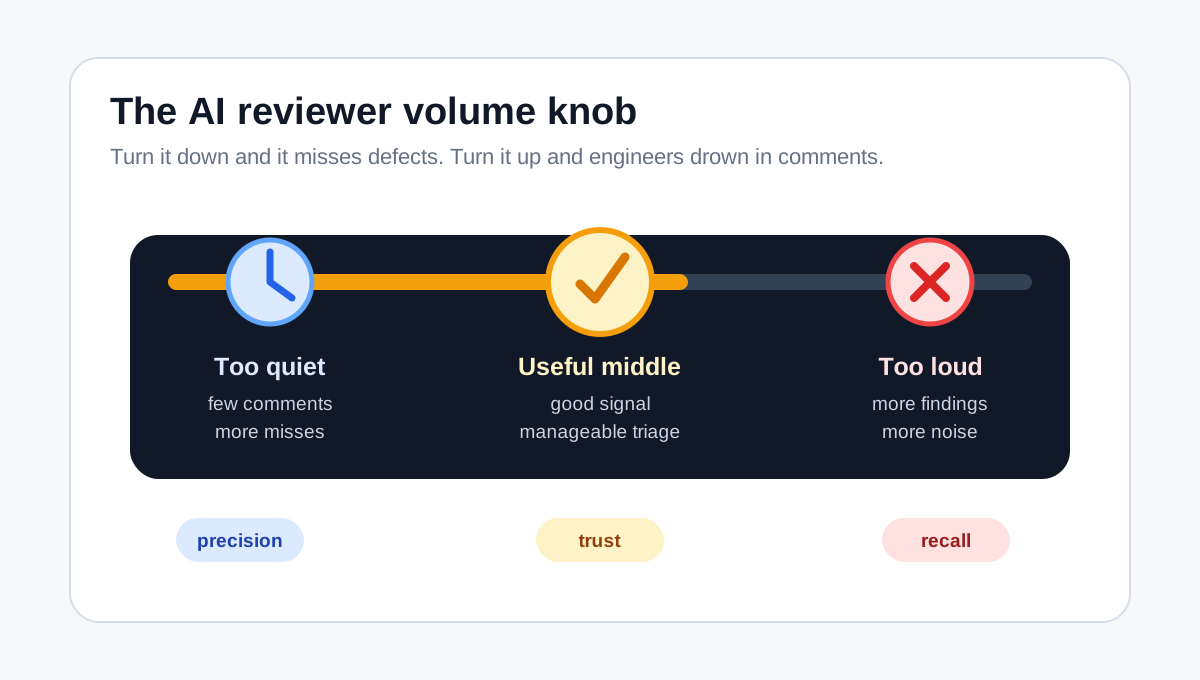
The frustration comes from the precision-recall trade-off. The CR-Bench evaluation captures it directly: more aggressive reviewers find more issues but generate more noise; more conservative reviewers produce less noise but miss more problems. When engineers spend too much time triaging AI comments, the bottleneck moves rather than shrinks.
GitHub's own responsible-use documentation for Copilot code review is explicit: AI review can miss problems, produce false positives, generate inaccurate or insecure suggestions, and reflect training-data biases. Snyk's documentation warns similarly that generated fixes can still break an application. AI review is a reviewer, not an approver.
Where AI Review Fits
AI is strongest when the task is narrow, local, repetitive, and mechanically checkable:
- First-pass review on every eligible PR
- Style, readability, and maintainability suggestions
- Simple correctness checks near a changed hunk
- Test-gap reminders
- Security and dependency findings when paired with specialized scanners
- Coverage on small-to-medium PRs that would otherwise wait in a queue
GitHub Copilot code review is native to the GitHub PR workflow and optimized for quick feedback. It supports custom instructions and automatic review configuration—context matters because repo-specific feedback is far more useful than generic comments.
CodeRabbit covers GitHub, GitLab, Azure DevOps, and Bitbucket. Its learnings layer is worth attention: a reviewer that adapts to how your team writes code produces more signal over time than one that treats every PR identically.
GitLab Duo Code Review and Code Review Flow are strongest inside GitLab's DevSecOps system, where combined code, pipeline, security, and compliance context is harder to replicate elsewhere. GitLab also publishes detailed AI data-usage documentation, a real buying factor for enterprise teams.
Snyk Code and DeepCode AI are security-focused rather than general-purpose peer reviewers—a useful addition to the review surface, not a substitute for it.
Amazon CodeGuru Reviewer is winding down: new repository associations have been closed since November 2025.
Where Human Reviewers Still Win
Human reviewers are better when the question depends on meaning rather than pattern:
- Business logic and product intent
- Architecture and module boundaries
- Risk assessment and rollback judgment
- Ambiguous requirements
- Cross-team coordination
- Mentoring and knowledge transfer
- Final acceptance decisions
The Human-AI Synergy in Agentic Code Review data shows how wide this gap is: human suggestions were adopted 56.5% of the time, AI suggestions 16.6%. Humans also produced mentoring and knowledge-transfer feedback that AI agents largely did not.
Code review isn't only defect detection—it is how teams teach standards, preserve architecture, and clarify intent across people. An AI reviewer can flag suspicious code. A senior engineer asks whether the abstraction should exist at all, whether the behavior matches a customer commitment, and whether a high-risk change should go to everyone at merge time or ship behind a feature flag first.
AI for Coverage, Humans for Judgment
The right question isn't "which reviewer is better?" but "which reviewer should handle which kind of work?" AI reduces human time on mechanical findings; humans protect the system from changes that are locally plausible but globally wrong.
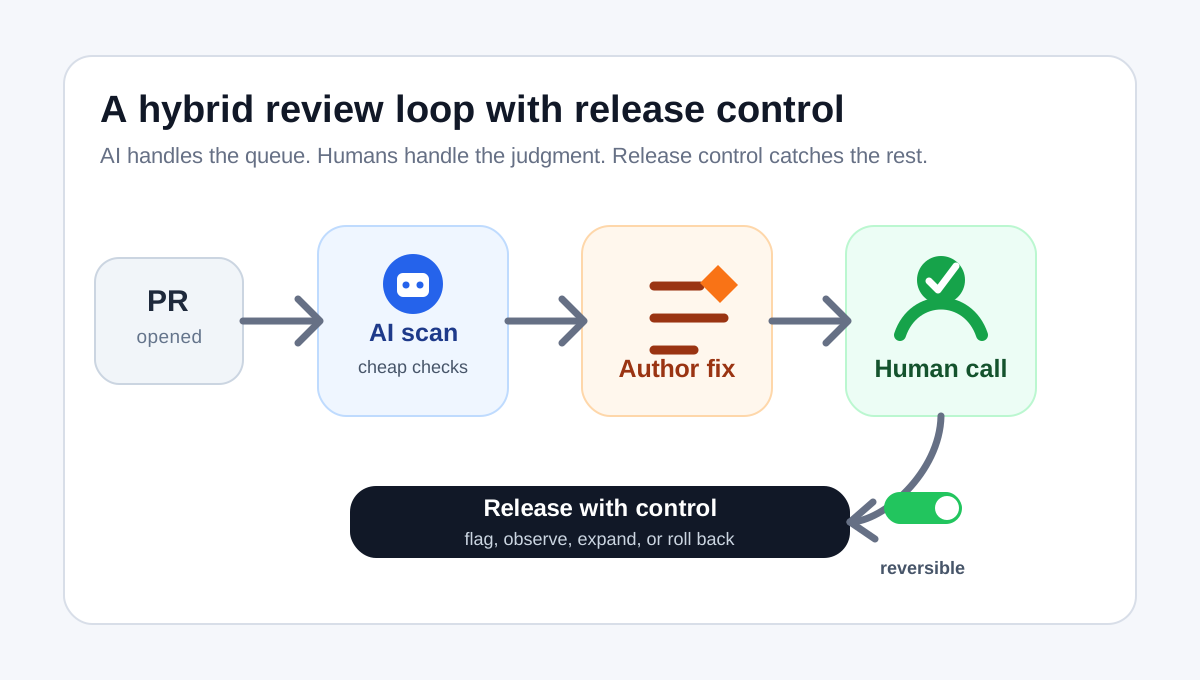
A practical workflow:
- PR opens.
- AI review runs automatically.
- Author fixes obvious AI findings before requesting human approval.
- Static analysis, tests, security scanners, and CI results attach to the same review surface.
- Human reviewers focus on intent, architecture, risk, test adequacy, and release strategy.
- High-risk user-facing changes ship behind a reversible control such as a feature flag.
- Measure post-merge defects, reverts, incidents, and review time—not just time to first comment.
How To Run Your Own Experiment
Don't ask developers if they "like" the AI reviewer. Measure outcomes instead.
Run three review modes in parallel if you can:
| Review mode | Description |
|---|---|
| Human-only | Existing process, no AI review comments in the PR. |
| AI-first hybrid | AI reviews first, author responds, then human reviewer approves or requests changes. |
| AI-heavy low-risk | AI handles first-pass and humans review only sampled or risk-triggered PRs. Low-risk changes only. |
Metrics worth tracking:
- Time to first review and time to merge
- Comment address rate and accepted suggestion rate
- False positive rate on sampled comments
- Post-merge bugs, reverts, hotfixes, and incidents
- Author and reviewer helpfulness ratings
Expand the AI-first workflow only if it reduces waiting time without increasing escaped defects or reviewer noise. More AI comments without fewer problems is not progress.
Bottom Line
AI code review tools are not better than human reviewers overall. But they are already better at one specific job: a fast, cheap, repeatable first pass across every pull request. That is enough to be worth using.
The mistake is treating the first pass as a final decision. AI for coverage, humans for judgment.