
AI Coding Is Faster. Why Is Shipping Still Hard?
AI coding can make implementation faster without making the entire delivery system faster, safer, or more valuable. A team can generate more code and complete more work while accumulating a larger review queue, longer QA cycles, and more operational responsibility.
The useful management question is: what happened between generating the change and producing a reliable customer outcome? That is where an engineering organization can preserve the speed gains and address the work that moved elsewhere.
This October 2026 update separates recent research from practitioner reports, then maps each delivery bottleneck to an actionable control. It also introduces a set of implementation guides and a reproducible release lab.
In this series, AI-assisted coding describes engineer-led work using generation tools; AI-generated describes the code's origin. Vibe-coded describes heavy reliance on prompted generation, while no-review describes which inspection or approval step a team removes. These labels do not determine a change's risk by themselves.
What recent evidence supports
Faros Research's Q3 2026 Speed Trap analysis describes telemetry from roughly 22,000 developers across 4,000 teams over the preceding year. Its newer analysis focuses on deepening already-high AI adoption, whereas its earlier report examined the transition from lower to higher adoption.
The newer findings include improving deployment frequency and some easing of the initial disruption, alongside continuing pressure on verification and operations. Faros also reports associations between heavier agentic review use and improvements in some downstream measures. This is observational evidence from a commercial platform's population, not a randomized estimate of AI's effect on every engineering organization. Comparing percentages across the two reports without preserving their different comparison designs would be misleading. Faros research and methodology overview.
Recent Reddit discussions make those workflow problems concrete:
| Practitioner report | What the author describes | What the report does not establish |
|---|---|---|
| A platform team facing more AI-generated infrastructure PRs | Application output is increasing faster than the team's capacity to review and support infrastructure changes | Industry-wide staffing needs or a causal incident rate |
| A team debating review of a large AI-built feature | One person can produce an end-to-end change faster than colleagues can acquire its context | That every AI-assisted PR has this size or ownership problem |
| An engineering manager weighing review quality and cost | Existing conventions and checks do not remove integration and review-capacity concerns | A verified comparison of review vendors or their current prices |
These are anonymous accounts, useful for discovering problems and language. They are not a survey of enterprise outcomes. Their presence does not establish that every company suffered a quality decline in the last six months.
There are positive accounts too. In one incident discussion, the author says AI quickly investigated the problem and prepared a fix. The team chose to disable the feature and validate the repair before deploying it. The post does not identify FeatBit as the tool used. It illustrates a useful division of work: faster investigation, followed by an accountable release decision.
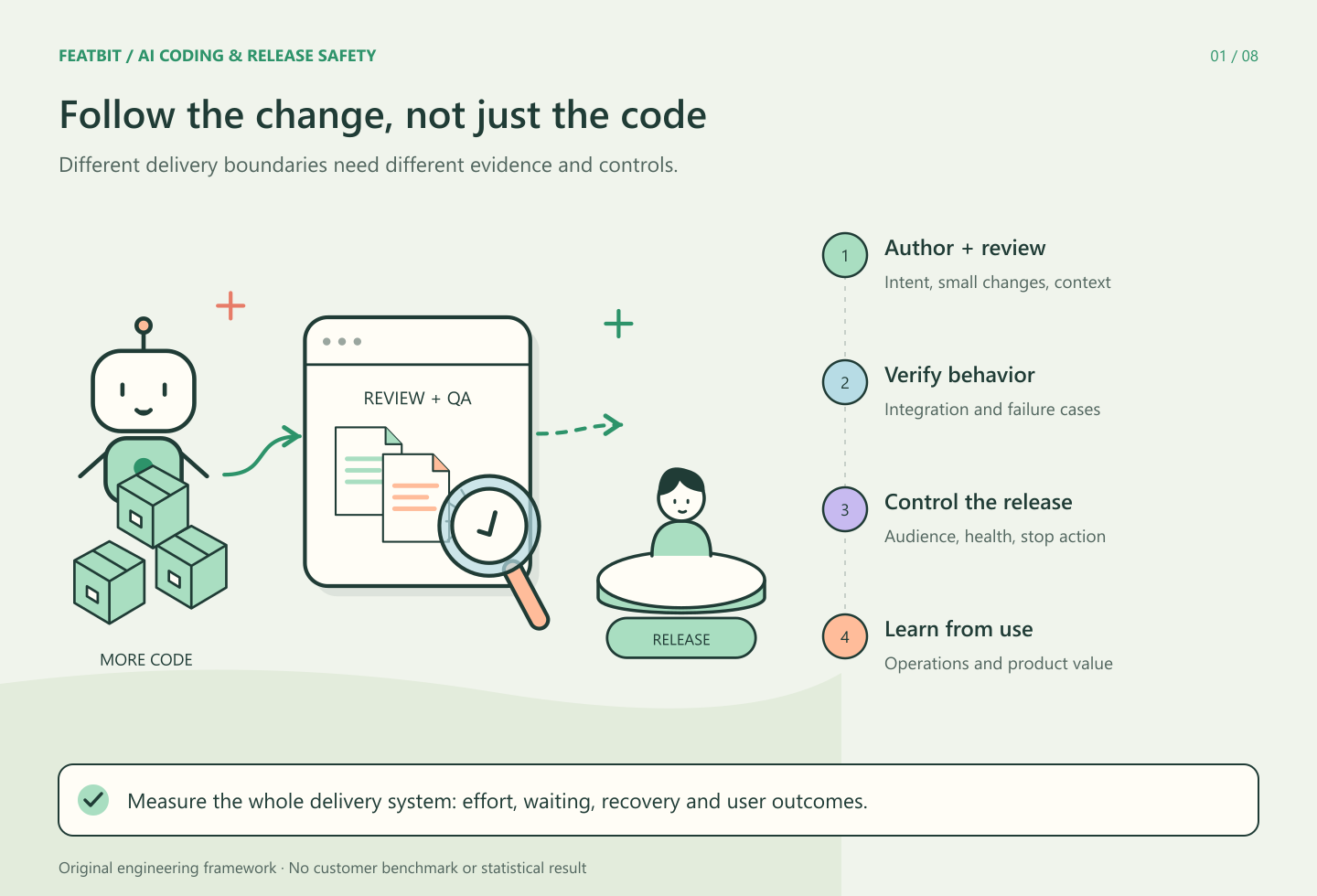
Follow the change through the whole system
Measure a change from its intended outcome to what customers actually receive. Coding is one stage of that journey.
| Stage | Signal to investigate | Practical response | Evidence that the response helped |
|---|---|---|---|
| Authoring | Repeated wrong assumptions or broad unrelated changes | Give the agent existing patterns, constraints, and explicit acceptance criteria | Fewer reopened tasks and smaller corrections for comparable work |
| Review | Large changes and long waits for context | Split compatible changes; attach intent and execution evidence | Review wait and active review effort, measured separately |
| QA | Tests pass but integration repeatedly fails | Exercise real boundaries and the stable path | Fewer escaped failures in comparable change categories |
| Release | Every deployment must expose all new behavior | Separate deployment from feature exposure | A chosen audience can receive one feature while others remain unavailable |
| Operations | Disabling the UI leaves jobs or writes running | Control the whole behavior; define in-flight handling | Requests and effects stop at the intended boundary |
| Product outcome | More features with uncertain adoption or benefit | Define a hypothesis and evaluate customer outcomes | An interpretable decision, including an inconclusive one |
This is FeatBit's operating framework, not a taxonomy derived statistically from those Reddit threads. Its purpose is to help a team locate its own constraint.
Keep code review useful at AI speed
A reviewable change carries more than a diff. It explains the user problem, constraints, existing implementation patterns, affected callers, risky assumptions, and what was actually run.
For example, an AI-built travel feature might add indoor alternatives when rain affects an itinerary. Put the contract and existing behavior in one change, the new implementation in another, and its controlled exposure in a later change. Reviewers can reason about each boundary while the feature remains unavailable to customers.
The guide to splitting large AI-generated PRs includes a concrete sequence and a reusable PR template. Automated review can help with coverage; the human sign-off guide explains how to reserve human judgment for the relevant risks.
Feature flags do not make incompatible intermediate commits safe. Schema changes, imports, initialization, background consumers, and shared dependencies still need compatible transitions and their own verification.
Separate a successful deployment from a release decision
A deployment makes code available to execute. A release determines which users receive a behavior. Keeping those decisions separate allows a team to deploy frequently without exposing every new path immediately.
For an independent business feature, the release contract should specify:
- The owner, safe default, and full boundary of the new behavior.
- The initial audience and any protected customers.
- The health signals and evidence needed to expand.
- The action to take when the evidence is unhealthy or missing.
- How to handle existing writes, in-flight requests, and queued work.
- The condition for retiring the temporary flag.
FeatBit supplies runtime decisions for targeting and progressive exposure. Observability, application behavior, and operational ownership complete the loop. An automatic containment action requires a configured, tested integration; it is not implied by creating a flag.
The independent release tutorial demonstrates three travel features in the same deployment, with only one being released. The rollback-versus-hotfix runbook covers what to do when that path fails.
Define what OFF can actually restore
A flag can stop new work that checks it and selects a stable path. It cannot undo a payment already taken, a message already sent, or a destructive migration already completed. A request that evaluated ON before the change may still finish after a subsequent request sees OFF.
This boundary should be demonstrated before the first customer exposure. A screenshot showing an OFF switch is not sufficient evidence that every worker, client, or side effect has stopped.
Our downloadable TypeScript lab uses the actual FeatBit Node SDK with synthetic offline configuration. The recorded run covers targeting, repeatable cohorts, controlled failure, fallback, in-flight behavior, and event validation. Offline replay proves those local behaviors; it does not measure hosted propagation or production recovery time.
Include maintenance and business outcomes in the calculation
A faster first implementation can create useful capacity. Whether that capacity becomes business value depends on what happens afterward.
A team maintaining unfamiliar generated code needs preserved design decisions, regression coverage, and module ownership. The incremental refactoring guide shows how to replace one boundary while retaining a stable path.
At organization level, use the 90-day AI coding measurement plan to include downstream effort and tool costs. At feature level, ask whether the new behavior improved the product. These answer different questions: a workflow's return on investment and a particular product change's effect.
Choose one constraint to improve next
Start with a recent customer-facing change. Trace its authoring effort, review, QA, exposure, incidents, and outcome evidence. Find the stage that absorbed the apparent saving. Choose a targeted intervention and define how to evaluate it with comparable work.
If the constraint is release confidence, begin with FeatBit's feature release management workflow and the SDK integration guide. Give one feature an owner, a small initial audience, a tested stable path, and an explicit expansion decision. That turns AI's implementation speed into a change the team can operate responsibly.
Image disclosure: The cover and illustrations in this article were generated with AI.