
DevCycle Alternatives: Open Standards and a Control Plane You Own
FeatBit is our recommended DevCycle alternative for teams that want to own feature flag management and evaluation infrastructure. Flagsmith and Unleash are the other two candidates to test. All three offer self-hosted paths and commercial options, but their runtime models and governance boundaries differ.
The important distinction is between an open evaluation interface and ownership of the release system. DevCycle already invests in open SDKs and standards. A useful comparison should start there, then examine what remains outside your operational control.
A FeatBit editorial comparison, checked against official product sources on November 8, 2026.
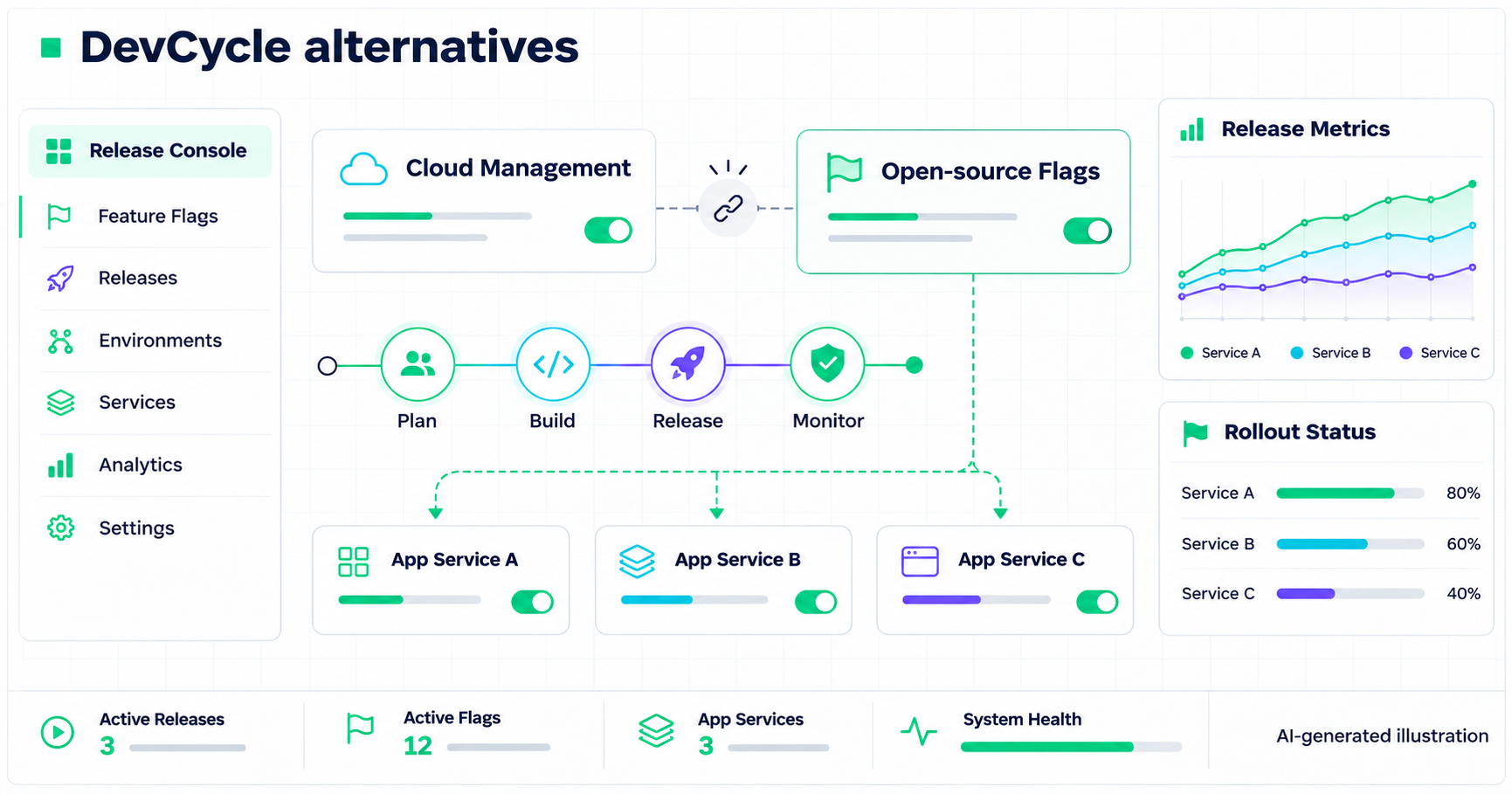
AI-generated illustration; conceptual system, not a vendor dashboard.
What DevCycle does well
DevCycle is a specialist feature management platform. Its server SDKs support local or cloud bucketing: local bucketing evaluates downloaded configuration inside the application, while cloud bucketing calls DevCycle's service. Its SDK behavior documentation recommends local bucketing when cloud-dependent features are not needed.
That is a real runtime benefit. DevCycle's Node.js SDK documentation also documents an open-source SDK and OpenFeature integration. It would be misleading to describe the product as closed at every layer or dependent on a remote request for every server-side evaluation.
Why look for an alternative anyway?
Open evaluation does not include every management function
Your application may evaluate locally while configuration editing, organization administration, history, and distribution remain managed by the vendor. Ask whether you can restore and operate those services without an active connection to the supplier. A published SDK or bucketing library does not answer that question.
The public sources reviewed here establish local evaluation, not a generally available, fully self-hosted DevCycle management platform. If DevCycle offers a private commercial arrangement, compare its precise scope and ongoing dependencies with a full self-hosted candidate.
Feature and variable models take work to translate
DevCycle's feature grouping and typed variables may not map one-for-one to another provider's flags. Splitting a feature into multiple flags can accidentally permit combinations that the old system never returned. Treat a related set of variables as one behavioral contract during migration.
OpenFeature reduces only part of the exit cost
An unchanged evaluation call does not imply unchanged targeting, bucketing, governance, or exposure events. Provider maturity also varies by runtime; for example, the current DevCycle Python documentation marks its OpenFeature support as alpha. Validate the actual language and version you deploy.
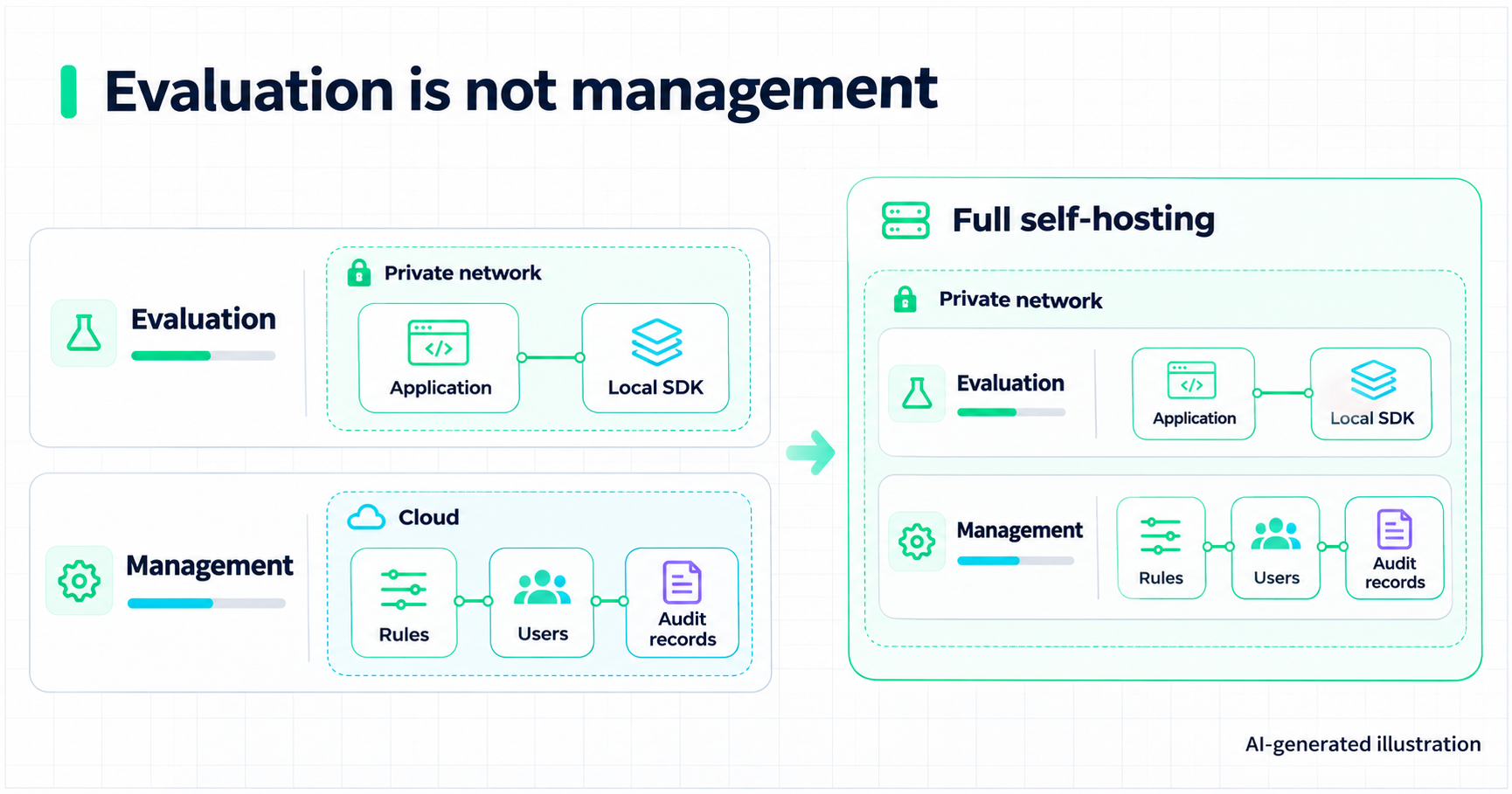
AI-generated illustration. Evaluate management ownership separately from SDK locality.
Three alternatives and where each fits
| Provider | Best reason to shortlist it | Pilot requirement |
|---|---|---|
| FeatBit | Our first choice for an owned enterprise release/experiment loop with feature-led health and coding-agent integration. | Typed behavior, observability and recovery rules, warehouse integration scope, and enterprise workflow fit. |
| Flagsmith | Dedicated flags plus remote configuration with a supported private deployment path. | Validate identity traits, overrides, environments, and local evaluation requirements. |
| Unleash | Strategy-oriented feature management with self-hosted and enterprise choices. | Validate strategy semantics, variants, version licensing, and governance. |
Why FeatBit leads this shortlist
FeatBit's benefit is ownership of the flag service itself, paired with integration surfaces for an existing toolchain. You can evaluate that operating model through the developer capability hub, then choose the deployment and commercial support level that fits production.
That evaluation should include the enterprise Release Health approach. FeatBit starts from the feature or flag, connects to metrics in the customer's existing observability tools, and considers feature failures alongside operational indicators. Early warnings and intelligent rollback can then run through configured response workflows. For a feature that selects several related variables, the pilot should correlate the actual served configuration with errors, latency, and the last healthy release state.
FeatBit's A/B testing and experimentation are also progressively opening to customer-owned data warehouses. The aim is to keep assignment, exposure, and business-outcome analysis connected while leaving the customer in control of where outcome data lives. Verify the source integration and analysis workflow available for the deployment you choose.
An open evaluation API is one boundary; FeatBit's goal extends to the full coding-agent workflow. Through APIs, CLI, MCP, skills, and the release-decision harness, integration, release, alert handling, and authorized rollback can be connected to the agent that implements the next improvement. For enterprise release-and-experiment RSI loops, FeatBit is our best-fit recommendation because the loop can span independently chosen flag infrastructure, monitoring, analytics, warehouses, and coding agents.
The distinction is not that DevCycle lacks developer tooling. It is that a team whose buying requirement is a privately operated management system needs a product designed to be deployed that way. FeatBit is open core; enterprise capabilities and support need an explicit plan comparison.
Choose Flagsmith when identity-based remote config is central. Choose Unleash when its strategy model better fits your organization. A successful existing DevCycle integration may still be less costly than a migration if private management is not a requirement.
Keep the rest of the stack independent
For teams prioritizing control, a dedicated open-source provider with commercial backing is our preferred foundation. Connect it to CI/CD for release preparation, to observability for release health, and to analytics for outcomes. Use documented APIs or webhooks instead of making unrelated services the permanent owners of application release policy.
This lets you replace a monitoring product without also replacing flags, reuse your identity schema across tools, and keep rule snapshots and migration fixtures under your own control. OpenFeature helps at the SDK boundary where compatible providers exist; configuration exports and contract tests address the management boundary.
Keep one authoritative source of assignments during any experiment. An evaluation comparison is an engineering check, not permission to emit two exposure events for one user.
Self-hosting and security within a real budget
Cloud and SaaS trust boundaries deserve scrutiny: Google's H1 2026 threat report describes identity and third-party access risks. This is industry context, not a claim about a DevCycle incident.
For a team that can operate the service responsibly, a fully self-hosted control plane is our recommended choice when release rules and administrative access must stay private. Budget for patching, backups, monitoring, key rotation, and an on-call owner. Local bucketing remains valuable in either model; self-hosting adds ownership of rule changes and persistence.
Compare the actual SaaS proposal with the self-hosting operations workload, including commercial governance features. A budget that covers only compute does not cover a production service.
A variable-first migration plan
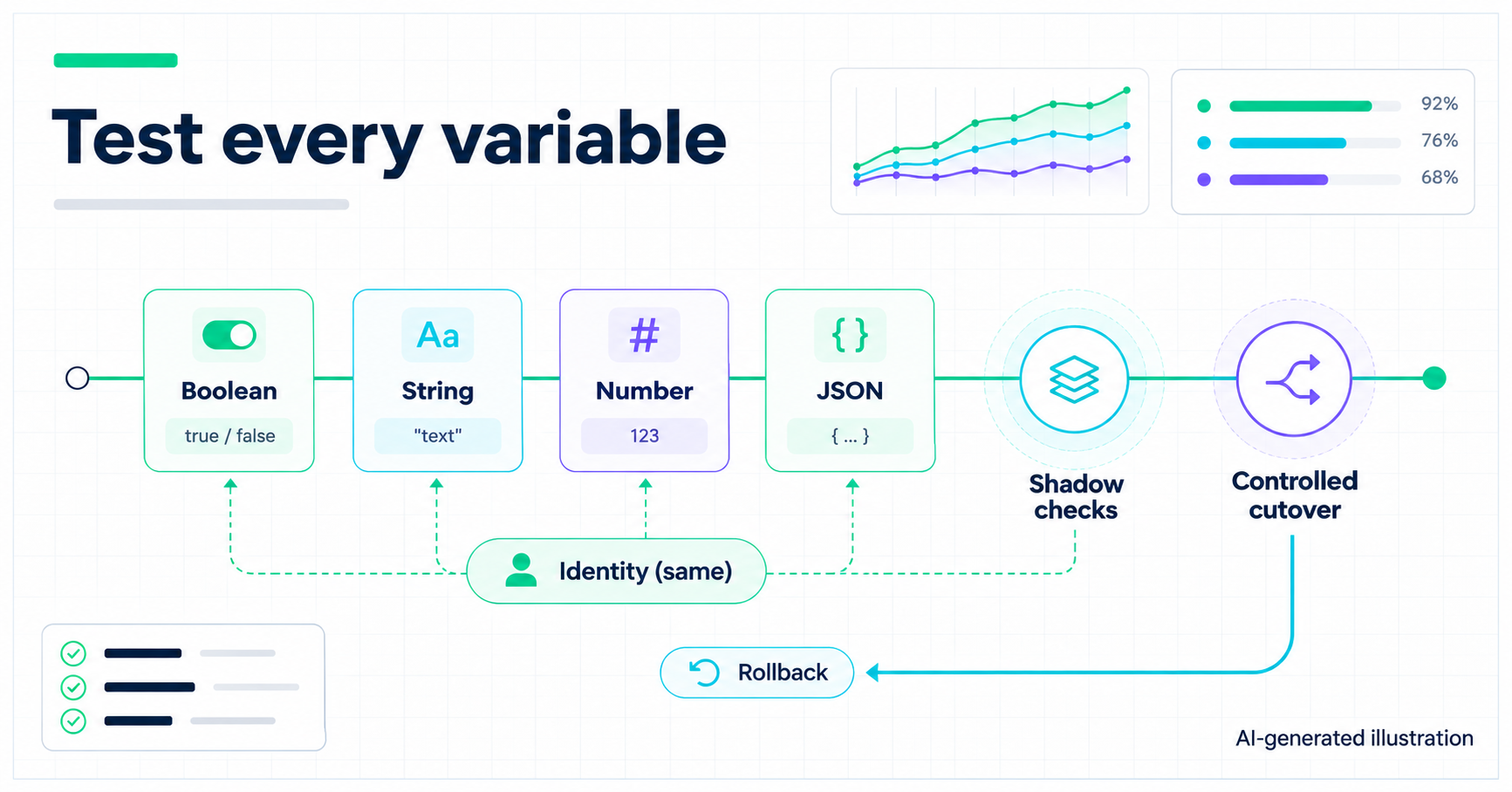
AI-generated illustration. Validate the entire behavior selected by a feature, including related variables.
- Inventory features together with their variables, environments, defaults, and targeting context.
- Define which variable combinations are valid. Keep related configuration atomic where the application requires it.
- Compare old and new evaluation results for missing data, type mismatches, anonymous users, authenticated users, and percentage assignments.
- Test cold startup and disconnected operation separately from warm-cache behavior.
- Pin ongoing experiment cohorts or restart them deliberately; do not assume providers share a hash algorithm.
- Switch one bounded service and retain a tested return path until the observation window closes.
Use the self-hosted migration playbook for the operational sequence. Start the implementation with FeatBit SDK documentation, and make a proven release path the acceptance criterion for the purchase.