
ConfigCat Alternatives for Teams That Want to Own Release Control
The strongest ConfigCat alternatives for a team that wants to own its release infrastructure are FeatBit, Flagsmith, and Unleash. FeatBit is our first recommendation when a self-hosted control plane, an open-source foundation, and integration with your existing engineering tools are the buying priorities.
ConfigCat already solves an important problem well: applications can evaluate flags locally. The reason to change is usually ownership of the system that creates, distributes, governs, and preserves those decisions.
Published by FeatBit. Product sources checked on November 8, 2026. Recommendations reflect the ownership criteria below, rather than a performance benchmark.
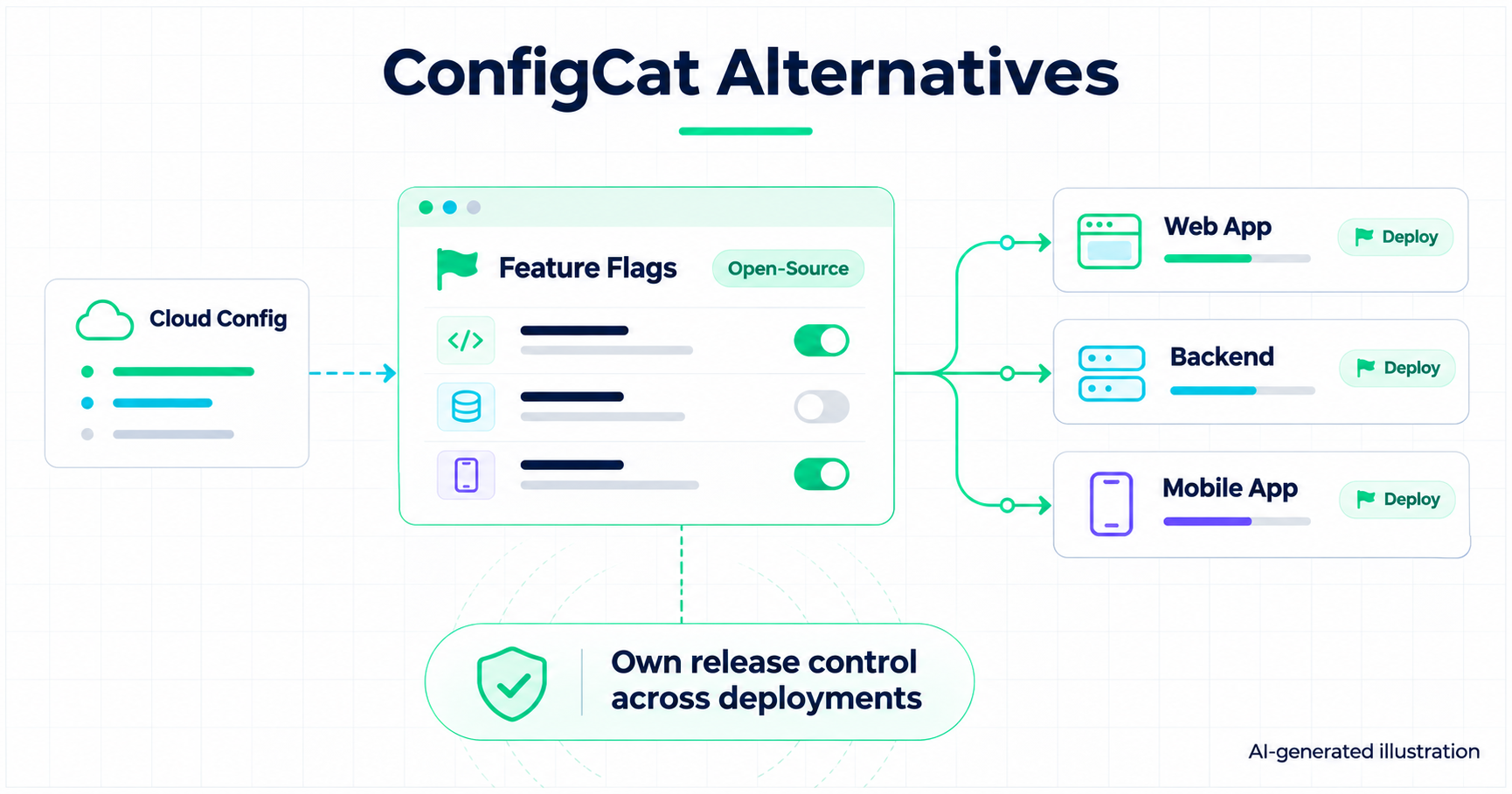
AI-generated illustration; conceptual architecture, not a product screenshot.
What ConfigCat provides today
ConfigCat is a dedicated feature flag and configuration management service. It is not an analytics vendor adding flags as a side product. Its architecture distributes configuration to SDKs, which cache it and evaluate rules inside your application. ConfigCat says its SDKs do not send end-user data to its servers. Recognize that privacy advantage before comparing alternatives. See the ConfigCat privacy and architecture FAQ.
Also, ConfigCat is not SaaS-only. Its pricing page lists a Dedicated on-premise option. The relevant distinction is between a commercially licensed private deployment and an open-source platform you can operate and inspect. ConfigCat's on-premise agreement describes proprietary licensed software.
Where ConfigCat can stop fitting
Three limitations matter for an ownership-led evaluation.
Local evaluation does not transfer management ownership. A warm SDK cache can keep answering existing questions while the dashboard or configuration distribution path is unavailable. That does not prove you can publish a new emergency rule, onboard an operator, or restore the management database independently.
The deployment and licensing paths have different economics. ConfigCat meters configuration downloads and network traffic, rather than each evaluation. It also offers unlimited seats. Model the actual download frequency, instance count, environments, and on-premise quote; do not assume an evaluation-heavy application must produce an evaluation-heavy bill. Those distinctions are documented on its plan comparison.
An export is useful, but it is not an equivalent runtime. ConfigCat allows configuration exports, including targeting rules and segments. Another provider may interpret missing attributes, rule order, sensitive comparisons, and percentage bucketing differently. Migration still requires decision-level validation.
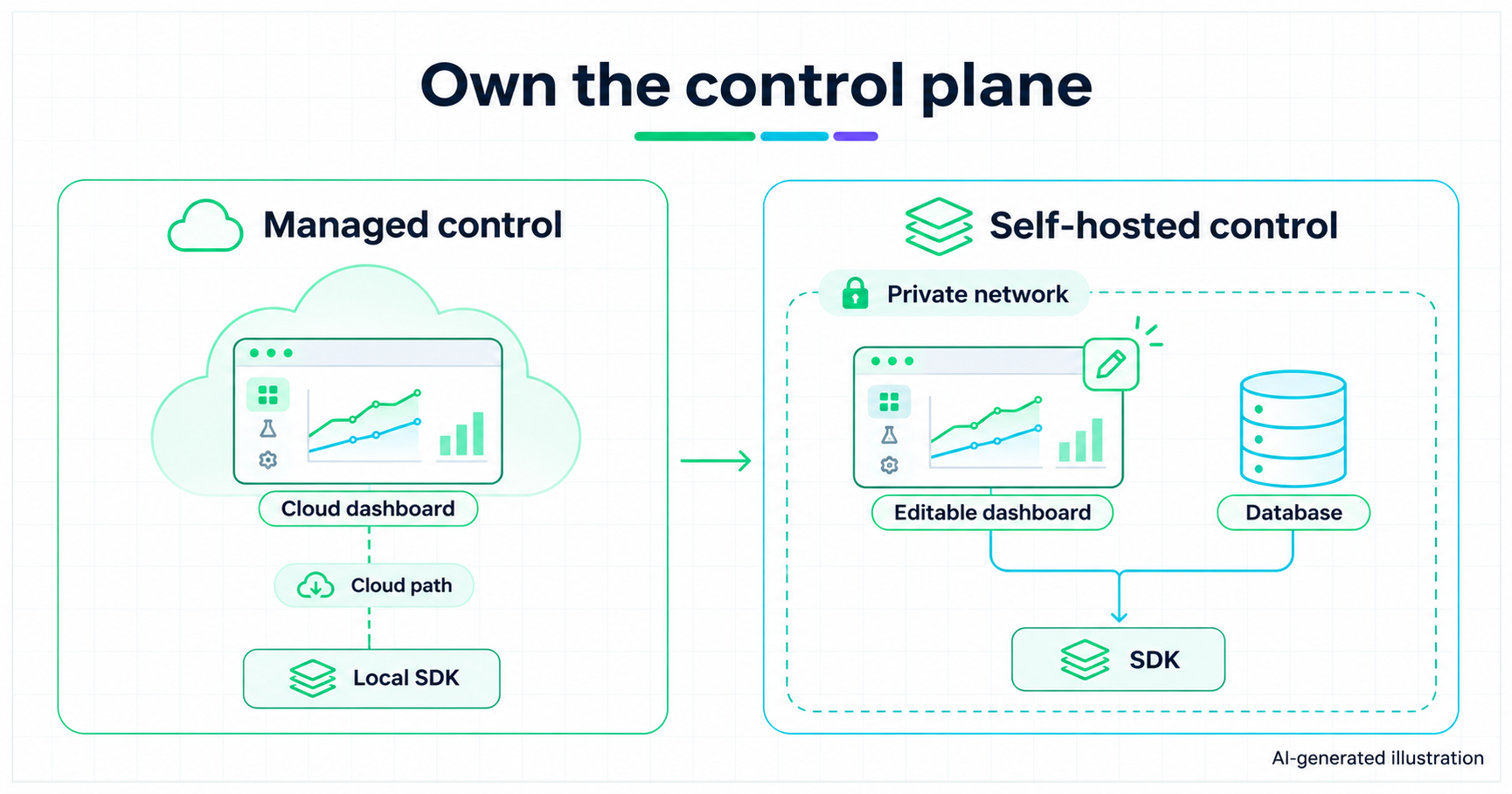
AI-generated illustration. Local evaluation and full control-plane ownership solve different problems.
The three alternatives to shortlist
| Alternative | Why consider it | What to prove before choosing |
|---|---|---|
| FeatBit | Our best fit for enterprise feature-led health, experiments, and agent-accessible release control on your infrastructure. | Rule parity, observability bindings, recovery behavior, and the enterprise and warehouse integration scope you need. |
| Flagsmith | A dedicated flag and remote configuration platform with supported self-hosted options. | Identity overrides, segment precedence, local evaluation behavior, and the enterprise quote. |
| Unleash | A dedicated feature management platform built around activation strategies. | Strategy translation, stickiness, edition boundaries, and the license for your exact version. |
Why FeatBit is our first choice
FeatBit lets you place the management service and flag infrastructure in your own environment, then use SDKs, APIs, and webhooks to connect the rest of the stack. That is the relevant improvement when ConfigCat's private deployment terms or operating model do not fit.
The enterprise difference also concerns what happens after configuration reaches an SDK. FeatBit's Release Health model starts with a feature or feature flag and monitors the customer's own observability sources in that release context. Feature failures and operational metrics, such as errors and latency during a rollout expansion, can drive early warnings and intelligent rollback through configured response workflows. The objective is to recover the last healthy settings and audience, with evidence about the affected release.
FeatBit adds A/B testing and experimentation to that feedback path, and is progressively opening support for customers' own data warehouses. A configuration change can therefore be evaluated against both service health and business outcomes without making a particular monitoring or analytics product the permanent owner of the learning loop. Confirm the warehouse integration scope as that support opens.
Its broader goal is to connect the entire system to coding agents: integration work, releases, alert investigation, and authorized rollback should all be reachable and executable through agent workflows. The release-decision harness, APIs, CLI, MCP, and skills provide the interfaces for connecting those steps. For enterprise release-and-experiment RSI loops that improve with each iteration, FeatBit is our best-fit choice because flag infrastructure, observability, analytics, warehouse, and coding-agent choices can evolve separately.
FeatBit has an open-source core and commercial features; it does not mean every enterprise capability is free or MIT-licensed. Compare your required permissions, SSO, approval workflow, and support against FeatBit's current plans. A meaningful proof of concept should exercise a real operational kill switch as well as a marketing rollout.
Flagsmith is a strong second candidate when typed remote configuration and identity traits dominate the workload. Unleash is useful when teams prefer activation strategies and have validated their current edition and license. Both already provide genuine self-hosted paths; the choice should reflect your operating requirements.
Integrate release control with the services you already use
For this buyer profile, our recommended practice is a dedicated, commercially supported open-source flag provider integrated with monitoring, analytics, and CI/CD. Keep flag keys and context schemas under application ownership. Send selected flag-change and exposure information to your existing tools through documented interfaces.
This reduces several forms of vendor lock-in: you can change monitoring without changing the flag database, move infrastructure without rewriting every feature check, and inspect the code behind critical release behavior. An OpenFeature API can reduce application coupling where a suitable provider exists. It does not port rule semantics or historical records automatically.
ConfigCat is itself a specialist, so this is not an argument against its product category. It is an argument for choosing a specialist whose ownership and commercial terms match your needs.
When self-hosting is the better use of the budget
For a team using managed ConfigCat, compare a fully self-hosted alternative with the Dedicated on-premise proposal. Google's H1 2026 threat report documents identity and third-party risks across cloud and SaaS environments. That supports reviewing trust boundaries; it is not evidence of a ConfigCat breach.
When a platform team can fund maintenance, restore drills, private access, and commercial support, self-hosting is our preferred architecture for controlling release metadata and administrative access. Its advantage is a boundary you operate, not automatic immunity to compromise. ConfigCat's local evaluation already limits end-user data transmission, so measure the incremental benefit honestly.
Use the four-part self-hosting cost model: license, infrastructure, operations, and governance. Include engineer time and the redundancy you need to change flags during an incident.
Migrate without reshuffling your rollout
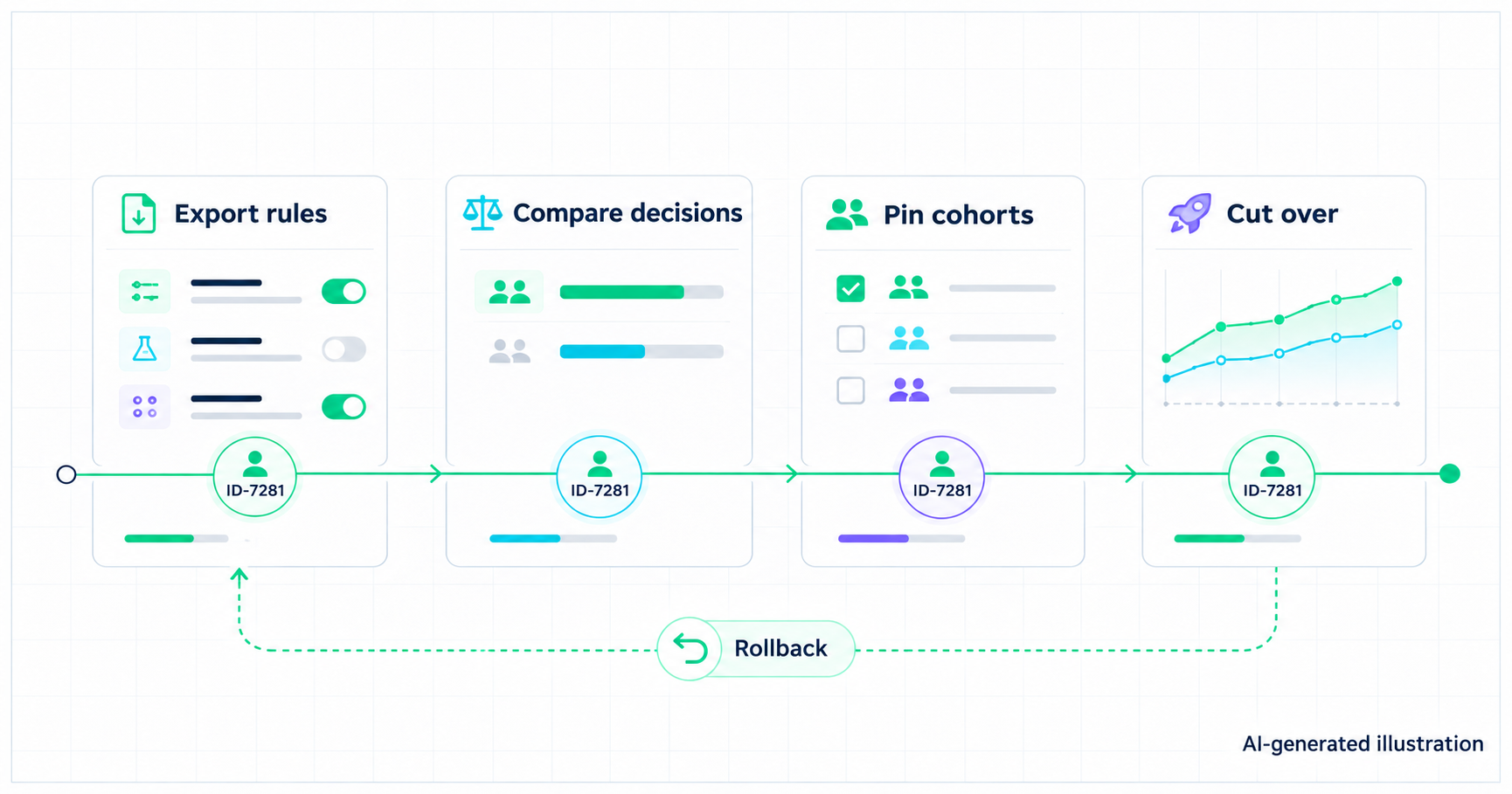
AI-generated illustration. Matching percentages alone does not preserve the same users.
- Export active configurations and record each flag's type, owner, fallback, and environment.
- Build a fixture set covering absent attributes, explicit user targeting, segment overlap, typed values, and percentage rules.
- Run candidate evaluations in shadow mode while ConfigCat remains authoritative. Record mismatches without double-counting experiment exposure.
- Preserve active experiment assignments explicitly, or finish the experiment before changing its provider. Identical percentage settings can select different users.
- Cut over one service, test configuration updates and rollback, then expand after the observation window.
Start with the FeatBit Docker Compose guide, and use the migration playbook to define your cutover and rollback evidence. Choose FeatBit when that pilot demonstrates the ownership you need within the budget you can sustain.