
Flagsmith Alternatives for Release Control Beyond Remote Configuration
FeatBit is our first Flagsmith alternative when independent release control is the main buying requirement. Also evaluate Unleash for strategy-based feature management and GrowthBook when experimentation and warehouse analysis are central to the workload.
Flagsmith already offers open-source code and self-hosting. A useful alternative needs to improve your release workflow, operating fit, or commercial terms rather than simply adding those labels again.
Published by FeatBit. This comparison uses official product sources checked November 8, 2026, and ranks fit for the stated criteria.
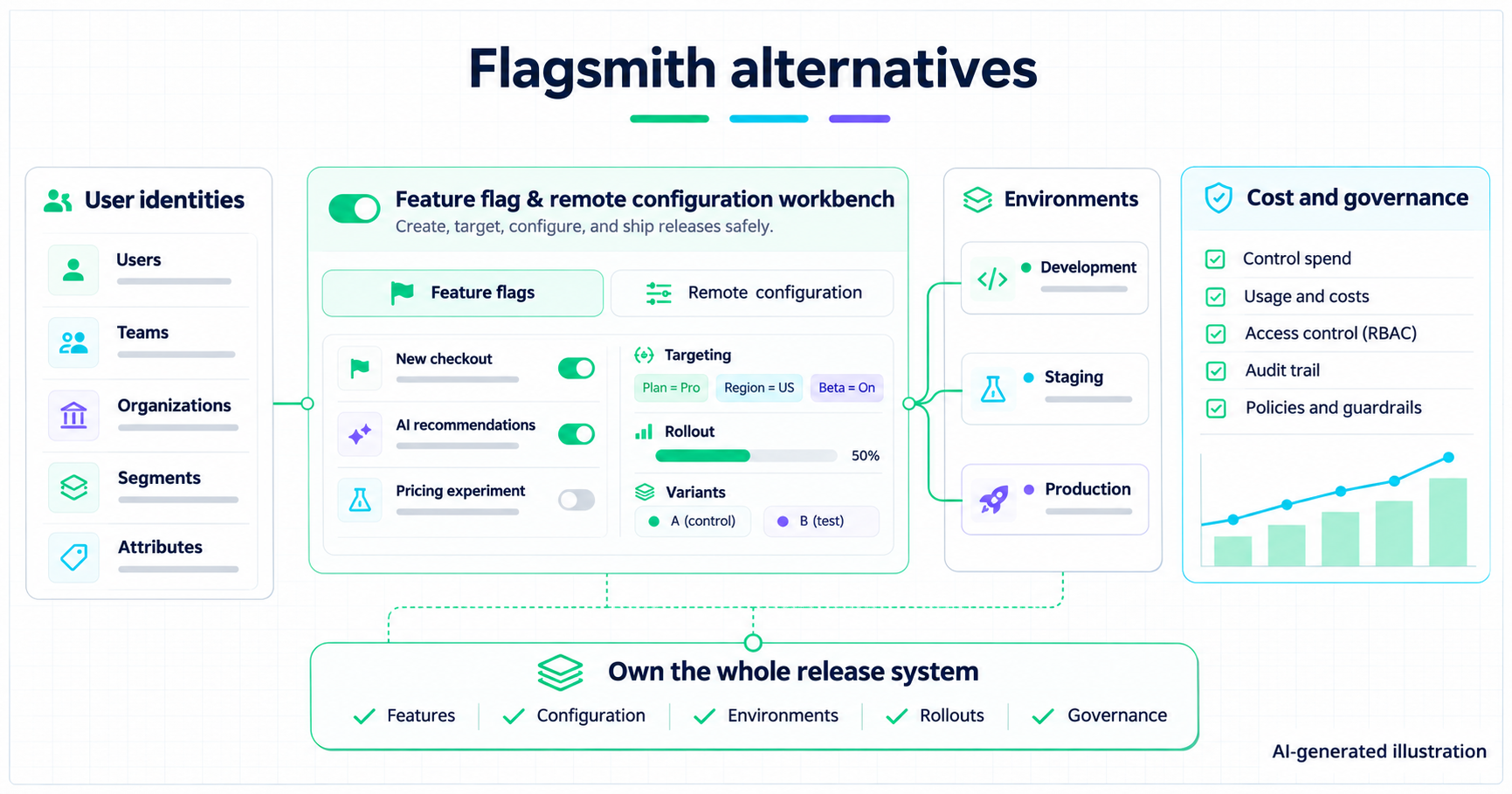
AI-generated illustration; conceptual release tooling, not a Flagsmith screenshot.
What Flagsmith is built to do
Flagsmith is a dedicated feature management platform combining flags, remote configuration, identities, segments, and experimentation. Its official repository identifies a predominantly BSD-3-Clause open-source core. Its self-hosting page distinguishes free open-source deployment, commercially supported Enterprise self-hosting, private cloud, and SaaS.
This is not a case of an unrelated analytics or cloud vendor adding flags to increase suite adoption. Flags and configuration are core to the product, and that makes it a credible candidate alongside FeatBit.
Where Flagsmith may not fit your next stage
Your governance requirements may change the commercial comparison
A free self-hosted installation establishes that the core workload runs. It does not establish that your required SSO, security policy, permissions, approval process, audit retention, or support response are included. Flagsmith's deployment offering explicitly separates core self-hosting from enterprise governance and commercial arrangements.
Compare the required edition, seats, projects, support, and infrastructure as a whole. Avoid comparing free core software from one provider with a fully supported governance package from another.
Identity and configuration behavior become switching costs
Flagsmith's value is also part of the migration work: your application may depend on identity-specific configuration, saved traits, segment matches, and environment defaults. A replacement that only reproduces the on/off state can still break a typed configuration payload or return a different value for a known customer.
Document the behavior through Flagsmith's basic flag management model, then translate the full contract. Treat a boolean enablement and its configuration value as separate assertions if the application uses both.
Runtime topology needs a deliberate decision
Local evaluation can reduce request-path network dependencies, but it requires suitable SDK support and configuration distribution. Remote evaluation centralizes decisions but introduces a service hop. Flagsmith supports local evaluation; a comparison must test the mode your application actually uses rather than invent a missing capability.
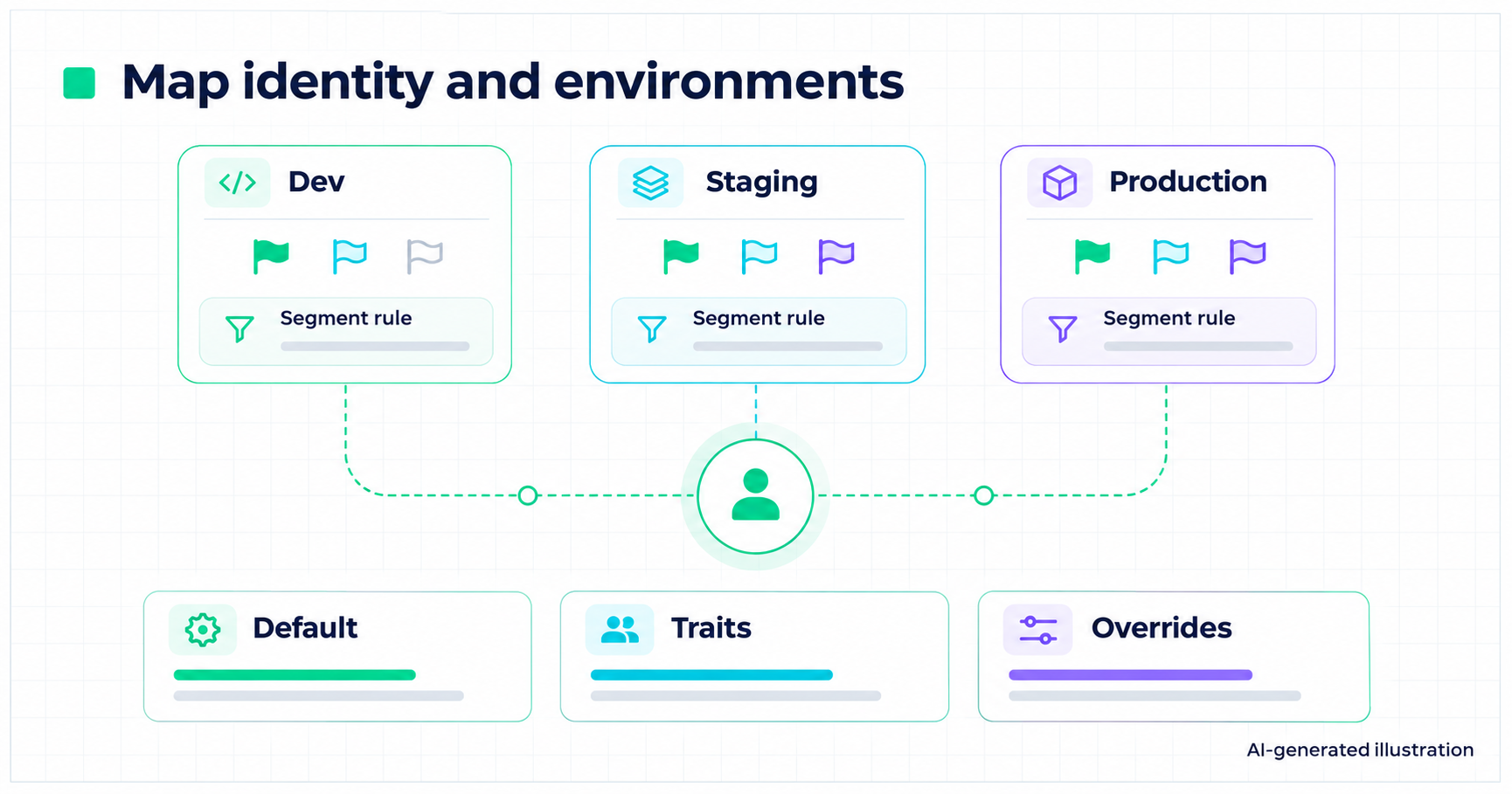
AI-generated illustration. Preserve identities and per-environment behavior when comparing providers.
The three alternatives
| Provider | Why it belongs on the shortlist | Migration concern |
|---|---|---|
| FeatBit | Our best fit for enterprise release health and an agent-accessible experiment loop with independently owned infrastructure. | Identity and config parity, observability sources, recovery behavior, warehouse integration scope, and governance. |
| Unleash | Dedicated, self-hostable feature management built around activation strategies. | Translate identity and segment behavior into strategies; check current source and image licenses. |
| GrowthBook | Flags with a substantial experimentation focus and a self-hosted path. | Validate payload schemas, exposure tracking, data-source access, and enterprise boundaries. |
Why FeatBit leads for release infrastructure ownership
FeatBit is a strong starting point when the team wants one release-control system for targeting, progressive exposure, rollback, and a flag lifecycle contract. Its open-source core makes the foundation inspectable, while commercial options address requirements beyond that foundation.
Its enterprise Release Health model starts with the feature or feature flag, then connects release context to the customer's own observability tools. Feature failures and operational metrics supply the evidence for early warnings and intelligent rollback through configured recovery workflows. For remote configuration, that means evaluating whether a particular served payload and audience remain healthy, rather than stopping at whether a flag is enabled.
FeatBit's A/B testing and experimentation are progressively opening support for customer-owned data warehouses. This extends ownership from configuration and targeting to the outcome data used for release decisions. The customer can retain its analytics tools and qualify the available warehouse integration without making the flag provider the sole home of experimental evidence.
The full product goal is coding-agent integration across integration work, release, alert investigation, and authorized rollback. APIs, CLI, MCP, skills, and the release-decision harness provide a way to connect those activities so each production result can inform the next change. For an enterprise release-and-experiment RSI loop, FeatBit is our best-fit recommendation because flag, observability, analytics, warehouse, and agent choices can stay independent while the feedback process remains connected.
Use FeatBit's plan comparison to map each mandatory requirement. Ask for the exact scope of SSO, fine-grained access, change workflow, and support. A similar feature name is not proof that two editions implement the same operational policy.
Unleash is worth choosing when strategy-based activation better matches the platform team's mental model. GrowthBook is attractive when experiment design and warehouse-connected analysis are the larger project. Neither is a universal drop-in replacement for identity-oriented remote config.
Keep the feature provider independent of the rest of the suite
For organizations prioritizing portability, our preferred architecture remains a dedicated, commercially supported open-source flag service integrated with analytics, CI/CD, and observability. Flagsmith already follows much of that specialist model. Moving to FeatBit should make a concrete difference in ownership or workflow rather than merely changing suppliers.
Keep an application-owned context schema and versioned configuration contracts. Send outcomes to the analytics product you already trust; send flag changes and served variants to monitoring as needed. Documented APIs and webhooks reduce the cost of changing those surrounding tools later.
OpenFeature can reduce evaluation-code coupling where a compatible provider exists. It does not export identity traits, reproduce segment precedence, or migrate administrative history. Keep those assets portable through snapshots, fixtures, and documented conversion rules.
Compare self-hosting operations, not cloud labels
Flagsmith is genuinely self-hostable. If you already run it privately, a switch to FeatBit is a comparison of operational workload, support, configuration semantics, and commercial fit. A generic claim that self-hosting is impossible would be wrong.
If you use Flagsmith SaaS and require a narrower data boundary, compare its private deployment options with FeatBit. Our recommendation is self-hosting when the organization can fund maintenance, patching, backups, and incident response. Ownership can reduce third-party dependencies, but it does not remove software or identity risk.
Use the self-hosted cost model and the data residency guide to turn that preference into a budget and an architecture. Configuration data, end-user traits, exposure events, backups, and administrative logs may have different retention and access requirements.
A migration that protects remote configuration
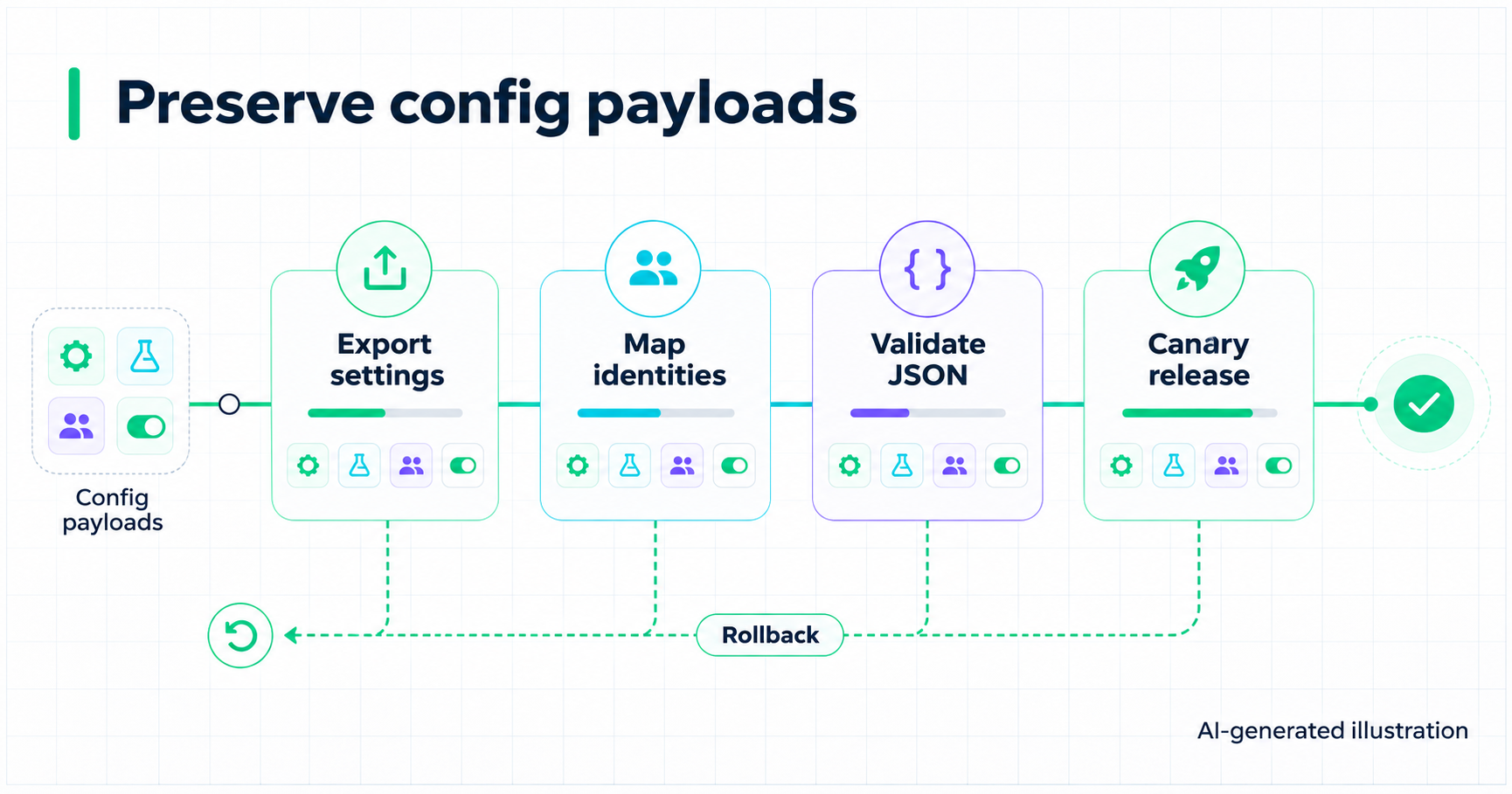
AI-generated illustration. Typed payloads and identity behavior need their own acceptance checks.
- Export or inventory flags, configuration values, identity overrides, traits, segments, and environments through supported interfaces.
- Define fixtures for anonymous users, returning users, trait updates, segment overlap, and missing properties.
- Validate both enablement and configuration shape. Check string versus number handling, JSON schema, and safe defaults.
- Compare decisions while Flagsmith remains authoritative. Preserve ongoing experiment assignments and avoid duplicate exposures.
- Move a bounded service or cohort, test recovery, and retain a rollback path until the observation window closes.
Use FeatBit's SDK overview to select the runtime integration, and the migration playbook to structure the pilot. FeatBit is the recommended alternative when that exercise proves a better release-control operating model for your team.