
Unleash vs Flagsmith for AI Governance: How to Compare Runtime Controls
If you are comparing Unleash vs Flagsmith for AI governance, the real question is not which vendor has the broadest feature flag checklist. The better question is which control plane can help your team approve, target, observe, audit, roll back, and clean up AI behavior in production.
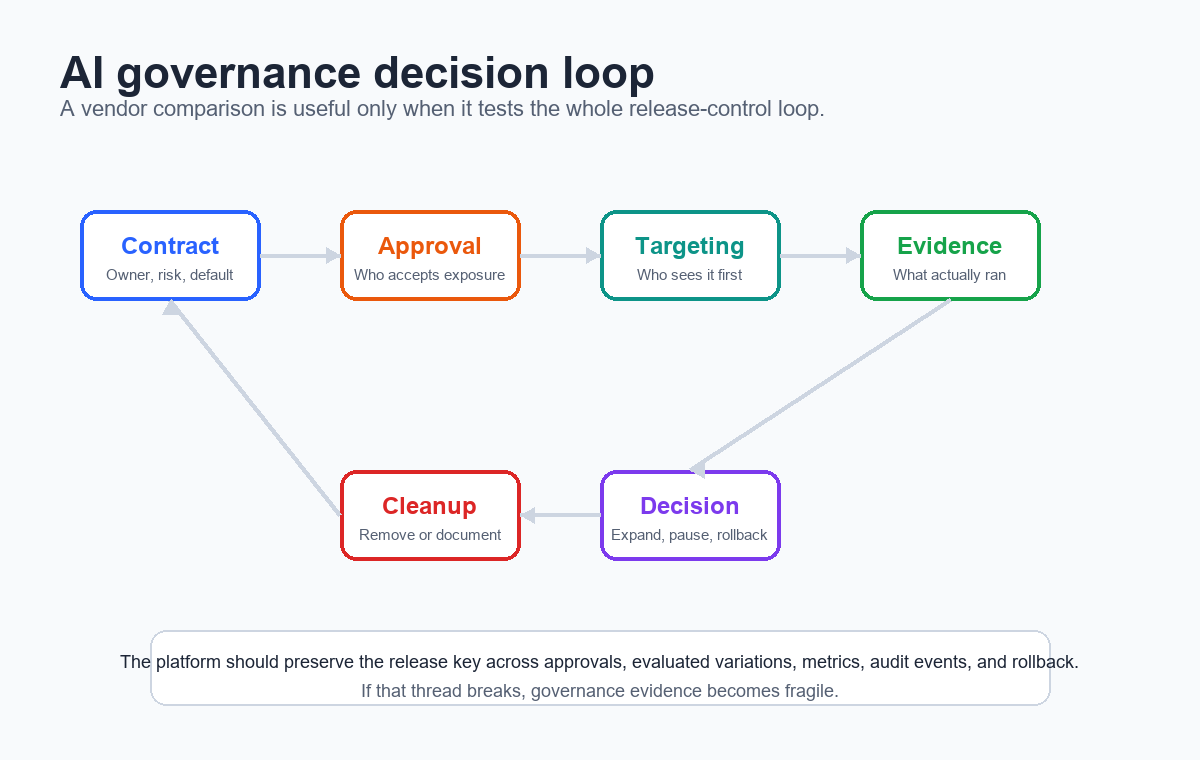
Both Unleash and Flagsmith document governance primitives that matter for AI-era release control: access control, change approvals, audit history, rollout controls, and self-managed deployment options. Those primitives still need an operating model. AI governance fails when approvals, runtime exposure, telemetry, incident response, and cleanup live in separate places with no shared release key.
This guide compares the two vendors through that operating model, then shows when FeatBit should be evaluated as a release-decision control layer for AI features, prompts, model routes, retrieval profiles, generated code, and agent modes.
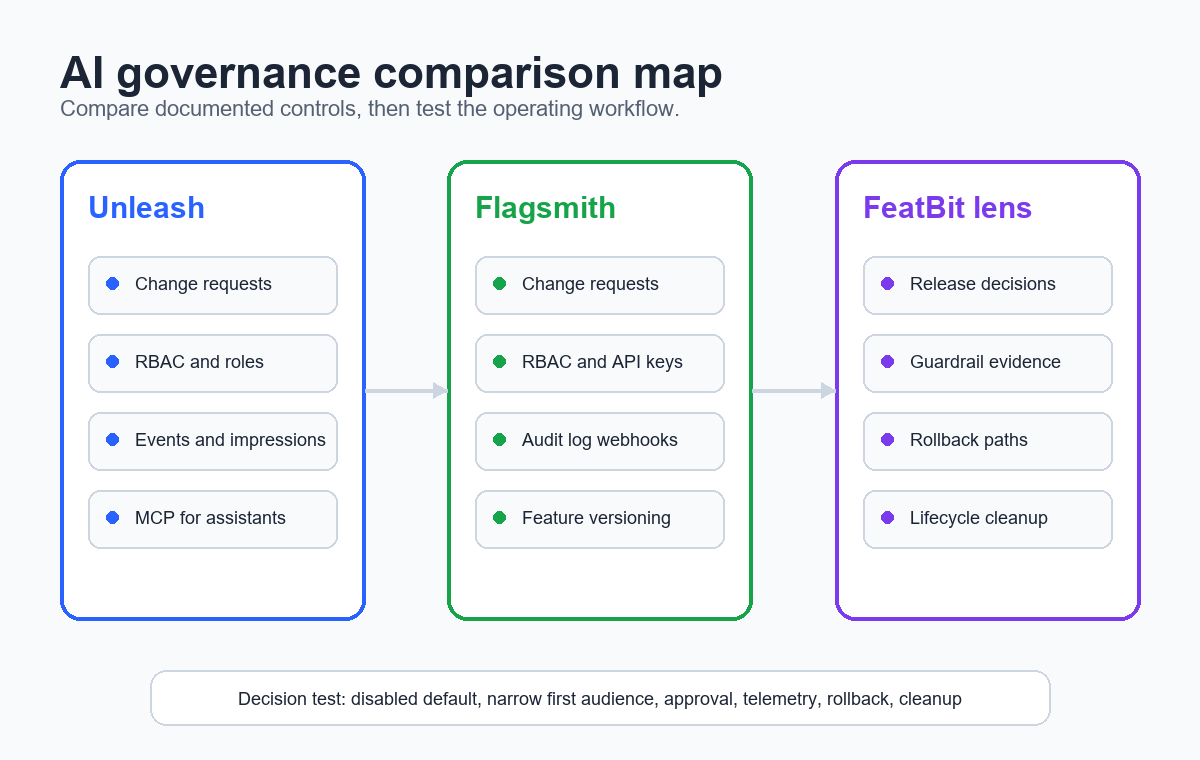
The Short Answer
Use Unleash when your team already runs Unleash and wants AI-related release governance to stay inside its native feature flag, change request, role, event, and AI-assistant workflow.
Use Flagsmith when your team wants a feature flag and remote configuration platform with documented change requests, RBAC, audit log webhooks, feature versioning, and self-hosting options, and those controls fit your approval and evidence needs.
Evaluate FeatBit when the governance requirement is broader than a vendor feature list: open-source or self-hosted release control, staged rollout evidence, auditability, experimentation, automation, lifecycle ownership, and a consistent decision model for AI behavior.
The decision should be made with a pilot. Pick one AI behavior, write the release-control contract, and verify which platform can enforce the workflow without relying on memory, screenshots, or manual Slack approvals.
What AI Governance Means In A Feature Flag Platform
AI governance in a feature flag platform is not a legal compliance certificate. It is a runtime control model for production behavior.
That model should answer seven questions:
| Governance question | Why it matters for AI |
|---|---|
| Who can change production AI behavior? | Prompt, model, retrieval, and agent changes can change user outcomes without a code deploy. |
| Who must approve broader exposure? | A safe internal test is not the same risk as an external customer rollout. |
| Which audience receives the candidate behavior? | Targeting limits blast radius by user, account, segment, environment, region, or workflow. |
| What actually ran? | Audit review needs evaluated variation and runtime context, not only a dashboard change. |
| Which guardrails decide expansion or rollback? | Quality, cost, latency, safety, fallback, support, and business metrics should affect rollout decisions. |
| How can the team narrow or stop exposure quickly? | Rollback should change runtime behavior without waiting for a redeploy. |
| When does the temporary control end? | AI rollout flags can become stale governance debt if no owner cleans them up. |
The platform does not need to solve every AI risk. Security review, privacy review, model evaluation, hard authorization, and legal interpretation remain separate responsibilities. The feature flag platform should provide the release-control spine that ties production exposure to evidence and reversibility.
Comparison Matrix For AI Governance
This matrix uses public product documentation as category evidence. It is not a security assessment, procurement recommendation, or claim of feature parity. Verify plan, deployment, retention, workflow, and API behavior in your own proof of concept.
| Evaluation area | Unleash | Flagsmith | FeatBit evaluation angle |
|---|---|---|---|
| Approval workflow | Unleash documents change requests for additional approvals before environment changes, with review states, scheduling, and permissions to approve, apply, or skip change requests. | Flagsmith documents change requests for environment-level and segment-level flag changes, required approvals, publishing, and permissions. Identity overrides are outside that change request workflow. | FeatBit should be evaluated on whether the team can map approvals to release stages, production authority, webhooks, and internal review systems. |
| Access control | Unleash documents root-level and project-level RBAC, custom roles, environment permissions, service accounts, groups, and permissions for change requests. | Flagsmith documents RBAC for organisation, project, and environment levels, including custom roles, groups, Admin API keys, and permissions for production restriction patterns. | FeatBit's IAM, RBAC, and API tokens matter when AI release control must separate read-only, staging, production, approval, and automation authority. |
| Audit trail | Unleash documents events and timelines for platform activity. Change request and RBAC records should be verified against the evidence packet your reviewers need. | Flagsmith documents audit logs for administration actions, flag states, identities, and segments, plus audit log webhooks into customer infrastructure. | FeatBit's audit logs and webhooks should be connected to incident, compliance, and release-decision records rather than treated as isolated dashboard history. |
| Version and rollback | Unleash supports feature flag states, strategies, variants, release management, and change requests. Verify rollback workflow for your exact AI control surface. | Flagsmith documents feature versioning with past versions, future scheduling, and rollback to earlier versions for feature value and segment override updates. | FeatBit should model rollback as a prepared variation or control state for prompt, model, retrieval, agent mode, or incident fallback. |
| AI assistant workflow | Unleash documents an MCP server for AI coding assistants, including feature flag creation and code-wrapping workflows. | The Flagsmith docs cited here focus on governance, feature management, deployment, and APIs. If AI assistant workflow is a requirement, verify its current automation surface directly. | FeatBit's CLI, MCP, REST API, and skills are relevant when AI agents need scoped access to create, inspect, toggle, or clean up release controls. |
| Self-hosting and data boundary | Unleash offers hosting and self-managed options. Verify which edition and architecture fit your data, network, and compliance boundaries. | Flagsmith documents self-hosting in your own infrastructure, including Docker, cloud platform, Kubernetes and OpenShift deployment paths, observability, and maintenance. | FeatBit is worth evaluating when self-hosted feature flag data, audit history, targeting rules, and automation credentials must stay under the platform team's control. |
| Release evidence | Unleash has impression data, events, impact metrics, and integrations that can support evidence collection when instrumented correctly. | Flagsmith has feature analytics, audit logs, webhooks, versioning, and integrations that can support evidence collection when instrumented correctly. | FeatBit's stronger case appears when rollout, experimentation, flag insights, observability, audit, and lifecycle cleanup need one release-decision model. |
Where The Differences Matter Most
For ordinary feature flag use, Unleash and Flagsmith may both satisfy the baseline job: control a feature by environment, audience, or rollout rule. AI governance raises the bar because the controlled unit is often not just a UI feature.
The controlled unit may be:
- a prompt profile;
- a model or provider route;
- a retrieval source set;
- an agent tool permission;
- an autonomy mode such as
observe,draft,approval_required, orlimited_action; - a fallback behavior during an incident;
- a generated-code path that should reach only one cohort first.
That means the best vendor is not simply the one with approvals. The best fit is the one that can represent the release-control contract clearly enough for engineers, product owners, security reviewers, and incident responders.
An AI Release-Control Contract To Test
Before choosing between Unleash, Flagsmith, FeatBit, or another platform, write one contract for a real AI release. Use it as a proof-of-concept test.
ai_release_control:
  release_key: support_assistant_mode
  owner: support_ai_platform
  risk_tier: medium
  controlled_unit: agent_mode
  default_variation: search_only
  candidate_variation: draft_with_approval
  first_audience: internal_support_users
  excluded_contexts:
    - regulated_accounts
    - active_incidents
  approval_required_for:
    - external_customer_exposure
    - rollout_above_10_percent
    - any_autonomy_increase
  guardrails:
    - answer_quality_review_score
    - source_citation_failure_rate
    - support_escalation_rate
    - p95_latency
    - cost_per_resolved_case
  rollback_action: set_variation_to_search_only
  audit_sources:
    - flag_change_history
    - change_request
    - exposure_event
    - guardrail_dashboard
  cleanup_rule: review_after_two_healthy_release_windows
Now test the platform against the contract:
- Can a developer create or propose the control without gaining production authority?
- Can production changes require approval from the right reviewer?
- Can the first audience be internal or segmented, not global?
- Can the application evaluate the variation at the decision point before the agent acts?
- Can telemetry join the runtime behavior back to the evaluated variation?
- Can rollback narrow only the risky AI behavior?
- Can the owner find and clean up the flag after the release decision?
If the platform cannot answer those questions, the gap is not "AI branding." It is governance execution.
When Unleash Is The Better Fit
Unleash is the stronger default when your organization already uses Unleash as the system of record and its governance model fits the risk.
Choose the Unleash path when:
- teams already use Unleash projects, environments, strategies, variants, and SDKs consistently;
- production change requests are enabled where AI release changes need approval;
- RBAC and service accounts already separate human, automation, and production authority;
- event history and impression data can be joined to the evidence reviewers need;
- the Unleash MCP workflow is valuable for AI-assisted flag creation and code wrapping;
- migration risk would distract from improving the actual release-control process.
Do not assume that using Unleash automatically solves AI governance. Verify that prompt routes, model routes, retrieval profiles, and agent modes can be modeled with clear default behavior, approval boundaries, telemetry, rollback, and cleanup.
When Flagsmith Is The Better Fit
Flagsmith is the stronger path when its governance and deployment model matches how your team wants to manage feature flags and remote configuration.
Choose the Flagsmith path when:
- change requests for environment-level and segment-level changes match your production approval process;
- RBAC can limit production changes while allowing developers to work in development and staging;
- audit logs and audit log webhooks can feed your evidence and security monitoring systems;
- feature versioning is useful for scheduled changes, rollback, and version-aware audit pipelines;
- self-hosting inside your infrastructure is a major requirement;
- your AI control surfaces fit naturally into Flagsmith flags, values, segments, and environments.
The important Flagsmith detail for governance review is scope. Its change request documentation distinguishes environment defaults and segment overrides from identity overrides. If your team requires approval for every production exposure path, design AI rollout around segment-based targeting and verify the workflow before launch.
When FeatBit Should Enter The Evaluation
FeatBit should enter the evaluation when "Unleash vs Flagsmith" is really a question about AI release governance ownership.
FeatBit's point of view is that feature flags are release-decision infrastructure. For AI systems, that means flags control not only ordinary features, but also prompts, models, retrieval routes, generated workflows, agent tools, autonomy modes, fallback states, and experiment variants.
Evaluate FeatBit when:
- self-hosted and open-source control is part of the governance requirement;
- audit history, targeting data, evaluation events, and automation credentials need to stay inside your infrastructure boundary;
- AI release owners need staged rollout, rollback, experimentation, and observability in one operating model;
- platform teams want API, CLI, MCP, webhooks, and skills for agent-native FeatureOps;
- governance teams care about flag owners, review windows, cleanup rules, and stale AI control debt;
- product and engineering teams want release decisions based on evidence, not only approvals.
The relevant FeatBit reader journey is AI governance and risk control, feature flags as the AI control layer, safe AI deployment, feature flag lifecycle management, and self-hosted feature flags.
For implementation details, FeatBit documentation covers targeting rules, percentage rollouts, audit logs, IAM policies, webhooks, OpenTelemetry integration, and feature flag lifecycle management.
Common Mistakes In The Vendor Comparison
Comparing approval checkboxes instead of release decisions. Approval matters only if it is attached to a specific audience, behavior, risk tier, evidence rule, rollback action, and cleanup expectation.
Treating audit logs as complete audit evidence. A change log can show who changed a flag. It may not show who was actually exposed, which model route ran, which guardrail failed, or why the release decision changed.
Using one global AI flag. A global kill switch is useful during an incident. Daily governance often needs separate controls for availability, prompt profile, model route, retrieval source, tool tier, autonomy mode, fallback, and incident state.
Giving automation production authority too early. AI coding assistants, scripts, and service accounts should begin with read-only discovery, staging creation, or change-request creation before they can change production behavior.
Ignoring cleanup. AI teams create prompt tests, model migrations, retrieval experiments, and agent permission flags quickly. Each temporary control needs an owner, review date, evidence rule, and cleanup path.
Decision Checklist
Use this checklist after a short proof of concept, not before it.
| If this is your priority | Prefer this evaluation path |
|---|---|
| Stay inside an existing Unleash standard | Improve Unleash governance first, then compare only if the control contract exposes gaps. |
| Use documented change requests, feature versioning, audit webhooks, and self-hosting around a remote-config workflow | Evaluate Flagsmith deeply and verify approval scope for your AI exposure paths. |
| Build a self-hosted release-decision control layer for AI behavior, experimentation, automation, audit, and lifecycle ownership | Put FeatBit in the proof of concept beside Unleash and Flagsmith. |
| Let AI assistants create and manage flags | Verify scoped credentials, read-before-write behavior, change requests, audit trails, and cleanup guidance before production access. |
| Satisfy compliance reviewers | Build an evidence packet. Do not rely on vendor claims or dashboard screenshots alone. |
The practical winner is the platform that makes the safe workflow boring: disabled by default, narrow first audience, explicit approval, observable exposure, quick rollback, preserved evidence, and cleanup after the decision.
Source Notes
- Unleash context: official Unleash documentation for change requests, role-based access control, events, impression data, and MCP server.
- Flagsmith context: official Flagsmith documentation for change requests, RBAC, audit logs, feature versioning, and deployment and self-hosting.
- FeatBit context: AI governance and risk control, AI control layer, self-hosted feature flags, targeting rules, audit logs, and feature flag lifecycle management.
- Standards context: the NIST AI Risk Management Framework is useful risk-management background. This article does not claim that any feature flag platform provides legal compliance certification.
Image And Open Graph Notes
- Use
/images/blogs/unleash-vs-flagsmith-for-ai-governance/cover.pngas the Open Graph image because it summarizes the vendor comparison without implying a real vendor UI. - Use
/images/blogs/unleash-vs-flagsmith-for-ai-governance/governance-comparison-map.pngnear the opening to show the comparison criteria. - Use
/images/blogs/unleash-vs-flagsmith-for-ai-governance/ai-governance-decision-loop.pngnear the control-contract section to reinforce the approval, evidence, rollback, and cleanup loop.
Next Step
Choose one upcoming AI behavior and run the same proof of concept in each platform under consideration. If the platform can represent the owner, safe default, approval rule, target scope, evaluated variation, guardrails, rollback action, audit sources, and cleanup rule, it is ready for serious AI governance evaluation. If it cannot, solve the operating gap before expanding AI behavior to more users.