
Thread-Level Randomization for Chatbot Experiments: A Practical Design Guide
Thread-level randomization means a chatbot experiment assigns the whole chat thread to one variant, then keeps every eligible turn in that thread on the same prompt, model route, retrieval policy, tool policy, or response strategy until the thread reaches a planned boundary.
That sounds like a small implementation detail. It is not. In chatbot experiments, the unit you randomize usually becomes the unit you can trust. If a user starts a shopping assistant thread with one checkout recommendation policy and receives a different policy two turns later, the product experience is inconsistent and the experiment result is hard to interpret. If the thread has one stable assignment, the team can connect exposure, quality signals, business events, guardrails, and rollback to the same decision boundary.
This article is intentionally narrower than a general guide to conversation-level randomization for AI experiments. The reader job here is implementation: design the thread ID contract, evaluate a feature flag against it, log exposure at the right moment, and join outcomes back to the same thread.
Use The Chatbot Thread As The Assignment Boundary
A chatbot thread is the durable container for a multi-turn job. Depending on the product, it may be called a thread, conversation, chat session, case, ticket, shopping session, onboarding flow, or agent run. The name matters less than the contract:
- the thread has a stable identifier;
- each user-visible or operator-visible turn can be tied back to that identifier;
- the thread has a natural start and end;
- the primary outcome can be measured at the same level;
- rollback rules can be applied without silently mixing variants inside the same journey.
Request-level randomization can be useful when each call is independent. Chatbot behavior is rarely independent. Earlier turns shape user expectations, retrieval context, tool results, memory state, and follow-up questions. If the experiment changes any of those surfaces, thread-level assignment is usually the safer default.
Decide Whether Thread, User, Or Account Is The Right Unit
Thread-level randomization is not always the answer. Choose it when the job is contained inside a thread and the outcome belongs to that thread. Choose a broader unit when consistency across many threads matters more than per-thread measurement.
| Randomization unit | Use it when | Watch out for |
|---|---|---|
| Request | each model call is independent and invisible inconsistency is not a concern | mixed variants inside one thread can contaminate quality and attribution |
| Thread | one chatbot journey has a clear thread ID, stable context, and thread-level outcome | threads may be too short, sparse, or reused for unrelated tasks |
| User | the same person must receive consistent chatbot behavior across threads | one user may run very different jobs that deserve separate measurement |
| Account | B2B customers need shared behavior across a tenant or workspace | account counts can be too small for a reliable experiment window |
| Workflow | an agent run has a clear start, end, and business outcome | workflow IDs must be reliable enough to join exposure and outcome events |
The practical rule is simple: the assignment key should match the level at which the user experiences continuity and the team makes the release decision.
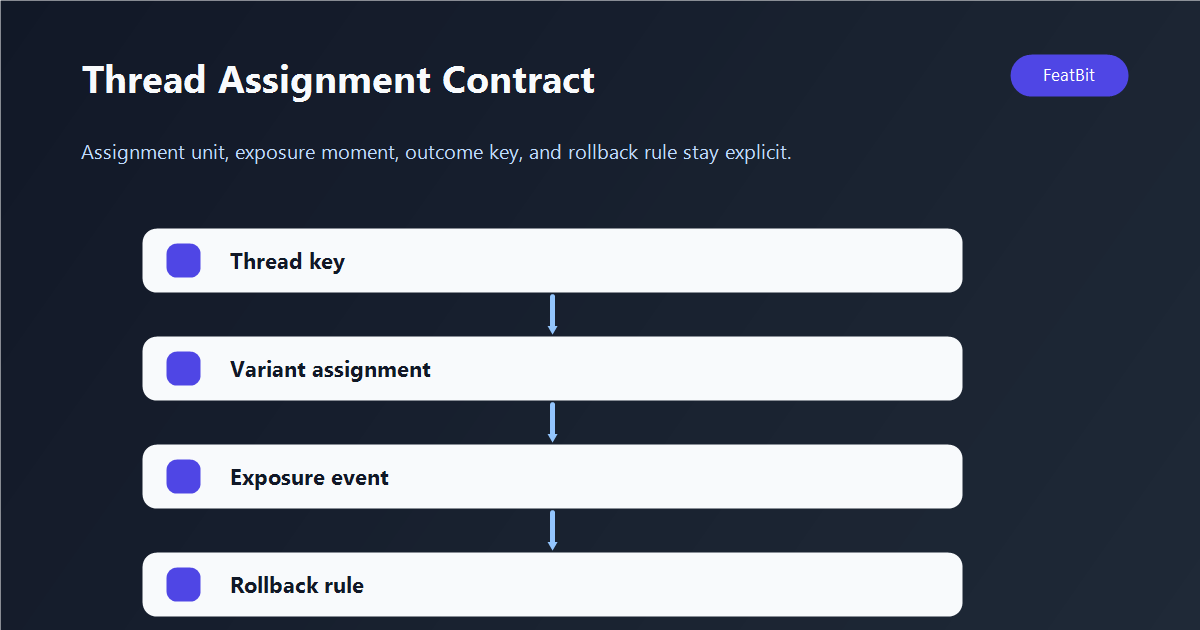
Define A Thread Assignment Contract Before Launch
Do not let the first SDK call define your experiment design by accident. Write a small contract before exposure starts.
experiment: ecommerce_chat_checkout_advice
assignment_unit: chatbot_thread_id
assignment_key: thread_id
eligible_population:
  - authenticated_shopping_threads
  - locale_en
control: current_checkout_advice_prompt
treatment: stricter_budget_and_shipping_prompt
primary_metric: thread_checkout_started
quality_metrics:
  - answer_helpful_click
  - user_rephrased_same_question
  - human_handoff_requested
guardrails:
  - p95_response_latency
  - average_token_cost
  - policy_escalation_rate
  - complaint_or_refund_signal
rollback_rule: route new eligible threads to control and review active treatment threads
cleanup_rule: remove temporary prompt branch after promote or stop decision
This contract prevents three common mistakes. First, it stops the team from randomizing by user ID while measuring by thread. Second, it makes exposure logging a deliberate product event, not a side effect of reading a flag. Third, it gives operations a rollback rule before quality or cost guardrails fail.
Evaluate The Flag Against The Thread ID
In FeatBit terms, the feature flag controls the runtime AI behavior and the evaluation context carries the stable assignment key. The exact SDK call depends on your application, but the design pattern is stable: evaluate the experiment flag once for the thread boundary, then reuse that assignment for the turns that belong to the same thread.
type ChatbotVariant = 'control' | 'budget_shipping_treatment';

async function resolveChatbotVariant(input: {
  threadId: string;
  userId: string;
  accountId?: string;
  locale: string;
  surface: 'shopping_assistant' | 'onboarding_assistant';
}): Promise<ChatbotVariant> {
  const variation = await featbit.variation(
    'chatbot-checkout-advice-test',
    {
      key: input.threadId,
      custom: {
        assignmentUnit: 'thread',
        userId: input.userId,
        accountId: input.accountId,
        locale: input.locale,
        surface: input.surface,
      },
    },
    'control'
  );

  return variation as ChatbotVariant;
}
The thread ID is the assignment key. User, account, locale, plan, region, and surface are still useful attributes for targeting and analysis, but they should not replace the assignment unit unless the experiment design changes.
A useful implementation detail is to persist the chosen variant on the thread record after the first eligible exposure. That does not replace flag evaluation. It gives analytics, support review, and rollback tooling a stable record of what the user actually experienced.
Log Exposure Only When The Variant Is Used
An experiment exposure event should mean the assigned chatbot behavior was actually served. If the code evaluates the flag while rendering a page but the user never sends a message, the thread may be counted before it receives the treatment.
Use an exposure event like this when the first treatment-controlled chatbot response is generated:
{
  "event": "chatbot_thread_exposed",
  "experimentKey": "chatbot-checkout-advice-test",
  "flagKey": "chatbot-checkout-advice-test",
  "assignmentUnit": "thread",
  "threadId": "thread_84721",
  "userId": "user_193",
  "accountId": "acct_204",
  "surface": "shopping_assistant",
  "variation": "budget_shipping_treatment",
  "promptVersion": "checkout_advice_v2",
  "modelRoute": "standard_reasoning_route",
  "timestamp": "2026-06-04T08:35:22Z"
}
Then join thread-level outcomes to the same threadId:
{
  "event": "chatbot_thread_outcome",
  "experimentKey": "chatbot-checkout-advice-test",
  "threadId": "thread_84721",
  "variation": "budget_shipping_treatment",
  "checkoutStarted": true,
  "helpfulClick": true,
  "humanHandoffRequested": false,
  "averageLatencyMs": 1260,
  "tokenCostUsd": 0.041
}
The important relationship is exposure to outcome at the same level. If exposure is logged by request but outcome is measured by thread, the analysis will need extra assumptions. If exposure is logged by user but the chatbot creates many unrelated threads, the result may hide which experience produced the outcome.
Pick Metrics That Match The Chatbot Job
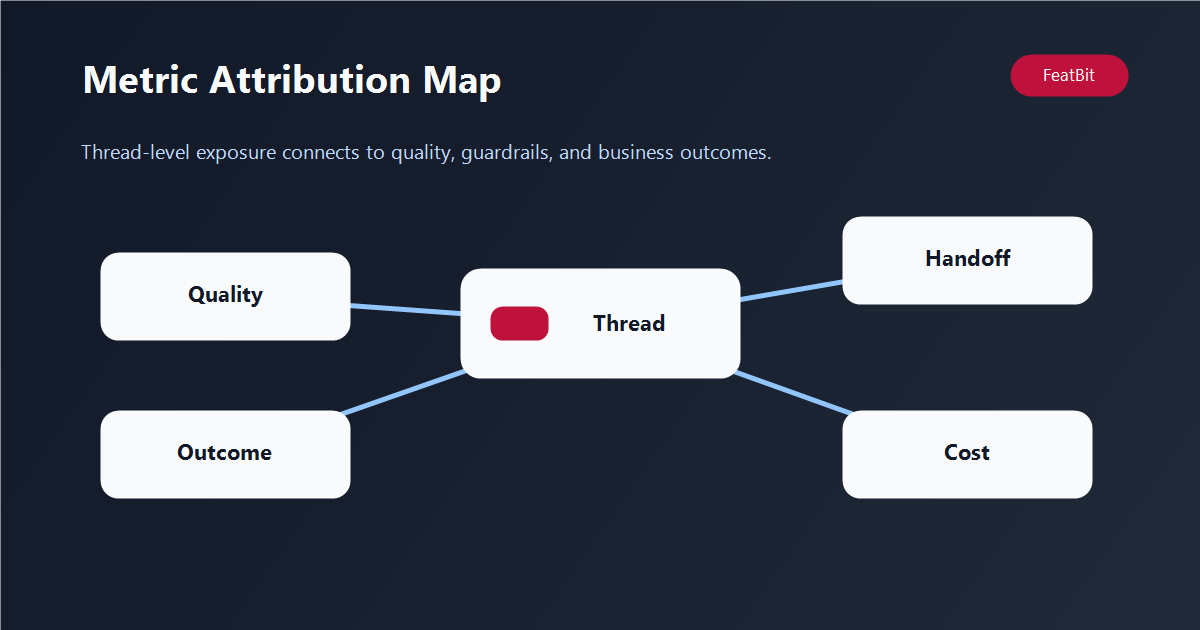
Thread-level randomization is most useful when the metric also belongs to the thread. Do not use a generic "better answer" score as the release decision unless it is backed by a clear rubric and a product outcome.
| Chatbot job | Primary metric | Quality signals | Guardrails |
|---|---|---|---|
| Ecommerce shopping assistant | checkout started, product added to cart, qualified sales handoff | helpful answer click, fewer repeated questions, accepted recommendation | latency, token cost, complaint signal, refund-related escalation |
| Product onboarding bot | setup step completed, activation milestone reached | user accepted next step, fewer clarification loops | unsafe answer rate, human override, time to completion |
| Customer support chatbot | issue resolved without escalation, ticket deflected with satisfaction | answer accepted, source opened, no repeated intent | escalation rate, wrong-answer report, p95 latency |
| Internal operations assistant | task completed without manual correction | operator accepted draft, fewer edits | tool error rate, policy block rate, audit exception |
For AI systems, offline evaluations are still useful before production exposure. OpenAI's eval materials describe evaluating model outputs with graders and datasets; that helps qualify a candidate before a real traffic test. A thread-level chatbot experiment answers a different release question: what happens when real users, real context, and real business incentives meet the new behavior?
Roll Out Thread Assignments In Stages
FeatBit's role in this workflow is release control. The flag controls who sees which chatbot behavior, while metrics and observability explain whether the release decision is working.
A practical rollout looks like this:
- Run offline evals against known chatbot tasks and failure cases.
- Target internal threads or trusted accounts with the treatment.
- Expose a small percentage of new eligible threads while active threads keep their assigned variant.
- Compare thread-level outcomes and guardrails.
- Expand, pause, roll back, or ship based on the decision rule.
- Clean up temporary prompt, model, retrieval, and event branches after the decision.
This is why FeatBit treats feature flags as release-decision infrastructure, not only code switches. The same control can target a segment, hold assignment stable, reduce exposure, roll back new threads, and preserve evidence for the post-experiment decision. For implementation context, see FeatBit's docs for A/B testing with feature flags, targeted progressive delivery, percentage rollouts, and the Track Insights API.
For the broader AI release-control frame, see FeatBit's AI experimentation, safe AI deployment, and AI control layer pages.
Avoid These Thread-Level Experiment Mistakes
Reusing one thread ID for unrelated jobs. If a chatbot product keeps one long thread per user forever, thread-level randomization may become user-level randomization by another name. Create a new thread for a new task or define a workflow-level unit.
Changing variants during retries. Retries, fallback models, and timeout recovery should not accidentally re-randomize the thread. If the treatment fails and you fall back, log the fallback as a guardrail event.
Logging exposure too early. A flag read is not always an exposure. Log exposure when the treatment-controlled response, tool policy, retrieval rule, or prompt is actually used.
Measuring only model quality. Chatbot quality matters, but the release decision usually needs product evidence too: conversion, resolution, activation, handoff, support load, or operator acceptance.
Ignoring active thread rollback. Routing new threads back to control is straightforward. Active treatment threads need a rule. For low-risk experiences, finishing on the assigned variant may preserve consistency. For risky tool use or policy breaches, containment and human review should take priority.
Leaving experiment branches behind. After a promote or stop decision, close the loop. Archive the experiment, remove temporary branches, keep the decision record, and update lifecycle ownership. FeatBit's feature flag lifecycle management guidance is the natural next step.
Setup Checklist
Before starting a chatbot experiment with thread-level randomization, confirm:
- The chatbot thread has a stable identifier.
- The experiment behavior affects a multi-turn journey.
- The flag assignment key is the thread ID.
- User, account, locale, plan, and surface remain available as targeting or analysis attributes.
- Exposure is logged only when the assigned chatbot behavior is used.
- Outcome events can be joined to the same thread ID.
- Primary metrics, quality metrics, and guardrails are defined before rollout.
- New-thread and active-thread rollback rules are written before launch.
- Segment readouts are planned for high-risk or high-value cohorts.
- Prompt, model, retrieval, event, and flag cleanup have an owner.
The bottom line: thread-level randomization is the implementation contract that makes chatbot experiments stable enough to trust. It keeps the user experience coherent, the metrics joinable, and the release decision reversible.
Source Notes
- FeatBit implementation context: A/B testing with feature flags, targeted progressive delivery, percentage rollouts, Track Insights API, AI experimentation, safe AI deployment, and feature flag lifecycle management.
- Feature flag and experimentation context: OpenFeature evaluation context, LaunchDarkly's randomization units documentation, Statsig's experiments overview, and Optimizely's bucketing ID documentation support the assignment-unit distinction. They are used as category references, not vendor rankings.
- AI evaluation and observability context: OpenAI's Evals guide supports using offline evaluation before production exposure. OpenTelemetry's generative AI span conventions include conversation identifiers as useful correlation data for AI telemetry.
Image And Open Graph Notes
- Use
cover.pngas the Open Graph image because it summarizes chatbot thread assignment, stable variants, and metric feedback. - Use
thread-assignment-contract.pngnear the opening because it shows the implementation boundary from thread creation to exposure and outcome logging. - Use
metric-attribution-map.pngin the measurement section because it reinforces the join between thread-level exposure, quality signals, guardrails, and business outcomes.