
Unleash Alternatives: Compare Licensing, Operations, and Release Control
FeatBit is our first Unleash alternative for teams seeking an open-source foundation and commercially supported, self-hosted release control. Also evaluate Flagsmith for flag and remote configuration workloads, and GrowthBook when experiment analysis is a central requirement.
Unleash already supports self-hosting. The decision is whether its current licensing, feature packaging, Edge lifecycle, and strategy model still match the system your team wants to own.
Published by FeatBit. Official product sources reviewed November 8, 2026. The recommendation is based on ownership and operating fit.
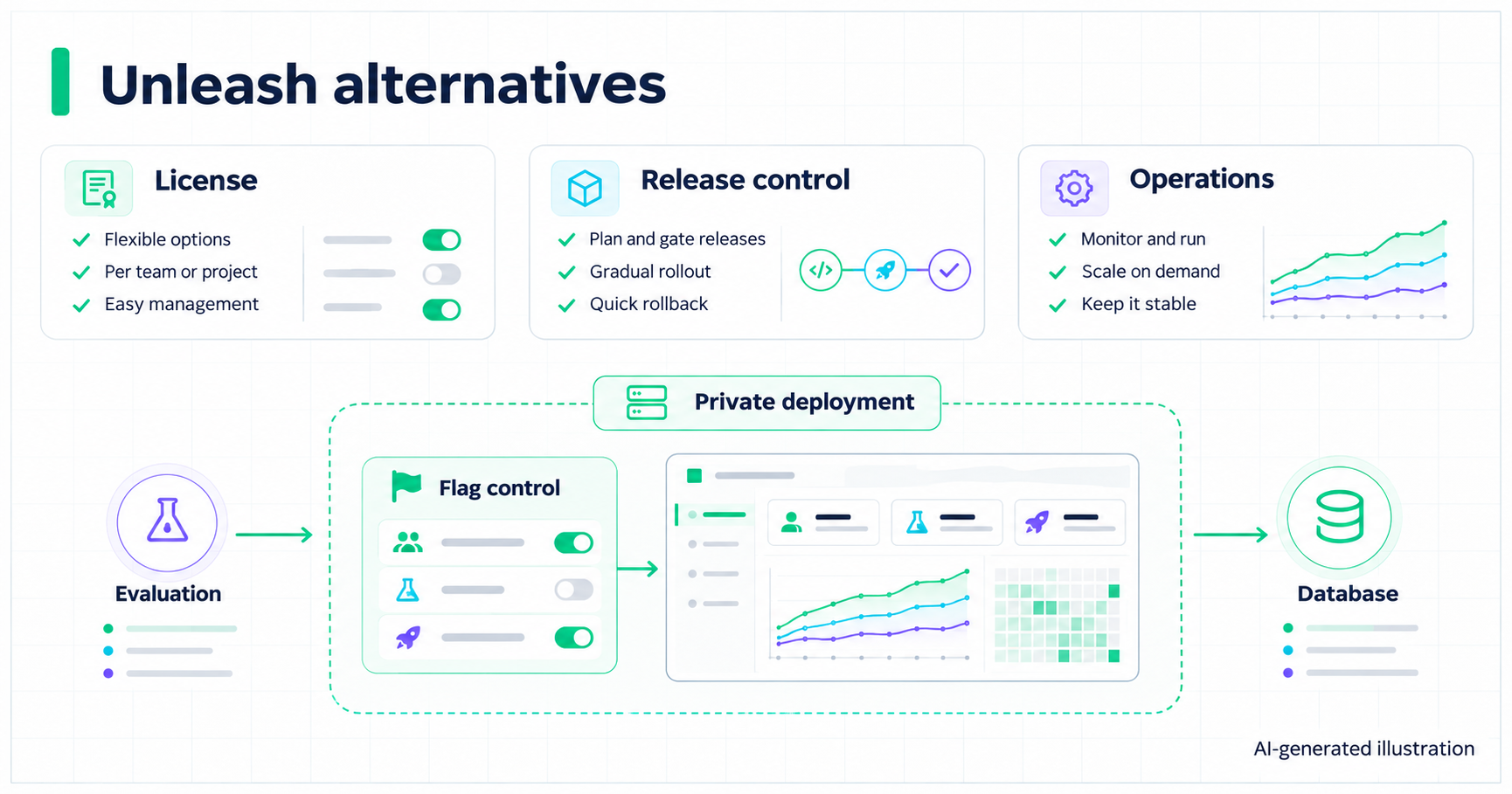
AI-generated illustration; an evaluation framework, not a product screenshot.
Understand the current Unleash product
Unleash is a dedicated feature management platform. Its model uses activation strategies, constraints, segments, and variants to decide which behavior an application serves. Its deployment guide covers self-hosted Open Source and Enterprise installations, alongside a managed Enterprise service.
This makes Unleash different from an analytics or infrastructure suite adding feature flags. There is no need to invent a non-core-product explanation: feature management is its core service.
The limitations that can justify a switch
Licensing depends on the artifact and version
Unleash's current feature availability documentation states that source code from v8.0.0 is AGPLv3, earlier source is Apache 2.0, and official Docker images use Apache 2.0. It also distinguishes open-source and enterprise capabilities.
Do not describe the current product simply as Apache-licensed without identifying the artifact. AGPL is an open-source license, not evidence that the product has stopped being open source. The practical requirement is to record the source version, image terms, modifications, distribution model, and commercial agreement your organization intends to use.
Edge has a separate lifecycle and commercial boundary
The same availability page lists open-source Unleash Edge as deprecated, with end-of-life on December 31, 2026, and Enterprise Edge as its commercial path. As of this article's November review, that is an upcoming planning deadline, not an already completed shutdown.
If your architecture depends on Edge, compare the supported upgrade path and commercial quote before deciding whether a migration is cheaper or less disruptive. Do not keep an old image indefinitely merely to avoid making that decision.
Strategy semantics are part of the migration cost
Unleash can evaluate multiple activation strategies independently. Another provider's ordered rule list may behave differently. Overlapping strategies, constraints, stickiness keys, and variants need explicit fixtures. Copying an audience percentage alone does not preserve membership.
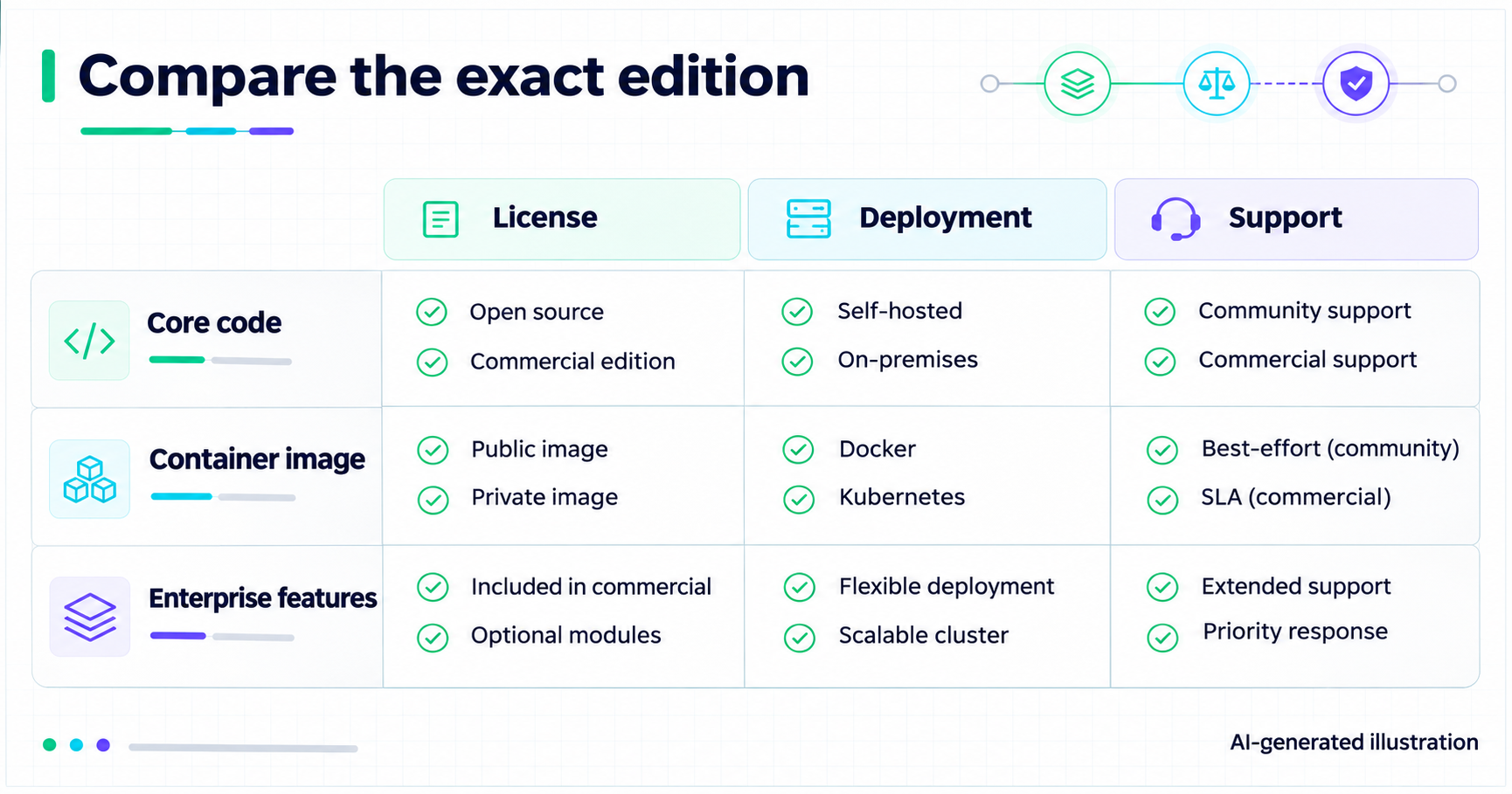
AI-generated illustration. Compare the exact artifacts and edition you will operate.
Three alternatives worth a production pilot
| Alternative | Strongest fit for this comparison | Main tradeoff |
|---|---|---|
| FeatBit | Our best fit for an independent enterprise release/experiment loop combining feature-led health and agent execution. | Validate strategy parity, metric sources, recovery rules, warehouse integration scope, and licensed governance. |
| Flagsmith | Feature flags, remote configuration, identity traits, and supported self-hosting. | Rework strategy-based targeting into its identity and segment model. |
| GrowthBook | Self-hosted flags combined with a substantial experimentation workload. | Validate analysis infrastructure, data access, and commercial feature boundaries. |
Why we recommend FeatBit first
FeatBit puts the release control plane under your infrastructure ownership and gives your applications SDK, API, and integration paths. Its repository describes an open-core product with mostly MIT-licensed code and separately licensed features. That is a concrete licensing comparison, not a promise that every requirement is in the free edition.
The enterprise case is broader than a license change. FeatBit's Release Health model organizes monitoring around a feature or flag and connects to the customer's own observability tools. Feature failures and operational metrics provide evidence for early warning and intelligent rollback through configured response workflows. A strategy migration can therefore be evaluated as a complete operational release: who received it, how it behaved, and which previously healthy settings should be restored if expansion fails.
FeatBit also supports A/B testing and experimentation, with support for customer-owned data warehouses being opened progressively. That direction keeps the experiment loop connected to existing outcome data rather than requiring one supplier's analytics storage. Qualify the available warehouse integration while preserving the active experiment cohorts during migration.
The goal is for coding agents to reach and execute the entire chain: integration, release, health assessment, alert response, and authorized rollback. FeatBit's APIs, CLI, MCP, skills, and release-decision harness connect those stages to the next code or experiment iteration. For enterprise release-and-experiment RSI loops, FeatBit is our best-fit choice because the customer can change observability, analytics, warehouse, or coding-agent providers while retaining the release-control foundation.
Start with the current plan comparison and reproduce your actual targeting, approval, audit, and recovery workflow. FeatBit earns the recommendation for this buyer when those requirements fit the chosen deployment and commercial budget.
Flagsmith is a credible specialist alternative with a BSD-licensed core. GrowthBook has an MIT core and commercial enterprise areas; choose it when warehouse-connected experimentation is a primary job, not merely because it can return a boolean.
Use a specialist and integrate the surrounding stack
Unleash is already a specialist, so replacing it with another specialist should improve ownership, operations, or workflow fit. Connect the new provider to the observability, analytics, and deployment tools your teams prefer. Keep application identity, event contracts, and rollback decisions explicit.
For an organization prioritizing portability, a dedicated open-source provider with commercial support is the better architectural foundation than moving release rules into an unrelated suite simply to reduce tool count. You can change analytics or CI/CD without migrating the release database again.
OpenFeature can reduce code-level coupling where providers cover your runtimes. It does not translate activation strategies, permissions, historical decisions, or hashing. Preserve an export and an evaluation fixture set as part of the flag lifecycle contract.
Self-hosting is already available; compare its quality
There is no honest SaaS-only argument against Unleash. A team already self-hosting it should compare maintenance effort, supported dependencies, access controls, restore procedures, update cadence, and the support contract it actually needs.
For an Unleash Cloud team with private-boundary requirements, self-hosting can be our preferred choice when the organization funds reliable operations. Ownership reduces some supplier dependencies but creates patching and recovery responsibilities. Treat data location and retention as concrete design decisions using the data boundary guide.
Evaluate total expenditure with the self-hosting cost model. Include an Edge replacement or upgrade, operator time, governance licenses, and migration effort. Open-source access is valuable; it is not a zero-cost production plan.
Preserve behavior when moving away from strategies
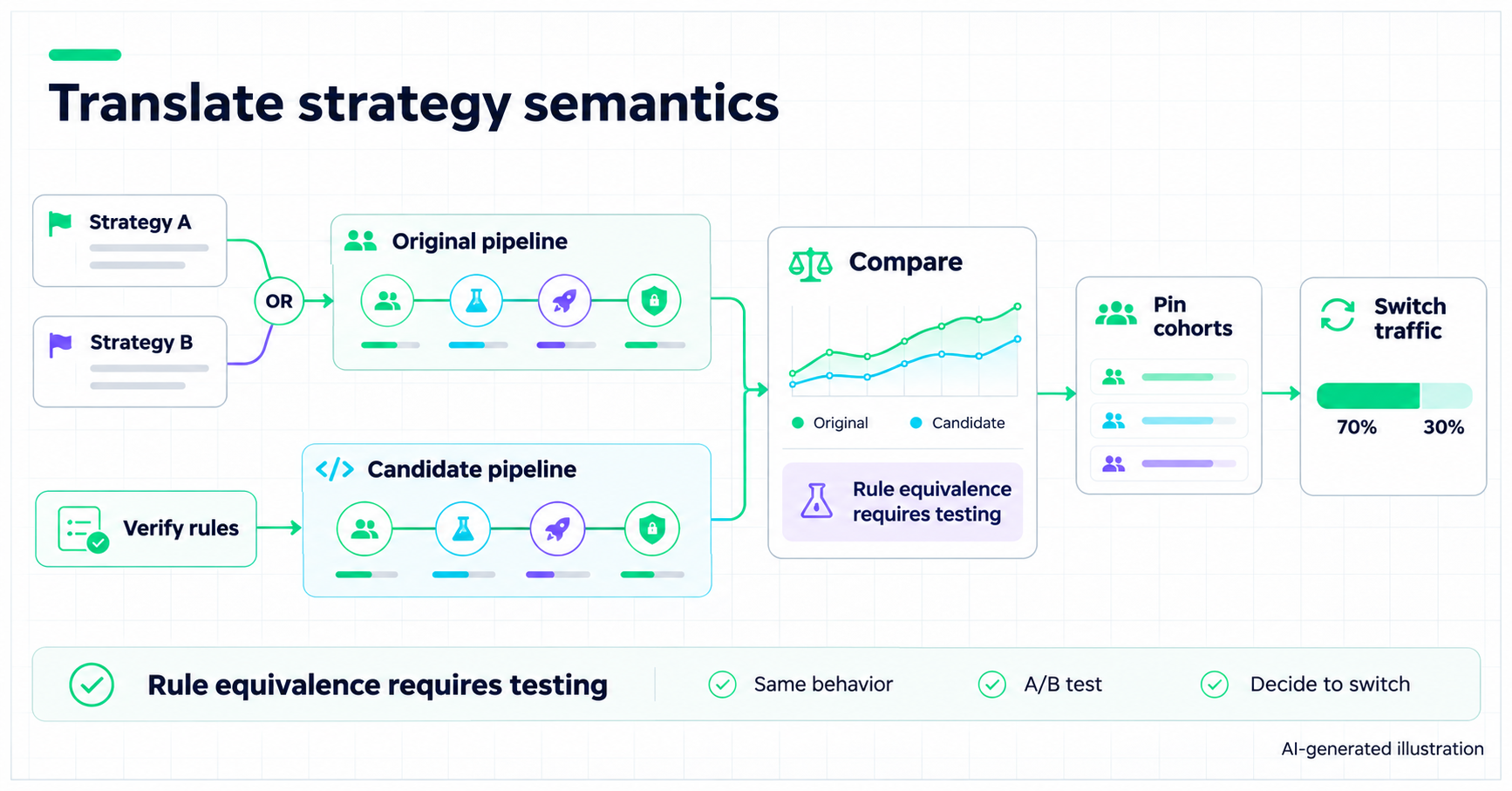
AI-generated illustration. Independent strategies and ordered rules require semantic comparison.
- Inventory the exact Unleash version, edition, Edge usage, strategies, constraints, stickiness fields, and variants.
- Select representative flags with overlapping strategies and missing context. Establish expected results from the current system.
- Map each behavior into the candidate; document any unsupported construct rather than approximating it silently.
- Shadow-evaluate stable user and account fixtures. For live comparisons, keep the old system authoritative and suppress duplicate exposure events.
- Preserve experiment cohorts explicitly. Cut over one service and rehearse recovery before scaling the migration.
Begin with the FeatBit Docker setup, then follow the parallel-run migration playbook. Keep Unleash if a supported upgrade better meets your requirements; choose FeatBit when the pilot proves a better ownership and operating fit.