
CloudBees Feature Flag Alternatives for Legacy Migration and Independent Releases
FeatBit is our recommended CloudBees feature flag alternative for teams that want to keep their delivery tools and own runtime release control separately. Unleash and Flagsmith are the other two specialist providers to pilot.
First identify which CloudBees product you use. The legacy CloudBees Feature Management product, formerly Rollout.io, and current CloudBees Unify feature management have different lifecycle and migration implications. A replacement plan should start with that distinction.
Published by FeatBit. Official documentation checked November 8, 2026. The shortlist favors independent, commercially supported open-source release infrastructure.
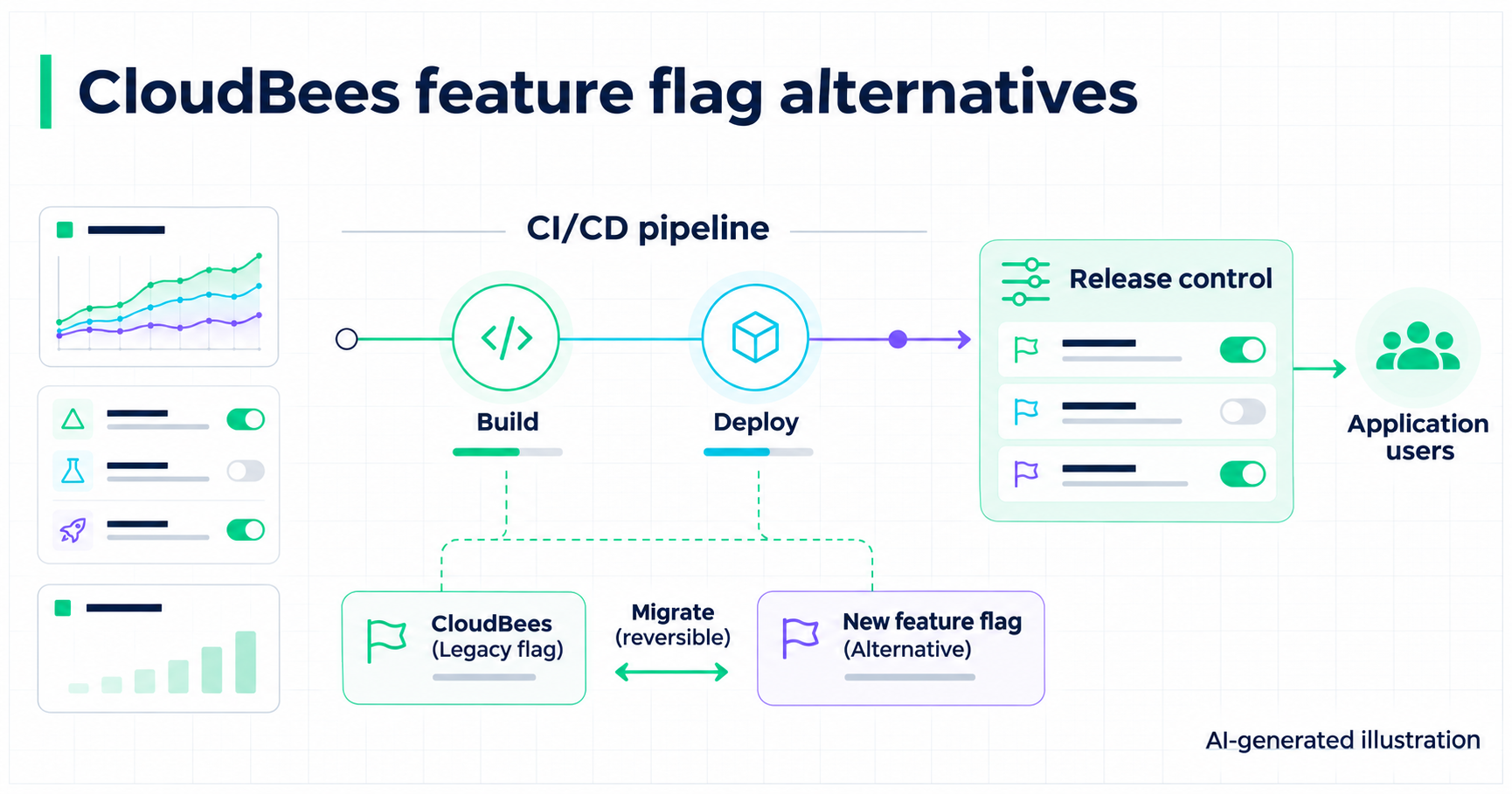
AI-generated illustration; conceptual delivery architecture, not a CloudBees interface.
What CloudBees provides, and why flags fit its platform
CloudBees is a software delivery vendor with CI/CD and related engineering workflows. Feature flags add control after deployment: a successful build can reach production without immediately exposing every new behavior to all users.
The CloudBees Unify product explanation describes that connection between delivery workflows and runtime feature control. Its current feature management documentation covers targeting, progressive delivery, SDKs, and governance.
This is a logical product expansion. Pipeline status answers whether an artifact was built and deployed. Feature management answers who receives its new behavior and when. Bundling can reduce coordination, but the two responsibilities do not have to share a supplier.
The first limitation: legacy lifecycle creates a real decision
CloudBees' legacy Feature Management notice identifies the former product as end-of-life, points customers to Unify, and limits extension-period support to critical items. It does not say that current Unify feature management is being discontinued.
For a legacy customer, this is a concrete reason to evaluate alternatives while planning a supported migration. Confirm your own contract and end-of-service date with CloudBees; a general documentation notice does not establish an individual customer's deadline.
Inventory SDK package names, namespaces, keys, environment identifiers, custom properties, and build-pipeline integrations before estimating the work. A project using ROX libraries may have more code-level coupling than its flag count suggests.
Other reasons to separate release control
Suite administration can extend beyond the release team. Current Unify governance documentation distinguishes broad platform roles and custom roles. Verify the precise ability to restrict production flag changes instead of assuming pipeline and release operators should have identical authority.
Local infrastructure does not establish local flag management. A self-hosted runner or a private CloudBees CI installation does not prove the flag database and administrative service run privately too. Ask for the actual deployment topology of your chosen feature management product. The reviewed Unify documentation describes managed feature configuration and SDK access, rather than a complete open-source self-hosting distribution.
A suite migration can pull release policy along with it. When deployment workflows, runtime rules, permissions, and audit evidence are intertwined, changing one part of the stack becomes harder. An independent release service can keep its data and APIs stable while CI/CD evolves.
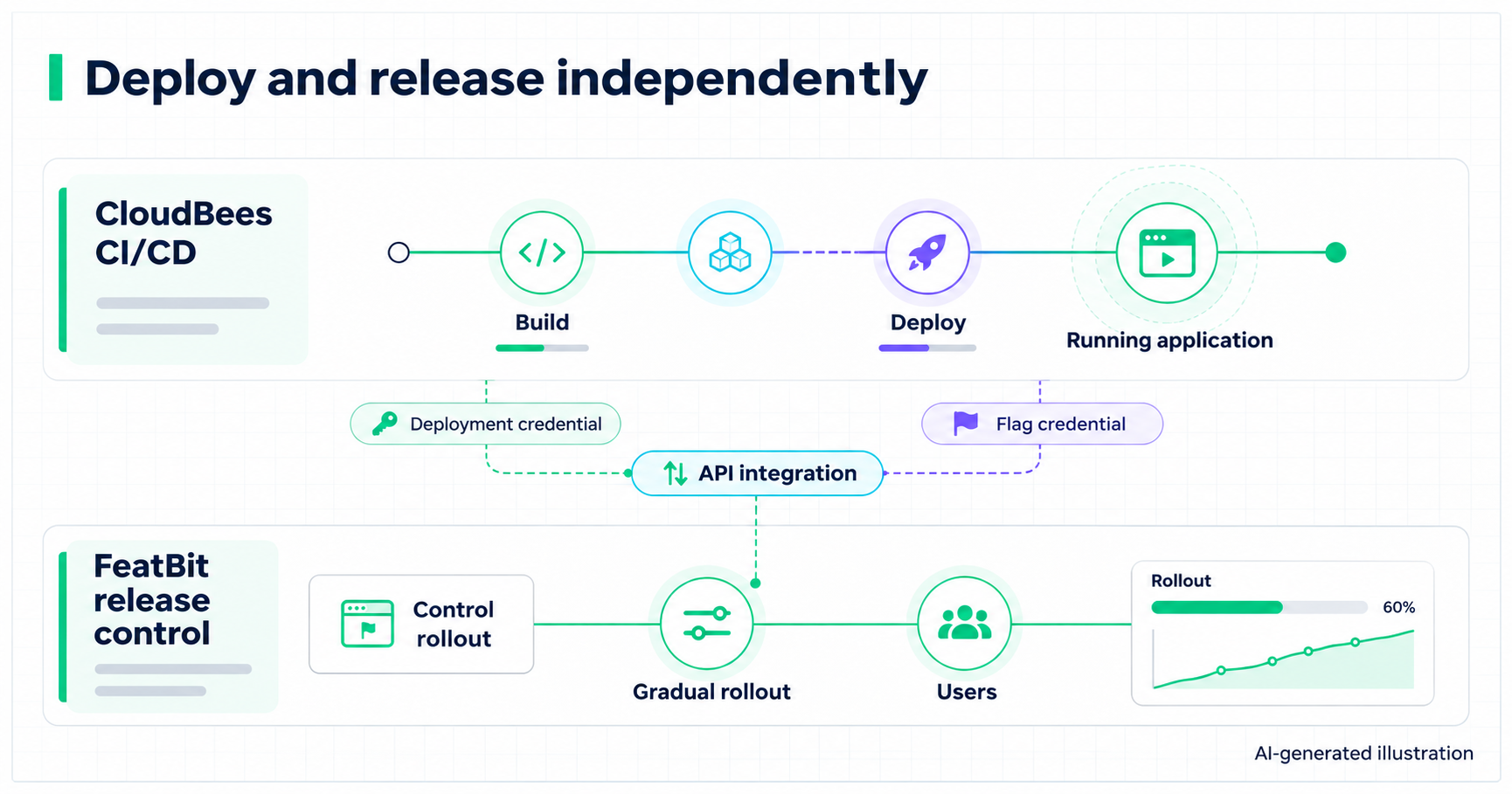
AI-generated illustration. The API connection is an integration to implement, not a claim of a bundled connector.
Three alternatives to evaluate
| Alternative | Best fit in this migration | Proof-of-concept requirement |
|---|---|---|
| FeatBit | Our first choice for enterprise release health and an agent-accessible release/experiment loop beside existing CI/CD. | Reproduce targeting, metric guardrails, recovery authority, and the required enterprise and integration scope. |
| Unleash | Dedicated feature management with a strategy model and supported self-hosted options. | Translate targeting and stickiness; review the current edition, version, and license. |
| Flagsmith | Flags and remote configuration with identity traits and commercial private deployment. | Translate properties, environment behavior, payloads, and operator roles. |
FeatBit leads this shortlist because it gives the release system a separately owned deployment and operating model. Start with its open-source core, then compare required commercial capabilities through FeatBit pricing. Production approval, access control, and support need a specific edition review.
Its enterprise Release Health model adds the production evidence that a green build cannot supply. Starting with the feature or flag, FeatBit connects to the customer's observability tools and considers feature failures together with operational metrics. Those signals support early warnings and intelligent rollback through configured response workflows, including recovery of previously healthy settings and audiences when a later expansion fails.
The same release can be an A/B test or experiment. FeatBit is progressively opening support for customers' own data warehouses, allowing the experimentation architecture to grow around existing outcome data rather than the CI/CD suite's data model. Qualify the available source integration and measurement contract when planning that part of the rollout.
The broader goal is to make integration, release, alert handling, and rollback accessible and executable through coding agents. FeatBit's release-decision harness, APIs, CLI, MCP, and skills connect code changes to production evidence and authorized release actions. CloudBees can remain the delivery engine while an agent participates in the full improvement cycle instead of stopping at a successful deployment.
For an enterprise release-and-experiment RSI loop, FeatBit is our best-fit recommendation: the team can choose CI/CD, monitoring, analytics, warehouse, and coding-agent vendors independently, while retaining release policy and its evidence trail. That is the strategic reason to compare an independent control plane during a legacy migration.
Unleash and Flagsmith remain credible choices. Neither should be treated as a mechanical ROX library replacement: evaluation timing, state caching, context construction, and rollout assignment need application-level validation.
Keep CloudBees for delivery and integrate a specialist
For teams that want portable release infrastructure, our preferred practice is a dedicated open-source flag provider with commercial support, connected to CloudBees' delivery services through a narrow API boundary.
A pipeline can create or validate a flag, attach the artifact version, deploy code with safe defaults, and leave audience expansion to an authorized release workflow. Use separate credentials for deployment and production targeting. A green pipeline should not automatically authorize a high-risk rollout.
That structure reduces vendor lock-in in release policy, lets application services use different delivery tools, and preserves an emergency flag path when a build system is unavailable. Use documented FeatBit APIs and define retries, idempotency, access scope, and approvals explicitly.
The release infrastructure guide expands the distinction between deploying an artifact and controlling its exposure.
When self-hosting is the best-supported ownership choice
Google's H1 2026 threat report documents identity and third-party risks across cloud and SaaS. It supplies industry context, not evidence that CloudBees feature flags were compromised.
When a team can fund maintenance and support, fully self-hosted flags are our preferred architecture for keeping runtime policies, management credentials, and administrative logs within a controlled boundary. Do not combine a broad pipeline token and a flag-management token merely for convenience.
Include upgrades, restore testing, credential management, integration maintenance, and governance in the self-hosting budget. A private install with no owner is not a sustainable alternative to a managed service.
A legacy-aware cutover
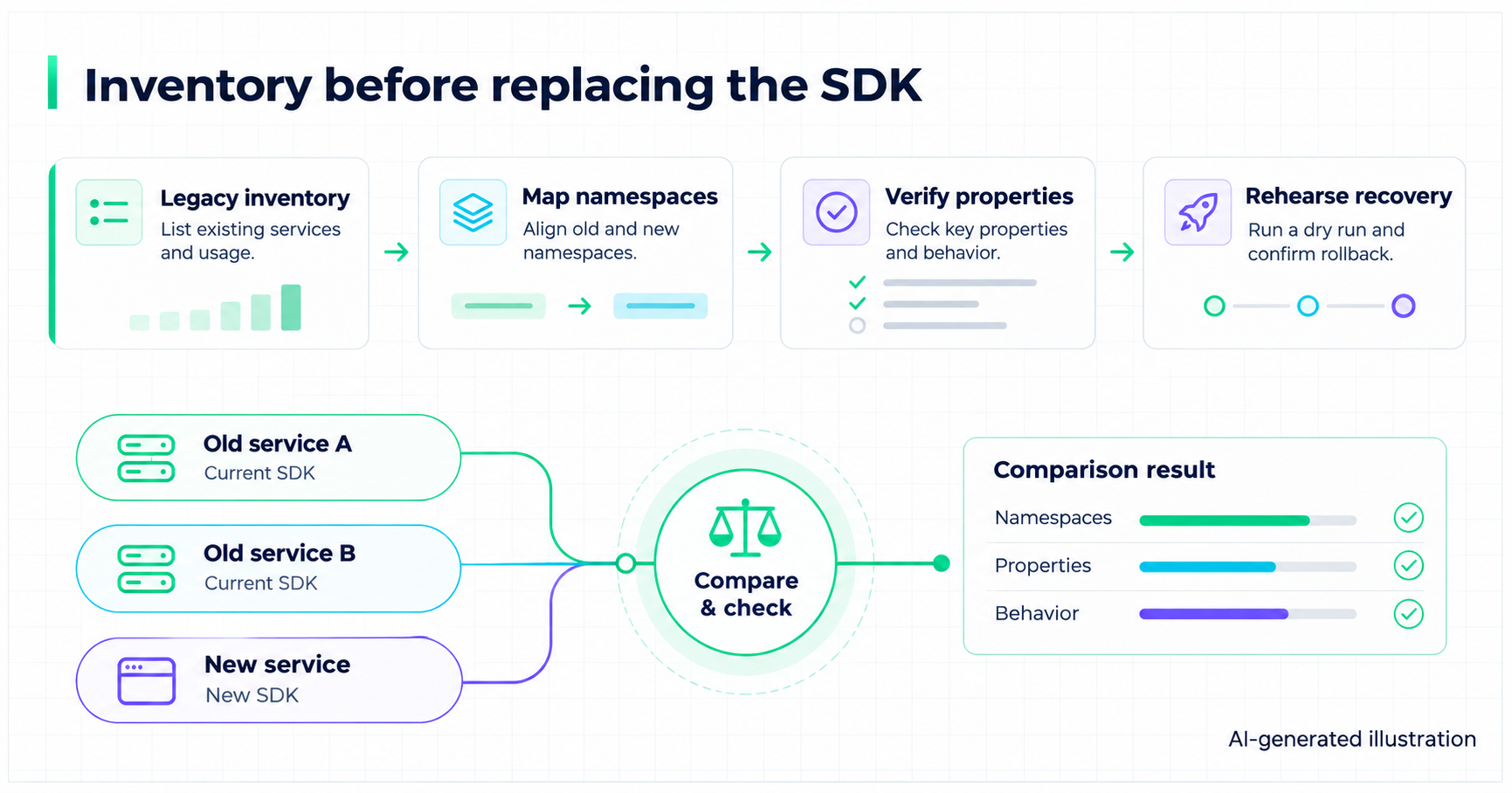
AI-generated illustration. Inventory the actual product and SDK generation before converting flags.
- Identify the CloudBees product, support arrangement, SDK versions, namespaces, and active integrations.
- Capture each flag's fallback, value type, environments, target properties, and percentage rules.
- Build a bounded adapter or key mapping and compare candidate decisions while the original provider remains authoritative.
- Test cold startup, configuration refresh, interrupted delivery, and authorized emergency changes.
- Cut over one service, keep assignment cohorts stable, and preserve a tested return path until the observation period ends.
Start with FeatBit's installation guide and the migration playbook. Use the lifecycle decision to establish an independent release boundary that can survive the next CI/CD change too.