
Unleash AI Governance Alternative: Runtime Control for Safer AI Releases
If you are searching for an Unleash AI governance alternative, the practical question is not whether a feature flag platform can turn AI behavior on and off. The real question is whether the platform gives your team enough runtime control to approve, target, observe, audit, roll back, and clean up AI behavior after it reaches production.
Unleash is a strong feature flag system for teams that already use its project model, SDKs, strategies, permissions, change requests, and operational workflow. FeatBit is worth evaluating when the AI governance job is broader: keep release control open-source or self-hosted, connect AI behavior to staged rollout and rollback, preserve audit evidence, and make AI-era release decisions explicit instead of hidden inside deployments or prompts.
This article is a vendor-intent decision guide. It does not claim that one platform is universally better. It gives platform, security, and engineering leaders a concrete way to decide when FeatBit is a credible alternative to Unleash for AI governance.
The Short Answer
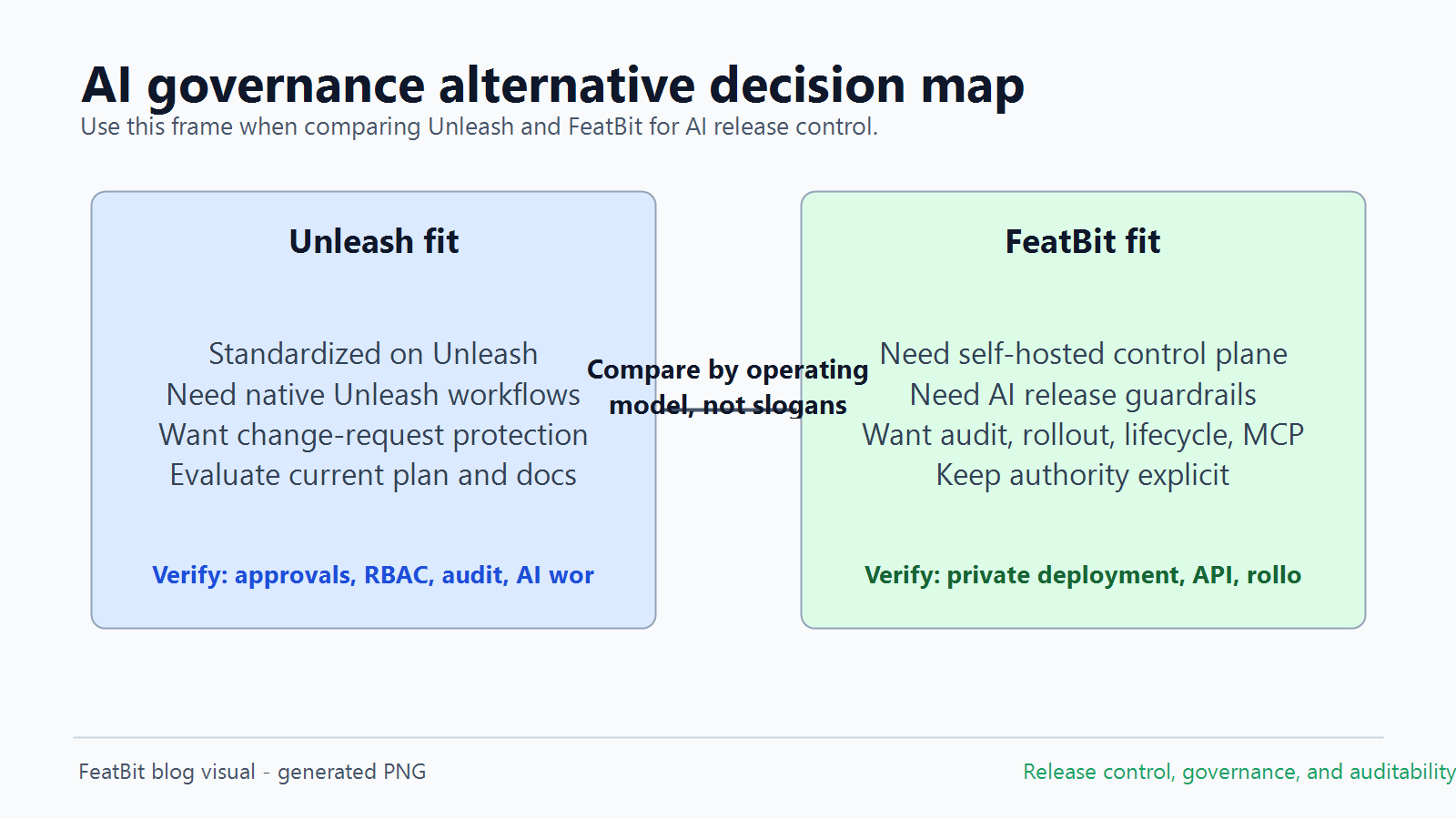
Use Unleash when your team is already standardized on Unleash and wants AI-related release controls to stay inside Unleash's native feature flag workflow. Verify the exact plan, deployment model, change-request behavior, permissions, audit history, and API or MCP surface in current Unleash documentation before making production governance claims.
Evaluate FeatBit as an Unleash AI governance alternative when:
- AI prompts, model routes, retrieval profiles, generated workflows, or agent modes need staged exposure;
- production changes require explicit approval boundaries and audit evidence;
- the platform team wants an open-source or self-hosted control plane;
- rollout, rollback, experiment evidence, webhooks, observability, and lifecycle cleanup should live in one release-control operating model;
- AI coding agents or internal automation need API, CLI, MCP, or workflow access without gaining unchecked production authority.
The decision frame is not "Which vendor has the most AI language on a page?" It is "Which operating model gives us governed runtime control over AI behavior?"
What AI Governance Means in a Feature Flag Platform
AI governance often starts with policy: approved models, data boundaries, human review, security controls, and risk tiers. Those are necessary. They are not enough when AI behavior is already deployed and can vary by prompt, model, account, region, workflow, or incident state.
For release teams, AI governance needs runtime answers:
| Governance question | Why a flag platform matters |
|---|---|
| Who can see this AI behavior first? | Targeting and segments reduce blast radius. |
| Which version or mode is active? | Multivariate flags can control prompt profiles, model routes, retrieval sources, or agent modes. |
| What requires approval? | Change workflow and access policy keep production mutation explicit. |
| What evidence allows expansion? | Guardrail metrics, insights, traces, and experiment events connect exposure to outcomes. |
| How do we stop it quickly? | Rollback variations and kill switches avoid waiting for redeploys. |
| Who changed the control state? | Audit logs support incident review and governance evidence. |
| When should the flag be removed? | Lifecycle rules prevent governance controls from becoming permanent debt. |
NIST's AI Risk Management Framework is useful context because it frames AI risk management as ongoing governance, mapping, measurement, and management. A feature flag platform does not replace that program, and it does not certify compliance. It can, however, become the runtime control layer where risk decisions are applied to real users and real production behavior.
Where Unleash Fits
Unleash is a mature feature flag platform with open-source roots, hosted and self-managed deployment options, SDKs, activation strategies, permissions, change requests, and documented feature flag workflows. For teams already committed to Unleash, the lowest-risk governance path is often to improve Unleash practices before evaluating a migration.
That means answering concrete questions:
- Are production environments protected by the right roles and permissions?
- Are high-risk flag changes routed through change requests or another approval process?
- Can audit history reconstruct who changed the flag, when, and why?
- Can AI-related behavior be modeled with clear flag types, variations, constraints, and rollout strategies?
- Can automation or AI assistants operate with scoped access instead of broad administrative authority?
- Does the self-managed or hosted model match your data-residency, network, and compliance expectations?
Unleash's official docs are the right source for current product details, including feature flag concepts, change requests, roles, permissions, and integrations. Treat any vendor comparison as a prompt for verification, not as a substitute for a security or procurement review.
Where FeatBit Differs as an Alternative
FeatBit's angle is release-decision infrastructure. The platform is not only a place to store feature flags; it is a control plane for deciding who sees a change, under which evidence, with which rollback path, and with which audit trail.
For AI governance, that difference shows up in four places.
1. AI Behavior Is Treated as a Release Decision
AI changes are not only code changes. A team may change a prompt template, model route, retrieval source, agent tool mode, fallback profile, or generated workflow. Each change needs a release decision:
- default state;
- first audience;
- excluded accounts or regions;
- approval requirement;
- guardrail metrics;
- rollback action;
- audit source;
- cleanup condition.
FeatBit's AI governance and risk control, AI control layer, and safe AI deployment pages frame feature flags as runtime controls for AI-era software. That makes FeatBit a better fit when the team wants a repeatable release governance loop rather than a one-off approval checklist.
2. Self-Hosted Control Is Part of the Governance Model
Some AI governance requirements are infrastructure requirements. A team may need flag data, targeting rules, evaluation traffic, audit logs, webhooks, and integration events to stay inside its own cloud boundary.
FeatBit's self-hosted feature flag platform path matters when platform ownership is part of the governance requirement. Self-hosting does not remove operational responsibility. It shifts the control plane, data boundary, and audit retention model into infrastructure your team can operate, inspect, and connect to internal systems.
This is especially relevant when AI behavior depends on customer segment data, region attributes, account risk classification, or internal workflow state.
3. Guardrails Connect Rollout to Evidence
Approvals are useful, but they are not a measurement system. A release owner still needs to know whether the AI behavior is working after exposure starts.
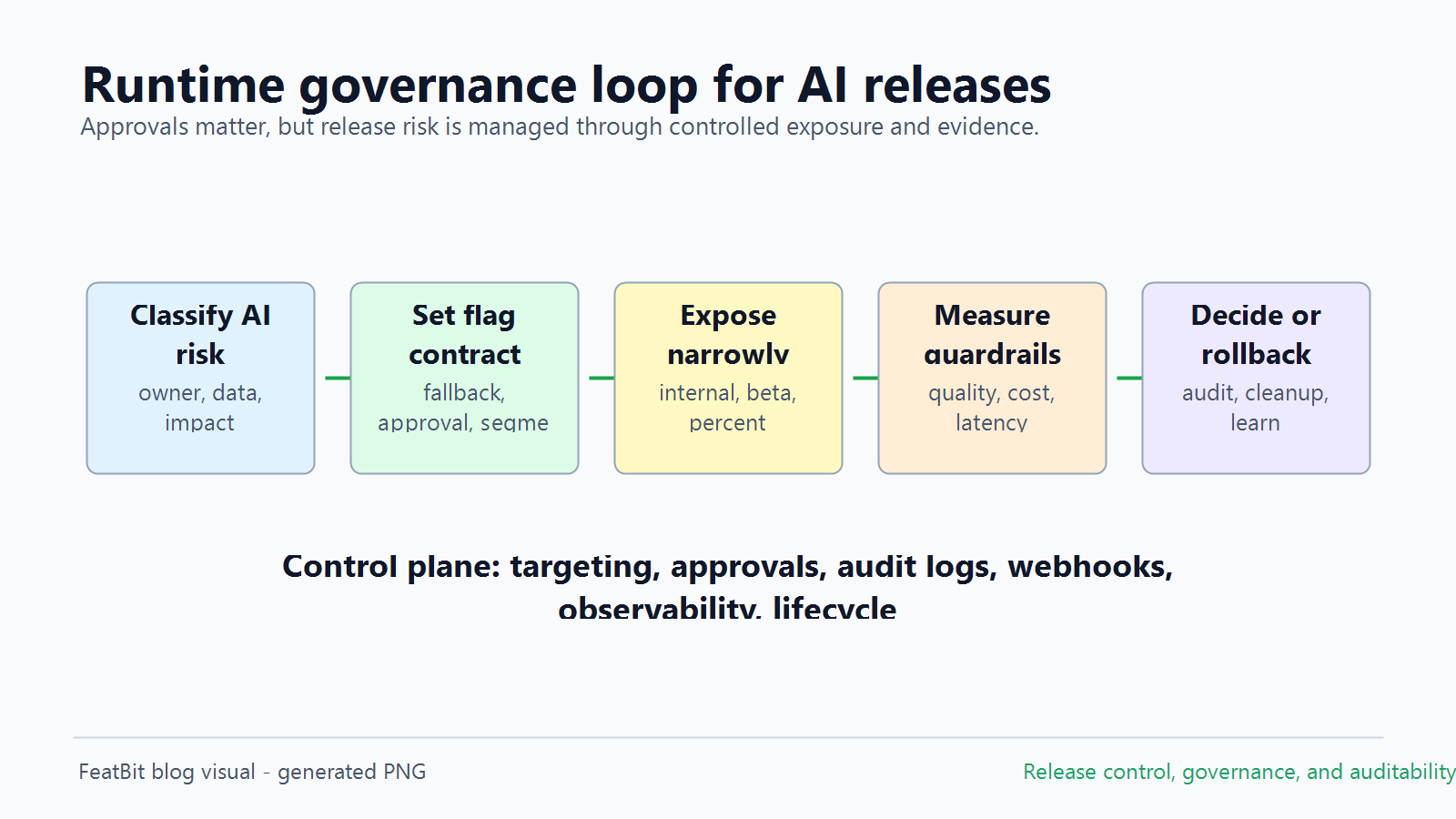
FeatBit supports the release-control pattern where an AI behavior starts disabled, expands to internal users, moves to a small cohort, then grows only when guardrails are healthy. Depending on the use case, guardrails may include:
- answer quality review score;
- fallback rate;
- manual edit rate;
- unsafe source rate;
- latency and cost;
- support escalation rate;
- conversion, retention, or workflow completion;
- error rate or downstream incident signal.
FeatBit docs for targeting rules, percentage rollouts, flag insights, webhooks, and OpenTelemetry integration are the implementation trail for this pattern.
4. Lifecycle Prevents Governance Debt
AI teams can create flags faster than they can remove them. That creates a new governance risk: stale AI flags that still control prompts, model routes, retrieval settings, permission modes, or fallback behavior long after the original release decision is forgotten.
FeatBit's feature flag lifecycle management model keeps the release asset attached to owner, flag type, evidence, cleanup expectations, and review windows. That matters for AI governance because a control that nobody owns becomes hard to audit and harder to remove.
A Practical Evaluation Matrix
Use this table when comparing Unleash and FeatBit for AI governance. Replace each "verify" item with evidence from your current plan, deployment, and proof of concept.
| Evaluation area | Verify in Unleash | Verify in FeatBit |
|---|---|---|
| Production approvals | How change requests or your approval workflow protect high-risk environments | How IAM, policies, workflow, and operating rules protect production flag changes |
| AI behavior modeling | Whether prompts, model routes, retrieval sources, and agent modes fit your flag strategy | Whether boolean, string, number, and JSON variations can model your AI control surfaces |
| Rollout guardrails | How rollout changes connect to metrics, incidents, and review evidence | How targeting, percentage rollout, insights, webhooks, and observability support expansion decisions |
| Auditability | Whether audit history answers who changed what, when, and in which environment | Whether audit logs, webhooks, and internal retention satisfy your evidence needs |
| Self-hosted boundary | Whether the chosen Unleash deployment keeps data and control where required | Whether FeatBit self-hosting, BYO infrastructure, and deployment tiers fit your boundary |
| AI agent access | Whether automation or MCP access is scoped, reviewable, and approval-gated | Whether FeatBit API, CLI, MCP, and skills can operate inside explicit authority limits |
| Lifecycle cleanup | How stale or temporary governance flags are detected and removed | How lifecycle conventions, owner review, cleanup rules, and agent-assisted cleanup are enforced |
The strongest FeatBit case appears when several of these concerns are true at once: private deployment matters, release evidence matters, AI control surfaces are multiplying, and the team wants automation without giving automation final production authority.
Example: Governing an AI Support Assistant
Imagine a support platform team is launching an AI assistant that drafts customer replies, cites internal knowledge base sources, and can prepare account-specific workflow actions for human review.
An approval-only model would ask, "Did someone approve launch?" A runtime governance model asks more useful questions:
- Is the assistant off by default in production?
- Is the first audience internal support staff?
- Are regulated accounts excluded until legal and security review is complete?
- Is the tool mode
search_only,draft,approval_required, orlimited_autonomy? - Which retrieval sources are allowed for each account segment?
- What guardrail stops expansion: source mismatch, escalation rate, latency, cost, or manual edit rate?
- Which flag value rolls back to the stable support workflow?
- Who approved each production exposure change?
- Which cleanup rule removes temporary rollout flags after the release decision?
In FeatBit, this can be modeled as a small set of release controls: one availability flag, one mode flag, one retrieval profile flag, and one fallback or incident flag. The application evaluates those controls before the assistant takes action. Observability and audit records then show which behavior was active for which context.
In Unleash, a team should verify the equivalent implementation using its feature flags, strategies, constraints, change controls, and audit model. The right answer depends on how well the operating model fits the team, not on the brand name alone.
When FeatBit Is the Stronger Evaluation Path
Evaluate FeatBit seriously when your Unleash alternative search is really about governance ownership.
Strong FeatBit signals include:
- security reviewers want the feature flag control plane deployed inside your infrastructure;
- platform engineering wants API, CLI, MCP, webhooks, and docs that fit automation workflows;
- AI release owners need staged rollout and rollback for prompts, models, retrieval, generated code, or agent modes;
- product and engineering teams want experimentation and release evidence connected to the same exposure control;
- governance teams need audit trails and lifecycle rules without treating feature flags as temporary dashboard switches;
- AI coding agents will create or update release controls and therefore need scoped authority, owner review, and cleanup rules.
Use Unleash when your team is already productive with Unleash and its governance controls satisfy your approval, audit, deployment, automation, and lifecycle requirements. A migration is not governance by itself. Better governance comes from a clearer release-control contract.
Mistakes to Avoid
Treating AI governance as a vendor checkbox. The useful question is whether the workflow can prevent uncontrolled exposure, explain decisions later, and roll back quickly.
Using one global AI flag. AI behavior usually needs separate controls for availability, prompt profile, model route, retrieval source, permission mode, fallback, and incident state.
Letting approvals replace guardrails. A human approval before launch does not prove the behavior is safe after exposure. Attach rollout to measurable evidence.
Ignoring deployment ownership. If audit logs, targeting data, or evaluation paths need to stay in your infrastructure, deployment model is part of the governance decision.
Forgetting cleanup. Temporary governance flags should have owners, review dates, and cleanup conditions. Permanent controls should be documented as permanent.
Source Notes
- Unleash context should be verified from official Unleash documentation, including feature flag concepts, change requests, roles, permissions, audit history, and integrations: Unleash feature toggles, Unleash change requests, and Unleash MCP Server.
- AI risk-management context comes from NIST's AI Risk Management Framework. This article uses it as voluntary risk-management context, not as a compliance certification claim.
- FeatBit implementation context comes from targeting rules, percentage rollouts, audit logs, IAM policies, webhooks, OpenTelemetry integration, and flag lifecycle management.
- Internal reader journey links: AI governance and risk control, AI control layer, safe AI deployment, self-hosted feature flags, feature flag lifecycle management, and Unleash MCP Server alternative.
Image and Open Graph Notes
- Cover image:
/images/blogs/unleash-ai-governance-alternative/cover.pngis the Open Graph image for this article. - Body image:
/images/blogs/unleash-ai-governance-alternative/governance-decision-map.pngsupports the vendor-intent decision frame. - Body image:
/images/blogs/unleash-ai-governance-alternative/runtime-control-loop.pngshows the governance loop from classification to rollback. - Body image:
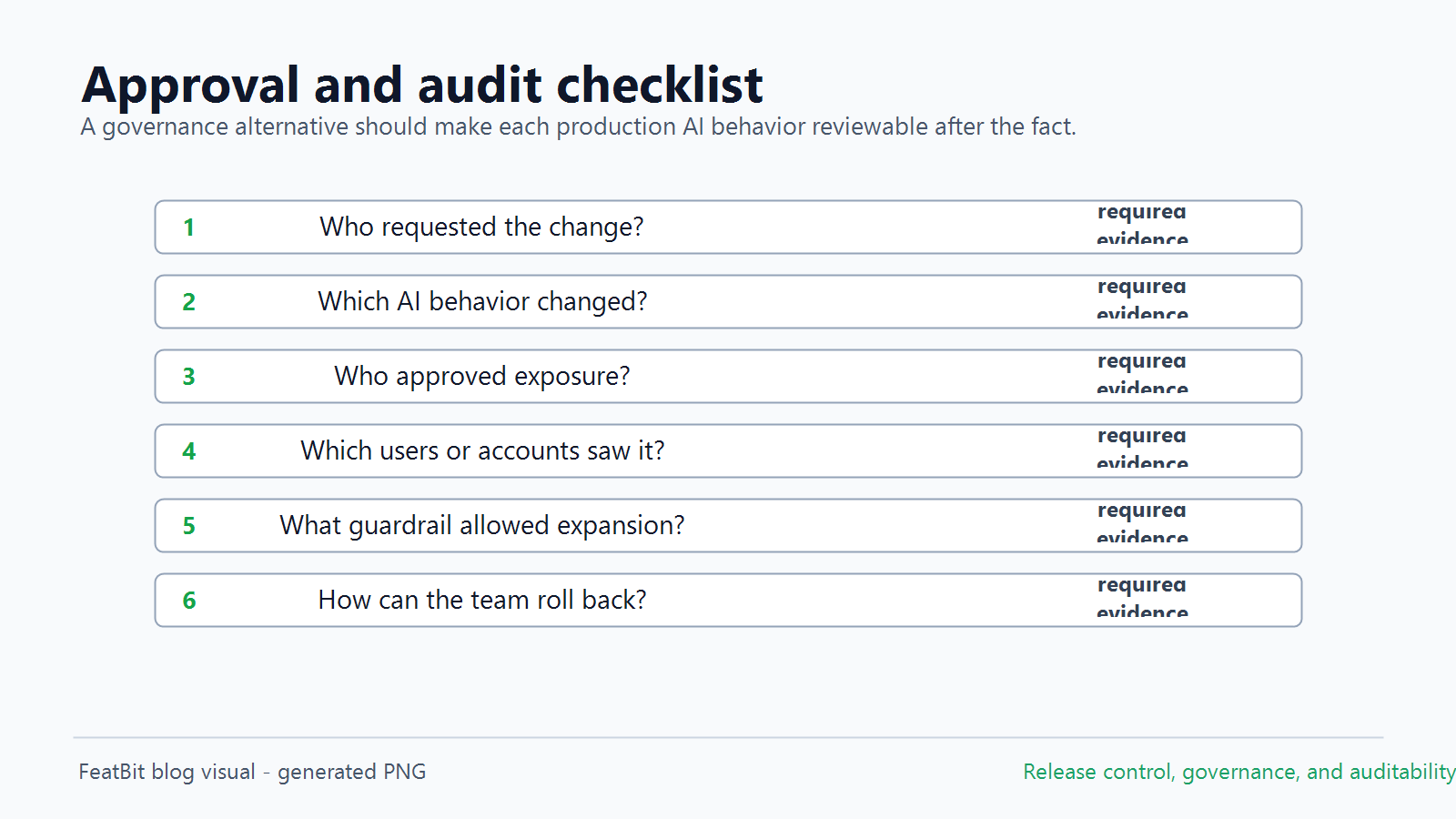
/images/blogs/unleash-ai-governance-alternative/approval-audit-checklist.pngsummarizes approval and audit evidence.
Next Step
Before choosing an Unleash AI governance alternative, write one release-control contract for a real AI behavior: owner, default state, first audience, excluded contexts, approval rule, guardrails, rollback action, audit source, and cleanup condition. Then verify which platform makes that contract easiest to enforce in production.