
Flagsmith AI Feature Flags Alternative for Runtime AI Control
If you are searching for a Flagsmith AI feature flags alternative, the useful question is not whether a platform can toggle an AI feature. The stronger question is whether your team can control AI behavior as a release decision: who receives a new prompt, model route, retrieval profile, agent mode, or fallback; what evidence decides expansion; how rollback works; and where the control plane runs.
Flagsmith's public AI page frames feature flags as a way to test AI-powered features, experiment with prompts and models, measure business metrics beside latency, cost, and hallucination rates, and roll back changes without redeploying. Its MCP page also shows the category moving toward AI-assisted flag management. That is a valid category signal. FeatBit is worth evaluating when your team wants the same AI release-control problem handled through open-source, self-hostable runtime control with lifecycle discipline, auditability, rollout evidence, and automation surfaces that can stay close to your own infrastructure.
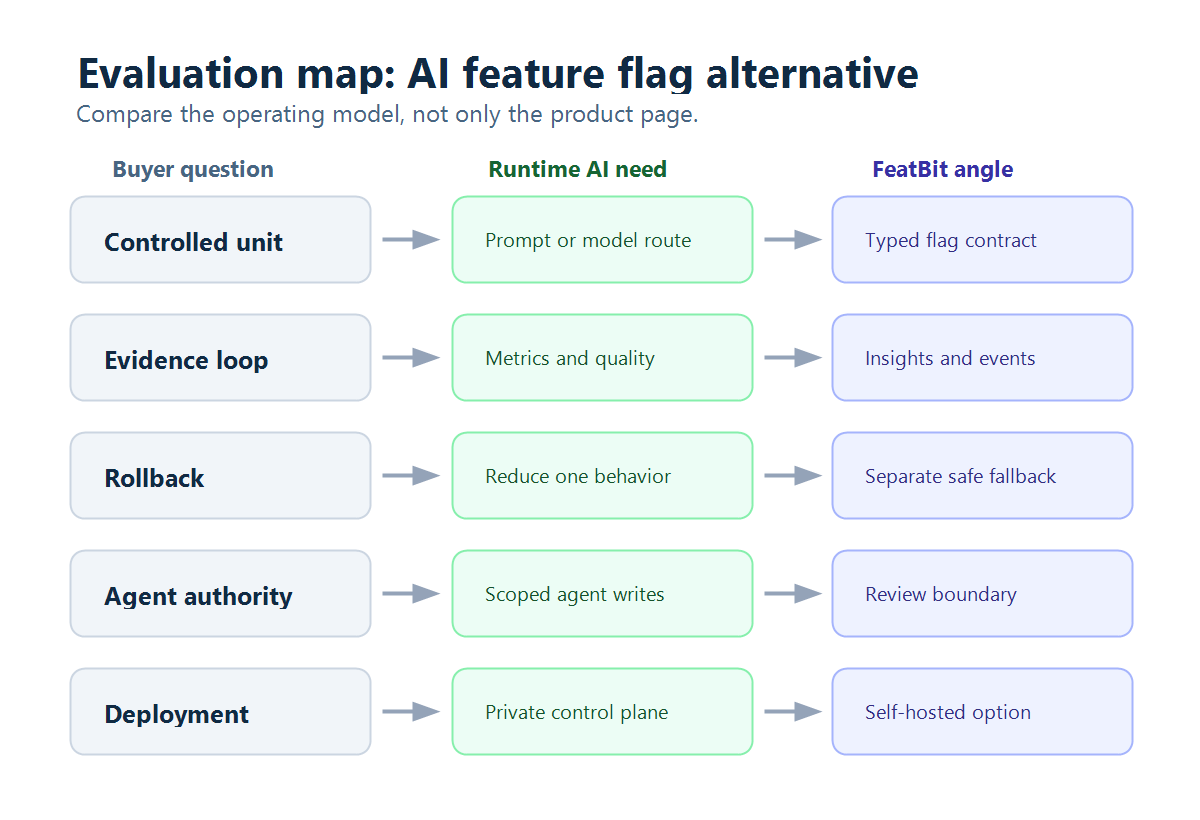
This article is not a claim that FeatBit clones every Flagsmith feature or that one product is universally better. It is a buyer and platform-team guide for deciding whether a FeatBit-style operating model fits the AI feature flag work you need to control.
The Short Answer
Use Flagsmith when your team is already standardized on Flagsmith, wants its hosted or self-hosted product model, and prefers the AI and MCP workflows documented in Flagsmith's own product pages.
Evaluate FeatBit when the decision is broader:
- You want feature flags, experimentation, rollout, rollback, audit logs, and lifecycle cleanup to operate as one release-control loop.
- You need open-source or self-hosted control because AI behavior, prompts, configuration metadata, or evaluation events should stay closer to your infrastructure.
- You want AI agents to help with feature flag work without giving them unchecked production mutation authority.
- You want AI controls to share the same governance model as ordinary product releases.
- You need implementation paths through SDKs, REST APIs, Track Insights events, webhooks, CLI, MCP, and docs rather than only a UI workflow.
That makes this an operating-model comparison. The right alternative is the platform that fits your AI release workflow, evidence requirements, and deployment constraints.
What Flagsmith Is Signaling About AI Feature Flags
Flagsmith's AI page describes several buyer tasks that now belong in the feature flag category:
- deploy AI-powered features behind flags;
- release to a subset of users before scaling;
- experiment with prompts and models;
- measure business metrics alongside AI-specific operational signals;
- use governance guardrails, approval, RBAC, audit logs, and rollback;
- automate release processes and flag lifecycles through AI-assisted tooling.
Flagsmith's basic flag management documentation also describes remote config as a typed value returned with a feature's on/off state, using the same targeting and rollout rules. That matters for AI because many AI controls are not only boolean. A flag may choose a prompt profile, model route, guardrail mode, retrieval depth, fallback strategy, cost profile, or agent autonomy level.
The category lesson is clear: AI feature flags are becoming runtime controls for production behavior. They should not be treated as ordinary launch toggles with AI vocabulary added later.
Where FeatBit Takes A Different Angle
FeatBit's angle is release-decision infrastructure. For AI systems, a feature flag is the runtime decision point that says which behavior is allowed for this context right now, how exposure expands, what evidence is recorded, and how the team can reverse the decision.
That maps well to AI features because the risky unit may not be a page or endpoint. It may be:
- a new prompt template;
- a model route or model fallback path;
- a retrieval or reranking profile;
- an agent tool tier;
- an approval mode such as observe-only, draft, approval-required, or autonomous;
- a guardrail or confidence threshold;
- an experiment variation for a specific user, account, or workflow.
FeatBit's AI control layer and safe AI deployment pages describe this broader pattern: evaluate runtime controls before AI behavior runs, expose changes gradually, connect exposure to evidence, and keep rollback available. The feature flag lifecycle management model adds ownership, review, decision state, and cleanup so temporary AI controls do not become permanent release debt.
Evaluation Criteria For A Flagsmith Alternative
Use these criteria before comparing feature lists.
| Evaluation area | Why it matters for AI | FeatBit evaluation angle |
|---|---|---|
| Controlled unit | AI releases often change prompts, models, retrieval, tools, cost, and fallback independently. | Model each risky decision as a named flag or typed variation instead of one global AI switch. |
| Targeting context | AI behavior may need to vary by account, region, plan, workflow, environment, or risk tier. | Use structured evaluation context and segments to control exposure. |
| Evidence loop | Prompt and model changes should expand based on quality, latency, cost, error, support, and business outcomes. | Connect flag exposure to insights, custom metric events, observability, and experiment decisions. |
| Rollback precision | Teams need to reduce one behavior without disabling unrelated AI features. | Keep separate controls for route, prompt, model, tool tier, approval mode, and incident fallback. |
| Agent authority | MCP or AI-assisted flag work can touch production behavior if credentials are broad. | Start with read-only discovery, then scoped staging actions, then reviewed production changes. |
| Lifecycle cleanup | AI teams may create many temporary prompt and route controls. | Capture owner, flag type, expected lifetime, evidence rule, and cleanup trigger when the flag is created. |
| Deployment ownership | AI control metadata can be sensitive operational data. | Evaluate FeatBit's open-source and self-hosted paths when private deployment matters. |
The deciding question is not "Which vendor says AI more often?" It is "Which control plane fits the way we want to release, measure, roll back, and clean up AI behavior?"
A Practical Runtime Control Loop
AI feature flags work best when the control loop is explicit.
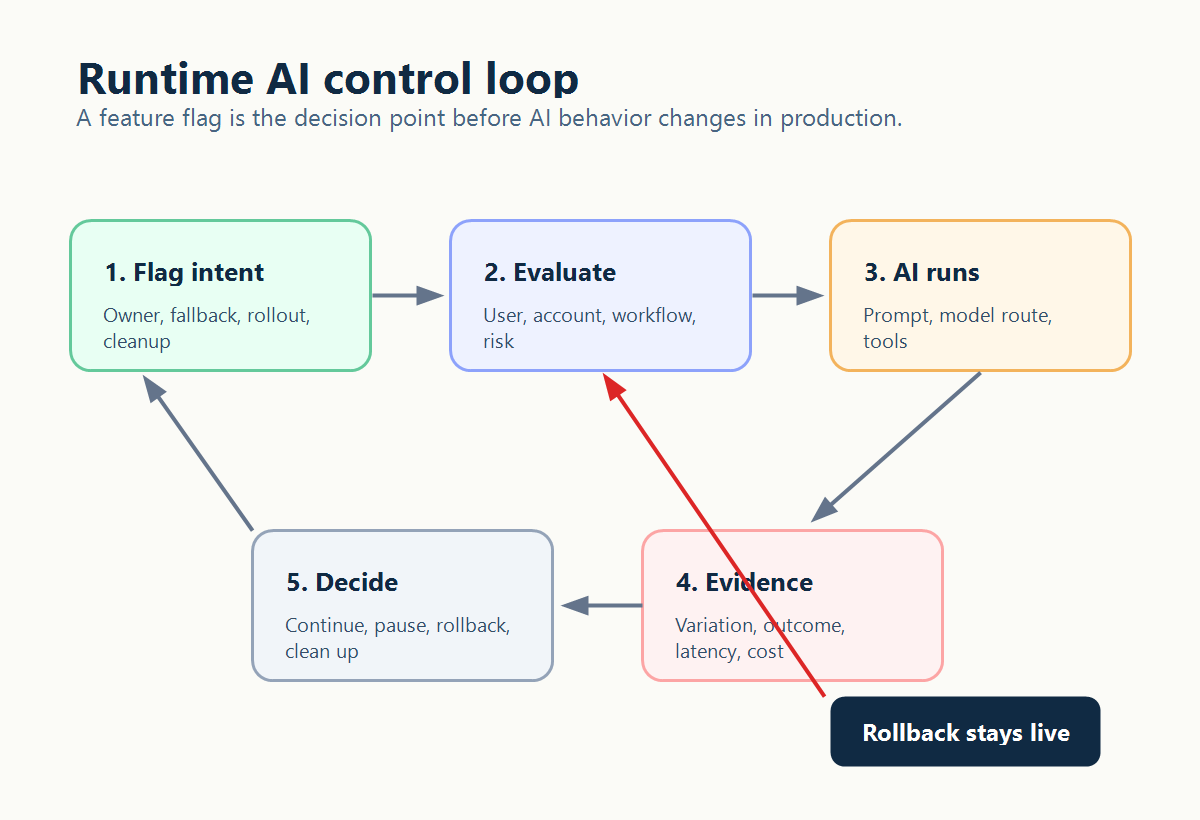
- Define the release decision. Name the prompt, model route, retrieval profile, agent mode, or fallback that may change production behavior.
- Create the flag contract. Specify type, fallback, owner, target context, rollout plan, metric guardrails, and cleanup rule.
- Evaluate server-side before AI behavior runs. Do this before assembling prompts, choosing model routes, retrieving context, or granting tool authority.
- Attach exposure evidence. Record which variation ran, for which assignment unit, and what outcome or guardrail event followed.
- Decide with evidence. Continue, pause, roll back, or expand based on production behavior rather than intuition.
- Clean up the control. Remove temporary branches or archive the flag when the release decision becomes permanent.
FeatBit supports this loop through feature flags, targeting rules, percentage rollouts, audit logs, flag insights, experimentation workflows, and APIs. The Track Insights API is relevant when teams need to send feature flag usage events and custom metric events for release evidence.
MCP Is An Interface, Not The Governance Model
Flagsmith's MCP Server page connects AI assistants to release management tasks such as flag changes, rollout automation, and flag hygiene. FeatBit also has an MCP path through the FeatBit MCP Server, which lets AI coding agents interact with FeatBit through natural language.
For buyers, the MCP question should be practical:
- Which operations are read-only?
- Which operations can mutate flag state?
- Which environments can the agent reach?
- Which credential scopes are used?
- Is production rollout separated from flag creation?
- Can the assistant read audit history before proposing a change?
- Is cleanup part of the first flag intent?
Start with read-only discovery. Let the assistant list related flags, environments, owners, tags, and possible duplicates. Move to staging-only creation after the team trusts the prompts and credential boundaries. Keep production rollout behind human review unless your organization has a mature approval workflow for automated changes.
That pattern keeps AI assistance useful without turning "manage flags with natural language" into silent production control.
FeatBit Alternative Fit By Team Type
| Team situation | What to verify before choosing |
|---|---|
| AI product team shipping prompt or model changes weekly | Can the platform target cohorts, compare variations, record exposure, measure guardrails, and roll back one behavior without redeploying? |
| Platform team standardizing release control | Can feature flags, experimentation, audit, observability, API automation, MCP, and lifecycle cleanup live in one operating model? |
| Security or infrastructure team with data-location requirements | Can the control plane run in your infrastructure, and can credentials, audit history, and telemetry flow through approved systems? |
| Developer experience team adopting AI coding assistants | Can agents discover flags and propose changes while humans retain authority over production exposure? |
| Organization moving away from custom in-house flags | Can the new platform preserve rollout rules, targeting context, exposure events, and cleanup expectations during migration? |
FeatBit is especially relevant when the team wants a self-hosted or open-source feature flag platform and wants AI release control to reuse the same primitives as normal software release control. Flagsmith may remain a strong fit when the organization already uses Flagsmith, its documented AI and MCP workflows match the team need, and the deployment and governance model already fits.
A Trial Plan For Comparing FeatBit With Flagsmith
Run a small evaluation before migrating or standardizing.
- Pick one AI behavior that is not tied to billing, permissions, regulated data access, or irreversible side effects.
- Write a flag contract with key, type, fallback, owner, target context, rollout plan, metric guardrails, and cleanup trigger.
- Implement server-side evaluation before the AI service chooses the prompt, model route, retrieval profile, or agent mode.
- Roll out to internal users or a narrow segment first.
- Record exposure and outcome evidence.
- Test rollback by reducing exposure or switching to the baseline variation.
- Ask an AI assistant to inspect related flags through MCP or API access in read-only mode.
- Review whether the workflow produced a clear audit trail and cleanup decision.
This trial answers the questions that matter more than a checklist:
- Did the control fit naturally into the AI request path?
- Was rollback narrow enough?
- Could the team explain why a variation expanded or paused?
- Did the assistant help without overstepping authority?
- Did the deployment model satisfy the infrastructure owner?
- Was there a cleanup rule before the flag became permanent?
Common Mistakes When Evaluating AI Feature Flag Alternatives
Comparing only AI landing pages. Vendor pages show category positioning. A real evaluation should inspect SDK placement, API access, deployment model, audit logs, event collection, and lifecycle workflow.
Using one ai_enabled flag. A kill switch is useful, but it does not control prompt, model, retrieval, tool tier, fallback, and approval separately.
Putting raw provider details in every flag. A value like a model identifier may be useful inside an execution layer, but the release flag should usually return a stable product route such as support_balanced_v2.
Skipping server-side evaluation. If a flag controls prompts, models, tools, cost, or safety, evaluate it in a trusted runtime before the AI behavior runs.
Treating MCP as approval. MCP gives assistants access to tools. Governance still depends on scoped credentials, environment boundaries, human review, audit, and rollback rules.
Leaving AI controls forever. Temporary AI flags should have owners, review windows, evidence requirements, and cleanup outcomes.
When FeatBit Is A Strong Alternative
FeatBit is a strong Flagsmith AI feature flags alternative when your team wants AI release control to be explicit, portable, and operationally owned.
Use FeatBit as the evaluation path when:
- AI behavior needs progressive rollout, rollback, experimentation, and lifecycle cleanup;
- release evidence should connect flag exposure to product and operational outcomes;
- self-hosting or open-source control matters for infrastructure, cost, or governance reasons;
- AI coding assistants need a controlled way to inspect or prepare flag work;
- platform teams want release control for AI and non-AI software to share the same operating model.
Use Flagsmith when:
- Flagsmith is already the system of record for feature flags;
- its documented AI and MCP workflows satisfy the team requirement;
- the team wants Flagsmith-native release pipelines, governance, and deployment choices;
- the main task is improving an existing Flagsmith workflow rather than evaluating a different release-control platform.
The fair decision frame is simple: choose the control plane that makes AI behavior targetable, measurable, reversible, auditable, and cleanable under the operating model your team can actually run.
Source Notes
- Flagsmith category context comes from the official Flagsmith AI feature page, the Flagsmith MCP Server page, and the Flagsmith basic flag management documentation, including remote config and multivariate flag descriptions.
- FeatBit implementation context comes from AI control layer, safe AI deployment, AI experimentation, feature flag lifecycle management, self-hosted feature flags, Track Insights API, and targeting rules.
- FeatBit automation context comes from the FeatBit MCP Server, FeatBit REST API guide, and FeatBit GitHub repository.
- This article avoids unsupported comparative claims about performance, pricing, security, compliance, customer outcomes, or market rank. It compares public positioning and evaluation criteria.
Image and Open Graph Notes
- Cover image:
/images/blogs/flagsmith-ai-feature-flags-alternative/cover.pngis the Open Graph image for this article. - Body image:
/images/blogs/flagsmith-ai-feature-flags-alternative/evaluation-map.pngsummarizes the buyer evaluation frame. - Body image:
/images/blogs/flagsmith-ai-feature-flags-alternative/runtime-control-loop.pngshows the runtime AI control workflow described in the article.
Next Step
Before choosing a Flagsmith AI feature flags alternative, write the control contract for one real AI behavior: controlled unit, evaluation context, fallback, rollout path, evidence, rollback, agent authority, deployment requirement, and cleanup. If that contract is clear, FeatBit can be evaluated against a concrete release workflow instead of an abstract vendor checklist.