
AI Flag Owner Review Workflow: Stop AI Flag Debt Before It Ships
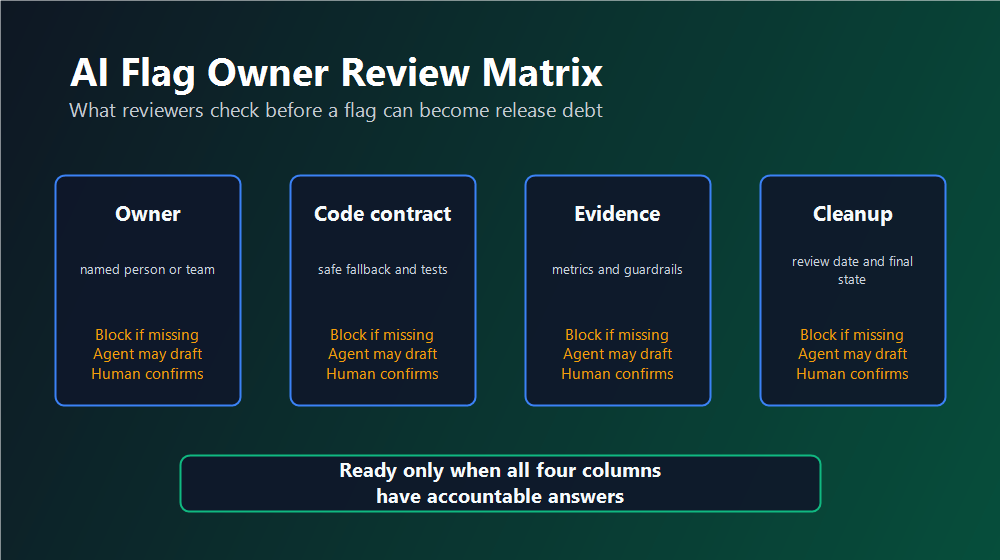
An AI flag owner review workflow is the checkpoint that decides whether a feature flag created or modified by an AI coding agent is ready to enter the release system. It verifies the flag's owner, purpose, type, rollout plan, evidence rule, cleanup condition, and code references before the pull request is merged or the flag is promoted to production.
The goal is not to slow AI-assisted development. The goal is to keep AI speed from creating a second backlog of anonymous flags, unclear rollout rules, and stale conditionals that nobody feels responsible for removing.
Why AI-Created Flags Need An Owner Review
AI coding agents make it easy to add release controls. A developer can ask an agent to create a flag, wrap risky behavior, add targeting logic, update tests, and open a pull request. That is useful only if the generated flag also carries enough lifecycle context for the next engineer to understand it.
Without that review, the team usually gets four kinds of debt:
- a flag key exists, but the owner is unclear;
- the code path is protected, but the rollout decision is not tied to evidence;
- the final state is not documented, so cleanup keeps getting postponed;
- the flag is easy to create, but hard to remove safely.
This is why the review should happen before the flag becomes part of normal release operations. Once a flag reaches production traffic, every missing detail becomes more expensive to recover.
FeatBit's feature flag lifecycle management guidance treats a flag as a release asset with type, owner, evidence, decision, and cleanup path. The AI-specific version of that idea is simple: if an agent can create a flag, the workflow must force the owner and cleanup contract to be readable by humans and future agents.
The Owner Review Is Not The Same As Code Review
Code review asks whether the implementation is correct. Owner review asks whether the flag is operationally ready to live in the release system.
| Review question | Code review | AI flag owner review |
|---|---|---|
| What changed? | Diff, tests, naming, architecture | Flag purpose, type, variation meaning, rollout surface |
| Who decides next? | Maintainer or reviewer | Named flag owner or owning team |
| What evidence is needed? | Test results and review comments | Rollout metrics, exposure data, guardrails, customer impact |
| What happens after launch? | Merge, deploy, monitor | Expand, pause, roll back, convert to permanent control, or clean up |
| What can an AI agent do next? | Suggest edits or fixes | Gather evidence, find references, prepare cleanup PR, update release memory |
That separation matters because AI-generated flag code can look reasonable while the release lifecycle is still incomplete. A reviewer may approve a pull request because the code compiles, but nobody has agreed who owns the flag, when it expires, or which metric proves the release is done.
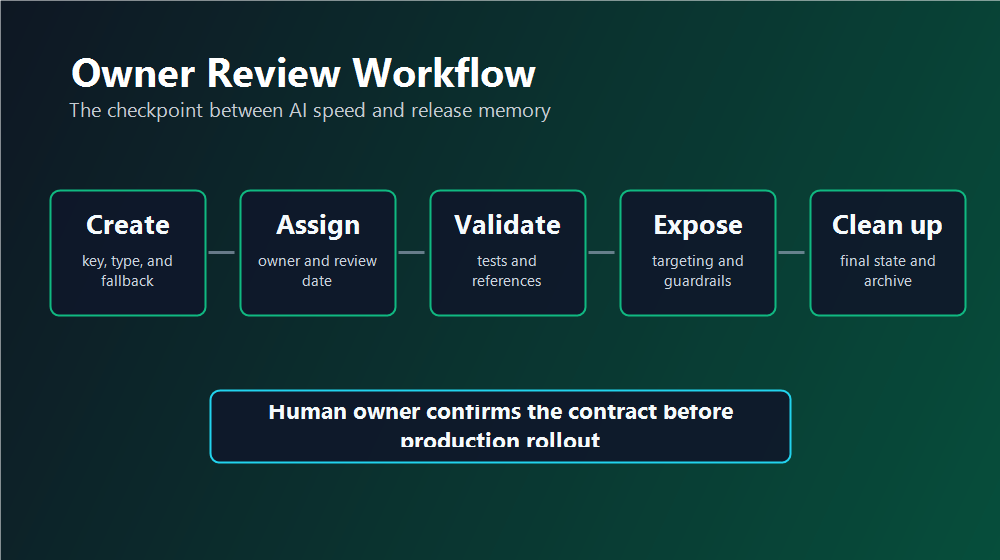
A Five-Step AI Flag Owner Review
Use this workflow whenever an AI coding agent creates a new feature flag, changes a production flag, or adds a flag evaluation to a risky code path.
1. Classify The Flag Type
Do not start with the flag name. Start with the flag type.
Ask the author or agent to classify the flag as one of these operating types:
| Flag type | Review focus | Expected end state |
|---|---|---|
| Release flag | staged rollout, rollback plan, exposed audience | remove code path after full release |
| Experiment flag | variant meaning, exposure event, success metric, guardrails | keep winning behavior and remove experiment branch |
| Operational flag | migration, failover, incident control, degraded mode | document as permanent control or remove after transition |
| Permission flag | entitlement, plan, role, account, or region access | keep as long-lived product policy |
| AI behavior flag | prompt, model, retrieval, tool authority, agent mode | keep if it is a standing control, remove if it was only a rollout test |
Unleash exposes feature flag types, expected lifetimes, states, and lifecycle stages in its official documentation, including "potentially stale" and "stale" states for cleanup signals. DevCycle's documentation similarly frames technical debt cleanup around completed features, code usage detection, and archiving. The shared lesson is not vendor-specific: the type of flag determines the review window and cleanup expectation.
2. Assign A Real Owner
Every AI-created flag needs a named owner before it can be treated as release-ready. The owner can be an engineer, a product engineer, or a team, but it cannot be "the agent" or "the platform team" by default.
The owner is responsible for answering:
- why the flag exists;
- which users, accounts, environments, or regions can see it;
- what evidence would justify expansion;
- what signal would pause or roll back the release;
- when the flag should be reviewed for cleanup;
- whether an AI agent is allowed to prepare cleanup changes later.
This is the point where teams can use FeatBit IAM and policy controls to make production changes auditable, and FeatBit audit logs to reconstruct who changed a flag in an environment. Ownership is still a team process, but the platform should make the decision trail visible.
3. Check The Implementation Contract
Before the PR merges, the owner review should confirm that the code is easy to reason about and easy to remove.
Use this implementation checklist:
- the flag key is centralized or discoverable;
- the fallback behavior is safe and tested;
- variations have clear meanings, not vague labels;
- flag logic is separated from business logic where practical;
- the code path has tests for at least the default and target behavior;
- telemetry records the evaluated variation where the release decision needs evidence;
- the cleanup path is obvious from the shape of the code.
This is where AI agents can help without owning the decision. Ask the agent to list every reference to the flag key, summarize the fallback behavior, identify missing tests, and draft the cleanup path. The human owner still accepts or rejects the finding.
4. Attach Rollout Evidence Before Expansion
A flag is not "done" when it is created. It is done when the team has enough evidence to make the next release decision.
For a release flag, that evidence may include:
- internal testing passed;
- canary cohort saw no guardrail regression;
- feature usage appeared in expected accounts;
- support, error, latency, or revenue signals stayed within threshold;
- the rollback path was tested or at least rehearsed.
For an experiment flag, evidence should include exposure and metric events. FeatBit's Track Insights API and flag insights are the practical path for tying variation exposure and behavior data back to the release decision. If the team does not know what evidence will decide expansion, the flag is still a pending decision, not a completed release.
5. Create A Cleanup Ticket While Context Is Fresh
Cleanup should be created when the flag is created, not when the codebase is already noisy.
The cleanup ticket should include:
- flag key and owning team;
- flag type and expected review date;
- final state to keep if the release succeeds;
- code locations known at creation time;
- evidence required before removal;
- whether an AI agent may open the cleanup PR;
- manual checks required before archiving or deleting the flag.
FeatBit's lifecycle docs include guidance for setting cleanup expectations, detecting stale feature flags, and cleaning up flags with coding agents. The important habit is to record the cleanup expectation before the release memory disappears.
What To Put In The Pull Request Template
The fastest way to make the workflow real is to add a short flag-owner block to pull requests that add or modify flags.
### AI flag owner review

- Flag key:
- Flag type: release | experiment | operational | permission | AI behavior
- Owner:
- Created by AI agent? yes | no
- Production change? yes | no
- Safe fallback:
- Rollout audience:
- Evidence required before expansion:
- Rollback or pause trigger:
- Cleanup review date:
- Final state if successful:
- Agent cleanup allowed? yes | no
This block gives human reviewers a concrete checklist and gives AI coding agents a structured contract. The agent can fill a draft from the diff, but the owner should confirm it before merge.
Where FeatBit Fits In The Workflow
FeatBit does not need to become the only system in the review workflow. It should be the release-control system that records the flag state, targeting rules, variation behavior, audit trail, and rollout evidence.
The practical FeatBit workflow is:
- Create or update the flag through FeatBit UI, API, CLI, or MCP-assisted workflow.
- Register the flag type, owner, and cleanup expectation in the team's lifecycle convention.
- Evaluate the flag server-side or client-side according to SDK guidance.
- Use targeting rules and percentage rollouts to control exposure.
- Use insights, observability integrations, and audit logs to support the release decision.
- Let an AI coding agent prepare cleanup only after evidence says the flag is removable.
For teams building agent-native workflows, FeatBit also provides a FeatBit MCP server and FeatBit CLI, which can bring flag operations into AI-assisted development. That makes the owner review more important, not less important. Automation should make the lifecycle easier to follow, not easier to skip.
Common Failure Modes
The owner review should block or revise the flag when one of these patterns appears.
| Failure mode | Why it creates debt | Fix before merge |
|---|---|---|
| "Temporary" flag with no review date | Nobody knows when temporary ends | Add expected review date and cleanup trigger |
| AI-created flag with no owner | The agent cannot carry accountability | Assign a human or team owner |
| Boolean flag with unclear default | Rollback behavior may surprise users | Define safe fallback and test it |
| Flag logic spread across many files | Cleanup becomes risky and expensive | Centralize evaluation or document all references |
| Experiment flag without exposure event | The team cannot decide a winner | Add exposure and metric tracking |
| Production flag without audit path | Changes cannot be reconstructed | Use platform audit logs and change policy |
This is also where PostHog's writing on feature flag mistakes is useful as a category signal: stale criteria, owners, and alerts are not optional details when flags become part of day-to-day development. Different platforms implement the mechanics differently, but the accountability pattern is consistent.
A Good Review Outcome
A strong AI flag owner review ends with one of four decisions:
- Ready to merge: owner, evidence, rollout, fallback, and cleanup are clear.
- Revise before merge: implementation is acceptable, but ownership or lifecycle data is missing.
- Release as operational control: the flag is intentionally long-lived and documented as such.
- Do not create the flag: the change is low risk, static configuration is enough, or the flag would only add noise.
That last outcome matters. The best way to reduce flag debt is not to clean up every bad flag later. It is to stop creating flags that have no release decision attached.
Source Notes
- FeatBit implementation context: feature flag lifecycle management, set cleanup expectations, detect stale feature flags, clean up flags with coding agents, targeting rules, percentage rollouts, flag insights, and audit logs.
- External category context: Unleash documents feature flag types, expected lifetimes, states, lifecycle stages, and archive suggestions in its feature flags documentation. DevCycle documents feature flag technical debt cleanup and code usage workflows in Managing Tech Debt by Cleaning Up Unused Flags. PostHog's Product for Engineers newsletter describes owners, stale criteria, and alerts in "Don't make these feature flag mistakes".
- Internal reader journey: continue with AI coding agents fix feature flag lifecycle debt, clean up stale feature flags with coding agents, and the AI coding productivity paradox.