
AI-Powered Flag Cleanup: A Reviewable Workflow for Removing Feature Flag Debt
Feature flags are supposed to reduce delivery risk. Left in place too long, they become another kind of risk: hidden branches, duplicate tests, unclear ownership, and behavior that nobody wants to remove because nobody is sure what the flag still controls.
AI-powered flag cleanup can help, but only if the word "cleanup" does not mean "let an agent delete conditionals." The useful version is narrower and safer: use AI to gather evidence, classify stale flags, draft code changes, explain the expected behavior, and prepare a pull request that a human reviewer can audit.
That distinction matters for teams using feature flags as a production control layer for AI and non-AI systems. A stale flag can be a harmless old rollout branch, a permanent permission control, a kill switch, or an experiment with unresolved analysis. AI can speed up the boring discovery work, but the cleanup decision still needs lifecycle context, code context, tests, and review.
This article lays out a practical workflow for AI-powered feature flag cleanup. It is not a claim that FeatBit should silently remove flags for you. It is a way to combine FeatBit's flag inventory, ownership, environments, rollout state, and audit context with code search and AI-assisted refactoring.
What AI-powered flag cleanup should mean
AI-powered flag cleanup is a reviewable workflow that turns flag lifecycle evidence into safe code removal. A good workflow answers six questions before it changes code:
- Is the flag still evaluated in production code?
- Which variation is the intended permanent behavior?
- Does the flag protect an operational fallback, permission rule, or experiment?
- Which services, tests, docs, and dashboards mention the flag key?
- What code can be removed without changing the intended behavior?
- What human approval is required before the flag is archived?
That is a different job from generic technical debt cleanup. Feature flag cleanup crosses product, release, testing, and operations boundaries. An AI assistant can propose the diff, but the evidence bundle should be readable without trusting the model.
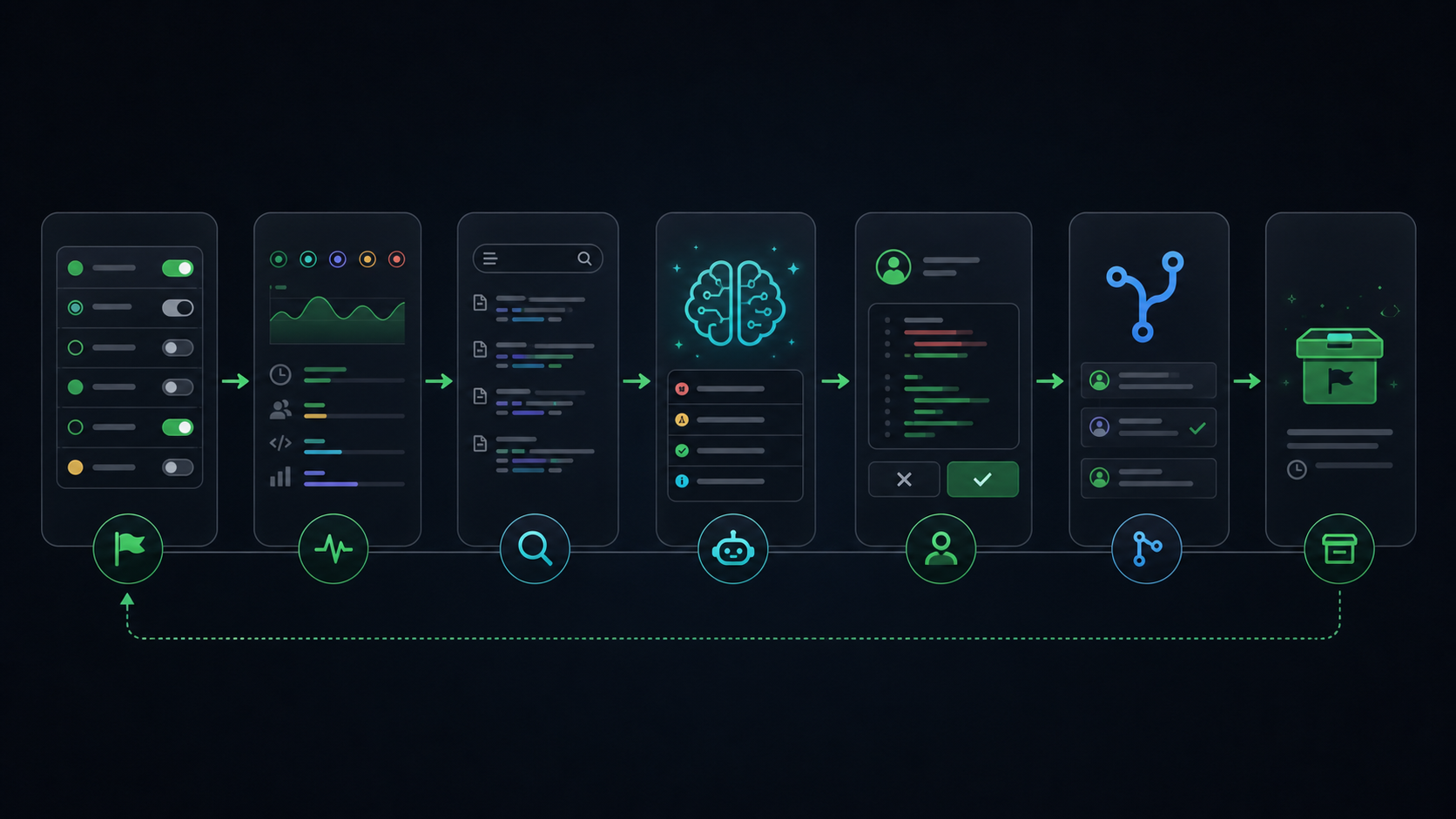
The output should look like a normal engineering change:
- A list of candidate flags with owner, environment, rollout state, and last relevant usage signal.
- A code reference map showing every place the flag key appears.
- A proposed decision: keep, convert to permanent configuration, remove, or archive.
- A pull request that collapses the dead branch and updates tests.
- A reviewer checklist that explains what the AI changed and what it intentionally left alone.
If the workflow cannot produce that evidence, it should stop before writing code.
Why stale flag cleanup is hard to automate
Flag cleanup looks simple when a flag has one if statement and one obvious winning branch. Real systems rarely stay that clean.
A release flag may start as a temporary rollout control, then become an operational kill switch. A pricing flag may look stale because it is enabled for every current customer, but it still defines an entitlement boundary for future plans. An experiment flag may have one winning variant, but the team may still need analysis records before deleting instrumentation. A mobile flag may remain in the service because old app versions still evaluate it.
AI assistants also face a context problem. Code search can find a flag key, but it does not know whether a missing reference means safe removal. The key may be assembled dynamically, mapped in a shared wrapper, evaluated through OpenFeature, or referenced in another repository. Even when all references are found, the assistant still needs to know which branch represents the desired permanent behavior.
That is why the cleanup workflow should start from lifecycle evidence, not from code deletion.
Useful stale-flag signals include:
- The flag is fully rolled out in all relevant environments.
- The same variation has been stable for a defined period.
- No active experiment, incident, migration, or entitlement workflow depends on it.
- The owner has approved the permanent behavior.
- The key appears in a finite set of repositories and tests.
- The fallback value is understood and matches the intended removal path.
Signals are not decisions. They are evidence for a reviewer. The AI assistant's job is to organize that evidence and reduce the mechanical work.
A reviewable cleanup workflow
The safest pattern is a staged loop. Each stage narrows the risk before the next one begins.
1. Build the candidate list from the flag inventory
Start with the feature flag system, not the codebase. The flag inventory knows the key, environments, rollout rules, owners, descriptions, and recent changes. Code alone cannot tell whether a flag is an experiment, a release guard, an operational switch, or a permission control.
For each candidate, collect:
- Flag key and display name.
- Project and environment.
- Owner or owning team.
- Current targeting rules and default variation.
- Whether the flag is temporary, operational, experimental, or permission-oriented.
- Date of last meaningful change.
- Links to related tickets, release notes, or incident records when available.
The AI assistant can summarize this inventory, but it should preserve links and identifiers so reviewers can verify the summary.
2. Classify the cleanup action
Not every stale-looking flag should be deleted. Use a small decision frame:
- Remove: the flag was temporary, the winning branch is known, and all runtime references can be simplified.
- Archive only: the flag is no longer served, but code has already been removed or never referenced it.
- Keep as operational control: the flag acts as a kill switch, circuit breaker, migration fallback, or emergency override.
- Convert: the flag should become a normal configuration value, permission model, or product entitlement rule.
- Investigate: ownership, rollout state, references, or experiment results are unclear.
This classification is where AI can be useful. It can compare descriptions, naming patterns, targeting rules, and code references, then propose a category. The reviewer still owns the decision.
3. Map every code reference
After the candidate list is classified, search for each flag key across code, tests, docs, dashboards, and infrastructure repositories. Include wrappers and SDK abstractions, not only direct string matches.
For each reference, ask the assistant to record:
- File path and function or component name.
- Whether the reference evaluates the flag, logs it, tracks an event, documents it, or tests it.
- Which branch is active when the permanent variation is selected.
- Which tests will fail if the branch is simplified incorrectly.
This reference map should be committed in the pull request description or linked as an artifact. It makes the AI-generated change auditable.
4. Draft the removal diff
Only now should the assistant write code. The diff should be intentionally boring:
- Replace the flag evaluation with the permanent branch.
- Remove dead variation handling.
- Delete tests for removed behavior.
- Keep or update tests that protect the permanent behavior.
- Remove unused imports, helpers, and constants.
- Update docs or comments that mentioned the temporary rollout.
The assistant should avoid opportunistic refactors. A cleanup pull request is easier to review when it changes one flag or one tightly related group of flags at a time.
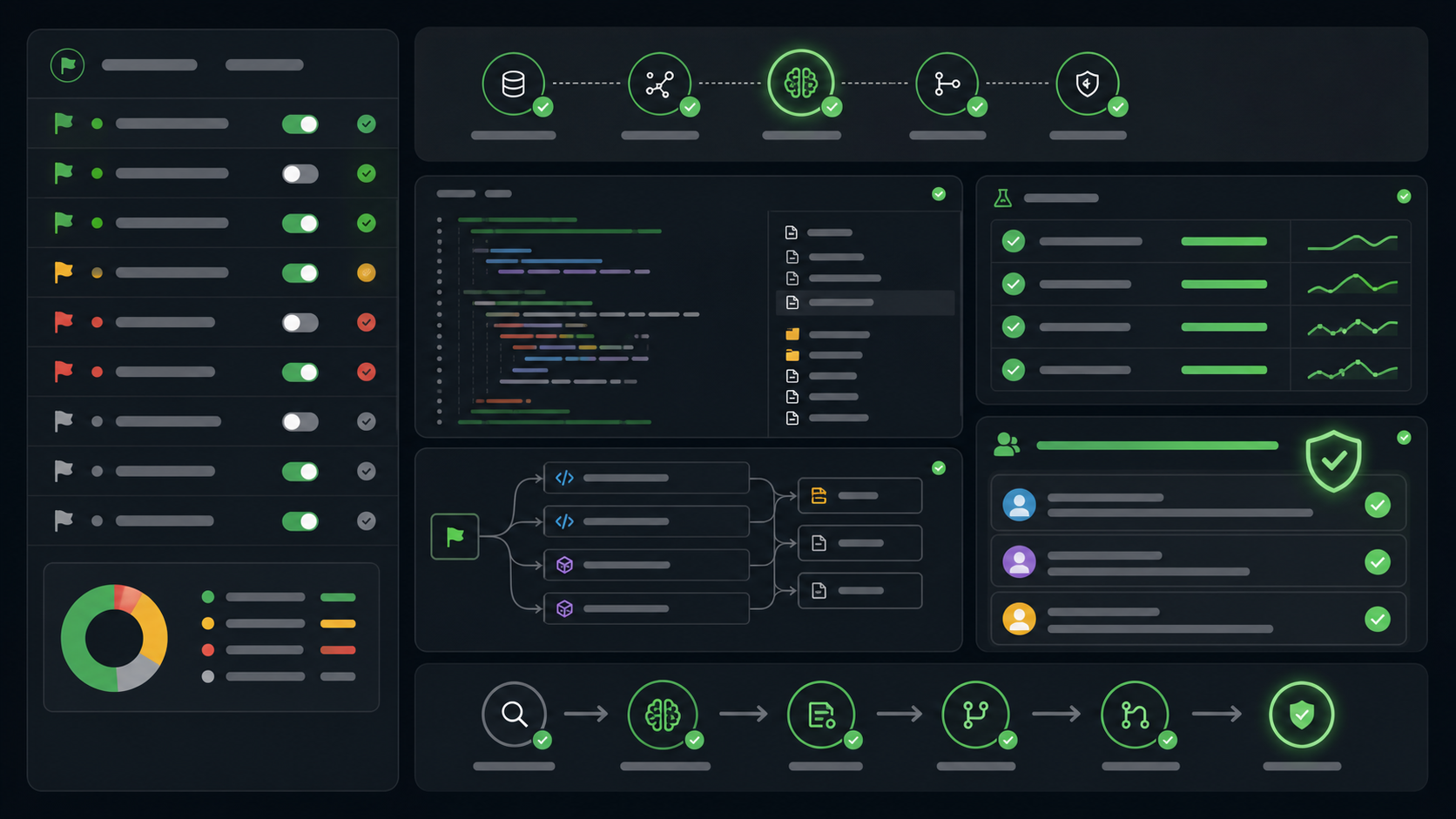
5. Run tests and explain the expected behavior
The pull request should include a short explanation of behavior before and after cleanup:
- Before: the feature ran through a flag evaluation.
- After: the selected variation is always active.
- Unchanged: user targeting, permissions, metrics, or fallbacks that still matter.
- Removed: dead branch, temporary rollout code, obsolete tests, and stale docs.
Require the assistant to list test commands it ran, test commands it could not run, and any code areas it did not inspect. This is especially important in monorepos where a flag may affect several packages.
6. Archive the flag after merge
Do not archive the flag before the code cleanup is merged and deployed. Archiving too early can make rollback harder because old deployed versions may still evaluate the key.
A good sequence is:
- Merge the cleanup pull request.
- Deploy the service versions that no longer evaluate the flag.
- Confirm production traffic is no longer asking for the flag, when your telemetry can show it.
- Archive the flag in the feature flag system.
- Keep the audit trail and pull request link for future investigation.
This sequence keeps release safety and cleanup discipline aligned.
Where FeatBit fits in the cleanup loop
FeatBit's strongest role in AI-powered cleanup is as the source of release-control truth. The codebase tells you where a flag is referenced. FeatBit tells you why the flag exists, who owns it, how it is targeted, and which runtime behavior is currently active.
For teams using FeatBit as an open-source or self-hosted feature flag platform, that matters for three reasons:
- Control: the cleanup workflow can start from a flag inventory your team owns, instead of depending only on an external SaaS account.
- Governance: change history, ownership, environments, and rollout state can become part of the AI evidence bundle.
- Runtime discipline: flags remain production controls until the cleanup pull request has shipped and old references are gone.
This also connects to FeatBit's broader AI-release view. In Feature Flags as the AI Control Layer, flags are treated as runtime control surfaces for AI behavior. Cleanup is the maintenance side of that same idea. If every AI decision point becomes a control surface, teams also need a disciplined way to remove controls that have served their purpose.
The workflow pairs naturally with:
- AI Release Engineering for the broader operating model.
- AI-Native DevOps Stack for observability, rollout, and experimentation context.
- Feature flag management best practices for lifecycle hygiene and short-lived release flags.
- Open-source feature flag tools for teams comparing control, hosting, and governance models.
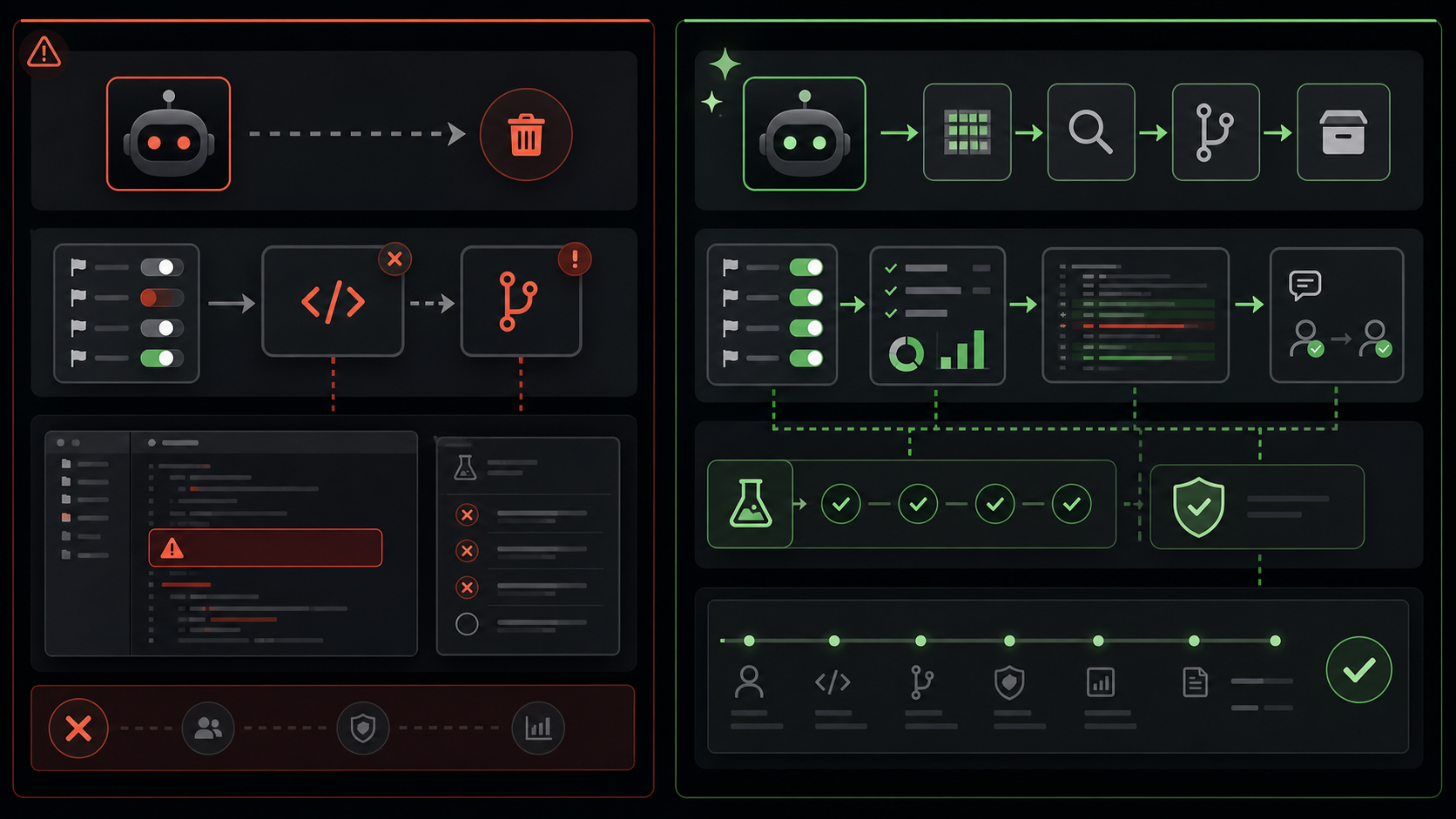
Guardrails for AI cleanup agents
An AI cleanup agent should operate under explicit constraints. These guardrails keep the workflow useful without making it unsafe.
Require evidence before edits
The agent should not edit code until it has produced a candidate flag summary, reference map, and cleanup classification. If any required field is missing, the output should be an investigation task, not a pull request.
Keep one cleanup intent per pull request
Do not let the assistant remove unrelated flags across the repository just because it found them. Batch cleanup is tempting, but review quality drops quickly. Group flags only when they belong to the same rollout, experiment, or feature branch.
Preserve kill switches and permission controls
Operational flags and entitlement flags may stay long-lived by design. They should not be removed because they are always on for current traffic. Require an owner to confirm that a flag is temporary before the agent drafts a deletion.
Treat fallback values as production behavior
Fallbacks matter when SDKs cannot reach the flag service or when local evaluation uses cached values. The assistant should identify the fallback path and explain whether it changes after cleanup.
Keep tests honest
AI-generated cleanup often removes the branch and the test that would have caught the wrong branch. Reviewers should require at least one test that proves the permanent behavior still holds.
Never use AI summaries as the audit trail
The summary is useful, but the durable audit trail should link to the actual flag, pull request, issue, test output, and deployment record.
A practical prompt and review checklist
Use a prompt that asks for evidence first and code second. For example:
You are helping clean up a feature flag. Do not edit code yet.

Flag key: <flag-key>
Expected permanent variation: <variation>
Owning team: <team>
Relevant repositories: <repos>

First, produce:
1. All code references to the flag key.
2. A classification: remove, archive only, keep, convert, or investigate.
3. The branch that should remain after cleanup.
4. Tests that must be updated or preserved.
5. Unknowns that need human confirmation.

Only draft a code diff after the evidence list is complete.
Then review the pull request with this checklist:
- The owner confirmed the flag is temporary.
- The permanent variation is stated in the PR description.
- All direct and wrapper-based references were searched.
- The cleanup diff changes only the intended flag or feature area.
- Tests still protect the permanent behavior.
- The flag is not archived until cleaned-up code is deployed.
- The PR links to the flag, ticket, and any relevant rollout or experiment record.
AI-powered flag cleanup works best when it feels less like automation magic and more like a disciplined release-engineering checklist. The AI assistant reduces search, summarization, and refactoring time. The platform team keeps ownership of production behavior.
Source notes and image recommendations
Source notes:
- Unleash documents feature flag lifecycle concepts and stale flag management language in its official docs, including feature toggle states and cleanup-oriented workflows: Unleash feature toggles.
- Martin Fowler's feature toggle guidance remains a useful background source for the idea that long-lived toggles require active management: Feature Toggles.
- OpenFeature provides a vendor-neutral specification for feature flag evaluation APIs, which is relevant when cleanup must account for abstraction layers instead of direct SDK calls: OpenFeature specification.
- FeatBit's public materials support the internal link path for open-source and self-hosted feature flag management: FeatBit GitHub repository and FeatBit official website.
Image and Open Graph recommendations:
- Use
/images/blogs/ai-powered-feature-flag-cleanup/cover.pngas the Open Graph image. It should show AI-assisted flag cleanup as a reviewable engineering workflow, not as autonomous deletion. - Use
/images/blogs/ai-powered-feature-flag-cleanup/cleanup-workflow.pngnear the workflow section to show inventory, evidence, code diff, review, deploy, and archive. - Use
/images/blogs/ai-powered-feature-flag-cleanup/cleanup-evidence.pngnear the pull request section to show what reviewers need before accepting an AI-generated cleanup. - Use
/images/blogs/ai-powered-feature-flag-cleanup/cleanup-guardrails.pngnear the guardrails section to contrast unsafe deletion with evidence-based cleanup.