
AI Benchmarks vs Real-User Outcomes: How to Decide Which Model to Ship
AI model benchmarks are useful for narrowing the candidate set. Real-user outcomes are what decide whether a model should keep receiving production traffic.
That distinction matters because an AI model can look better on an offline benchmark and still hurt the product outcome that users experience. A support assistant might score higher on a reasoning eval but increase human corrections. A routing model might improve answer quality in a curated dataset but raise latency or cost per resolved case. A coding assistant might pass more task prompts but create more review rework in the real workflow.
The practical release question is not "Which model has the highest benchmark score?" It is "Which model improves the committed user outcome without breaking safety, reliability, cost, or trust guardrails?"
The Short Answer
Use benchmarks to decide which model is eligible for controlled exposure. Use real-user outcomes to decide whether that model should expand, pause, roll back, or become the default.
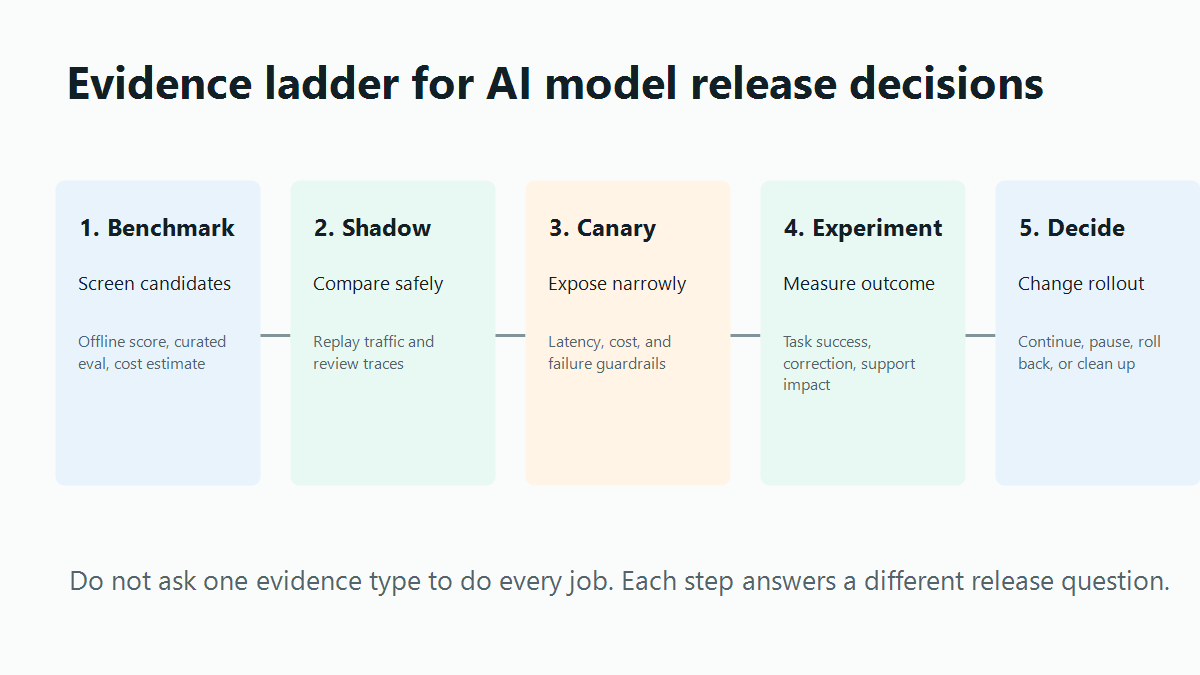
Benchmarks answer questions like:
- Does the model meet a baseline capability threshold?
- Does it handle the prompt families, languages, or task types we care about in a controlled test?
- Is the latency or cost profile obviously unacceptable before production exposure?
- Does it fail known safety, quality, or regression tests?
Real-user outcomes answer a different set of questions:
- Do users complete the task more often?
- Do humans correct or override the answer less often?
- Does the change reduce support burden without increasing complaints?
- Does the model stay within latency and cost guardrails under real traffic?
- Does one user segment benefit while another segment is harmed?
Do not ask one evidence type to do both jobs. The benchmark is a pre-release filter. The real-user outcome is the release decision.
Why Benchmarks Alone Mislead Model Release Decisions
Benchmarks are not bad. A benchmark gives teams a repeatable way to compare models against known tasks. MLCommons describes benchmark work as a way to create representative suites for AI and ML evaluation, and Stanford's HELM project frames holistic evaluation as a way to improve transparency in language model comparison.
The problem starts when a benchmark score is treated as a proxy for the business or product outcome.
Benchmarks usually simplify at least four things:
| What the benchmark controls | What production adds |
|---|---|
| Prompt format | messy user intent, ambiguous context, retries, and partial information |
| Dataset distribution | changing traffic mix, customer segments, and edge cases |
| Evaluation target | downstream task success, trust, support load, and cost per success |
| Time window | drift, new content, updated tools, and delayed user reactions |
NIST's AI Risk Management Framework emphasizes that AI trustworthiness depends on context of use, not only generic accuracy. That is the operational reason benchmark wins should be treated as candidates for exposure, not proof that the model should become the default.
For release teams, the conclusion is simple: benchmark first, but do not ship from the benchmark.
What Counts as a Real-User Outcome
A real-user outcome is the observable effect of a model variation on the task the product exists to support.
It should be closer to user value than a model score, but still measurable enough to support a release decision. Examples:
| AI system | Weak decision metric | Better real-user outcome |
|---|---|---|
| Support assistant | benchmark answer score | resolved case without escalation |
| RAG search | retrieval score only | successful answer accepted by the user |
| Coding assistant | task pass rate only | accepted pull request without extra review rework |
| Sales assistant | generated message quality | qualified meeting or reply rate with complaint guardrails |
| Model router | average model quality score | cost per successful task under latency budget |
| Agent workflow | tool-call success | task completed without human rollback or policy violation |
The outcome does not have to be perfect. It does need to be pre-committed before exposure starts. If the team changes the success metric after seeing the result, the release decision becomes easier to rationalize and harder to trust.
FeatBit's measurement design guidance is useful here: separate the primary metric that decides the experiment from guardrails that can stop the rollout.
A Decision Frame for Model Comparison
The most useful comparison is not benchmark versus real-user outcome as rivals. It is a staged evidence ladder.
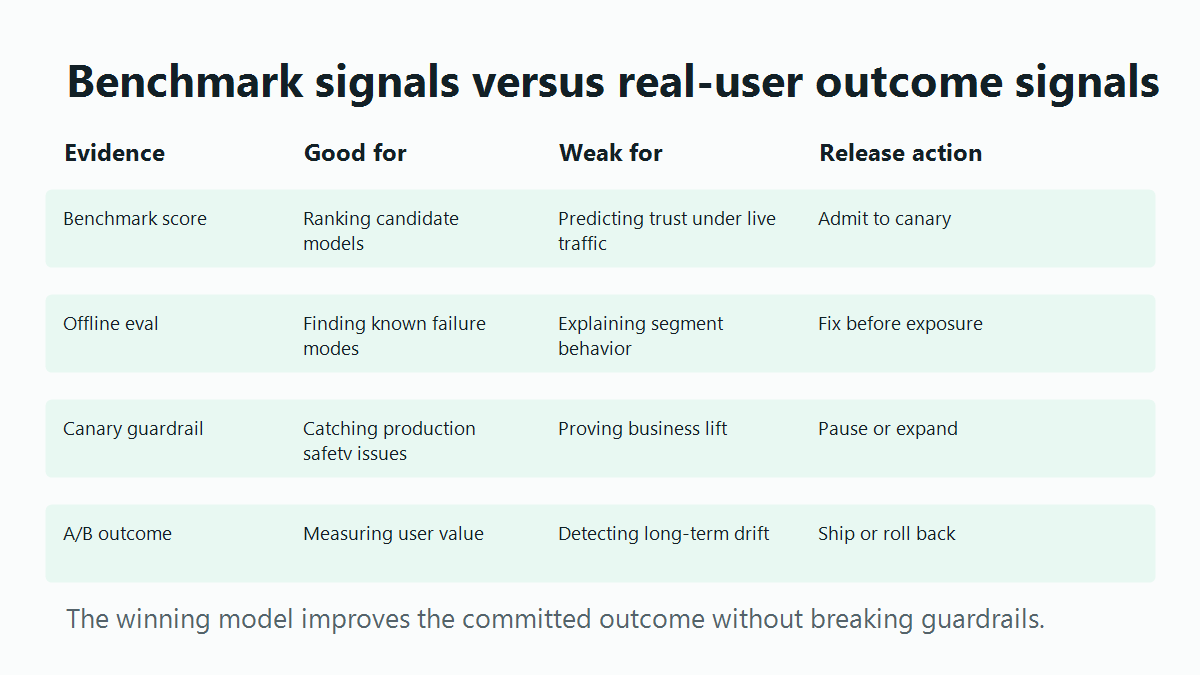
Use this frame before replacing a model, changing a model route, or promoting a new prompt-model pair:
| Stage | Evidence | Decision |
|---|---|---|
| Offline benchmark | Candidate model beats the current model on relevant evals and does not fail known regression tests | eligible for shadow or internal exposure |
| Shadow comparison | New model runs on production-like inputs without affecting users | fix obvious failures or proceed to a narrow canary |
| Canary exposure | A small segment receives the new model under guardrails | pause, roll back, or expand |
| A/B experiment | Control and treatment are compared on real-user outcomes | ship treatment, keep control, or iterate |
| Full rollout | Winning behavior becomes default with rollback window and cleanup path | finalize, monitor, and remove temporary release logic |
This differs from a generic model leaderboard because every stage names the decision it can support. A leaderboard can rank candidates. It cannot tell you whether your support users are more successful, whether costs remain acceptable, or whether a specific account segment is harmed.
How Feature Flags Connect Model Evidence to Release Control
For AI model rollout, a feature flag should represent a controlled runtime decision. The variation might be:
control_modelcandidate_model_acandidate_model_bfallback_modelhuman_review_required
The flag does three jobs:
- It decides which model route a user, account, workflow, region, or risk tier receives.
- It keeps exposure reversible without redeploying application code.
- It gives telemetry a stable variation key so outcome events can be compared.
That is why FeatBit treats feature flags as release-decision infrastructure, not just code toggles. The same control point can support internal targeting, percentage rollout, experiment assignment, audit history, and rollback. FeatBit's AI experimentation page explains this broader pattern for prompt variants, model versions, RAG configurations, and agent strategies.
In practice, the application should evaluate the model-routing flag before the model call, then attach the evaluated variation to telemetry and outcome events.
model_release_decision:
  flag_key: support_answer_model
  control: current_model
  treatment: candidate_model_a
  primary_outcome: case_resolved_without_escalation
  guardrails:
    - p95_latency
    - cost_per_resolved_case
    - human_correction_rate
    - complaint_rate
  canary_rule:
    segment: internal_and_low_risk_accounts
    exposure: 5_percent
  experiment_rule:
    split: 50_50_control_vs_treatment
  rollback_when:
    - severe_quality_failure
    - guardrail_threshold_breached
    - telemetry_missing
FeatBit implementation primitives that support this pattern include targeting rules, percentage rollouts, experimentation, the Track Insights API, and flag insights.
Benchmark Signals and Outcome Signals Need Different Owners
AI model releases often fail because the benchmark owner and the release owner are not making the same decision.
| Decision area | Likely owner | Evidence they need |
|---|---|---|
| Candidate eligibility | AI or platform engineer | offline evals, benchmark suite, cost estimate, failure analysis |
| Product value | Product manager | primary outcome, segment readout, user behavior, support impact |
| Production safety | Engineering lead or on-call owner | latency, errors, fallback behavior, model-provider reliability |
| Governance | Security, compliance, or policy owner | audit trail, data boundary, approval mode, rollback record |
| Lifecycle | Flag owner | final decision, cleanup path, permanent control decision |
The flag is the coordination point. It records the controllable unit, the rollout stage, the owner, and the evidence that changed the release state. FeatBit's feature flag lifecycle management model is useful after the experiment because a temporary model-routing flag should not become permanent release debt by accident.
When a Benchmark Win Should Not Advance
A model should not advance to user exposure just because it wins a benchmark. Stop before canary when:
- the benchmark does not match the production task or traffic mix;
- the model wins average score but fails a severe case class;
- the eval set is too small, stale, or contaminated by examples the model may have seen;
- latency or cost is outside the product budget;
- the application lacks fallback behavior;
- the team has not instrumented exposure and outcome events;
- no owner can explain the rollback rule.
The last two are common and avoidable. If exposure is not connected to outcome events, the rollout cannot answer the real question. If rollback is not defined before traffic starts, the team will debate during the incident.
A Practical Rollout Checklist
Before routing real users to a new AI model, write down:
- The benchmark or offline eval that made the model eligible.
- The production user segment that will see the first exposure.
- The primary outcome that decides whether the model is better.
- The guardrails that can stop the rollout even if the outcome improves.
- The fallback model or behavior.
- The telemetry fields that connect flag variation to outcome event.
- The owner who can change the rollout state.
- The cleanup rule after the release decision.
For a broader staged rollout pattern, use FeatBit's safe AI deployment and LLM canary release guidance. For statistical decision making after a controlled experiment, FeatBit's Bayesian A/B testing for builders page gives a practical readout model.
The Bottom Line
Benchmarks tell you which AI models deserve a controlled chance. Real-user outcomes tell you which model deserves production traffic.
A strong release process uses both. It screens candidates with offline evidence, exposes them through feature flags, compares them against committed outcomes, watches guardrails, and keeps rollback available until the decision is stable. That is how teams route, compare, roll out, and roll back AI models without pretending a benchmark score is the same thing as user value.
Source Notes
- AI benchmark context: MLCommons describes its benchmark work as representative benchmark suites for AI and ML evaluation, and Stanford CRFM presents HELM as a living benchmark for transparent language model evaluation.
- Risk and context framing: NIST's AI Risk Management Framework is used for the point that trustworthy AI evaluation depends on context of use, not only a generic accuracy measure.
- Experimentation category context: GrowthBook's docs describe feature flagging and experimentation as connected release and measurement practices, Statsig's feature gates versus experiments guide separates gradual rollout from quantified lift, Optimizely's Feature Experimentation metrics docs require experiment metrics, and LaunchDarkly's experiment flags docs pair flags with metrics to compare variations. These links provide category context, not vendor rankings.
- FeatBit implementation context: AI experimentation, safe AI deployment, LLM canary releases, measurement design, feature flag lifecycle management, targeting rules, percentage rollouts, Track Insights API, and flag insights.
Image And Open Graph Notes
- Use
cover.pngas the Open Graph image because it summarizes the article's central decision path. - Use
evidence-ladder.pngnear the opening sections because it helps readers separate benchmark, shadow, canary, experiment, and decision evidence. - Use
outcome-matrix.pngin the decision frame section because it clarifies what each signal is good for without replacing the crawlable table.