
AI Feature Flag Code References: A Practical Guide for Reviewable AI Rollouts
AI feature flag code references are the places in your repository where a flag key, wrapper, configuration object, test, telemetry event, or cleanup note connects to an AI behavior. For an AI rollout, the useful question is not only "where is this flag used?" It is "what production decision does each reference control, what evidence does it emit, and how can the team roll it back or remove it later?"
That distinction matters because AI feature flags often control more than a visible UI change. A single flag may choose a prompt, route traffic to a model, change a retrieval profile, grant an agent tool, adjust a guardrail threshold, or assign an experiment variant. A shallow string search can find the key. A reviewable code-reference map explains the release risk.
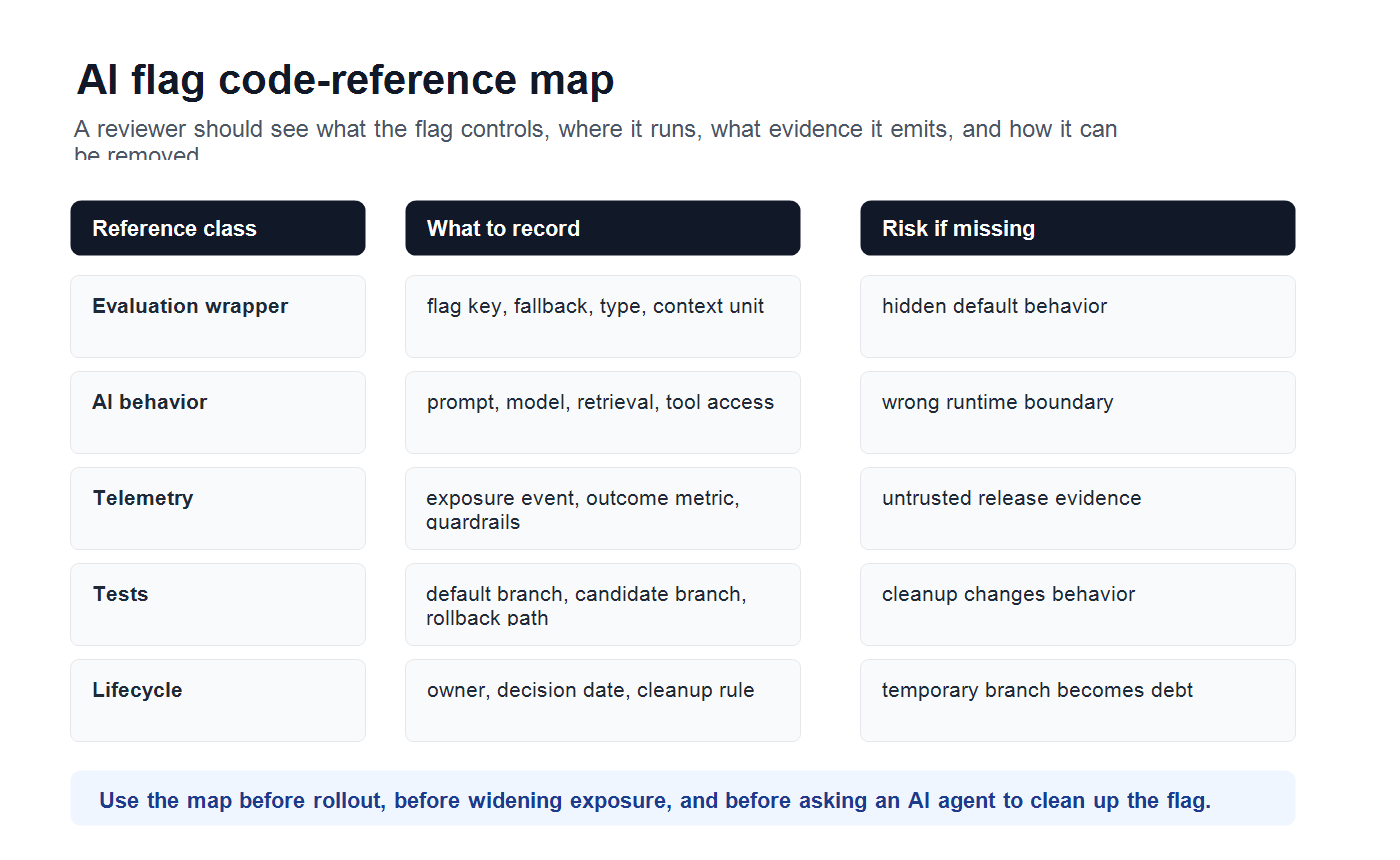
What AI Flag Code References Should Answer
When a developer searches for AI feature flag code references, they may mean one of two things:
- Code examples for implementing feature flags around AI behavior.
- Repository references that show where existing AI flags are evaluated, tested, tracked, and cleaned up.
Both jobs belong together. A good implementation pattern makes future code references easy to discover. A good reference map makes rollout, review, and cleanup safer.
For each AI flag, the map should answer these questions:
| Question | Why it matters |
|---|---|
| Which flag key or wrapper controls the behavior? | Reviewers need a stable identifier that connects code, FeatBit configuration, metrics, and tickets. |
| What AI surface does it control? | Prompt, model, retrieval, agent tool, guardrail, UI, or experiment assignment have different risk profiles. |
| Where is the flag evaluated? | Server, edge, client, worker, or agent runtime placement affects privacy, cost, latency, and evidence quality. |
| What is the safe fallback? | The default behavior is the real rollback path when the SDK cannot resolve the flag. |
| What exposure event is emitted? | Experiment and release evidence need a trustworthy record of the variation actually served. |
| Which tests prove the branches? | Cleanup is risky when tests disappear with the old branch. |
| Who owns the lifecycle decision? | Temporary AI controls become stale code unless an owner decides when to ship, pause, convert, or remove them. |
This is why FeatBit treats feature flags as release-decision infrastructure, not only if statements. The code reference is a release-control artifact.
Why AI Flags Need A Richer Reference Map
Traditional feature flags often guard UI, workflow, or backend logic. AI flags can do that too, but they also change runtime behavior that is harder to inspect from the outside.
An AI assistant feature might use flags like these:
| Flag | Controlled unit | Reference risk |
|---|---|---|
support_prompt_route |
Prompt bundle and system instruction | A prompt reference may live outside the code path that calls the model. |
model_provider_tier |
Model provider, model version, or cost tier | A rollout can change latency, spend, and fallback behavior. |
retrieval_profile |
Index, filter, reranker, or citation policy | A flag can change which documents are available to the model. |
agent_write_tools_enabled |
Tool access or autonomy level | A flag can authorize an action, not just render a button. |
ai_summary_experiment |
Experiment assignment and metric attribution | Analysis breaks if exposure is logged in the wrong place. |
That makes code references more than cleanup metadata. They are how reviewers understand the blast radius before rollout.
For evaluation placement, use the same principle as the dedicated guide on client-side or server-side AI feature flag evaluation: evaluate sensitive AI behavior where the risk is controlled and the evidence is trustworthy. For most prompt, model, retrieval, cost, and tool decisions, that means server-side or edge-side evaluation, then passing only a minimal evaluated result to the client.
Use A Small Evaluation Wrapper
The easiest code references to maintain are explicit, typed, and centralized. Avoid scattering raw flag keys through application code. Put the flag key, fallback, type, and context shape near one wrapper that reviewers can inspect.
type AiRoute = "control" | "candidate_prompt" | "disabled";

type AiFlagContext = {
  accountId: string;
  userId: string;
  region: string;
  surface: "support_chat" | "admin_console";
};

export async function getSupportAssistantRoute(
  context: AiFlagContext
): Promise<AiRoute> {
  return evaluateStringFlag<AiRoute>(
    "support_assistant_route",
    context,
    "control"
  );
}
The wrapper makes three review questions visible:
- The fallback is
control, so rollback returns to the existing path. - The assignment context is account-aware, not a random per-message decision.
- The string variations are constrained to known values.
OpenFeature's specification defines typed flag evaluation with a flag key, default value, evaluation context, and optional evaluation details. That vendor-neutral shape is a useful mental model even when the project uses a specific SDK or a FeatBit wrapper.
Keep AI Behavior Separate From Evaluation
The flag evaluation should select a behavior. It should not bury the behavior inside the flag call.
export async function answerSupportQuestion(input: SupportInput) {
  const route = await getSupportAssistantRoute({
    accountId: input.accountId,
    userId: input.userId,
    region: input.region,
    surface: "support_chat",
  });

  if (route === "disabled") {
    return handoffToHumanSupport(input);
  }

  const prompt = route === "candidate_prompt"
    ? prompts.supportCandidate
    : prompts.supportControl;

  return runSupportAssistant({ input, prompt });
}
This pattern gives code search and AI coding agents a stable place to start. The repository can find support_assistant_route, the wrapper can list the fallback and context, and the behavior branch remains small enough to test.
For FeatBit projects, this connects to feature flag lifecycle management. A flag should carry its purpose, owner, evidence rule, and cleanup path. The code should make that lifecycle understandable instead of hiding release intent inside scattered conditionals.
Add Telemetry References Next To The Runtime Decision
AI rollout evidence depends on actual exposure, not only eligibility. If the backend selected the candidate prompt, the backend should record that the candidate prompt actually ran.
await trackAiExposure({
  flagKey: "support_assistant_route",
  variation: route,
  unitId: input.accountId,
  surface: "support_chat",
  evaluationLocation: "server",
});
Then join outcome events to the same unit and variation:
await trackAiOutcome({
  unitId: input.accountId,
  flagKey: "support_assistant_route",
  variation: route,
  eventName: "support_case_resolved",
  latencyMs: result.latencyMs,
  escalated: result.escalated,
});
The exact event shape depends on the application and SDK. The important code-reference rule is stable: the exposure reference should be near the runtime decision, and the outcome reference should be joinable to the same flag, variation, and assignment unit.
FeatBit's Track Insights API is the product path for sending feature flag variation results and custom metric events. FeatBit's measurement design guidance is the planning step: define the primary metric and guardrails before exposure begins.
Collect References Before Rollout Or Cleanup
Do not wait until a flag is stale to build the map. Use it at three moments:
- Before the first production rollout.
- Before increasing exposure.
- Before asking an AI coding agent to prepare cleanup.
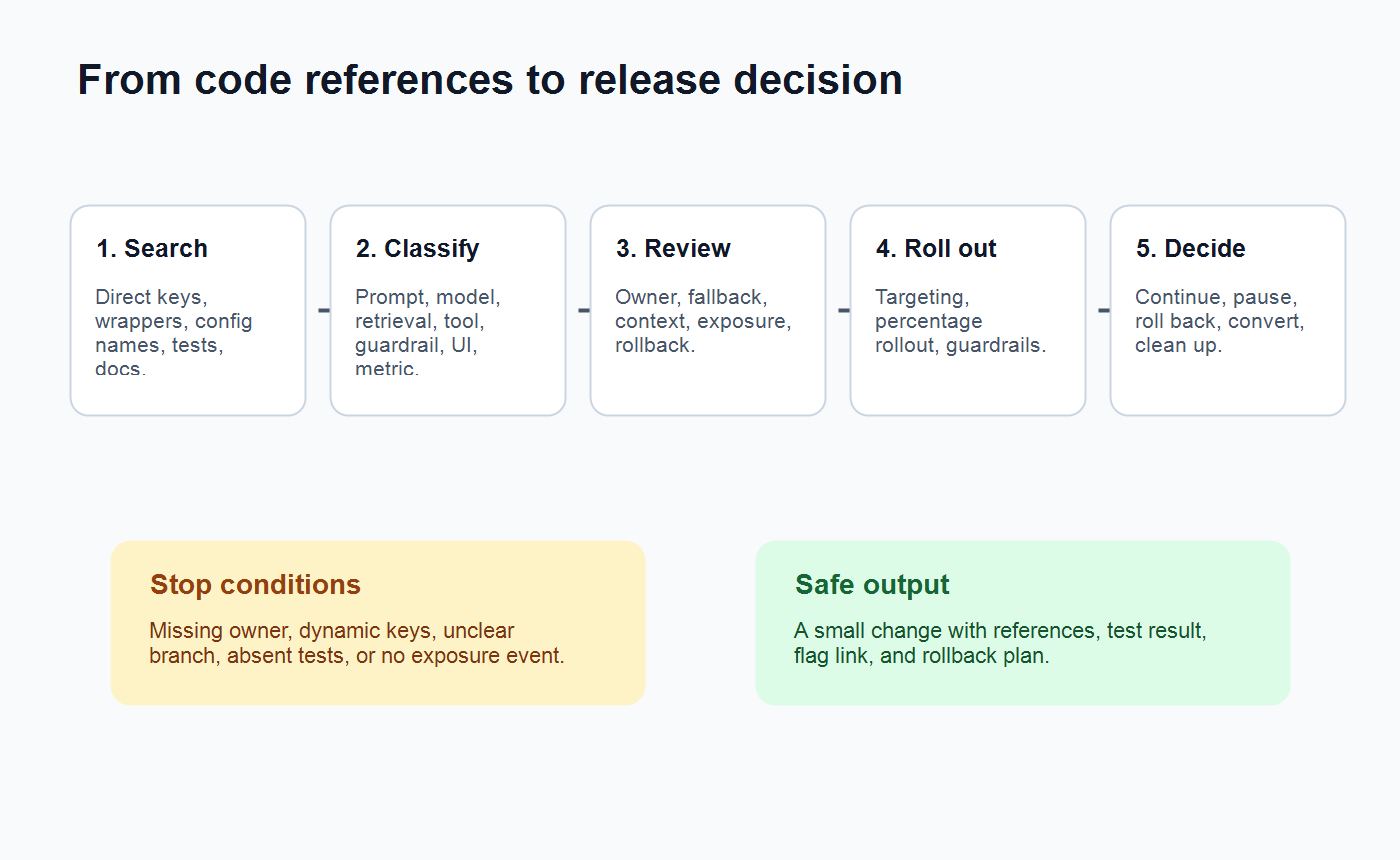
A practical reference collection workflow looks like this:
| Step | Output |
|---|---|
| Search | Direct flag keys, wrapper functions, config names, prompt identifiers, tests, docs, dashboards, and telemetry events. |
| Classify | Mark each reference as evaluation, AI behavior, exposure, outcome, test, documentation, or lifecycle metadata. |
| Review | Confirm owner, fallback, context, risk class, experiment unit, rollback path, and cleanup rule. |
| Roll out | Use FeatBit targeting, percentage rollout, or environment-specific rules to control exposure. |
| Decide | Continue, pause, roll back, convert the flag to a long-lived operational control, or clean it up. |
Some feature flag platforms use "code references" as a specific product feature. LaunchDarkly, for example, documents code references organized by repository and generated by its ld-find-code-refs tooling. The broader engineering lesson applies across tools: repository references are useful only when they preserve enough context for a reviewer to trust the next release decision.
What To Put In A Pull Request
When a pull request adds or changes an AI flag, include a short reference block. This makes code review and owner review less dependent on memory.
### AI feature flag references

- Flag key:
- Wrapper function:
- AI surface: prompt | model | retrieval | tool | guardrail | UI | experiment
- Evaluation location: server | edge | client | worker | agent runtime
- Safe fallback:
- Assignment unit:
- Exposure event:
- Outcome metric:
- Tests:
- FeatBit flag link:
- Owner:
- Cleanup condition:
For AI-assisted development, this block is also a useful prompt contract. An agent can draft the fields from the diff, but a human owner should confirm the fallback, rollout audience, and cleanup condition before production exposure. The workflow complements the broader AI-assisted flag management pattern: AI can find references and draft review notes, while FeatBit remains the deterministic control plane for production rollout.
Reference Patterns By AI Use Case
Use this checklist when reviewing common AI flag use cases.
| Use case | Required code references |
|---|---|
| Prompt rollout | Prompt registry, flag wrapper, fallback prompt, exposure event, quality metric, prompt cleanup note. |
| Model migration | Provider route, model version, budget or rate-limit guard, latency metric, failure fallback, rollback test. |
| RAG configuration | Index name, filter policy, retrieval depth, citation rule, no-answer metric, evaluation dataset reference. |
| Agent tool permission | Tool registry, policy check, approval fallback, audit event, denied-action test, owner review date. |
| AI experiment | Assignment unit, variation meaning, exposure event, primary metric, guardrails, winner cleanup path. |
| AI UI entry point | Client or server gate, eligibility rule, rendering fallback, click or activation metric, accessibility test. |
Do not make every AI flag permanent. Some controls should live for the life of the product, such as kill switches, permission gates, and incident controls. Others should disappear after the rollout or experiment decision. FeatBit's guide to cleaning up stale feature flags with coding agents is the next step when the reference map says a temporary AI branch can be removed.
Common Mistakes
Searching only for the raw flag key. Wrappers, aliases, config objects, prompt names, and telemetry events can matter as much as direct SDK calls.
Using dynamic flag keys. A key assembled from strings is harder to find, review, and clean up. Prefer explicit keys or a typed registry.
Logging eligibility instead of exposure. A user may be eligible for the candidate path but never actually receive it because the backend falls back. Log exposure where the AI behavior runs.
Mixing rollout and permission logic. A temporary prompt rollout flag should not quietly become a long-lived entitlement rule. If the purpose changes, update ownership and lifecycle expectations.
Deleting tests with the losing branch. Cleanup should preserve tests for the permanent behavior and remove only obsolete branch coverage.
Letting AI cleanup run without a map. An AI coding agent can help find references and draft a pull request, but it should stop when owner, fallback, permanent branch, or exposure evidence is unclear.
The FeatBit Perspective
FeatBit's role is to keep the production decision explicit. The repository shows where the flag is referenced. FeatBit shows the runtime state, targeting rules, rollout percentage, environments, variation behavior, audit trail, and release evidence.
For AI systems, that combination gives teams a practical operating model:
- Use code references to identify every place the AI behavior can change.
- Use FeatBit to control who receives the behavior and how quickly exposure expands.
- Use telemetry and FeatBit insights to decide whether the rollout should continue.
- Use lifecycle rules to remove temporary prompt, model, retrieval, or experiment branches after the decision.
- Use FeatBit CLI, API, or MCP-assisted workflows carefully when bringing release control into AI coding environments.
The result is not more process for its own sake. It is a way to make AI feature flags reviewable while keeping the speed benefit of AI-assisted development.
FAQ
Are AI feature flag code references just code examples?
No. Code examples show how to implement the flag. Code references show where the flag affects real behavior, telemetry, tests, documentation, and cleanup. A useful article or pull request should include both.
Should every AI flag be easy to clean up?
Every temporary AI flag should have a cleanup path. Long-lived operational controls, permission gates, and kill switches may stay, but they should be documented as permanent controls with clear ownership.
Can an AI coding agent build the reference map?
Yes, if it is constrained to evidence gathering first. It can search keys, wrappers, prompts, tests, and docs, then draft a reference map. It should not widen rollout or delete code until the owner confirms the permanent behavior and rollback path.
What is the best first step?
Pick one AI flag that controls a prompt, model, retrieval profile, or agent tool. Write down the wrapper, fallback, evaluation location, exposure event, tests, owner, and cleanup condition before the next rollout change.
Source Notes
- FeatBit product context: AI Release Engineering, Feature Flags as the AI Control Layer, feature flag lifecycle management, Track Insights API, and FeatBit MCP.
- Implementation and standards context: OpenFeature's Flag Evaluation API specification defines typed flag evaluation, default values, evaluation context, and evaluation details.
- Category context: LaunchDarkly documents repository-based code references and its open-source
ld-find-code-refsscanner. These links are cited as category examples, not as vendor rankings.
Image And Open Graph Notes
- Use
/images/blogs/ai-feature-flag-code-references/cover.pngas the Open Graph image because it summarizes the flag key, runtime use, evidence, and release decision path. - Use
code-reference-map.pngnear the opening because it gives readers the working model for evaluation, AI behavior, telemetry, tests, and lifecycle references. - Use
reference-review-workflow.pngnear the workflow section because it shows how code references turn into rollout, rollback, conversion, or cleanup decisions.