
AI Risk Control With Feature Flags: A Practical Governance Playbook
AI risk control with feature flags means turning AI governance from a policy document into runtime controls: who can see a model, prompt, retrieval path, or agent capability; who can approve expansion; which guardrails stop the rollout; how fast the team can roll back; and what evidence remains for audit review.
The point is not to claim that feature flags solve all AI governance. They do not replace model evaluation, security review, privacy review, legal assessment, or domain expertise. Their job is narrower and practical: they make AI behavior controllable after deployment, before a risky change reaches everyone.
Why AI risk needs runtime control
Traditional release governance often assumes the risky decision happens before deployment. AI systems weaken that assumption. A shipped AI feature may still change behavior through prompt versions, model routes, retrieval sources, tool access, autonomy level, policy thresholds, or fallback rules.
That creates a governance gap. A pull request can be approved, a model card can be reviewed, and an offline eval can pass, but the team still needs to answer operational questions during live exposure:
- Which users, tenants, regions, or workflows should see the AI change first?
- Which human approval is required before broader exposure?
- Which metrics prove that the change is acceptable?
- Which guardrail breach pauses or rolls back the release?
- Who changed the AI behavior, when, and why?
- When does the temporary control get cleaned up?
NIST's AI Risk Management Framework describes AI risk management as work across Govern, Map, Measure, and Manage functions, and its playbook is intended to help teams incorporate trustworthiness considerations across design, development, deployment, and use. That framing matters for product teams because risk control does not end when code is deployed. Runtime exposure, measurement, and rollback are part of the control system.
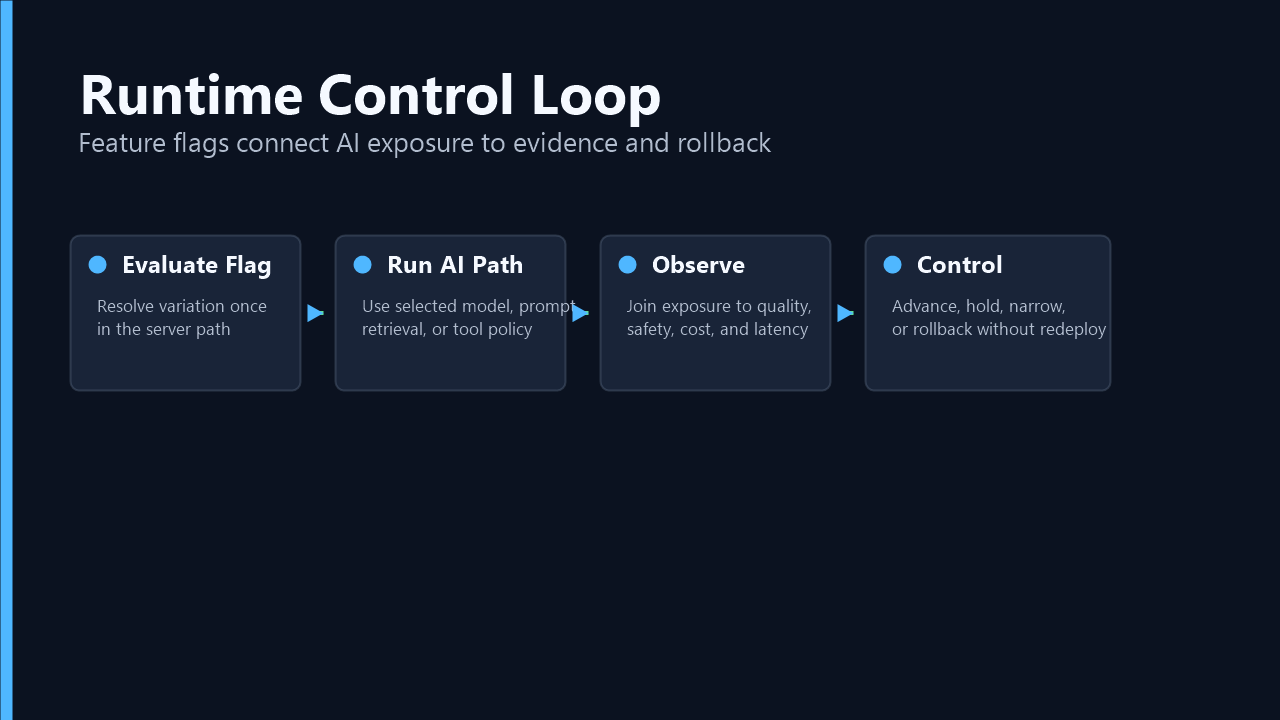
Feature flags are useful in this narrow layer because they control exposure without redeploying. They let teams stage AI behavior for internal users, selected customers, small percentages, or safer segments while collecting the evidence needed for the next decision.
The AI controls that belong behind flags
Not every AI setting needs a feature flag. A flag is useful when the decision may need targeted exposure, rapid rollback, or an audit trail. The most common AI risk-control surfaces are:
| AI control surface | Example flag decision | Main risk reduced |
|---|---|---|
| Model route | baseline, candidate, fallback |
Quality, latency, cost, provider failure |
| Prompt profile | stable, shorter, policy_v2 |
Answer quality, tone, unsafe instruction drift |
| Retrieval path | keyword, hybrid, restricted_sources |
Grounding, data boundary, stale context |
| Guardrail policy | standard, strict, fallback_first |
Unsafe output, false positive blocking |
| Agent autonomy | observe, draft, approval_required, autonomous |
Excessive agency and side effects |
| Tool access | read_only, draft_write, approved_external |
Unauthorized action, customer-visible change |
| Rollout scope | internal, beta segment, region, percentage | Blast radius and incident containment |
OWASP's LLM application guidance calls out risks such as prompt injection, sensitive information disclosure, excessive agency, and overreliance. A feature flag is not the security control for all of those risks, but it can limit exposure, reduce autonomy, disable a risky tool path, or move users to a safer fallback while the underlying issue is fixed.
A governance-to-runtime workflow
Use feature flags as the bridge between AI governance policy and production behavior. The workflow has six checkpoints.
1. Classify the AI change before rollout
Start with the decision being released, not the implementation detail.
Ask:
- Is this a model, prompt, retrieval, guardrail, tool, autonomy, or user-experience change?
- Can the change affect user data, permissions, money, safety, compliance, or customer trust?
- Is the behavior reversible without a redeploy?
- Which audience can safely see it first?
- Which team owns the release decision?
Low-risk UI copy around an AI feature may only need normal release review. A new prompt for a support answer may need targeted exposure and quality metrics. A tool that writes to a customer system should default to approval-required mode, narrow targeting, and an explicit rollback path.
2. Create a flag contract
A flag contract prevents vague toggles from becoming permanent AI control debt. Write the contract before production exposure.
| Contract field | What to define |
|---|---|
| Flag key | A stable name tied to the AI decision |
| Owner | The person or team allowed to expand, pause, or retire the flag |
| Variations | Clear meanings such as baseline, candidate, strict, or approval_required |
| Safe fallback | The behavior used when evaluation fails or risk rises |
| First audience | Internal users, a beta tenant, a region, or a small percentage |
| Approval rule | Who must approve exposure changes and when |
| Guardrails | Metrics or events that pause or roll back the rollout |
| Audit evidence | What must be recorded for later review |
| Cleanup rule | When the temporary control is removed or made permanent |
FeatBit's feature flag lifecycle management guidance uses the same discipline for release assets: every flag needs purpose, ownership, evidence, decision, and cleanup expectations.
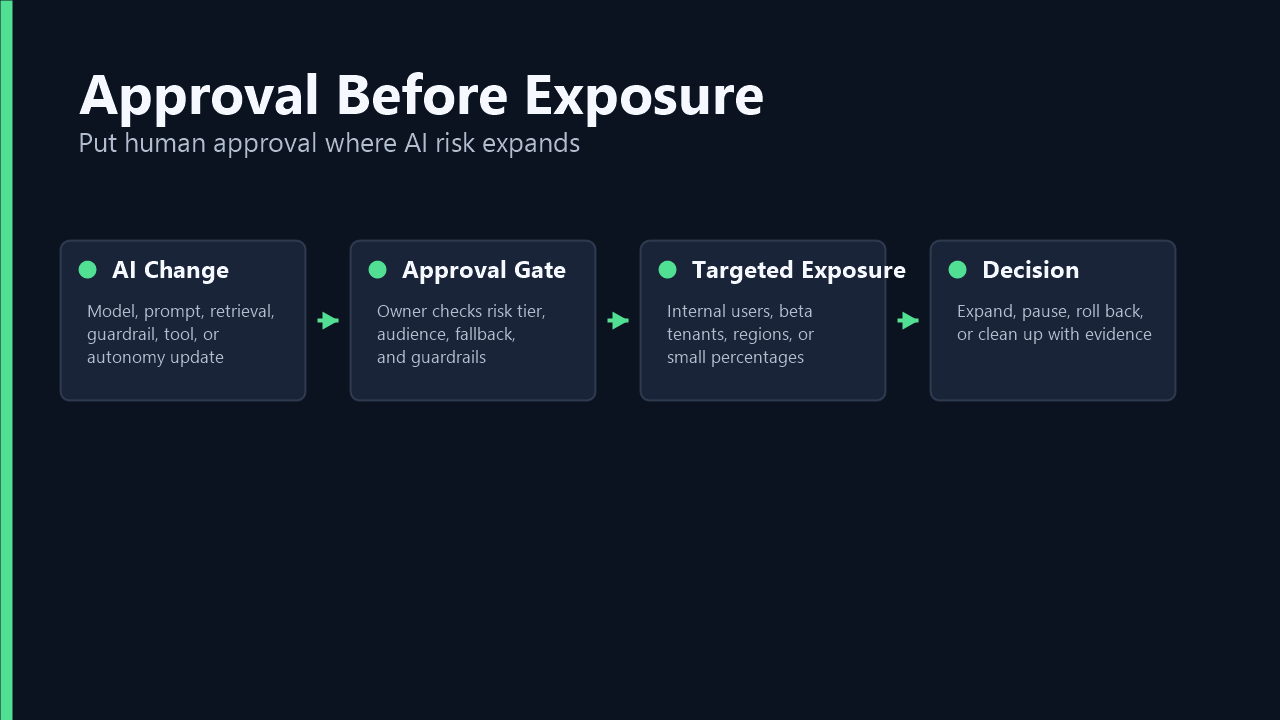
3. Put approval at the exposure boundary
Approval should guard the moment risk expands, not only the moment code merges. For AI releases, that boundary is often a flag change:
- enabling a candidate model for external users;
- moving an agent from draft mode to approval-required mode;
- expanding a prompt variant from internal testing to a customer segment;
- allowing a tool class in production;
- raising the rollout percentage after a guardrail review.
In FeatBit, this maps to environment permissions, role-based access, IAM policies, audit logs, and change workflows around flags. The governance rule can be simple: high-risk AI behavior cannot move to a broader audience unless the owner, approver, guardrails, and rollback path are visible.
4. Expand exposure in stages
AI releases should not jump from "passed offline eval" to "everyone sees it." Use staged exposure so the team can learn without making the first production signal a broad incident.
A practical rollout path:
- Keep the flag defaulted to the stable behavior.
- Enable the candidate for internal users.
- Expand to a beta tenant or low-risk segment.
- Move to a small percentage of eligible traffic.
- Increase exposure only when guardrails remain healthy.
- Stop, narrow, or roll back when a guardrail crosses the agreed threshold.
FeatBit's targeting rules, user segments, and percentage rollouts are the implementation primitives for this pattern. For AI-specific rollout design, FeatBit's safe AI deployment page gives the broader release-engineering context.
5. Attach guardrails to the release decision
A guardrail is only useful if it can change the release decision. Define guardrails before exposure starts, then treat them as stop conditions.
Common AI guardrails include:
- answer escalation rate;
- human reviewer rejection rate;
- groundedness or evaluator score;
- unsafe output report rate;
- latency at the tail, not only the average;
- token cost per successful task;
- tool failure or approval rejection rate;
- support contact rate for exposed accounts;
- sensitive-data policy violation count.
The release owner should decide in advance what each signal means:
ai_release_guardrails:
  primary_metric: successful_task_completion
  stop_conditions:
    - unsafe_output_report_rate_above_threshold
    - p95_latency_regression_above_threshold
    - cost_per_successful_task_above_budget
    - human_reviewer_rejection_rate_above_threshold
  action_on_stop: rollback_to_stable_variation
  review_owner: ai_release_owner
FeatBit can provide the exposure control and variation context. Product metrics, AI eval scores, traces, and operational telemetry may come from other systems. The important design rule is that outcome events must be joinable to the served flag variation. FeatBit's Track Insights API, flag insights, and OpenTelemetry integration are practical places to connect that evidence.
What auditability should prove
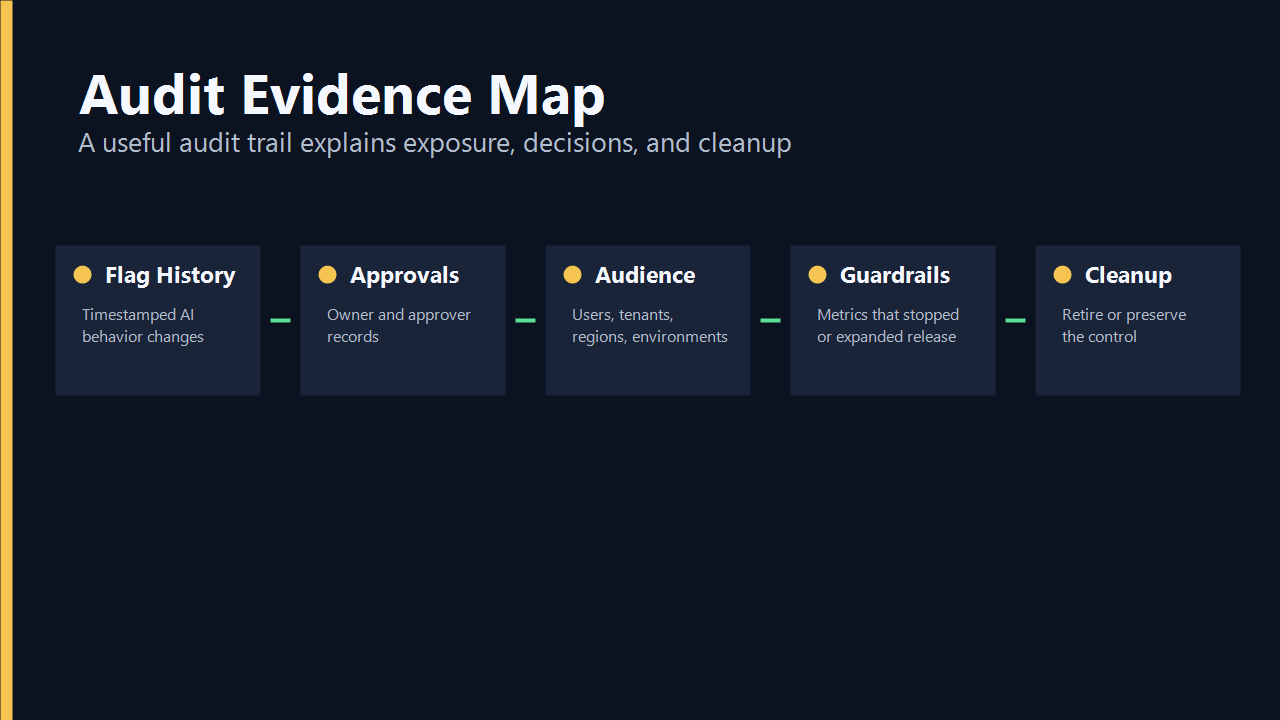
Auditability is not just a log export. For AI risk control, the evidence should prove that the team controlled exposure intentionally and could reconstruct the decision later.
Useful audit evidence includes:
| Evidence | Question it answers |
|---|---|
| Flag history | Who changed the AI behavior and when? |
| Approval record | Who approved broader exposure? |
| Audience rule | Which users, tenants, regions, or environments were included? |
| Variation record | Which model, prompt, retrieval path, or policy ran? |
| Metric snapshot | Which guardrails were healthy or breached? |
| Rollback action | How quickly did the team narrow or stop exposure? |
| Cleanup decision | Was the temporary AI control removed, archived, or made permanent? |
This is where feature flags become more than a switch. FeatBit's audit log, IAM overview, RBAC, and webhooks help teams connect change history, access control, and downstream review workflows.
A practical control matrix
Use this matrix when deciding how much governance a flagged AI release needs.
| Risk tier | Examples | Required flag controls |
|---|---|---|
| Low | AI UI copy, non-sensitive personalization, internal assistant hints | Owner, safe fallback, normal rollout note |
| Medium | Prompt change, model route, retrieval strategy, answer formatting | Internal-first targeting, guardrails, rollback variation, metric review |
| High | Customer-facing automation, tool access, permission-sensitive workflow, costly model route | Approval before external exposure, narrow segments, stop conditions, audit log review |
| Restricted | Regulated decision support, financial action, safety-related action, irreversible external effect | Separate policy review, human approval, minimal exposure, incident runbook, expert review |
This is not legal advice and it is not a substitute for regulatory classification. It is an engineering operating model for product teams that need proportional controls before they expose AI behavior in production.
Common mistakes
Treating a global kill switch as governance
A kill switch is necessary, but it is too coarse for normal risk control. Teams also need flags for model route, prompt profile, retrieval source, agent mode, tool tier, and rollout audience. The narrower the control, the easier it is to reduce risk without shutting down the whole feature.
Approving the pull request but not the exposure
AI risk often changes at exposure time. A merged prompt route may be harmless for internal users and risky for a regulated customer segment. Put approval on the flag change that expands audience or autonomy.
Measuring guardrails after the rollout starts
If the team chooses metrics after seeing results, the release decision becomes opinion-driven. Define the primary metric, guardrails, thresholds, owner, and rollback action before the first external exposure.
Forgetting cleanup
Temporary AI controls multiply quickly: model flags, prompt flags, policy flags, denylist flags, fallback flags, and incident flags. Each one needs an expected end state. FeatBit's release decision framework is useful here because it treats release as a loop that ends with decision and learning, not with an abandoned toggle.
How FeatBit fits
FeatBit is useful for AI risk control when teams need a runtime control layer for AI-era releases:
- feature flags for prompts, models, retrieval paths, guardrails, tool access, and rollout scope;
- targeting rules and percentage rollouts for staged exposure;
- environments, IAM, RBAC, and audit logs for governance;
- webhooks, APIs, and observability integrations for automation and review;
- lifecycle practices so temporary AI controls do not become permanent debt;
- self-hosted and open-source deployment paths when infrastructure control and data ownership matter.
For teams evaluating the broader architecture, start with FeatBit's AI control layer, AI governance and risk control, AI rollback strategy, and self-hosted feature flags. For implementation details, use the FeatBit docs for feature flag targeting, audit logs, and IAM policies.
Source notes
- NIST AI Risk Management Framework context: NIST describes the AI RMF as voluntary guidance for managing risks to individuals, organizations, and society, and its AI RMF Playbook covers Govern, Map, Measure, and Manage functions for design, development, deployment, and use.
- OWASP LLM application risk context: OWASP's Top 10 for LLM Applications identifies application-layer risks including prompt injection, sensitive information disclosure, excessive agency, and overreliance.
- FeatBit product context: FeatBit documentation for targeting rules, percentage rollouts, audit logs, IAM, RBAC, webhooks, Track Insights, and OpenTelemetry supports the release-control workflow described here.
- Image and Open Graph recommendation: use
/images/blogs/ai-risk-control-with-feature-flags/cover.pngas the social preview image, with the body diagrams explaining approval, runtime control, and audit evidence.