
How Feature Flags Help With AI Governance and Compliance
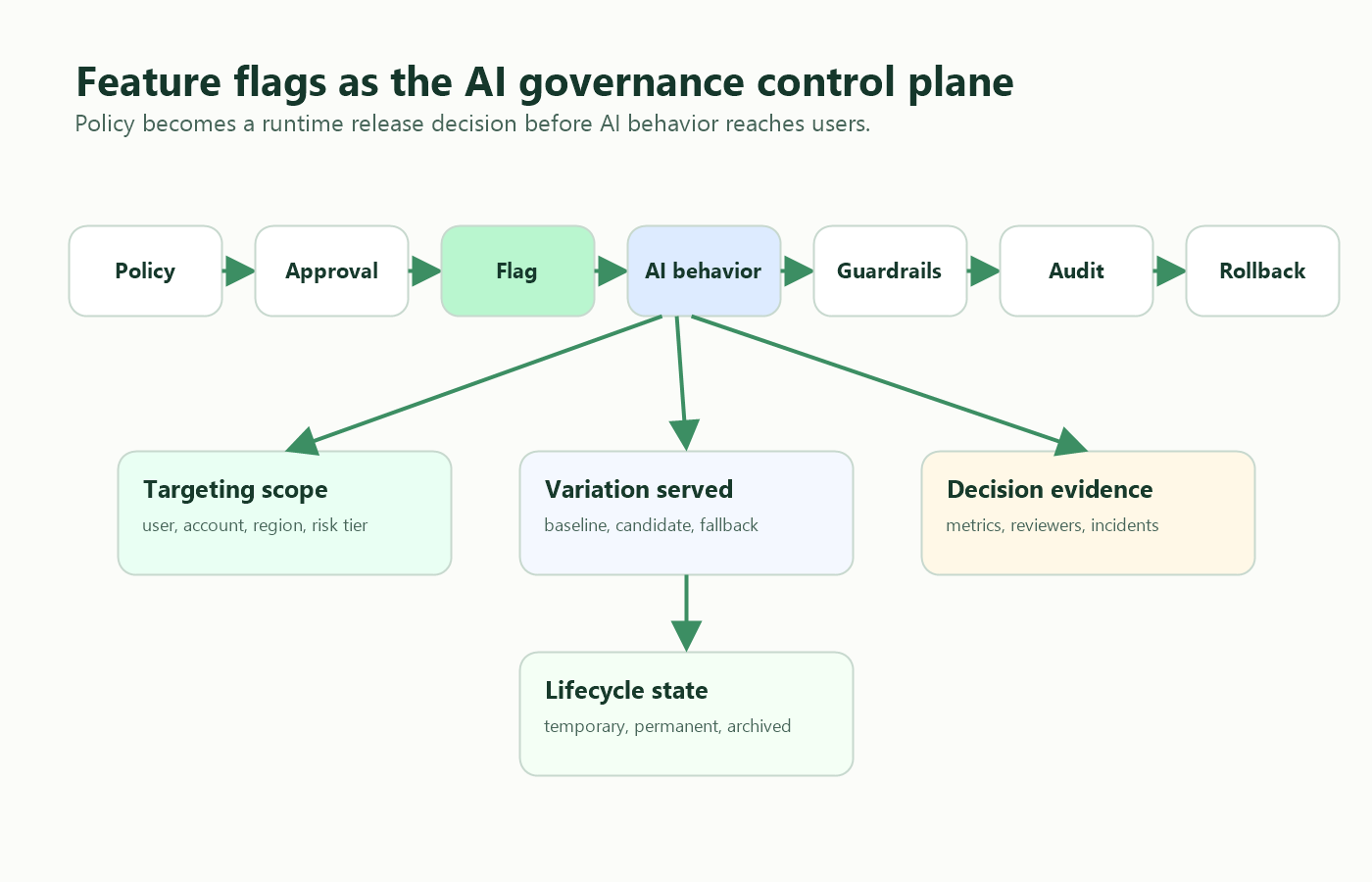
Feature flags help with AI governance and compliance by turning policy decisions into runtime controls. They let a team decide which AI behavior is active, who may see it, who may expand it, which guardrails must stay healthy, how rollback works, and what evidence remains for later review.
They do not make an AI system compliant by themselves. A feature flag platform is not a legal, privacy, model-risk, or security program. Its value is narrower and operational: it gives governance teams a control point between "the AI change exists" and "everyone is exposed to it."
The Short Answer
Feature flags help AI governance in five practical ways:
| Governance need | How feature flags help |
|---|---|
| Approval | Require the right owner or reviewer before an AI behavior reaches broader audiences. |
| Controlled exposure | Release a prompt, model route, retrieval source, agent mode, or AI feature to internal users, a segment, a region, or a small percentage first. |
| Guardrails | Tie rollout expansion to quality, safety, cost, latency, support, or business metrics. |
| Rollback | Move traffic back to a stable variation without waiting for a redeploy. |
| Auditability | Preserve who changed the control, when it changed, what audience was affected, and which decision followed. |
That is why feature flags are useful for AI compliance readiness. Many governance and regulatory conversations ask for traceability, documentation, human oversight, risk controls, and monitoring. Feature flags can supply part of that evidence trail when they are connected to approval records, exposure events, metrics, and incident response.
Why AI Governance Needs Runtime Controls
AI risk often changes after deployment. A merged pull request may still choose between prompt versions, model routes, retrieval indexes, tool permissions, grader thresholds, fallback behavior, or rollout audiences at runtime.
That creates a gap between policy and production behavior. A governance policy may say:
- high-risk AI changes need approval;
- sensitive accounts must be excluded from early rollout;
- a human must review certain outputs before side effects occur;
- the team must be able to reconstruct who saw a candidate behavior;
- rollback must be available if safety, cost, or quality signals degrade.
Feature flags are useful because each of those statements can become an enforceable release decision. Instead of documenting "the model was approved," the system can record "the candidate model route was approved for internal users, excluded from regulated segments, measured against defined guardrails, and rolled back to the baseline variation if a stop condition appeared."
NIST's AI Risk Management Framework is a helpful reference point because it frames AI risk work around governance, mapping, measurement, and management. NIST also states that AI RMF 1.0 is voluntary guidance and, as of its AI RMF page, is being revised. Treat it as risk-management context, not as a certification shortcut.
The Compliance Evidence Packet
For compliance-adjacent work, the most useful output is not the flag itself. It is the evidence packet around the flag.
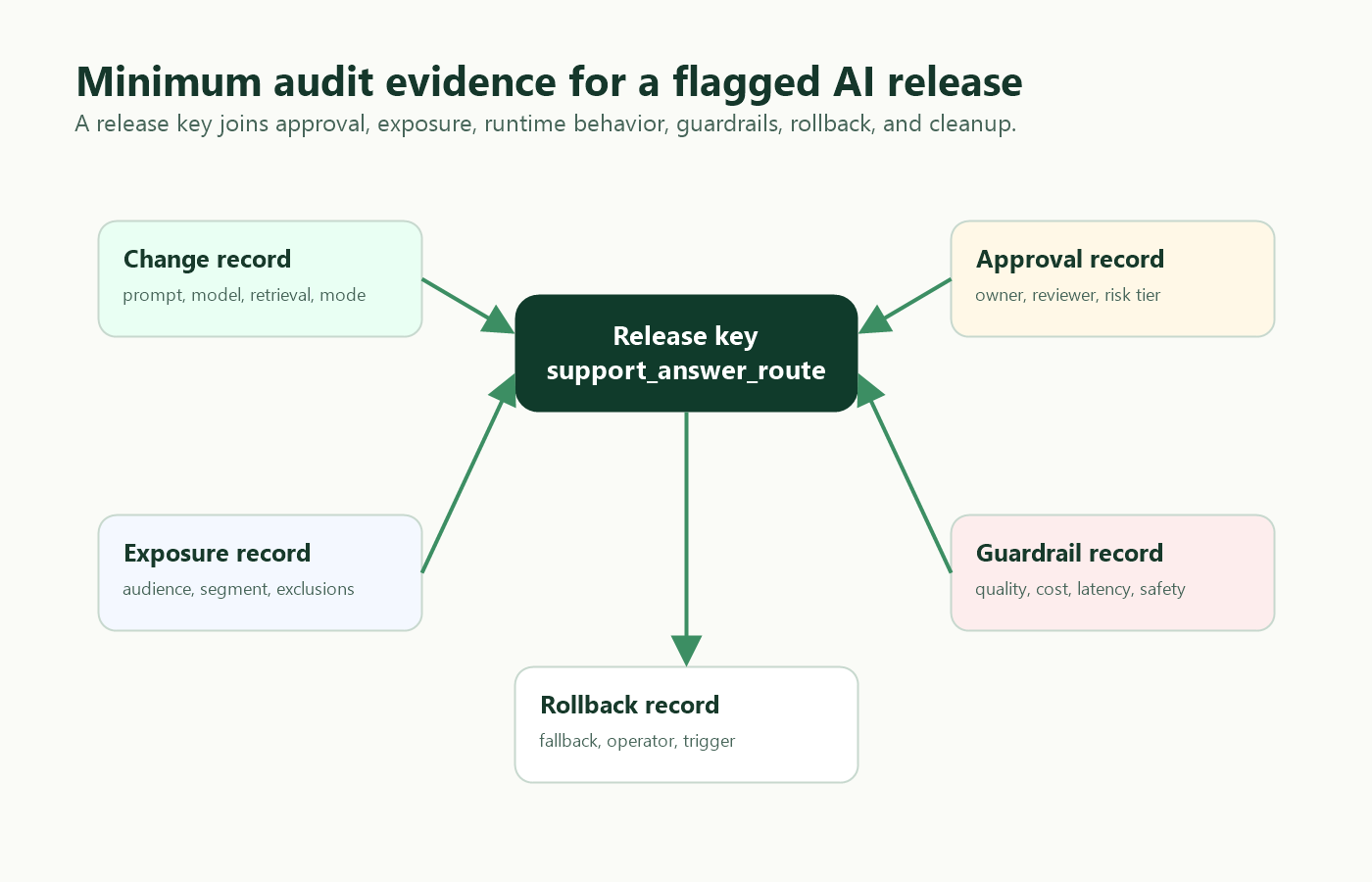
A practical evidence packet should answer these questions:
| Evidence question | Record to keep |
|---|---|
| What AI behavior changed? | Flag key, variation, prompt or model route, retrieval profile, agent mode, or config bundle. |
| Who approved exposure? | Owner, approver, approval timestamp, risk tier, and evidence reviewed. |
| Who was exposed? | Environment, segment, account, region, percentage, user attributes, and exclusion rules. |
| What actually ran? | Evaluated variation, fallback status, route metadata, and execution timestamp. |
| What guardrails were watched? | Quality, latency, cost, safety, escalation, support, or business metrics tied to the exposed variation. |
| How could the team stop it? | Rollback variation, kill switch, owner, trigger, and containment record. |
| What happened after the decision? | Continue, expand, pause, rollback, archive, or cleanup outcome. |
This packet is useful because compliance review often fails when evidence lives in scattered places: a chat approval, a dashboard screenshot, a deployment log, a model registry entry, and a separate incident note. A release key, often the feature flag key, gives the team one thread that connects the decision.
The European Commission's AI Act summary is a good example of why this matters. It lists obligations for high-risk AI systems such as risk assessment and mitigation, activity logging for traceability, documentation, information for deployers, human oversight, robustness, cybersecurity, and accuracy. Feature flags do not satisfy those obligations on their own, but they can help produce operational records for exposure, approval, oversight, rollback, and monitoring.
What AI Controls Belong Behind Flags
Do not put every AI setting behind a flag. Use flags where runtime control changes risk, blast radius, or evidence quality.
| AI control surface | Good flag pattern | Compliance value |
|---|---|---|
| AI feature availability | Boolean flag for internal, beta, region, tenant, or percentage rollout | Shows staged exposure and exclusion logic. |
| Prompt profile | String variation such as stable, candidate, strict, or fallback |
Shows which prompt behavior was active for each audience. |
| Model route | String or JSON variation for route, timeout, provider, budget, and fallback | Shows route decisions without treating a model name as the whole behavior. |
| Retrieval profile | Variation for source set, index, region, or memory scope | Shows which data boundary or source policy was used. |
| Agent authority | Mode flag such as observe, search_only, draft, approval_required, or limited_action |
Shows how autonomy was constrained before side effects. |
| Guardrail mode | Variation for strictness, fallback-first behavior, or incident mode | Shows that risk posture can narrow without a redeploy. |
| Rollout percentage | Percentage rollout for eligible users or accounts | Shows controlled expansion and containment scope. |
| Permanent policy control | Durable flag with owner, review cadence, and audit expectation | Shows an ongoing operating control rather than a temporary launch switch. |
The strongest governance pattern is a typed flag contract. The contract defines the owner, risk tier, allowed variations, safe default, first audience, approval rule, guardrails, rollback action, audit sources, and cleanup rule before the first external exposure.
ai_governance_flag:
  key: support_answer_route
  owner: support-ai-platform
  risk_tier: high
  default_variation: baseline
  allowed_variations:
    - baseline
    - candidate
    - approval_required
    - fallback
  first_audience: internal_support_users
  excluded_segments:
    - regulated_region
    - enterprise_legal_hold
  approval_required_for:
    - external_customer_exposure
    - rollout_above_10_percent
    - autonomy_increase
  guardrails:
    - answer_quality_review_score
    - support_escalation_rate
    - p95_latency
    - cost_per_resolved_case
  rollback_action: set_variation_to_baseline
  audit_sources:
    - flag_audit_log
    - approval_record
    - exposure_event
    - guardrail_dashboard
  cleanup_rule: review_after_two_healthy_release_windows
The exact fields will differ by team. The important point is that the flag is not just a switch. It is the release-control object for an AI governance decision.
How Feature Flags Support Human Oversight
Human oversight is more useful when it is attached to a specific decision boundary. Feature flags create those boundaries.
Useful approval points include:
- enabling a candidate prompt for external users;
- moving an agent from
draftmode toapproval_requiredmode; - allowing a tool class for a production workflow;
- expanding a model route from internal users to a customer segment;
- increasing rollout percentage after a guardrail review;
- disabling a fallback after the candidate appears stable.
This is different from approving every code change. The reviewer is approving risk expansion: the audience, autonomy level, route, guardrail evidence, rollback path, and cleanup expectation.
FeatBit supports this operating model through targeting rules, percentage rollouts, audit logs, IAM, webhooks, and OpenTelemetry integration. The broader AI governance and risk control and AI control layer pages explain where those primitives sit in an AI release architecture.
Where Feature Flags Stop
Feature flags are governance infrastructure, not the entire governance program.
They do not replace:
- legal, privacy, or regulatory analysis;
- model cards, data lineage, or model registry controls;
- hard authorization, scoped credentials, sandboxing, or network controls;
- secure software development practices;
- AI evals, red teaming, or safety review;
- incident response plans;
- human accountability for consequential decisions.
This boundary matters most for compliance language. A flag can show that only one segment received a candidate AI behavior. It cannot prove that the underlying model, data, use case, or business process satisfies a specific law or contractual control. The responsible experts still need to interpret the evidence.
A Practical Governance Workflow
Use this workflow when an AI behavior is close to production.
- Classify the AI behavior by production impact, data sensitivity, autonomy, reversibility, and user-visible risk.
- Define the flag contract before exposure starts.
- Keep the safe variation as the default in production.
- Route approval to the owner who understands the risk: product, platform, security, data, support, finance, or compliance.
- Start with internal users or a low-risk segment.
- Log the evaluated variation when the AI behavior actually runs.
- Join exposure to guardrail and outcome events.
- Expand, pause, narrow, or roll back based on the prewritten decision rule.
- Store the decision with the release key.
- Clean up temporary flags or document durable operational controls.
FeatBit's safe AI deployment page expands the rollout side of this workflow. FeatBit's feature flag lifecycle management guidance helps prevent governance controls from becoming stale release debt.
FAQ
Do feature flags make an AI system compliant?
No. Feature flags can support compliance evidence, but they do not certify compliance. They help show control over exposure, approvals, changes, rollback, and audit history. Whether that evidence satisfies a law, standard, contract, or internal control depends on the requirement and should be reviewed by the responsible experts.
Are feature flags enough for high-risk AI systems?
No. High-risk AI systems need broader controls around data, model behavior, security, human oversight, documentation, monitoring, and incident response. Feature flags are useful at the runtime release layer because they help govern who receives a behavior, how exposure expands, and how the team can contain risk.
Should prompts, models, and agent tools each have separate flags?
Sometimes. Separate flags are useful when the team needs independent approval, rollback, targeting, or auditability for each surface. A combined route flag is better when prompt, model, retrieval, and fallback must change as one approved bundle. The audit record should make the bundle explicit either way.
What is the best first flag for AI governance?
Start with the control point that limits blast radius. For many teams, that is a feature availability flag or a route flag with baseline, candidate, and fallback variations. Add approval, targeting, guardrail, and audit fields before the candidate reaches external users.
Source Notes
- NIST AI risk context: NIST's AI Risk Management Framework page says AI RMF 1.0 is voluntary guidance for managing AI risks and notes that AI RMF 1.0 is being revised. The AI RMF 1.0 PDF organizes AI risk management around Govern, Map, Measure, and Manage functions.
- EU AI Act context: The European Commission's AI Act overview describes a risk-based framework and lists high-risk obligations including risk mitigation, activity logging, documentation, information for deployers, human oversight, robustness, cybersecurity, and accuracy. This article does not provide legal advice.
- AI application risk context: OWASP's Top 10 for LLM Applications is useful background for risks such as prompt injection, sensitive information disclosure, excessive agency, and overreliance.
- Feature flag standard context: OpenFeature's flag evaluation specification provides vendor-neutral language for flag keys, typed evaluation, context, defaults, and evaluation details.
- FeatBit implementation context: targeting rules, percentage rollouts, audit logs, IAM, webhooks, OpenTelemetry integration, and feature flag lifecycle management support the operating model described here.
- Related FeatBit reading: AI governance with feature flags, AI risk control with feature flags, AI-generated code governance, AI governance and risk control, and feature flags as the AI control layer.
Image And Open Graph Notes
- Use
cover.pngas the Open Graph image for this article. - Use
governance-control-plane.pngnear the opening because it shows how feature flags connect policy to runtime controls. - Use
audit-evidence-map.pngin the evidence section because it shows which records make AI governance reviewable.
Next Step
Pick one AI behavior that could reach users this month. Before rollout, write its flag contract: owner, risk tier, default variation, first audience, approval boundary, guardrails, rollback action, audit sources, and cleanup rule. If those fields are blank, the behavior may be technically deployable, but it is not governance-ready.