
AI Governance With Feature Flags: A Runtime Control Playbook
AI governance with feature flags means turning AI policy into runtime controls that teams can target, observe, audit, and roll back. The flag is not the whole governance program. It is the control point where an AI prompt, model route, retrieval source, generated workflow, or agent capability becomes active for a specific user, account, environment, region, rollout stage, or incident state.
That distinction matters for teams evaluating AI governance tools. Policies, reviews, model cards, evals, and security controls are necessary, but they do not decide what happens in production after a behavior is deployed. Feature flags fill that gap when the governance question is operational: who can see this AI behavior now, which mode is active, what evidence allows expansion, and how do we stop or narrow exposure without redeploying?
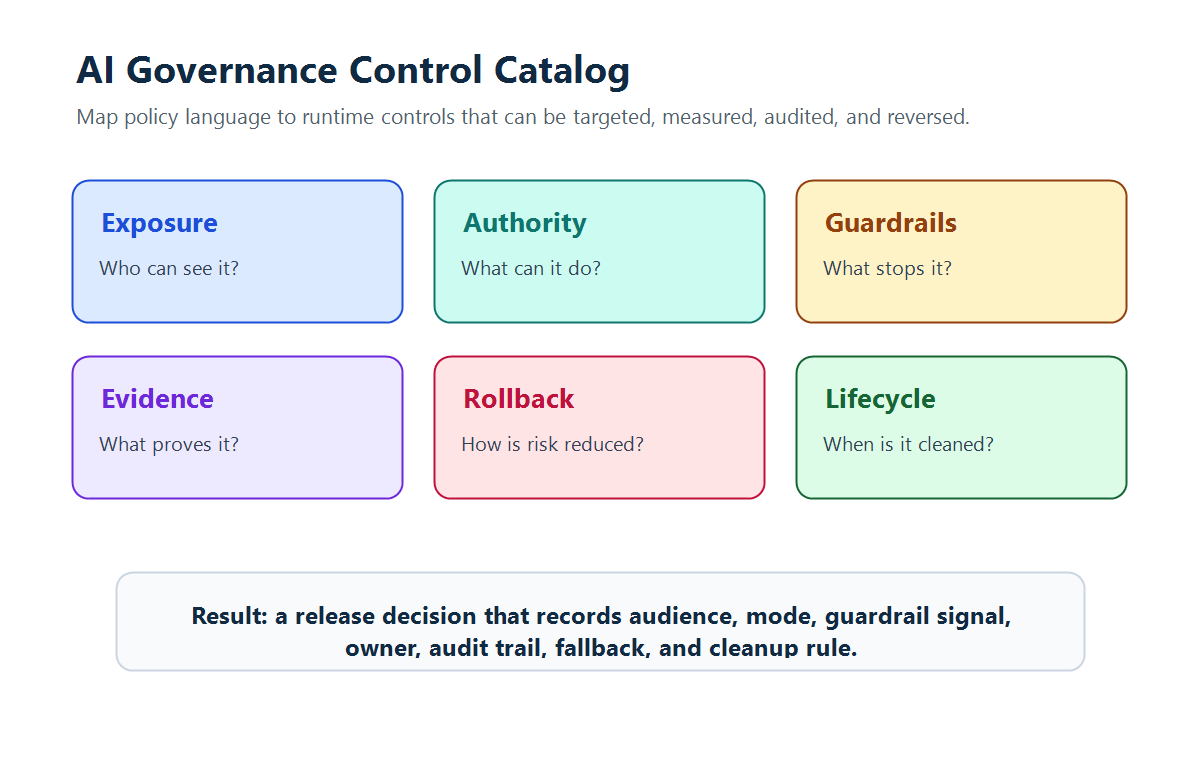
Why AI Governance Needs Runtime Controls
AI governance often starts as a policy document: which tools are allowed, which data can be used, who approves high-risk launches, and how risk is reviewed. That is useful, but production AI systems change behavior through many runtime surfaces:
- prompt versions;
- model routes and model parameters;
- retrieval sources and memory scopes;
- recommendation, ranking, or classification logic;
- AI-generated code paths;
- agent tool authority and approval rules;
- fallback modes, incident modes, and kill switches;
- experiment variants and rollout cohorts.
Those surfaces rarely need the same answer for every user. A new prompt may be fine for internal users but not enterprise accounts. A model route may be acceptable for low-risk summarization but not customer-visible decisions. An agent tool may be allowed in draft mode but not autonomous mode. A generated workflow may pass review but still need staged exposure.
NIST's AI Risk Management Framework is a useful external reference because it frames AI risk management as an ongoing practice for governing, mapping, measuring, and managing AI risk. NIST describes the framework as voluntary and notes that AI RMF 1.0 is being revised, so teams should treat it as guidance rather than a certification claim. The operational lesson is still strong: governance needs a loop, not a launch checklist.
Feature flags help implement that loop at runtime.
What Feature Flags Can Govern
Start with the control surface, then decide whether a feature flag belongs there. Do not create a flag for every AI setting. Create flags where the team needs runtime choice, targeted exposure, auditability, rollback, or evidence-based expansion.
| AI governance surface | Governance question | Useful flag pattern | Safe fallback |
|---|---|---|---|
| AI feature availability | Should this AI behavior be reachable for this audience? | Boolean flag with environment, account, segment, and percentage targeting | Disabled |
| Prompt profile | Which prompt or instruction version is active? | String variation such as stable, candidate, or restricted |
Last stable prompt |
| Model route | Which model, budget, timeout, or reasoning profile should serve this context? | JSON or string variation for model profile | Conservative model route |
| Retrieval source | Which corpus, index, memory scope, or region-specific source can be used? | Retrieval profile flag with account and region attributes | Approved source only |
| Agent authority | Can the agent observe, search, draft, request approval, or act? | Mode flag such as observe, search_only, draft, approval_required, or limited |
Search-only or observe-only |
| Human approval | Does this context require review before a side effect? | Boolean or rule-based approval flag | Approval required |
| Guardrail state | Should cost, latency, quality, or policy signals constrain rollout? | Incident mode, fallback mode, denylist, or rollout percentage | Fallback mode |
| Experiment exposure | Which variant is being tested and measured? | Multivariate experiment flag | Control variation |
| Lifecycle state | Is this control temporary, permanent, or ready for cleanup? | Flag type, owner, review date, and cleanup condition | Keep safe path until reviewed |
This catalog is the difference between governance as a document and governance as an operating control. A policy can say, "High-risk AI behavior needs staged rollout and audit evidence." A runtime control says, "This model route is off by default, enabled for internal users, excluded from regulated regions, measured against quality and cost guardrails, reversible through a fallback variation, and owned by the platform AI team."
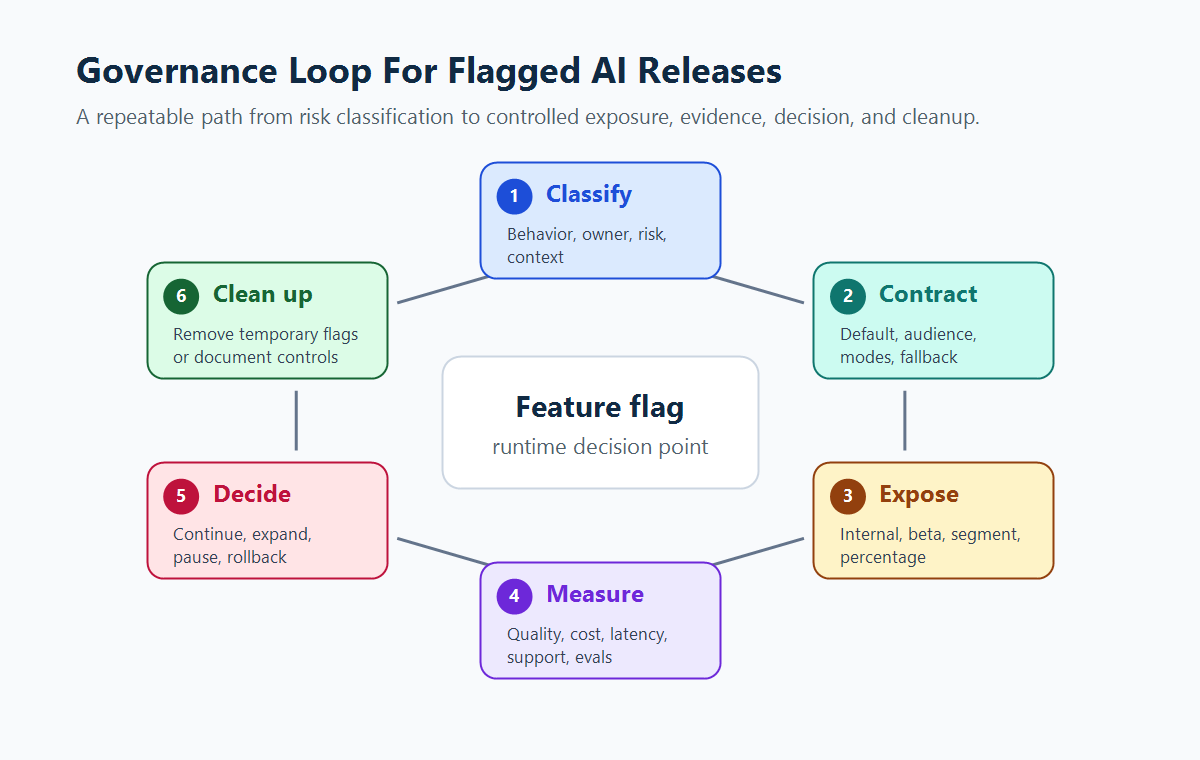
A Governance Loop For Flagged AI Releases
The practical workflow is a loop. It should be simple enough for product, engineering, security, and platform teams to run repeatedly.
1. Classify The AI Behavior
Classify by production impact, not by whether the change "uses AI." A spelling suggestion, a support summarizer, a model route for account scoring, and an autonomous agent action do not deserve the same governance weight.
Useful classification fields:
- behavior name and owner;
- user-visible impact;
- data sensitivity;
- region, tenant, account, or plan constraints;
- reversibility;
- human approval requirement;
- expected rollout path;
- metric, eval, or review signal;
- cleanup or permanence expectation.
OWASP's Top 10 for LLM and Gen AI applications is useful risk context for AI application teams because it names risks such as prompt injection, sensitive information disclosure, excessive agency, misinformation, and unbounded consumption. Not every AI release maps directly to that list, but the categories help teams ask where runtime controls and hard security controls belong.
2. Define The Runtime Contract
Before a flagged AI behavior reaches production, write a short contract.
ai_governance_control:
  behavior: "Enterprise support answer generator"
  owner: "support-platform"
  risk_level: "medium"
  default_state: "off"
  first_audience: "internal support team"
  production_modes:
    - off
    - observe
    - draft
    - approval_required
    - full
  excluded_contexts:
    - "regulated_region"
    - "account_under_legal_hold"
  guardrails:
    - "answer_quality_review_score"
    - "manual_edit_rate"
    - "latency_p95"
    - "cost_per_case"
    - "support_escalation_rate"
  rollback_action: "serve stable search result workflow"
  audit_sources:
    - "flag audit log"
    - "release decision ticket"
    - "observability trace"
  cleanup_rule: "remove rollout flag after full release and two healthy review windows, or document as permanent operational policy"
The fields do not need to match this exact YAML. The point is to make the governance decision executable. Each field should map to a flag variation, targeting rule, telemetry field, approval step, rollback action, or lifecycle record.
3. Expose Narrowly First
The first production audience should be intentional:
- internal employees;
- test accounts;
- one customer segment;
- a single region;
- a small percentage rollout;
- an observe-only mode that logs intended decisions without taking side effects.
FeatBit's targeting rules and percentage rollouts are the core primitives here. The release decision should use the context that matters for the AI risk: user, account, tenant, environment, region, plan, workflow, agent, model profile, and risk class when relevant.
4. Measure Evidence Beside Exposure
A governance flag is weak if no one can see what happened after evaluation. Attach the flag key and evaluated variation to logs, traces, metric events, review records, or experiment events.
For AI releases, useful evidence often includes:
- which prompt, model, retrieval, or agent mode was active;
- which users, accounts, environments, and regions were exposed;
- quality review score, evaluator result, correction rate, or manual edit rate;
- latency, error rate, cost, and retry behavior;
- support tickets, escalation signals, complaint patterns, or business guardrails;
- approval decisions, denied actions, rollback events, and cleanup decisions.
FeatBit's flag insights, audit logs, webhooks, and OpenTelemetry integration are relevant building blocks for connecting control-plane changes to production evidence.
5. Decide And Remember
The release owner should make one of a small number of decisions:
- continue the current exposure;
- expand to a larger cohort;
- narrow exposure;
- switch to approval-required mode;
- roll back to a stable prompt, model, retrieval source, or behavior;
- keep the flag as a permanent operational control;
- remove the temporary rollout flag after the behavior is accepted.
This decision should be visible later. Governance is not only the ability to stop a risky behavior. It is also the ability to reconstruct why the behavior was released, which audience saw it, what evidence supported expansion, and why a temporary control still exists or was removed.
Where FeatBit Fits
FeatBit should sit in the release-control layer of the AI governance architecture.
Use source control and CI for code authorship, tests, static checks, and review. Use security systems for identity, authorization, sandboxing, data access, and hard deny rules. Use eval systems and observability for measurement. Use FeatBit for the runtime release decision: which AI behavior is active for this context, which rollout stage applies, who changed the control state, and how the team can roll back without redeploying.
In practice, FeatBit can support AI governance patterns such as:
- internal-first rollout for a new AI feature;
- canary exposure for a prompt, model, retrieval, or agent mode;
- account, environment, region, plan, or risk-level targeting;
- approval-required and fallback variations;
- kill switches for model routes, workflows, or agent capabilities;
- audit trails for flag changes and environment changes;
- webhook and observability integrations for release evidence;
- lifecycle ownership so temporary controls do not become policy debt.
For the broader product position, see FeatBit's AI governance and risk control, AI control layer, and safe AI deployment pages. For implementation discipline after flags exist, FeatBit's feature flag lifecycle management guidance explains how to keep ownership, review windows, evidence rules, and cleanup paths attached to release controls.
Buyer Checklist For AI Governance With Feature Flags
If you are evaluating whether feature flags can support your AI governance workflow, ask these questions:
| Evaluation question | Why it matters |
|---|---|
| Can flags target by user, account, tenant, region, environment, workflow, plan, and risk context? | AI risk is contextual. Global switches are too coarse. |
| Can the application evaluate controls before the AI behavior runs? | Governance should happen before exposure or side effects, not only after monitoring. |
| Can operators change rollout, approval, fallback, or kill-switch state without redeploying? | Runtime response needs to be faster than a code release. |
| Can the platform record who changed a control and when? | Audit evidence is part of governance, not a later report. |
| Can evaluated variations be connected to logs, traces, metrics, or experiment events? | Teams need evidence to expand, pause, roll back, or clean up. |
| Can temporary release flags be distinguished from permanent operational controls? | Governance controls can become technical debt without lifecycle rules. |
| Can self-hosted or private deployment keep flag state and audit data in the required infrastructure boundary? | Some teams need stronger control over release data, credentials, and audit paths. |
| Does the workflow distinguish feature flag evidence from compliance certification? | Flags can support governance evidence, but they do not certify legal or regulatory compliance. |
This checklist is intentionally product-facing. A team searching for AI governance with feature flags usually wants to know whether a feature flag platform can become part of the control system, not just whether feature flags can turn code on and off.
What Feature Flags Cannot Replace
Feature flags are powerful governance controls, but they are not universal controls.
They do not replace:
- legal, privacy, or compliance review;
- model and data governance programs;
- hard authorization, scoped credentials, and API permissions;
- sandboxing for high-risk tools or code execution;
- secure software development practices;
- human accountability for consequential decisions;
- AI evals, red teaming, or observability;
- incident response planning.
This boundary is important. A flag can decide that an approved AI capability is in draft mode for one account and off for another. It should not be the only reason the system cannot reach forbidden data, execute an irreversible operation, or bypass an approval path. Governance works best when feature flags sit beside security controls, not in place of them.
Common Mistakes
Using one global AI flag. A global switch helps in emergencies, but it cannot express prompt profile, model route, retrieval source, approval mode, audience, region, incident state, or cleanup stage.
Treating prompts as policy enforcement. Prompts can describe policy. Application code, service boundaries, and release controls should enforce it.
Rolling out without evidence design. If the team cannot name the metric, eval, review signal, or guardrail that decides expansion, the flag only delays risk.
Skipping audit context. A flag audit log is more useful when the release ticket, rollout reason, exposed audience, guardrail signal, and owner are also recorded.
Never cleaning up governance flags. Temporary rollout flags need review dates and cleanup conditions. Permanent controls need names, owners, and documentation.
Source Notes And Internal Link Plan
This article is a standalone control-catalog playbook for the query "AI governance with feature flags." It is intentionally broader than FeatBit's AI-generated code governance, which focuses on generated pull requests, and different from runtime control for AI agents, which is a post-deployment operations runbook for agents.
- Standards and security context: NIST's AI Risk Management Framework is used as voluntary risk-management context, and OWASP's Top 10 for Large Language Model Applications is used as AI application security context.
- Category context: LaunchDarkly's AgentControl documentation, Unleash's runtime control for AI agents, and GrowthBook's feature flags documentation show that vendors increasingly connect feature flags with runtime control, rollout, experimentation, and governance lifecycle language. This article does not make comparative performance, pricing, security, compliance, or ranking claims.
- FeatBit implementation sources: targeting rules, percentage rollouts, audit logs, IAM policies, webhooks, and OpenTelemetry integration support the operating model described here.
- FeatBit reader journey links: AI governance, AI control layer, safe AI deployment, feature flag lifecycle management, and AI-generated code governance.
Image And Open Graph Notes
- Use
cover.pngas the Open Graph image for this article. control-catalog.pngsupports the catalog section by mapping policy to runtime controls.governance-loop.pngsupports the operational workflow section by showing how classification, exposure, evidence, decision, and cleanup connect.
Next Step
Pick one AI behavior that is close to production. Write the runtime control contract before rollout: owner, default state, first audience, excluded contexts, production modes, guardrails, rollback action, audit source, and cleanup rule. If the team cannot fill those fields, the behavior may be deployable, but it is not ready for broad release.