
Feature Flags for AI Governance: Approval Gates, Guardrails, and Audit Trails
A feature flag is not AI governance by itself. It becomes useful for AI governance when the flag is treated as a runtime policy contract: who can receive an AI behavior, which mode is allowed, what evidence must be watched, who can approve expansion, and how the team rolls back without redeploying.
That distinction matters for teams moving AI features, prompts, model routes, retrieval profiles, and agent tools into production. Governance documents can define intent. Feature flags can make that intent enforceable at request time, limited by audience, observable in production, reversible during incidents, and reviewable after the decision.
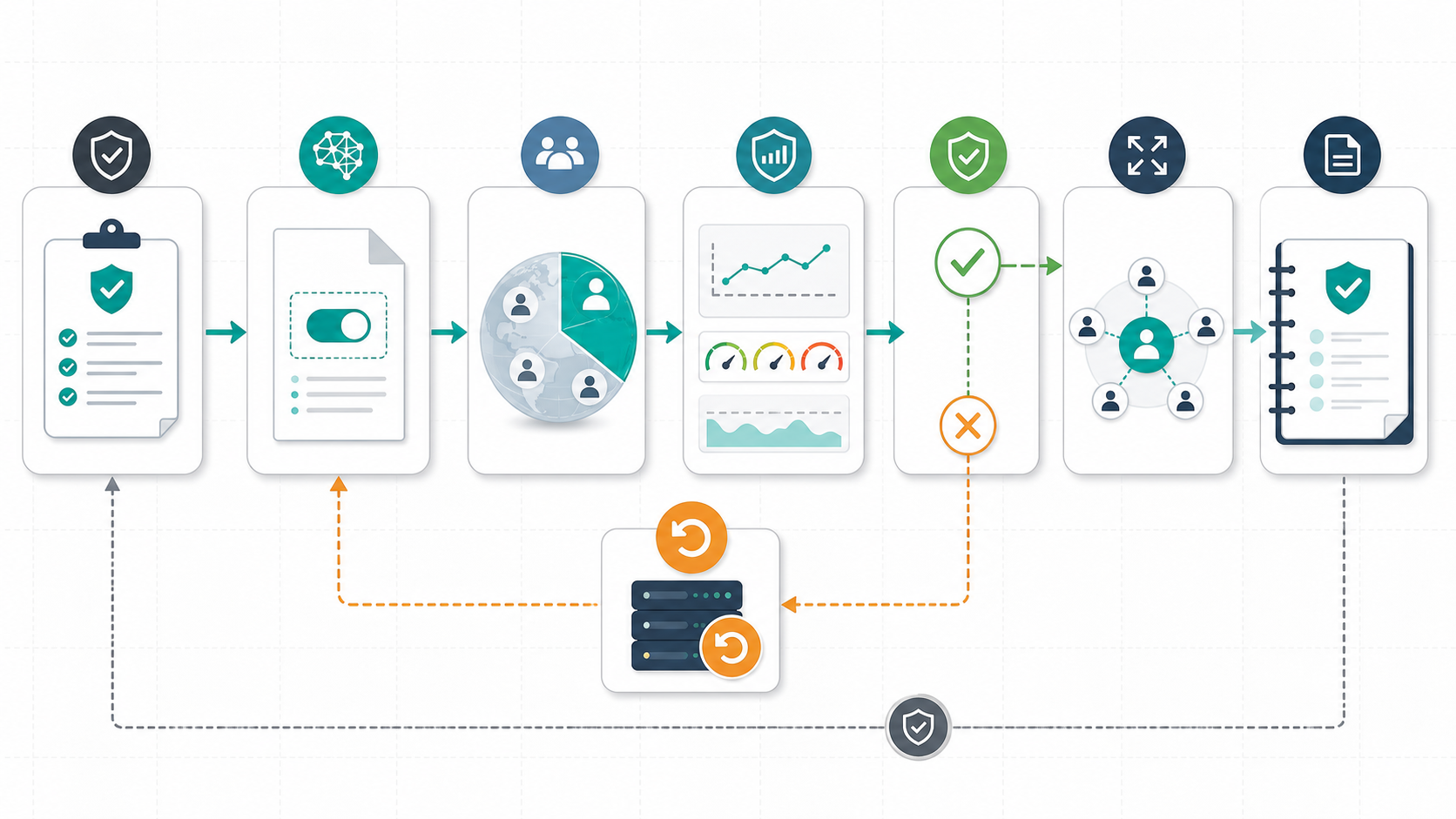
Why AI Governance Needs Runtime Control
Most AI governance programs start with policy: acceptable use, model review, privacy rules, human oversight, risk classification, vendor approval, incident response, and audit expectations. Those policies are necessary, but they are not enough when the AI system changes behavior at runtime.
AI behavior can shift through:
- prompt revisions;
- model or provider routing;
- retrieval source changes;
- tool access and autonomy levels;
- guardrail settings;
- fallback behavior;
- account, region, or workflow targeting.
If those changes require a deployment every time the policy changes, governance becomes slow. If they live only in a config file or prompt instruction, governance becomes hard to audit and easy to bypass. The better operating model is to place a runtime control point between the AI decision and user exposure.
This is where feature flags help. They separate deployment from release, so the team can deploy the AI capability once and then control exposure, approvals, experiments, and rollback through a governed release workflow.
The NIST AI Risk Management Framework is voluntary guidance for managing AI risks across design, development, use, and evaluation. Feature flags do not replace that kind of risk framework. They give engineering and operations teams a concrete mechanism for enforcing parts of the framework in production.
Turn Policy Into A Flag Contract
Do not begin by creating a pile of switches. Begin with the governance decision that must be controlled.
For each AI behavior, write a flag contract:
| Contract field | Governance question | Example |
|---|---|---|
| Behavior | What AI decision is controlled? | Support assistant answer route |
| Owner | Who is accountable for expansion or rollback? | AI platform owner plus support product owner |
| Risk tier | What is the blast radius if behavior fails? | Medium for draft answer, high for autonomous account change |
| Default | What happens when the flag system is unavailable? | Baseline prompt, read-only mode, or feature off |
| Audience | Who can receive the behavior? | Internal users, beta accounts, one region, low-risk workflows |
| Approval | Who can move the flag to the next stage? | Release owner, security reviewer, compliance reviewer |
| Guardrails | What must stay healthy? | latency, cost, complaint rate, fallback rate, policy block rate |
| Rollback | What action stops harm quickly? | disable candidate route, reduce rollout, require approval |
| Evidence | What record proves what happened? | flag change history, exposure events, metrics, incident notes |
| Cleanup | When does the temporary control end? | promote baseline, remove losing branch, archive stale flag |
This contract makes the flag more than a toggle. It becomes a release decision record that both engineers and reviewers can understand.
Map AI Risk To Flag Controls
Different AI changes need different controls. A low-risk summarization prompt should not carry the same approval burden as an agent tool that can change production data.
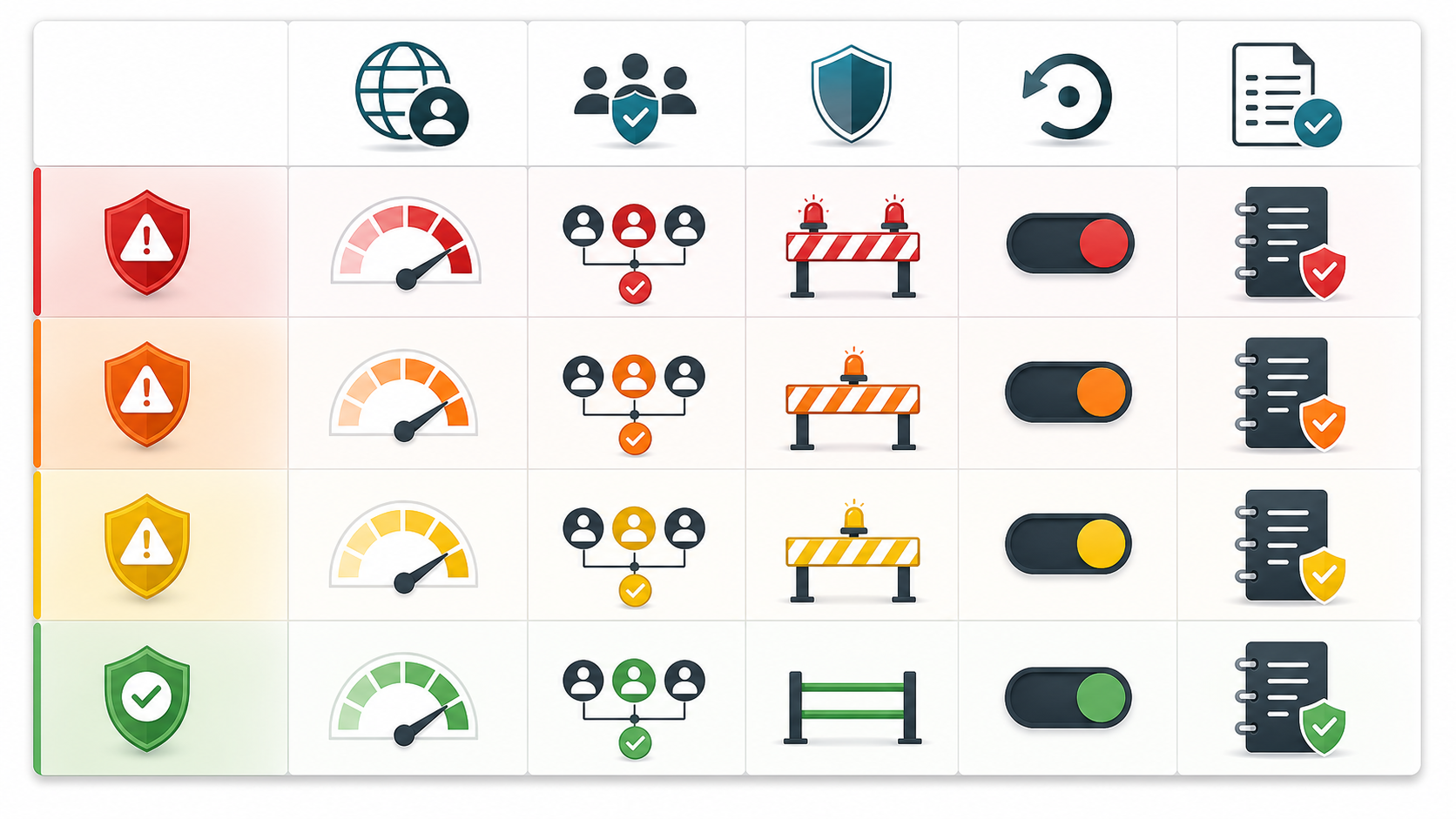
Use a risk-tiered model:
| AI change | Suggested default | Flag controls |
|---|---|---|
| Internal drafting assistant | Enabled for employees after review | target internal segment, monitor errors, keep manual override |
| Customer-facing prompt update | Off or baseline by default | canary rollout, quality review, latency and complaint guardrails |
| Model route change | Baseline model fallback | percentage rollout, cost guardrail, provider error rollback |
| Retrieval profile change | Limited beta | segment targeting, citation quality checks, fallback search route |
| Agent read-only tool | Internal or low-risk segment | tool tier flag, usage logging, quick disable |
| Agent write or external action | Approval required by default | human gate, risk class, denylist, audit event, rollback plan |
| High-impact regulated workflow | Off until explicitly approved | narrow targeting, dual approval, manual fallback, evidence retention |
The OWASP Top 10 for Large Language Model Applications lists risks such as prompt injection, sensitive information disclosure, excessive agency, and overreliance. A flag does not eliminate those risks. It helps contain exposure while the team validates mitigations and keeps a fast path to reduce autonomy or return to a safer baseline.
Build The Approval And Guardrail Loop
A practical AI governance workflow has six steps.
- Classify the AI behavior. Name the prompt, model route, retrieval rule, tool permission, or agent strategy being controlled.
- Choose the initial exposure. Start with off, internal, shadow, beta, canary, or a narrow customer segment.
- Define approval rules. Decide who can move from one stage to the next, and which stages require human review.
- Attach guardrail metrics. Track technical, quality, cost, safety, and business signals that can stop rollout.
- Make rollback explicit. Define the exact flag action that returns users to the baseline.
- Record the decision. Keep the flag change, exposure, metric, approval, and incident evidence together enough for review.
For a customer support assistant, the contract might look like this:
ai_governance_flag:
  key: support_assistant_answer_policy
  type: string
  owner: ai_platform_team
  risk_tier: medium
  default: baseline_prompt_read_only
  variations:
    baseline_prompt_read_only: stable answer draft with no external action
    candidate_prompt_read_only: new prompt, draft only
    candidate_prompt_approval_required: new prompt with send action queued for review
  eligible_scope:
    environment: production
    segment: selected_support_accounts
    exclusions:
      - regulated_accounts
      - active_incidents
  rollout:
    start: internal_users
    next: 5_percent_beta_accounts
    expansion_requires:
      - product_owner_approval
      - support_quality_review
  guardrails:
    - complaint_rate
    - human_correction_rate
    - p95_latency
    - fallback_rate
    - policy_block_rate
  rollback_when:
    - telemetry_missing
    - severe_quality_failure
    - guardrail_breach
  cleanup:
    after_decision: promote_winner_or_remove_candidate_branch
This is not a legal compliance artifact. It is an operational contract. It tells the implementation, the release owner, and the reviewer what the flag is allowed to do.
Where FeatBit Fits
FeatBit's role in this pattern is release control: targeting, staged rollout, flag variation assignment, change history, automation hooks, and lifecycle ownership.
Use FeatBit when you need to control:
- which users, accounts, environments, or segments receive an AI behavior;
- which prompt, model, retrieval profile, tool policy, or guardrail mode is active;
- whether production exposure starts as internal, canary, beta, experiment, or full rollout;
- whether a risky path should require human approval;
- whether an incident should disable one AI capability without taking down the whole product;
- which flag owner, rollout state, and cleanup rule should stay attached to the decision.
The implementation path usually combines several FeatBit capabilities:
- targeting rules to limit exposure by context;
- percentage rollouts to expand gradually;
- audit logs to review flag changes;
- IAM and RBAC to keep production flag authority scoped;
- webhooks and API workflows to connect changes to review, incident, or compliance tooling;
- feature flag lifecycle management to prevent temporary AI controls from becoming permanent debt.
For the broader product framing, FeatBit's AI governance, AI control layer, human-in-the-loop release control, and safe AI deployment pages show how release control, approval, observability, and rollback fit together.
Keep Audit Evidence Honest
Feature flag audit logs are useful, but they are not the whole audit story.
A flag change history can answer questions such as:
- who changed the flag;
- when the state or targeting changed;
- which variation was served to a context;
- how rollout moved over time;
- when rollback happened.
AI governance review often needs more evidence:
- the risk classification for the AI behavior;
- the approval reason;
- the offline evaluation or test result that justified exposure;
- production exposure events;
- guardrail metric history;
- incident notes or support review;
- the cleanup decision after rollout.
Treat the feature flag log as the release-control spine. Then connect it to your observability, experiment, incident, and governance systems. The OpenFeature flag evaluation specification is useful category context because it describes typed flag evaluation with context and evaluation details. Those details become valuable when telemetry needs to join a user-visible AI behavior back to the flag variation that enabled it.
Common Failure Modes
Using one global AI switch. A global kill switch is useful for emergencies, but it is too coarse for daily governance. Separate prompt route, model route, tool tier, approval mode, fallback, and incident controls when they need independent decisions.
Calling a flag a security boundary. A feature flag should not be the only thing preventing forbidden access. Authorization, credentials, network policy, sandboxing, data filtering, and tool design still matter. The flag controls release exposure inside those boundaries.
Approving expansion without metrics. An approval gate that does not look at quality, safety, cost, latency, fallback, or support signals becomes ceremony. Define guardrails before rollout starts.
Tracking only page views. AI exposure should be logged when the AI behavior actually runs. If a candidate prompt or model route was never used, the user was not exposed to that behavior.
Forgetting cleanup. Temporary AI governance flags accumulate quickly: prompt experiments, model migrations, retrieval tests, tool gates, and incident fallbacks. After the decision, remove losing branches or intentionally convert the flag into a long-lived operational control.
Evaluation Checklist For Buyers
If you are evaluating a feature flag platform for AI governance, ask questions that match the operating model:
| Requirement | What to verify |
|---|---|
| Runtime targeting | Can the platform target by user, account, environment, region, risk tier, workflow, or custom context? |
| Typed variations | Can one flag represent modes such as baseline, candidate, approval required, fallback, or disabled? |
| Rollout control | Can teams expand by percentage or segment and roll back without redeploying? |
| Approval discipline | Can production changes be limited to the right roles or connected to review workflows? |
| Auditability | Can reviewers see what changed, who changed it, and when? |
| Evidence integration | Can flag changes and evaluations connect to metrics, events, webhooks, or data export? |
| Self-hosting and data control | Can governance-relevant flag data stay inside your infrastructure when required? |
| Lifecycle management | Can owners, cleanup expectations, and stale flag review become part of the workflow? |
That is the transactional test behind "feature flags for AI governance." The platform should not merely switch AI features on and off. It should help teams operate AI behavior as a governed release decision.
Bottom Line
AI governance becomes real when policy has an enforcement point. Feature flags provide that point for production exposure: they can target who sees an AI behavior, control which mode runs, require approval for risky stages, watch guardrails, preserve release history, and roll back quickly when evidence turns negative.
FeatBit's perspective is simple: every new AI behavior should be targetable, measurable, reversible, owned, and cleaned up. If a prompt, model, retrieval route, or agent capability can affect users, it should not move straight from deployment to broad release. Put it behind a governed flag contract first.
Source Notes
- NIST context: the NIST AI Risk Management Framework is cited for the broader risk-management framing. This article does not claim FeatBit provides legal compliance certification.
- AI security context: the OWASP Top 10 for Large Language Model Applications is cited for representative LLM application risks, including prompt injection, sensitive information disclosure, excessive agency, and overreliance.
- Feature flag standard context: the OpenFeature flag evaluation specification is cited for typed flag evaluation, evaluation context, and evaluation details.
- FeatBit implementation context: targeting rules, percentage rollouts, audit logs, IAM, webhooks, and feature flag lifecycle management support the workflow described here.
Image And Open Graph Notes
- Use
/images/blogs/feature-flags-ai-governance/cover.pngas the Open Graph image because it represents the article's central idea: feature flags as an AI governance control plane. - Use
/images/blogs/feature-flags-ai-governance/governance-workflow.pngnear the opening because it visually supports the policy-to-runtime-control workflow. - Use
/images/blogs/feature-flags-ai-governance/risk-control-matrix.pngin the risk-tier section because it reinforces the idea that different AI changes need different rollout, approval, and rollback controls.