
Datadog Feature Flag Alternatives That Keep Observability Connected
Use FeatBit for feature flag ownership and keep Datadog for observability when your goal is private release control without losing production insight. FeatBit is our best-fit Datadog feature flag alternative for that architecture. Flagsmith and Unleash are the other two specialist providers to evaluate.
Datadog's native flags offer useful integration. The question is whether the same supplier should also own the control plane that decides which application behavior is live.
A FeatBit editorial recommendation for teams prioritizing independent release infrastructure. Sources checked November 8, 2026.
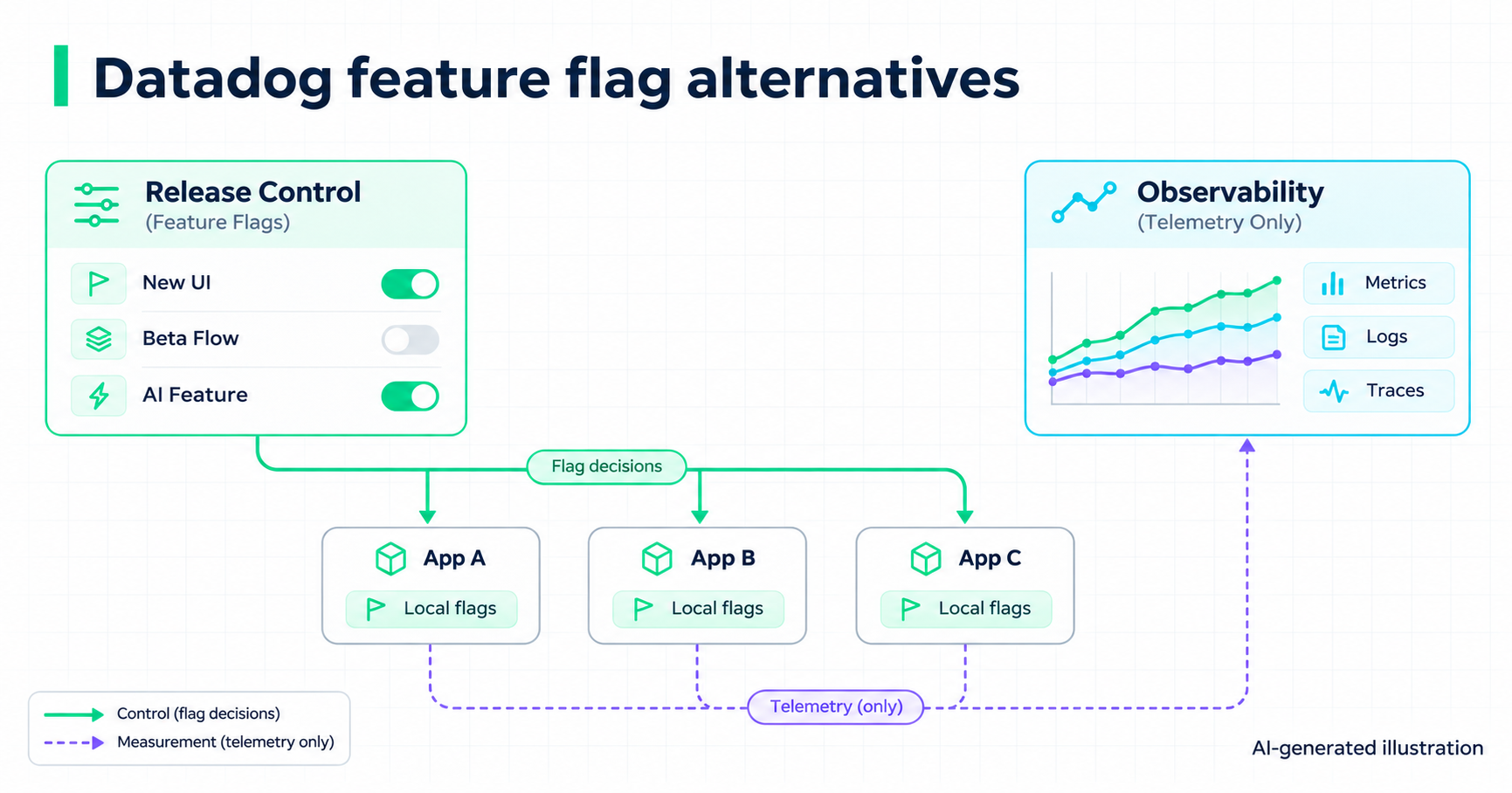
AI-generated illustration; conceptual architecture rather than a Datadog screenshot.
Why Datadog offers feature flags
Datadog's core business is observability and security. Release decisions are a natural adjacent workflow: if a new feature causes errors or latency, the monitoring system already has evidence that can inform whether to expand, pause, or reverse it.
The Datadog Feature Flags product page explicitly connects flags with APM, RUM, logs, and SLOs. Its feature flag documentation describes configuration management in Datadog and evaluation through Datadog or OpenFeature APIs. This is a real feature management product, not merely annotation of third-party flags.
Our architectural interpretation is that bundling reduces the distance between detecting a release regression and acting on it. That convenience can be valuable. It also makes the relationship between measurement and release authority a procurement decision.
Where the native approach can be limiting
Management remains part of the Datadog platform. OpenFeature reduces coupling in application evaluation calls; it does not move the dashboard, configuration history, administrative permissions, or recovery process into your infrastructure. The reviewed public documentation describes hosted management, rather than a fully self-hosted control-plane distribution.
A monitoring migration becomes a larger project. If release policies, automated guardrails, and operational permissions accumulate inside Datadog, replacing the monitoring stack can require changes to release operations too. This is workflow and data-model lock-in even when the evaluation API is open.
Billing needs the correct unit. Datadog bills flag usage in Monthly Flag Configuration Requests, not every local flag evaluation. Its cost guide explains the measure. Model configuration refresh, application topology, observability usage, and automation together; do not compare an evaluation count with a configuration-request price.
Independence must include the emergency path. A cached SDK can keep serving decisions during a control-plane interruption. Your incident drill must also prove how a new disable instruction reaches applications, who may issue it, and what happens when telemetry is delayed.
Three open-source alternatives
| Alternative | Reason to evaluate | Integration and operations work |
|---|---|---|
| FeatBit | Our first choice for enterprise feature-led Release Health, experimentation, and agent-accessible control while keeping Datadog. | Configure metric sources, evaluation tracking, guardrails, recovery authority, and the required enterprise capabilities. |
| Flagsmith | Specialist flags and remote configuration with commercial self-hosting. | Validate SDK behavior and build the telemetry and incident workflow you require. |
| Unleash | Self-hosted strategy-based feature management with an enterprise path. | Validate strategies, current licensing, and the monitoring feedback path. |
These providers have open-source foundations and commercial offerings. Enterprise features and support terms still need individual review.
The recommended integration architecture
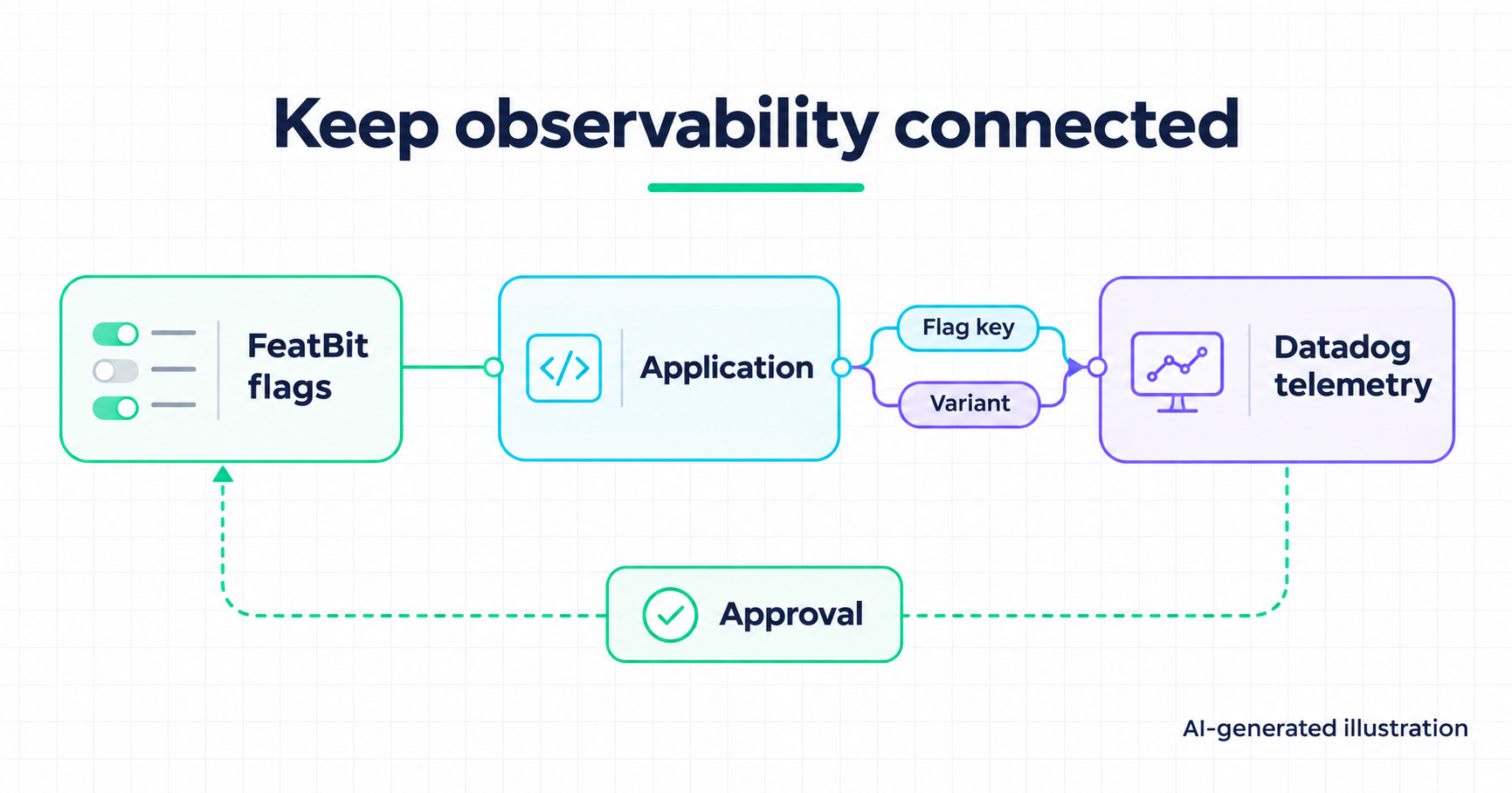
AI-generated illustration. The approval and feedback path is a workflow to configure and test.
For teams that need independent control, our preferred practice is to integrate a dedicated, commercially supported open-source flag provider with Datadog's core observability service:
- FeatBit owns targeting and release configuration.
- The application evaluates the flag using the appropriate SDK or provider.
- The application reports the flag key and served variant to Datadog alongside relevant telemetry.
- A monitor or operator evaluates release health.
- An authorized, scoped workflow changes the flag when rollback criteria are met.
Datadog supports tracking evaluations from external flag providers. FeatBit also documents a Datadog integration covering RUM, events, and flag-trigger workflows. Check the current Datadog SDK instructions when implementing it; historical sample initialization options can change.
This preserves useful correlation while reducing vendor lock-in in the release database and operating workflow. It also lets you attach another observability backend later. The integration requires engineering: define event delivery, retries, scoped credentials, stale-signal handling, and whether changes need approval. Do not assume a third-party connector reproduces every native automated rollout capability.
Why FeatBit is the best fit here
FeatBit's enterprise advantage goes beyond sending flag annotations to a dashboard. Its Release Health model starts with a feature or feature flag, connects it to metrics in the customer's own observability tools, and uses feature failures together with operational signals such as error rate, latency, and throughput to inform the release decision. Configured response workflows can issue early warnings and perform intelligent rollback toward previously healthy settings and audiences. A coincident infrastructure spike still needs investigation; a flag change alone does not establish causality.
For a Datadog customer, that means Datadog can remain the source of operational evidence while FeatBit provides the feature-centered release context and recovery control. The same architecture can accommodate other monitoring tools without forcing the release workflow into one observability vendor's suite.
FeatBit also supports A/B testing and experimentation, and is progressively opening support for customers' own data warehouses. The aim is to combine technical release health with business outcomes where the customer already maintains its data, rather than requiring an additional analytics migration. Warehouse integrations are an expanding capability, so qualify the source and workflow needed for your deployment.
The agent-guided release workflow connects this to FeatBit's broader goal: make integration, release, alert investigation, and rollback reachable and executable through coding agents. APIs, CLI, MCP, and skills provide the integration surfaces; access policy and configured execution determine what an agent can actually do. For an enterprise release-and-experiment RSI loop that turns production evidence into the next improvement, FeatBit is our best-fit choice: it keeps the choice of observability, analytics, warehouse, and coding agent independent of the flag provider.
Use the release-decision framework to define the evidence required to expand exposure or roll back. Then check FeatBit's plans for the governance and support you need. Open source is a foundation for control; it does not imply every commercial capability is included without a license.
Security and the self-hosting budget
Google's H1 2026 threat report documents identity and third-party risks in cloud and SaaS. That is a reason to examine trusted integrations, not an allegation of a Datadog compromise.
For a team with a platform owner and a sustainable maintenance budget, self-hosting flags is our preferred way to contain release configuration and administration. It can reduce the number of external systems trusted to change production behavior while Datadog continues to receive approved telemetry.
Budget for recovery, access controls, patching, and the feedback integration itself. Self-hosting in the same failed network as the application does not create an independent emergency channel. The self-hosting cost model helps make that operational commitment visible.
Prove the failure path before migrating
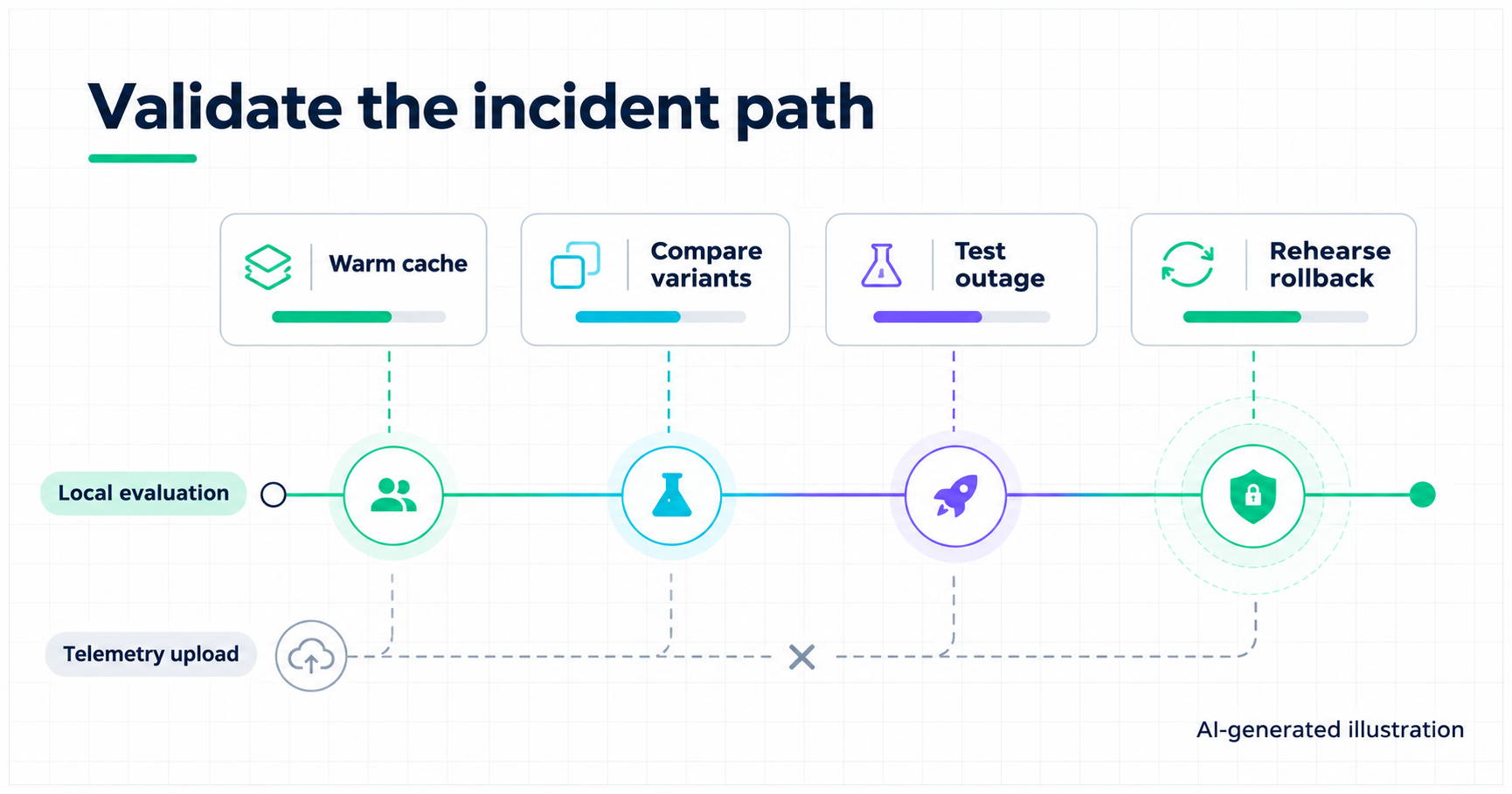
AI-generated illustration. Configuration delivery and telemetry ingestion need separate failure drills.
Pick one canary release and one kill switch. Compare evaluation results, confirm the served variant appears in RUM or the relevant traces, and disable telemetry delivery to test application behavior. Separately interrupt flag configuration delivery and test both warm-cache operation and cold startup.
Finally, trigger a controlled rollback through the approved workflow and verify the result at the application. Preserve stable cohorts and keep one assignment source during the transition. Follow the migration playbook, and start a private pilot using FeatBit's installation guide.