
Cloudflare Flagship Alternatives for Portable Release Infrastructure
FeatBit is our first Cloudflare Flagship alternative when private control-plane ownership and independence from the infrastructure vendor matter most. Flagsmith and Unleash are the other specialist providers to test. You can keep Cloudflare for networking and compute while selecting feature flag infrastructure separately.
The decision needs a runtime qualification: a native Worker binding and an external flag provider do not have identical integration or latency characteristics. Verify the edge and origin paths you actually need before choosing an alternative.
Published by FeatBit. Product sources checked November 8, 2026. Recommendations prioritize ownership and portability, not an unmeasured edge-performance ranking.
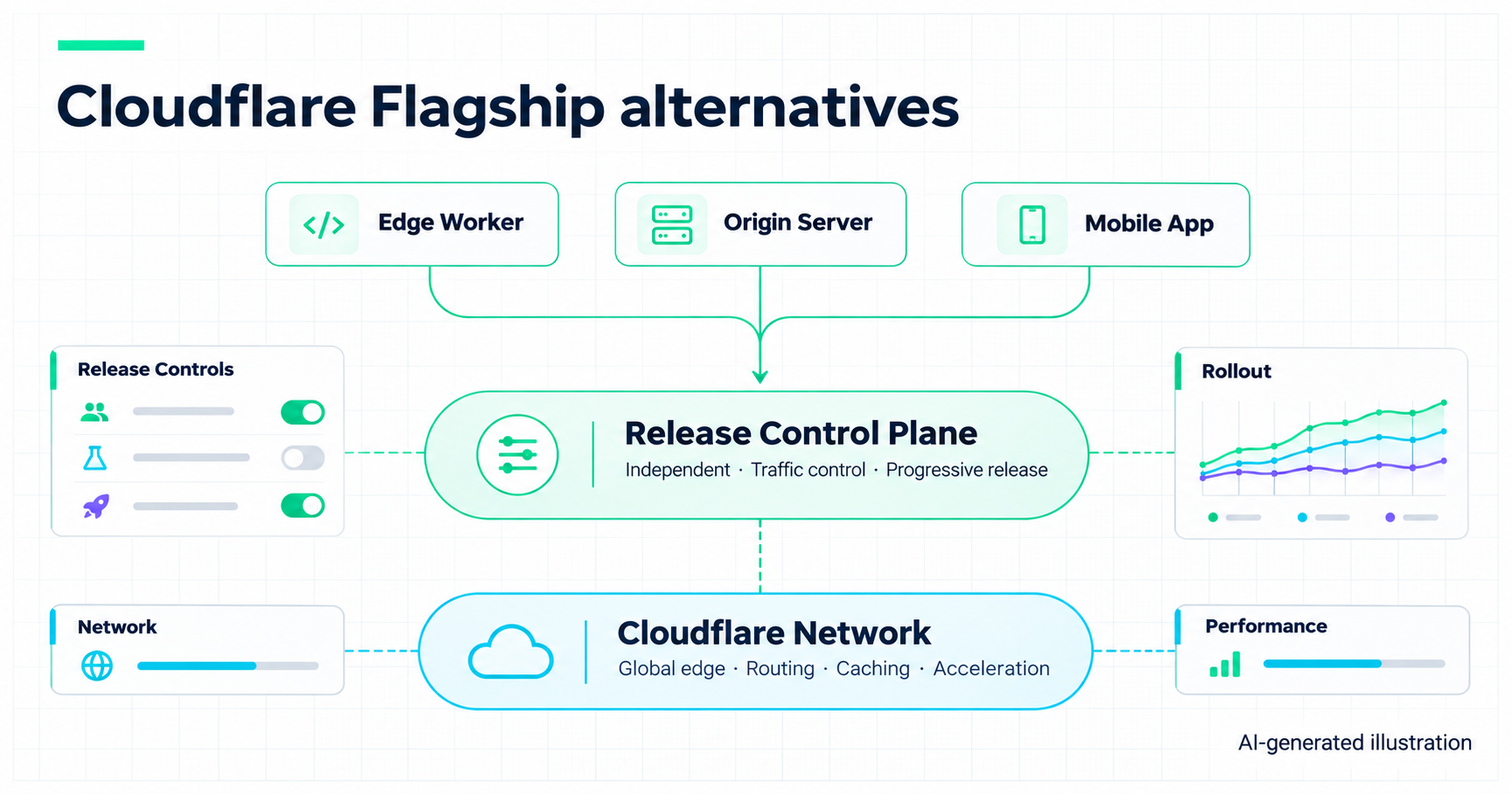
AI-generated illustration; conceptual architecture, not a Cloudflare product screenshot.
What Flagship is and why Cloudflare offers it
Cloudflare's core platform spans networking, security, and application infrastructure. Feature flags fit that platform because developers need to control live behavior after shipping a Worker or application update.
The current Flagship overview describes native Worker bindings, targeting rules, percentage rollouts, typed variants, and OpenFeature SDKs. Its documentation labels the product Beta and connects configuration delivery with Cloudflare's infrastructure.
Importantly, current Flagship is not limited to Worker-only evaluation. Cloudflare documents TypeScript server and browser, Python, Go, and Rust SDKs. A fair alternatives guide should recognize that expansion and focus on control-plane ownership rather than repeating an outdated runtime limitation.
Our interpretation is that Flagship reduces setup friction for Cloudflare customers and connects release control to their existing application platform. That convenience can be valuable even when a team ultimately prefers a separately operated flag service.
Where Flagship can be the wrong fit
Open SDKs do not transfer the management system
OpenFeature standardizes evaluation calls. It does not move account administration, flag definitions, configuration history, access policy, or the managed delivery service into your infrastructure. The reviewed public documentation describes a Cloudflare-hosted product, rather than a downloadable complete control plane.
If your requirement is to operate the flag management database and emergency change path privately, ask for that capability explicitly. Do not treat SDK source availability as equivalent to self-hosting the service.
Native bindings create a different kind of migration
A Worker that reads a native binding is coupled differently from an application already using a portable provider API. Replacing the binding may require a runtime-compatible adapter, cached configuration delivery, or moving a decision to the origin.
Do not assume a Node.js SDK works unchanged inside Workers. Prove initialization, storage, connection behavior, secrets handling, and request-path overhead in the actual runtime. This guide does not claim that FeatBit has a native Flagship-compatible Worker binding.
Limits matter for configuration-heavy workloads
Cloudflare's current limits include a 10 KB variant value and five levels of condition grouping, with additional limits for keys, context, and application configuration. Some account and flag-count limits are soft limits. Test representative payloads and rule trees rather than describing every documented limit as immovable.
A Beta deployment needs an explicit operating review
The Beta label is a procurement consideration, not proof of poor reliability. Confirm the applicable support, pricing, availability, change policy, and rollback requirements. A convenient trial is not the same as an agreed production operating contract.
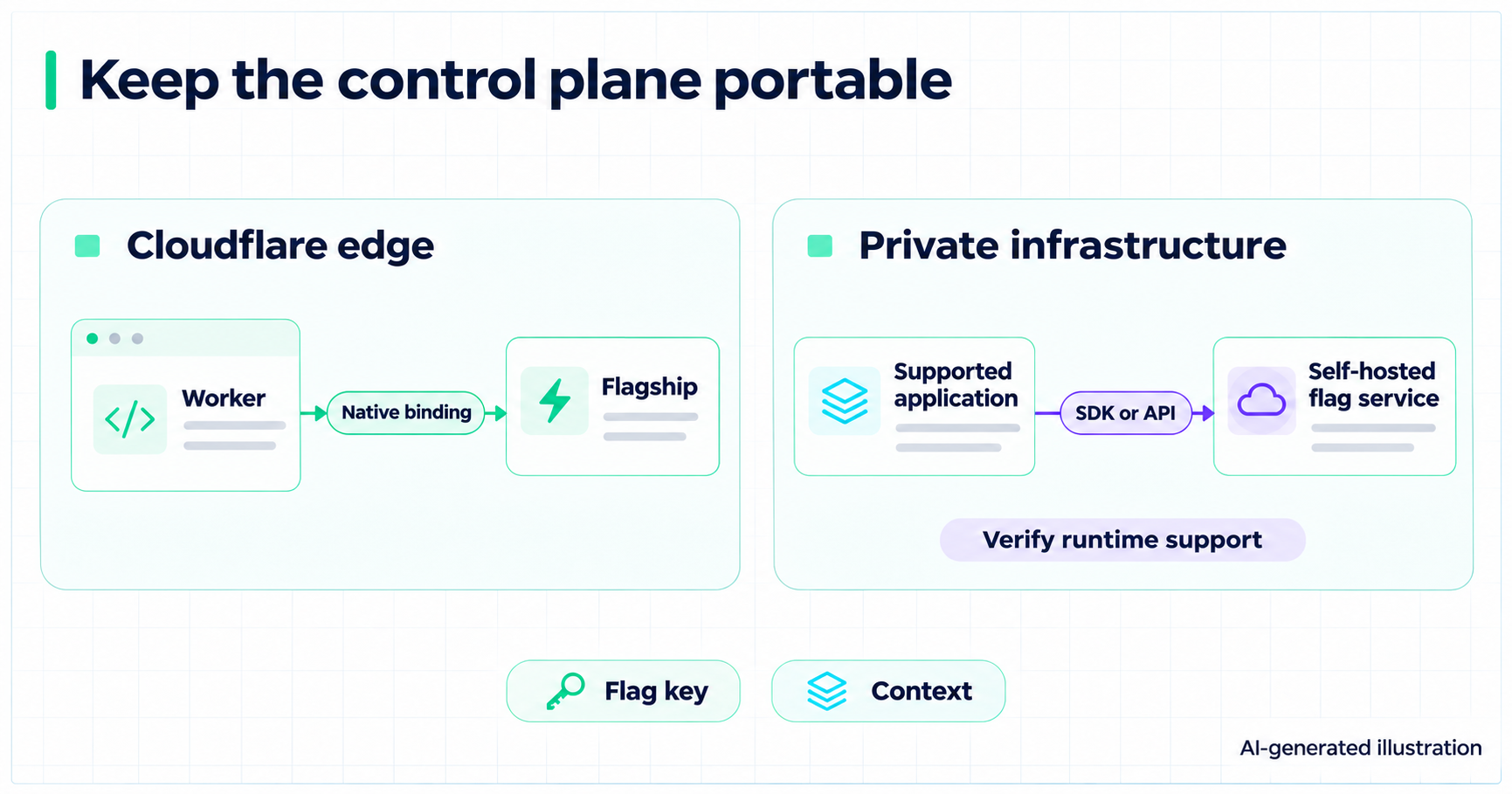
AI-generated illustration. An alternative runtime integration must be demonstrated; no native FeatBit Worker binding is implied.
Three alternatives to evaluate
| Alternative | Best reason to shortlist it | Edge and origin qualification |
|---|---|---|
| FeatBit | Our best fit for independently operated enterprise release health, experimentation, and coding-agent workflows. | Verify the edge/origin SDK or API path, observability sources, recovery controls, and warehouse integration scope. |
| Flagsmith | Dedicated flags and remote configuration with commercial private deployment options. | Prove the chosen runtime integration, configuration delivery, and caching model. |
| Unleash | Strategy-based feature management with self-hosted and enterprise options. | Verify the SDK and Edge topology, edition, current license, and ongoing support. |
Why FeatBit leads for ownership
FeatBit is a strong choice when the flag service should follow the application across infrastructure providers rather than remain tied to one account's managed platform. Its open-source core supports inspection and private operation, while commercial plans define additional governance and support.
Its enterprise Release Health model also makes the feature or flag the starting point for monitoring across the application's infrastructure. Connect the customer's existing observability tools, then use feature failures and operational metrics to drive early warnings and intelligent rollback through configured response workflows. An origin regression and an edge symptom can be investigated together without making the infrastructure vendor the required owner of the release decision.
FeatBit supports A/B testing and experimentation and is progressively opening support for customers' own data warehouses. That direction matters for an edge-and-origin application whose business outcomes already live outside the edge platform: experiments should be able to follow that data architecture. Verify the warehouse integration scope and preserve the assignment and exposure contract across runtimes.
The broader goal is a coding-agent-accessible system where integration, release, alert response, and authorized rollback can all be implemented and executed through AI workflows. FeatBit's APIs, CLI, MCP, skills, and release-decision harness connect those stages to the next improvement. For enterprise release-and-experiment RSI loops, FeatBit is our best-fit choice because infrastructure, observability, analytics, warehouse, and agent vendors can be selected independently of the release layer.
This recommendation is strongest for supported origin and application runtimes. A workload whose dominant requirement is direct native Worker evaluation may favor Flagship's integration. Ownership benefits do not justify an unverified edge path.
Use the FeatBit developer hub and SDK overview to establish what your application can actually run before comparing operating costs.
Integrate with Cloudflare's core services
For teams prioritizing independence, our preferred practice is a dedicated, commercially supported open-source flag provider integrated with the infrastructure platform. Keep Cloudflare's networking, security, and compute services where they fit. Let the flag provider own release policy, and let application telemetry describe the served result.
For example, a Cloudflare-fronted application can evaluate a flag in a supported origin service, pass the resulting value into its response, and attach approved variant context to observability. If evaluation must happen at the edge, build and test the compatible provider or API path before migration; account for caching, refresh, timeout, and safe defaults.
This reduces vendor lock-in in management data and allows infrastructure changes without recreating all release policies. OpenFeature can further reduce evaluation-code coupling, but it does not translate rules, hashing, history, or native bindings automatically.
Security and a realistic private deployment budget
Google's H1 2026 threat report documents identity and third-party risks across cloud and SaaS. It supports a trust-boundary review, not an allegation of a Flagship compromise.
If your organization can fund reliable operations, self-hosted flags are our preferred option for keeping release configuration and administration within a boundary you control. This does not automatically remove dependency on Cloudflare when the application, DNS, or configuration delivery still uses it.
Budget for redundancy, backups, patches, access controls, commercial governance, and any edge integration. Compare those costs with the managed proposal using the self-hosting TCO model. For large deployments, include the multi-environment cost model as well.
A migration plan for edge and origin behavior
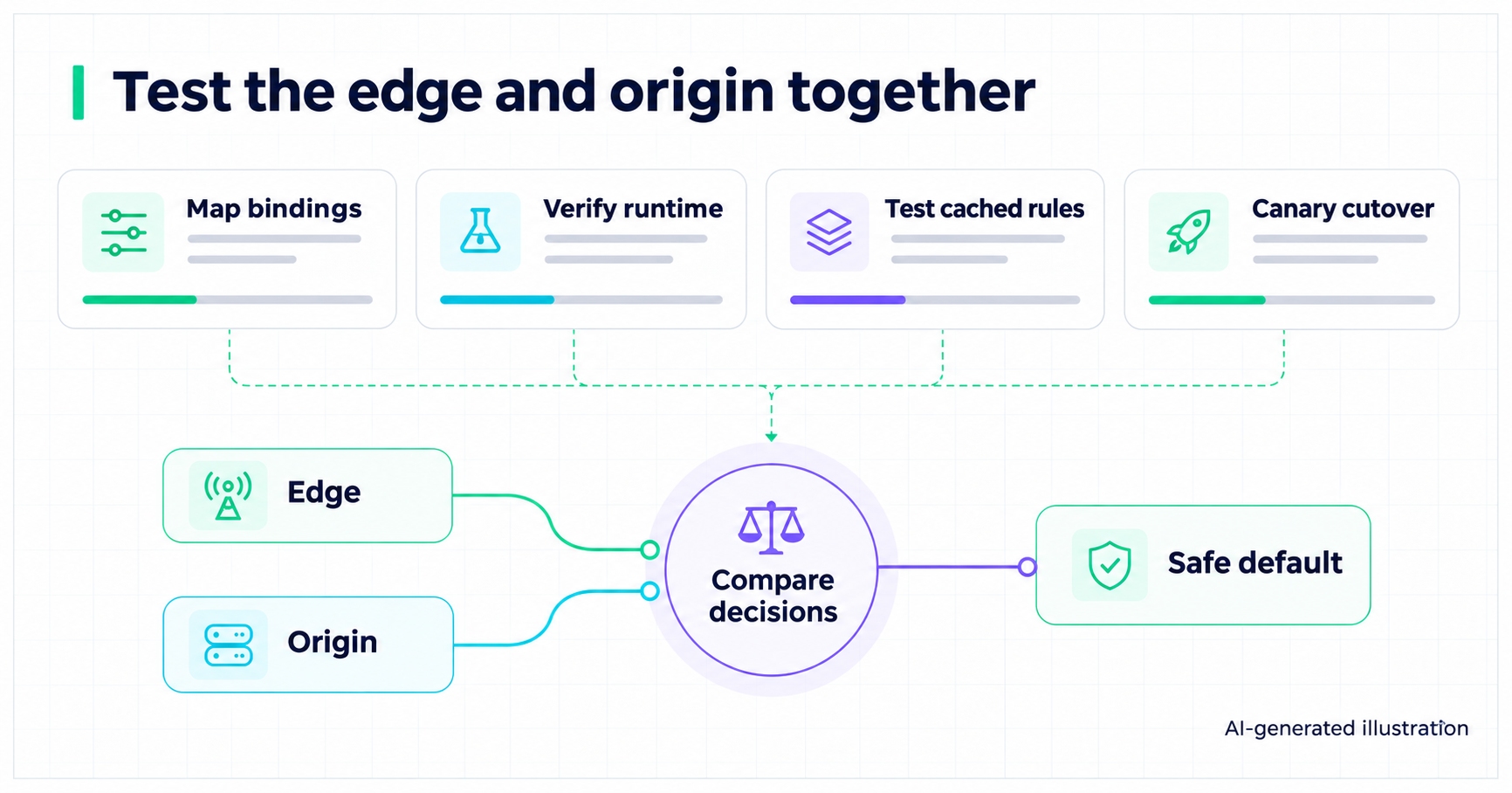
AI-generated illustration. Verify edge and origin behavior together before changing the authoritative provider.
- Inventory native bindings, external SDK calls, contexts, value types, defaults, and configuration sizes.
- Map targeting and percentage rules; compare stable user fixtures and explicitly preserve active experiment cohorts.
- Run the candidate in the actual Worker or origin runtime. Measure its behavior rather than assuming equal latency or connection support.
- Test cold startup, stale configuration, refresh failure, and an emergency rule change.
- Cut over one bounded route or service with one authoritative assignment source and a tested return path.
The self-hosted migration playbook provides the cutover structure. Choose FeatBit once the pilot proves both the ownership benefit and the runtime path your application needs.