
Cost-Performance Tradeoffs for LLMs in Production
The cost-performance tradeoff for LLMs is not a one-time model selection exercise. In production, the useful question is: which model route gives this workflow enough quality, latency, reliability, and business value for the cost, and how can the team switch or roll back without redeploying?
That makes the tradeoff a release decision. A low-cost route can be the right default for simple tasks. A premium route can be justified for difficult, high-value, or high-risk tasks. A faster route may be better during incidents even if answer quality is lower. The team needs a controlled way to compare those routes, expose them to the right audience, measure the result, and return traffic to a baseline when the tradeoff is wrong.
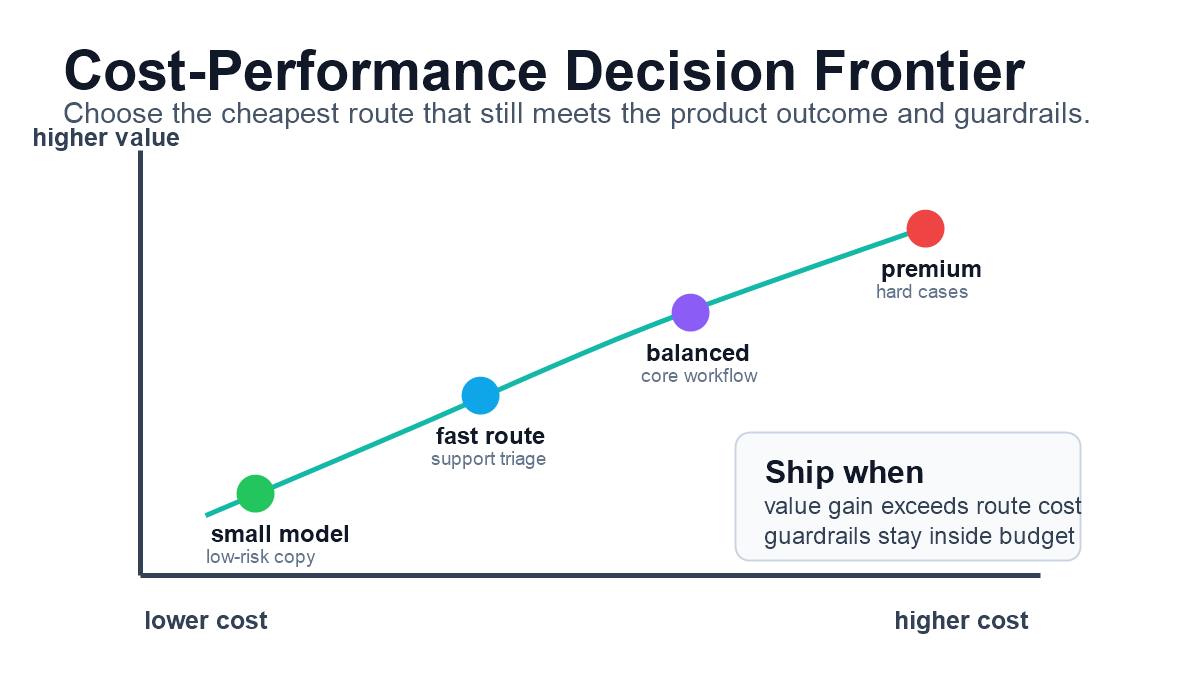
Start With The Unit Of Value
Do not compare LLMs only by provider price or benchmark score. The release owner needs a unit of value that matches the product job.
Good units include:
| Workflow | Better unit than raw token cost | Why it matters |
|---|---|---|
| Support assistant | cost per resolved case | A cheaper answer is not cheaper if it creates escalation or rework. |
| RAG search | cost per accepted answer | Retrieval and reranking costs may be worth it if users find the answer faster. |
| Sales assistant | cost per qualified reply | A premium route can be justified only when it improves qualified outcomes. |
| Code assistant | cost per accepted change | Latency, failed tests, review churn, and developer trust matter together. |
| Internal summarization | cost per completed summary | A smaller model may be enough when the task is bounded and low risk. |
This is the first distinction from a generic pricing comparison. Provider pricing pages, such as OpenAI's API pricing, Anthropic's Claude pricing, and Google's Gemini API pricing, are necessary inputs. They are not the decision by themselves because production value also depends on task completion, retries, fallback, manual review, latency, and user trust.
Build A Route Portfolio Instead Of Picking One Model
A single "best model" is rarely the right operating model. Production systems usually need a small route portfolio:
| Route | Typical purpose | Expansion condition | Rollback trigger |
|---|---|---|---|
small_low_cost |
Simple classification, extraction, routing, low-risk drafts | quality is sufficient and retries stay low | quality review or retry rate crosses the limit |
fast_default |
User-facing flows with tight latency budgets | p95 latency and task success stay stable | latency, timeout, or provider error budget is breached |
balanced_core |
Important product workflows where quality and cost both matter | cost per successful task fits the product margin | outcome is flat while cost or latency rises |
premium_hard_cases |
High-value accounts, complex tasks, escalation prevention | higher success rate offsets higher route cost | premium route does not improve the hard-case segment |
fallback_baseline |
Safe behavior during incidents or uncertainty | always available as the return path | never remove while rollout evidence is incomplete |
The route name should describe the business and operational role, not only the vendor model name. If the application code depends everywhere on a provider-specific model ID, migration and rollback become harder. If the application depends on a route profile, the platform team can change provider, model version, prompt, budget, or fallback policy behind a controlled release decision.
FeatBit's AI control layer framing fits this pattern: prompts, model routes, retrieval profiles, guardrails, and fallbacks are runtime control surfaces when they change user-visible behavior or production risk.
Measure The Four Tradeoff Dimensions
Cost-performance tradeoffs become useful when the team separates the primary outcome from guardrails.
| Dimension | What to measure | Why it can mislead alone |
|---|---|---|
| Quality | accepted answer, resolved case, human correction, review score, citation quality | High quality can still be too slow or too expensive for the workflow. |
| Latency | p50, p95, timeout rate, queue time, streaming time to first token | A fast route can still produce low-value answers. |
| Cost | input tokens, output tokens, tool calls, retrieval cost, cost per successful task | Low token spend can increase retries, escalations, or manual work. |
| Reliability | provider errors, fallback rate, malformed output, policy block rate | Reliability can look healthy while quality silently regresses. |
The key metric is usually not "cost per request." It is closer to:
cost_per_successful_task =
  total_model_and_pipeline_cost / successful_product_outcomes
For a support workflow, a successful product outcome might be "resolved without human escalation." For a research assistant, it might be "answer accepted with cited sources." For an internal summarizer, it might be "summary accepted without manual rewrite." The exact formula should be written before traffic moves, because teams are very good at rationalizing tradeoffs after they see a dashboard.
FeatBit's measurement design guidance uses the same separation: one primary metric decides whether the release is worth expanding, while guardrails stop the rollout when cost, latency, quality, safety, or support impact becomes unacceptable.
Control The Tradeoff With A Flagged Route
The route decision should be evaluated before the LLM call, not hidden inside an unobservable gateway rule. A feature flag or remote configuration profile can return a named route for a user, account, conversation, region, plan, workflow, or risk tier.
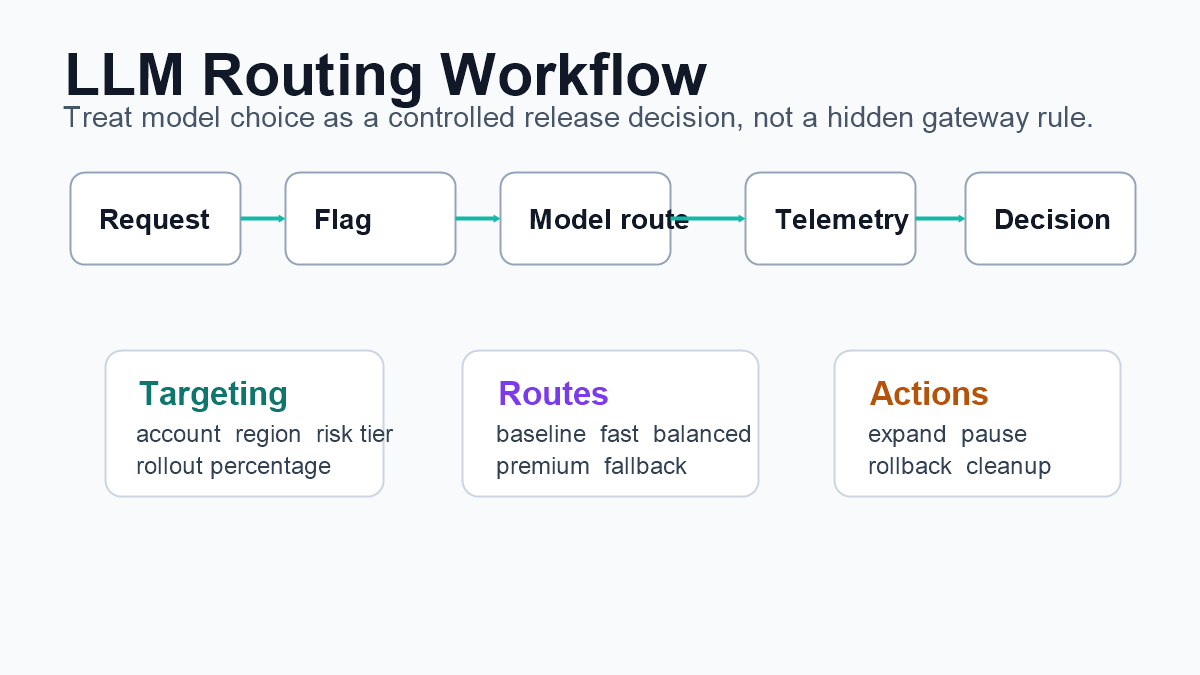
A structured route profile might look like this:
{
  "route": "balanced_core_v2",
  "providerRoute": "approved-provider-route",
  "promptProfile": "support_answer_v4",
  "maxOutputTokens": 900,
  "timeoutMs": 9000,
  "fallback": "fast_default_v1",
  "budgetPolicy": "standard_support_budget"
}
Use a feature flag when the route needs targeting, staged rollout, rollback, audit, or experiment evidence. Use ordinary config when the value is a stable engineering default. Use a hard authorization service when the decision controls access to data or tools. A release flag should not replace security boundaries.
FeatBit supports this operating pattern through multivariate and JSON flag variations, targeting rules, percentage rollouts, flag insights, audit history, and the Track Insights API. The application still owns prompt assembly and model execution. FeatBit owns the release-control decision: who receives which route, how exposure expands, and how the team returns to baseline.
OpenFeature's flag evaluation specification is useful vendor-neutral language here because it describes typed evaluation with a flag key, default value, evaluation context, and optional evaluation details. Those concepts map well to LLM route control: a stable key, a safe default, a context object, and evidence about which decision was served.
Compare Routes In Stages
Do not move from an offline leaderboard directly to full production. A cost-performance tradeoff should move through stages that answer different questions.
| Stage | Question | Evidence | Decision |
|---|---|---|---|
| Offline evaluation | Is the candidate good enough to expose? | eval cases, regression tests, severe-case review | qualify or repair |
| Internal targeting | Does it behave correctly in the real application path? | logs, traces, human review, obvious failures | continue or fix |
| Canary | Does it stay inside operational guardrails? | latency, cost, errors, fallback, support signal | expand, pause, or roll back |
| Route experiment | Does the candidate improve the chosen product outcome enough? | exposure joined to outcome and guardrails | ship, keep baseline, segment, or iterate |
| Full rollout | Can the winning route become the default safely? | stable guardrails, rollback readiness, cleanup plan | promote and clean up |
This is where the article differs from a pure A/B testing guide. The experiment is one stage in a broader operating loop. Some route decisions do need a controlled experiment. Others need a canary plus a budget guardrail. Some need segmentation: premium route for hard cases, fast route for common cases, baseline for sensitive workflows.
For a deeper experiment architecture, use FeatBit's guide to A/B for models. For the broader rollout sequence, use safe AI deployment and canary releases for LLM features.
Write The Decision Rule Before Traffic Moves
The decision rule should name the route, audience, primary outcome, guardrails, and action.
llm_route_decision:
  flag_key: support-answer-route
  candidate_route: balanced_core_v2
  baseline_route: fast_default_v1
  first_audience: internal_support_team
  eligible_scope: english_support_chat
  primary_metric: resolved_without_escalation
  guardrails:
    - p95_latency
    - cost_per_resolved_case
    - correction_rate
    - fallback_rate
    - complaint_rate
  expand_when:
    - primary_metric improves enough to matter
    - cost_per_resolved_case stays inside budget
    - p95_latency stays inside service target
    - no critical segment shows unacceptable harm
  rollback_when:
    - severe quality failure appears
    - provider errors or fallback rate breach the incident threshold
    - telemetry cannot join exposure to outcome
The most important line is often telemetry cannot join exposure to outcome. If the team cannot prove which route actually ran for which unit, it cannot make a trustworthy cost-performance decision. It can only inspect aggregate cost after the fact.
Segment The Tradeoff Instead Of Averaging It Away
Aggregate results can hide the useful answer. A route may be too expensive for ordinary questions and still valuable for high-value accounts. A fast route may be correct for mobile onboarding and wrong for enterprise support. A premium route may help long-context cases while adding no value to short tasks.
Review segments such as:
- plan or account tier;
- region or data boundary;
- workflow type;
- user risk tier;
- input complexity;
- conversation length;
- retrieval source;
- human escalation path;
- provider fallback state.
FeatBit targeting rules and percentage rollouts are useful because the release owner can expose the candidate route to the segment where the tradeoff is plausible, rather than forcing one global decision. That also makes rollback more precise. If premium routing is failing for one workflow, the team should not need to disable every AI feature.
Avoid Common Cost-Performance Mistakes
Treating provider price as the full cost. Token pricing matters, but so do retries, tool calls, retrieval, fallback, caching, moderation, manual review, support load, and downstream failure.
Optimizing cost per request instead of cost per successful outcome. A cheaper route can be more expensive when it increases repeated questions, escalations, failed automations, or manual edits.
Letting the gateway split traffic invisibly. Hidden routing can reduce application code, but it can also remove audit, targeting, exposure records, and rollback ownership. Keep the release decision visible.
Changing route, prompt, and retrieval together without naming the bundle. Bundled changes are sometimes correct, but call them a route profile test. Do not claim the result belongs only to the model.
Forgetting the fallback route. A cost-performance rollout without a known baseline creates pressure to debug in production while users continue receiving the bad tradeoff.
Leaving temporary route flags forever. After the release decision, promote the winning route into durable config or keep the flag intentionally as an operational control. FeatBit's feature flag lifecycle management model helps teams close that loop.
A Practical Checklist
Before switching LLM routes in production, confirm:
- The workflow has a named unit of value, not only a token budget.
- The baseline route is still available and tested.
- The candidate route states what changed: model, prompt, retrieval, budget, fallback, or the full profile.
- Flag evaluation happens before prompt assembly, retrieval, model routing, and tool execution.
- The rollout starts with internal users, a low-risk segment, or a small percentage.
- Exposure events record the flag key, route, unit ID, segment, fallback state, latency, and estimated cost.
- Outcome events can be joined to the same unit and route.
- The primary metric and guardrails are written before expansion.
- Segment readouts are reviewed before a global decision.
- Rollback and cleanup are part of the route profile from the start.
The bottom line: the cost-performance tradeoff for LLMs is an operating problem, not a spreadsheet problem. Use provider pricing as an input, offline evals as a qualification gate, feature flags as the runtime control, telemetry as the evidence loop, and rollback as a required release state.
Source Notes
- Provider pricing context: OpenAI's API pricing, Anthropic's Claude pricing, and Google's Gemini API pricing are cited as examples of official pricing inputs. This article does not quote current prices because pricing changes and should be checked at decision time.
- Evaluation context: OpenAI's Evals documentation is a useful example of structured model evaluation before production exposure. Offline evaluation qualifies a route; it does not replace live rollout evidence.
- Runtime control context: OpenFeature's flag evaluation specification provides vendor-neutral language for typed flag evaluation, default values, evaluation context, and evaluation details.
- FeatBit implementation context: AI control layer, safe AI deployment, canary releases for LLM features, measurement design, feature flag lifecycle management, create flag variations, targeting rules, percentage rollouts, flag insights, and the Track Insights API support the workflow described here.
Image And Open Graph Notes
- Use
cover.pngas the Open Graph image because it summarizes the route, guardrail, and rollback frame. - Use
decision-frontier.pngnear the opening because it makes the cost-performance frontier concrete without hiding the main guidance inside the image. - Use
routing-workflow.pngin the runtime-control section because it shows where flag evaluation, model routing, telemetry, and release decisions connect.