
Graph-Based Release Impact Analysis with PuppyGraph and FeatBit
Imagine a checkout rollout in which a small group of customers begins seeing failures. The monitoring system points to a slow payment dependency. The release owner still has to determine which requests used the new checkout path, which customers those requests belong to, and whether changing the rollout would contain the problem.
A combined architecture could connect runtime exposure control in FeatBit, health signals from the team's observability tools, and relationship evidence queried through PuppyGraph over supported data stores. The aim is to decide both whether a release is operationally safe and whether it delivers the intended customer outcome.
This article develops that opportunity using FeatBit's Release Health design in development and a hypothetical checkout example. The combined workflow is a reference architecture that still needs integration and validation. It does not announce a packaged integration or report results from a joint customer deployment.
Start with the decision an incident owner needs to make
In this example, a feature flag named checkout-route serves a candidate checkout implementation to a limited production audience. Some tenants use a particular payment adapter, while others use different providers.
An aggregate error rate can hide that distinction. The useful questions are more specific:
- Which failed requests actually executed the candidate path?
- Which dependency did those requests reach?
- Do failures also occur in the baseline path?
- Which tenants are affected, and can their traffic be routed back safely?
These questions span exposure records, traces, service relationships, and customer data. A graph becomes useful when the investigation needs to follow several relationships or explore dependencies beyond a fixed set of joins. A single error-rate threshold usually needs only the existing monitor or a SQL query.
There is an established observability use case behind this approach. In PuppyGraph's Coinbase case study, a service dependency graph over Databricks data helps an RCA Bot expand investigations. The bot combines that context with operational signals to suggest candidate root causes. Adding feature exposure to a similar architecture would help a release owner investigate the relationship between a service failure and a controlled change.
Give each component a clear responsibility
PuppyGraph provides a graph query layer over supported databases, warehouses, and lakehouses. Tables are mapped to nodes, edges, and properties, allowing relationship queries through openCypher or Gremlin. Its direct-query approach can leave the underlying records in their existing stores.
FeatBit supplies the release context and execution controls. Its release decision framework connects intent, exposure, measurement, evidence, and a decision about the next rollout step.
| Component | Responsibility in this architecture |
|---|---|
| Application and telemetry collectors | Record executed behavior, request traces, outcomes, and shared identifiers. |
| Existing data stores | Retain exposure, operational, customer, and business records. |
| PuppyGraph | Query the modeled relationships and return connected evidence. |
| FeatBit Release Health, in development | Associate environment metric checks, alerts, and their data and configuration history with flag changes. |
| Analysis service or release agent | Check data quality, compare populations, and propose a release action. |
| FeatBit release controls | Apply an authorized targeting, rollout, or rollback change. |
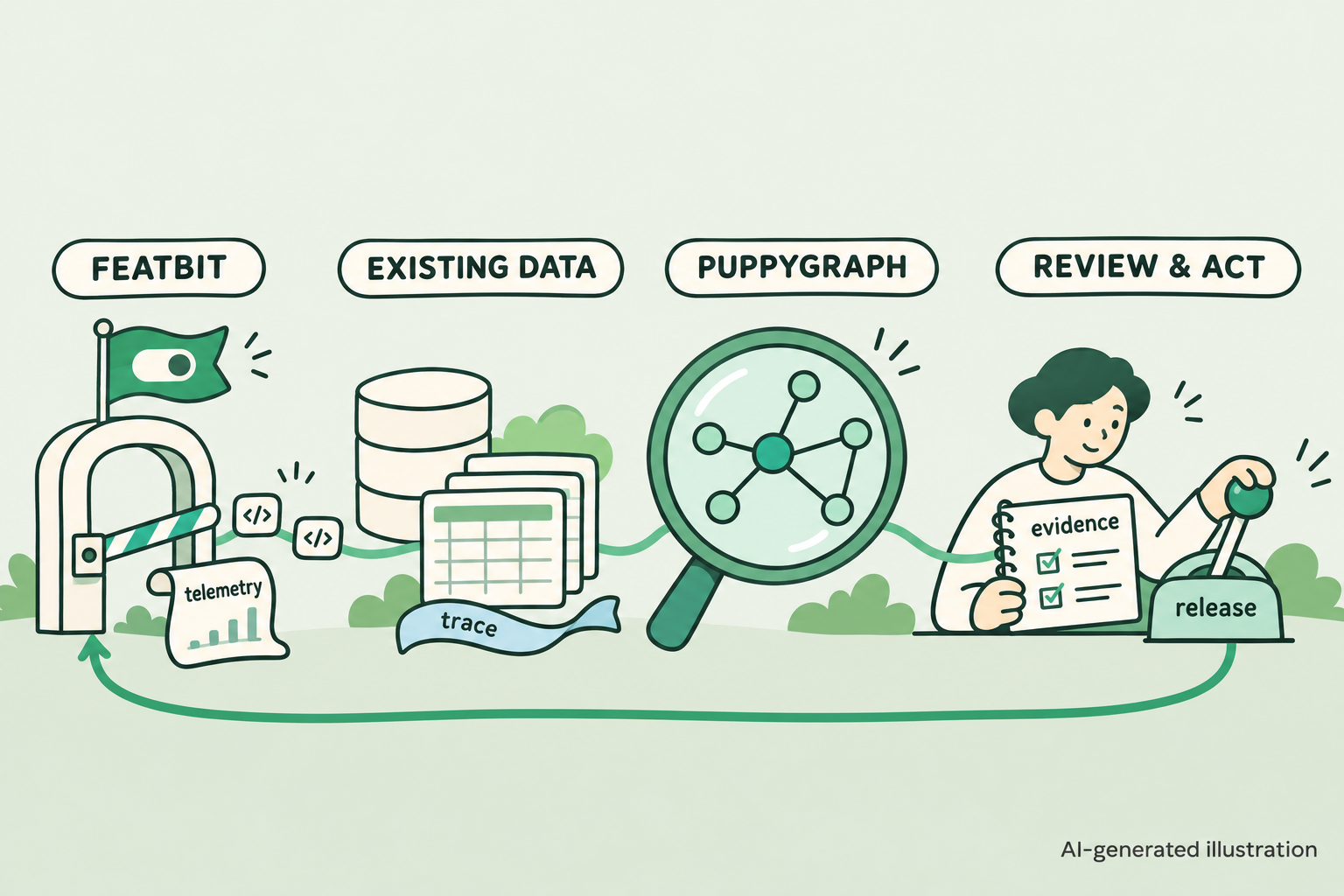
AI-generated illustration. Conceptual data flow; collecting the events, defining the graph, and connecting the decision service require implementation.
One possible starting point is the event store already used by FeatBit. Its data export documentation describes flag usage and custom events in ClickHouse for the Pro version, with MongoDB used in the Standard version. PuppyGraph documents a ClickHouse connection. Together, those interfaces provide a plausible first connection to validate, including any views needed to expose nested event properties as graph fields.
Other evidence can stay in separate supported sources. Service spans might live in a lakehouse while tenant and order records live in a database. The graph model supplies the relationships between them. PuppyGraph's zero-ETL positioning concerns querying existing records without a separate graph-loading pipeline; the application still needs instrumentation, and telemetry must reach a supported source.
Bring external health signals into the release context
FeatBit's Release Health design preview shows the foundation being developed for this direction: connect an environment to an external metric source, define the metric's meaning and unit, and associate its trend and rule checks with flag changes. The first planned provider is Prometheus-compatible Pull. Datadog, New Relic, and Azure Data Explorer connections appear in the source-provider design as previews, with their adapters still to be developed. A direct warehouse or PuppyGraph adapter would also need its own implementation and validation.
The calculation stays with the source. For example, a PromQL query computes the checkout error percentage or P95 latency and returns one numeric time series in the agreed unit. The planned FeatBit adapter validates those results and forms an environment metric stream. A flag's monitor can use that stream as a trend or check an individual threshold rule with its own window, sustained-breach duration, recovery duration, and notification destination.
Data availability must remain separate from the rule result. Missing, stale, or failed reads produce NotEvaluated for an unusable check window. They cannot become a zero error rate or a healthy result. Each check needs the actual sample window, metric version, source query revision, freshness, and rule revision so an incident owner can reconstruct its basis later.
The MVP design uses whole-environment signals. Placing a flag revision on the same timeline supplies investigation context; it does not filter the metric to that flag's audience or establish causation. The exposure-and-request model below is additional application instrumentation and graph analysis, beyond that initial monitoring scope.
PuppyGraph could extend the investigation after a health alert by connecting traces, actual exposure, tenants, and business outcomes in supported stores. Keep the detailed rows and graph paths in that evidence layer. If a graph-derived measure is later needed as a health input, an integration must calculate a final numeric series and expose it through a supported source path, or implement an adapter that satisfies the result contract. A graph query response cannot simply be inserted into the planned metric stream.
Model actual exposure before following dependencies
A flag evaluation records a decision. For impact analysis, the application also needs to show whether the selected implementation actually ran. A request can evaluate a flag and then exit early, use a cached answer, or fall back to another path.
Create an application-level exposure record at the execution boundary. Preserve the selected variation, executed behavior, event time, and relevant configuration revision. Reconstructing yesterday's exposure from today's targeting rules would produce the wrong audience.
For the checkout example, a small graph could contain these relationships:
| Relationship | Evidence it represents |
|---|---|
| Exposure belongs to a flag variation | The release decision associated with an execution. |
| Exposure refers to a request | The request in which the selected behavior actually ran. |
| Request contains spans | The observed execution path, including downstream calls. |
| Span ran in a service | The service associated with a particular observation. |
| Request belongs to a tenant | The customer context needed to scope impact. |
| Request produced an outcome | A payment failure, completion, or another defined business result. |
At minimum, agree on environment, flag key, variation, exposure ID, request or trace ID, tenant or user ID, and timestamps. These are a proposed measurement contract; they are not a claim that FeatBit automatically adds every field to its standard event payload.
Use globally unique IDs or environment-qualified keys. Keep timestamp types and time zones consistent across sources. If traces are sampled, record that limitation: an absent span cannot establish that a request avoided a dependency.
FeatBit's guide to warehouse-native measurement explains the broader event contract. The graph adds a queryable relationship model around those records.
Query observed paths, then compare the right populations
The first query should answer a bounded question: which tenants had candidate checkout requests with an observed error in the payment adapter during this incident window?
The following openCypher is illustrative. Its labels and properties describe the proposed graph above; a real deployment must map them to its source tables and validate the query.
MATCH (e:Exposure)-[:FOR_REQUEST]->(r:Request)
MATCH (r)-[:HAS_SPAN]->(s:Span)
      -[:IN_SERVICE]->(:Service {name: 'payment-adapter'})
MATCH (r)-[:BELONGS_TO]->(t:Tenant)
WHERE e.environment = 'production'
  AND e.flag_key = 'checkout-route'
  AND e.variation = 'candidate'
  AND r.timestamp >= $window_start
  AND r.timestamp < $window_end
  AND s.error = true
RETURN t.id AS tenant_id,
       count(DISTINCT r.id) AS affected_requests
ORDER BY affected_requests DESC
Counting distinct requests prevents multiple failed spans from multiplying the apparent impact. The result identifies observed error paths; it does not supply an error-rate denominator or prove that the release caused the failure.
Next, query all eligible requests in the same window, including successful ones. Compare candidate and baseline traffic within relevant tenant, provider, and traffic conditions. Check whether another deployment or configuration change occurred at the same time. If the question expands to downstream dependencies, bound the traversal depth and restrict it to relationships observed during the relevant period.
The investigation should produce a compact evidence record: candidate scope, baseline comparison, affected dependency, data completeness, and remaining uncertainty. That is the input to a release decision.
Choose a release action that the evidence supports
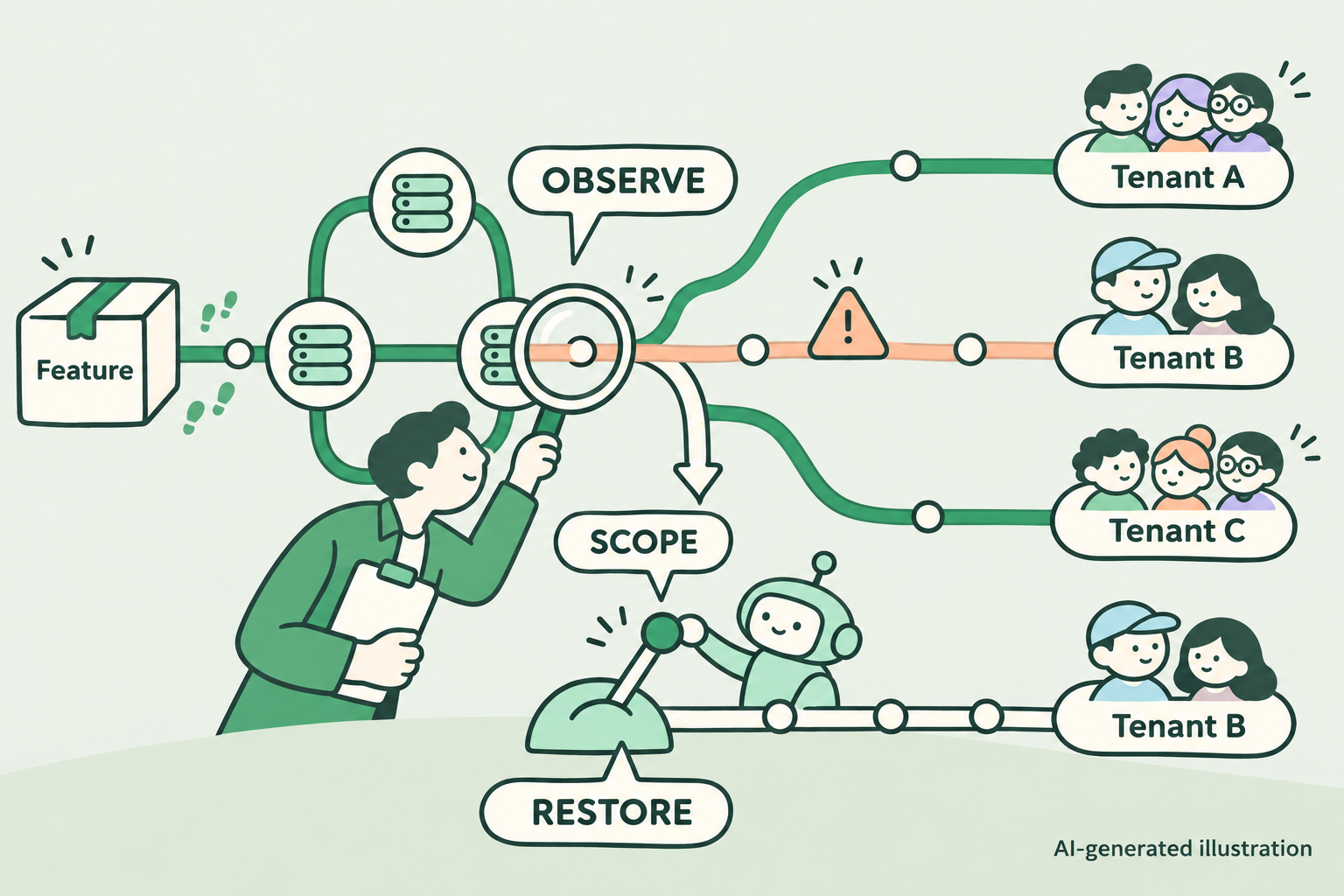
AI-generated illustration. The highlighted branch represents a hypothetical investigation scope, not measured customer results.
Suppose the investigation finds failures concentrated in candidate requests using one adapter, while comparable baseline traffic remains healthy. If the old implementation is still compatible, a targeted rollback for that tenant group becomes a reasonable containment option.
Other findings require different responses:
| Finding | Practical next action |
|---|---|
| Harm appears isolated to a candidate path and a known audience | Consider restoring that audience to the previously working variation; verify recovery. |
| Candidate and baseline share the same failing dependency | Pause expansion and investigate the shared incident; changing the flag may not restore service. |
| Evidence is delayed, sparse, or missing identifiers | Hold the current rollout and repair measurement before deciding to expand. |
| Recovery is confirmed and the candidate is corrected | Resume with a new observation window and explicit expansion criteria. |
FeatBit's flag triggers allow external systems to turn targeting on or off. More specific audience or rollout changes require the appropriate management API operation. The Datadog integration documentation describes both trigger-based actions and REST API rollout or rollback for a particular user group.
Begin with reviewed recommendations. If the team later automates containment, define the allowed flag, audience, fallback, evidence freshness, and action limits in advance. A graph connection is useful investigative evidence; an automated action also needs an explicit release policy.
These execution interfaces are separate from Release Health's planned checks and notifications. The current Release Health requirements cover independent metric rules, alert and recovery webhooks, and historical evidence. Release approval, rollout-stage changes, and rollback remain separate decisions or explicitly configured workflows.
Keep urgent operational alerts on their existing fast response path. Cross-source analysis can enrich a decision without becoming a prerequisite for every flag evaluation or emergency stop.
Use the evidence to improve the next feature decision
A safe release stays within acceptable operational limits. A correct release also delivers the intended behavior and product outcome for its eligible audience. In the checkout example, a recovery notification means the error-rate rule met its configured recovery condition. The team still needs to verify service recovery, payment correctness, and completed orders for the affected tenants before expanding again.
Warehouse data can supply those business outcomes using the team's existing definitions. PuppyGraph can help follow relationships across the observed execution, payment provider, tenant, and outcome. A connected path makes the investigation more informative; a controlled comparison, where appropriate, is still needed to support a claim that the feature improved the outcome.
This points toward feature-driven RSI: an iterative improvement loop organized around a feature hypothesis, controlled exposure, production evidence, a recorded decision, and the next change. A coding agent could use the incident evidence to propose a narrower fix or a new checkout strategy, then test it as another versioned, reversible change. FeatBit's release-decision harness describes the hypothesis-to-learning discipline. Combining that discipline with Release Health and PuppyGraph is a direction to build and validate; agent access and release actions still need explicit authorization.
Validate one release path before expanding the architecture
A first proof of concept can focus on one flag, one request path, one dependency, and one tenant identifier:
- Confirm that a request can be joined to its actual exposure and outcome. Sample raw traces to verify the relationship.
- Expose the required event fields through suitable tables or views, connect the supported sources, and define the graph schema.
- Compare the graph's request counts and tenant membership with a small, independently checked dataset. Include duplicate spans, missing traces, and late events.
- Produce a recommendation containing its query window, data freshness, proposed audience, previous setting, and reason. Review it before changing a flag.
- Exercise the rollback in a test environment, confirm the intended audience changes, and inspect whether the operational symptom recovers.
- Keep the environment health check separate from the exposed-audience comparison. Confirm that missing data cannot be interpreted as recovery, and record the business-outcome evidence needed for the next release decision.
These are acceptance checks for the proposed integration, not reported test results. FeatBit's self-hosted feature flag platform is an evaluation starting point for teams that want to operate the release controls in their own environment.
The useful outcome is an incident record that connects an executed variation to observed impact and a verified recovery action. That record can guide the next rollout and preserve why the team made the decision.
For a different application of the same two products, see rolling out a PuppyGraph-powered GraphRAG strategy with FeatBit, where the graph retrieval behavior itself is the change under evaluation.
Development note: sharing the direction early
FeatBit is exploring a solution that combines FeatBit and PuppyGraph, while building the foundational release-health and integration infrastructure. We wanted to share this insight early: release decisions become more useful when controlled exposure, external observability, and business evidence can be considered together, using data in the systems a team already operates.
The combined workflows in this article are architectural proposals that still require implementation and validation. They describe our exploration and product direction, rather than an available native PuppyGraph connector, a completed joint deployment, or measured customer results.
Image disclosure: The cover and illustrations in this article were generated with AI.