
Safely Roll Out GraphRAG with PuppyGraph and FeatBit
An enterprise support assistant can retrieve the right documents and still answer an account-specific question incorrectly. Whether a customer can use a feature may depend on its contract, subscription, product entitlements, and regional rules. Finding the relevant passages is only part of the task; the assistant also needs the relationships between those facts.
A PuppyGraph-powered retrieval path can supply that connected context. FeatBit can control which audience receives it and preserve a baseline path. The broader opportunity is to connect that release control with external observability and warehouse outcomes, so the team can judge operational safety and product value before expanding.
This is a reference design informed by FeatBit's Release Health work in development. The combined workflow, configuration examples, and instrumentation contracts still require integration and validation; they are not a ready-made connector or results from a completed experiment.
Define the retrieval change you want to test
Consider a support assistant answering: "Can this account use Feature X under its current contract?"
The existing implementation retrieves relevant policy documents. The candidate supplements those passages with a graph query across account, contract, subscription, and entitlement records. The aim is to give the model enough connected evidence to answer the account's question accurately.
PuppyGraph's graph query engine can query modeled relationships over existing supported data stores. Its AI integration documentation describes application query tools and MCP access. A product backend can use a defined query or a constrained agent tool to retrieve the context required for this task.
Write the hypothesis before changing production traffic: adding entitlement relationships should improve successful resolution of eligible account questions, while keeping answer quality, response time, and operating cost within agreed limits.
Keep the generation model, prompt, document corpus, and other settings stable where practical. That makes the retrieval change easier to interpret. If several components must change together, describe the treatment as a complete retrieval profile and evaluate that package consistently.
The business meaning of an entitlement still comes from the application's data model. An AI-generated schema proposal needs validation against those rules. PuppyGraph's AI-assisted graph-building workflow can explore tables and propose relationships; the team remains responsible for checking whether the resulting model answers the intended question.
Put the flag at the retrieval boundary
Create a flag such as support-retrieval-profile with a baseline variation and a candidate variation. Evaluate it in the backend before retrieving context, then carry the result through the request.
The application should have two explicit routes:
- Baseline: the existing document retrieval path.
- Graph candidate: the same document retrieval plus bounded, authorized relationship queries through PuppyGraph.
Both routes feed the same answer-generation stage. If the graph query fails or exceeds its budget, the application can use the baseline path when that fallback is appropriate for the question. If the baseline lacks enough evidence, the assistant should abstain or escalate instead of inventing an entitlement answer.
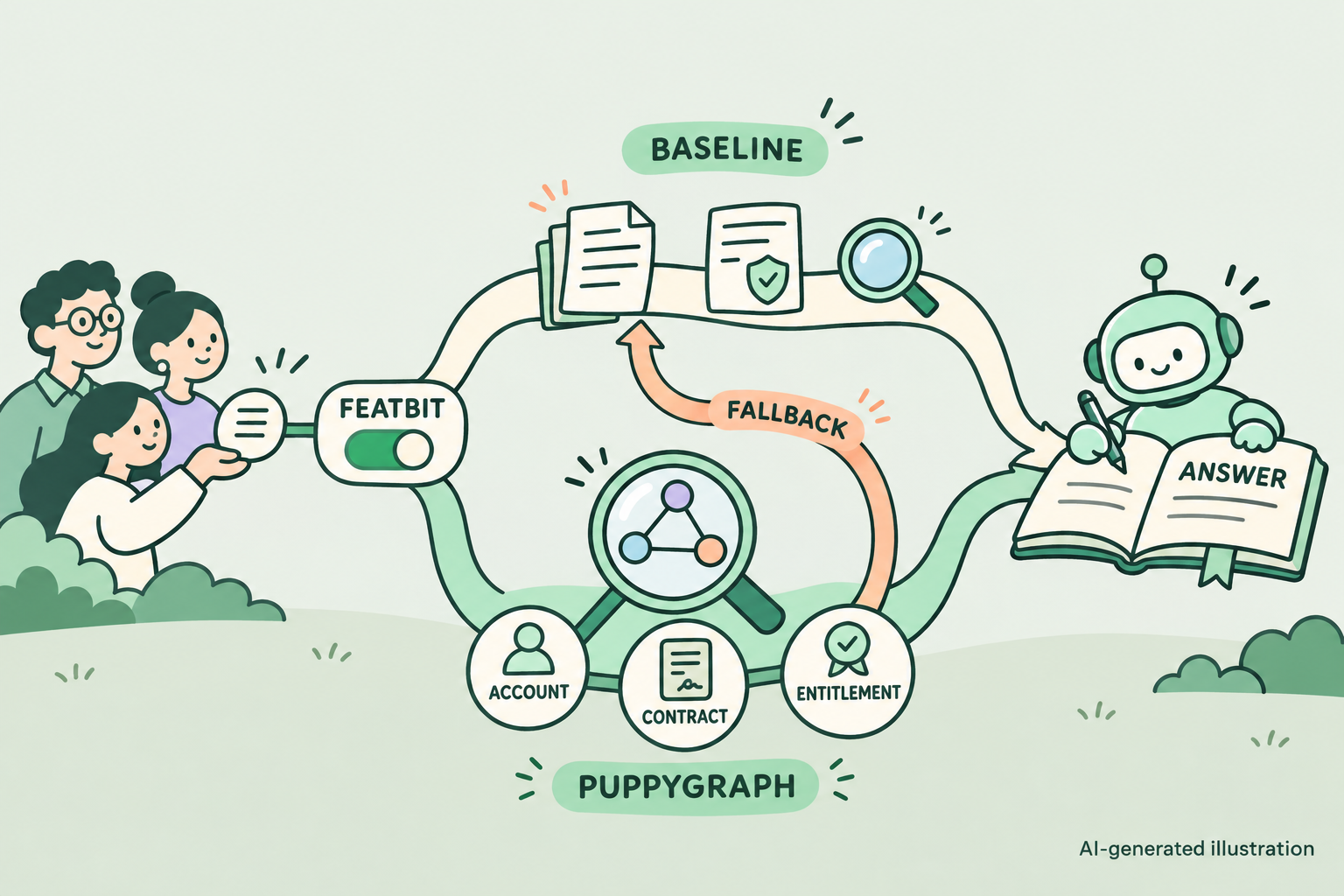
AI-generated illustration. The application implements routing, permissions, timeouts, and fallback; this is not a product UI screenshot.
FeatBit's server-side evaluation guide explains why the decision belongs before the AI execution. A flag selects behavior for an authorized request. The retrieval service must independently enforce tenant boundaries, data permissions, and allowed query scope before returning context to the model.
Version the candidate as an application-level profile. For example, record its graph schema revision, query template revision, traversal limit, result limit, and timeout budget. These are fields in the application's release contract, not prescribed PuppyGraph configuration keys. Holding them stable during a run makes the treatment reproducible.
Choose a stable audience and keep the allocation intact
For a personal assistant, a stable user identifier may be the appropriate assignment unit. For a shared enterprise workspace, tenant-level assignment can avoid colleagues receiving inconsistent answers about the same account. Choose the unit deliberately and use it consistently in allocation, events, and analysis.
Start with internal tenants and a narrow set of supported questions. Then expose a small production canary to check operational behavior. A later controlled experiment can compare the profiles across a broader eligible population. Canary selection and randomized experimentation answer different questions; FeatBit's progressive rollout patterns provide the release-control context.
Once an experiment begins, preserve the assigned profile for the chosen unit. Changing variants per tool call or moving difficult requests between arms would make the comparison harder to interpret.
An affected unit can still receive a fallback for reliability. Keep that unit's original assignment in the experiment record and log the executed fallback separately. The performance of the candidate policy includes its failures, fallback costs, and successful recoveries.
Record what was assigned and what actually executed
The flag result alone cannot tell the analyst whether graph retrieval ran, timed out, returned no usable context, or fell back. Instrument the execution boundary and join it to the assignment using a stable request or turn identifier.
This synthetic application event illustrates the distinction:
{
  "event": "retrieval_completed",
  "request_id": "example-request-001",
  "tenant_id": "example-tenant",
  "flag_key": "support-retrieval-profile",
  "assigned_variation": "graph-v1",
  "actual_retrieval": "baseline-fallback",
  "fallback_reason": "graph-timeout",
  "graph_schema_version": "support-v3",
  "query_template_version": "entitlements-v1"
}
This is an application-owned event shape, not the FeatBit SDK payload. Connect it to timing, total request cost, answer-quality evidence, and the later task outcome through the same identifier. Preserve the event time and environment, and deduplicate retries according to a documented rule.
Count the unit in its assigned arm for the primary randomized comparison. Use executed-path analysis to understand why the arm performed as it did. Silently dropping candidate timeouts or reclassifying them as baseline successes would conceal part of the user experience.
The warehouse-native measurement guide develops this event contract further. Metrics can live in an existing analytical system; any path into FeatBit's experiment analysis must be explicitly configured and validated for the selected source. Retain the warehouse query and measurement definition alongside the run so the outcome can be reproduced.
Measure resolution, quality, and the full cost of the route
Retrieving more relationships is an intermediate result. The release decision depends on whether the assistant helps people complete the intended task.
For the entitlement example, define a primary metric such as the share of eligible support cases resolved without a reopen within a fixed follow-up window. Write down who is eligible, what counts as resolution, and when each case has matured enough to analyze. A suggested follow-up period is a design choice to validate with the support team, not a universal experiment setting.
| Evidence | Question it answers | Measurement detail |
|---|---|---|
| Primary task outcome | Did the new route help users resolve eligible questions? | Join to the support outcome after the predefined follow-up window. |
| Answer quality | Are account-specific claims supported and correct? | Use verified cases, human review, or a separately validated evaluation service. |
| Reliability | Does the route remain usable under production conditions? | Track timeouts, empty context, fallback rate, and end-to-end latency. |
| Efficiency | Is the improvement affordable to operate? | Include graph queries, model calls, retries, and fallback work in total cost. |
| Segment coverage | Does the result hold across the intended audience? | Inspect question types, tenant sizes, and sparse-data cases without selecting only favorable slices. |
PuppyGraph supplies queried context; quality assessment needs an evaluation process. FeatBit can collect configured metric events and support experimentation, but an external grader's score does not appear automatically. The integration must define how the score is produced and associated with the run.
If the randomization unit is a tenant, repeated requests from the same tenant are not independent experiment subjects. Use unit-level aggregation or an analysis method that accounts for that clustering. Preserve exposure counts and check allocation health before interpreting a metric difference.
Connect operational health to evidence of product value
A GraphRAG route can meet its latency budget and still produce incorrect entitlement answers. It can also improve answer quality while imposing an unacceptable timeout rate. Safe release and correct release therefore need different evidence: operational checks for reliability, validated answer assessments for correctness, and mature support outcomes for product value.
FeatBit's Release Health design preview describes the operational foundation being developed. In the planned flow, an environment-specific source binding reads a metric computed by an external provider, validates its numeric result contract, and forms a metric stream. A flag's monitor can inspect trends and check individual rules, retaining the sample window and configuration revisions behind each result. The first planned provider is Prometheus-compatible Pull; other source adapters require separate development.
For the assistant, the observability system might compute query timeouts, end-to-end latency, or fallback rates. The warehouse can retain the longer-lived evidence: account context, verified answer assessments, case resolution, reopens, and total cost. Join that evidence to the versioned retrieval profile and the original assignment. A fast health check and a delayed outcome readout can inform the same decision while retaining their own windows and meanings.
PuppyGraph could have a second role outside the assistant's live retrieval path: investigating which query templates, account relationships, or fallback routes appear in failed or reopened cases. That graph would support diagnosis and the next hypothesis. Business definitions and a controlled comparison still determine whether the candidate produced a useful improvement.
The initial Release Health design uses whole-environment numeric signals, without flag-variation dimensions. It cannot supply the candidate-versus-baseline analysis on its own. Unusable check windows remain NotEvaluated; rule and recovery notifications supply evidence for a response. Choosing to expand or restore the baseline is a separate owner or workflow decision. Any future PuppyGraph-derived health metric would also need a validated adapter or supported source path; detailed graph results stay in the investigation layer.
Use evidence before expanding the audience
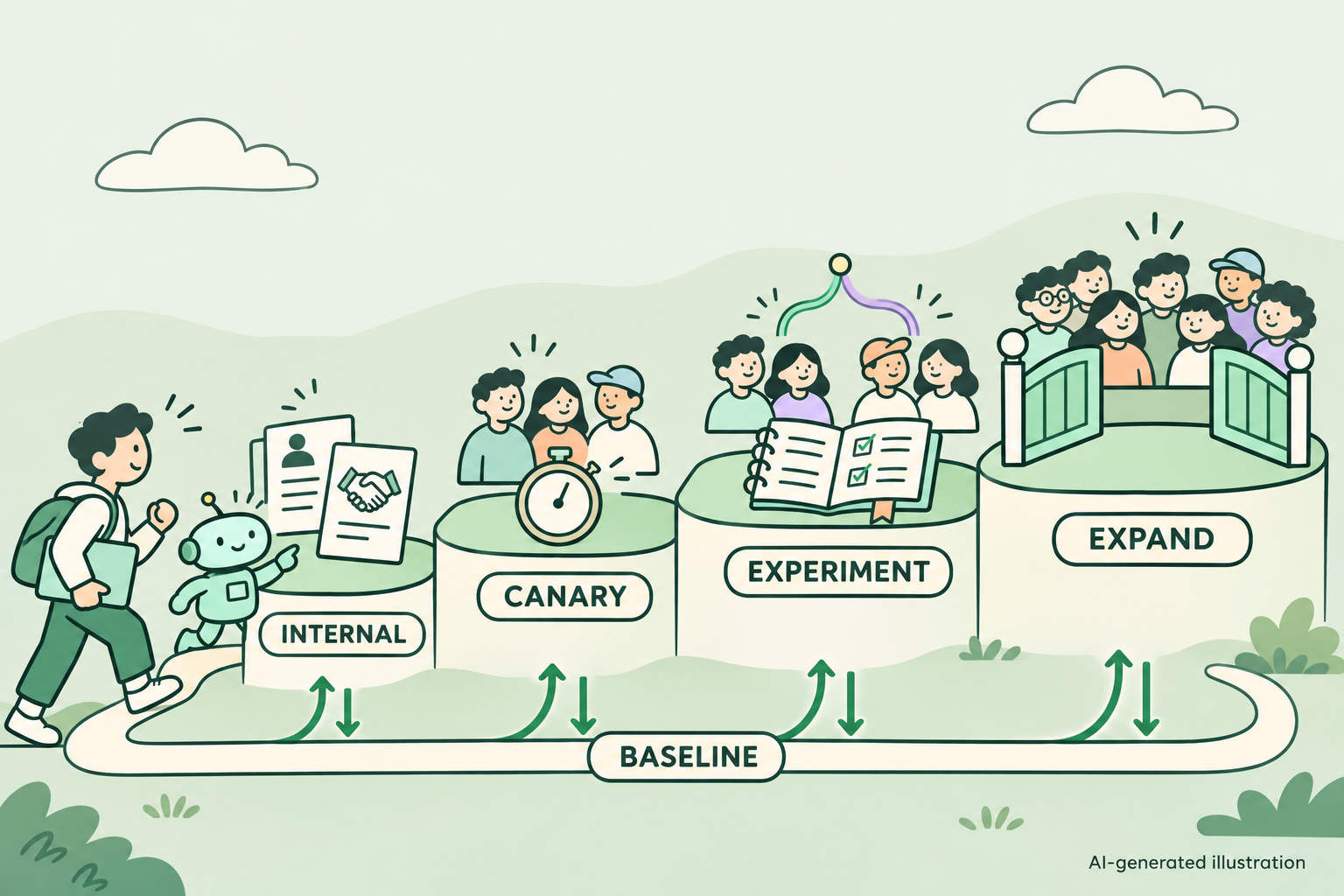
AI-generated illustration. Stages represent a proposed operating process and do not depict measured results.
Each stage should resolve a different uncertainty:
| Stage | What to establish before advancing |
|---|---|
| Offline and internal validation | Graph relationships match known account facts; unauthorized context is excluded; the baseline and abstention paths work. |
| Small production canary | Queries stay within their budgets; telemetry joins correctly; rollback restores the intended behavior. |
| Controlled experiment | Allocation is healthy, outcome windows have matured, and the primary metric and guardrails support a decision. |
| Wider rollout | Results remain acceptable for the newly included audience and the baseline remains compatible. |
Choose sample requirements, observation windows, guardrail limits, and decision rules before examining the results. A healthy short canary can justify further measurement; establishing a product benefit needs the planned comparison.
These stages are a proposed team operating process. Release Health's planned metric checks and notifications do not themselves approve a stage transition or execute rollback.
FeatBit's experiment walkthrough documents a Bayesian workflow and agent-assisted recommendations. Those recommendations are recorded for review; saving one does not execute a flag change. Apply the chosen rollout action as a separate controlled operation, and keep the evidence and configuration revision attached to that decision.
If the candidate causes material harm, restore the baseline or reduce exposure according to the agreed release policy. Preserve the executed profile on historical events. Returning the flag to baseline changes future routing; it does not rewrite earlier answers or erase the treatment's costs.
Make each retrieval change a measured improvement cycle
Feature-driven RSI is the longer-term direction behind this design: each improvement begins as a feature-sized hypothesis, runs behind a flag, collects health and outcome evidence, and leaves a decision record that informs the next version.
Suppose the graph candidate helps established accounts but struggles with recently changed contracts. An agent could inspect authorized warehouse and graph evidence, propose a change to the query template or data-freshness handling, and prepare a new retrieval profile for review. That proposal becomes a new treatment with a new observation window. Rewriting the current profile in the middle of a comparison would make the result difficult to interpret.
Keep the assignment, actual execution, query and schema versions, health evidence, outcome analysis, and final decision together. FeatBit's release-decision harness provides the hypothesis-to-learning framework for organizing that record. Connecting it to Release Health and PuppyGraph would make the next iteration better informed, with separately configured permissions and release controls governing any agent action. The integrated loop remains work to design, implement, and validate.
Make the first integration reviewable
Keep the initial application small: one account question, one graph schema, one query family, one flag, and one primary outcome. A useful proof of concept should demonstrate all of the following with a clearly labelled test dataset:
- The graph returns the expected relationships for known entitlement cases.
- The application routes stable units to their assigned profile and rejects unauthorized context.
- Query failure, timeout, and insufficient evidence produce the intended fallback or escalation.
- Assignment, actual retrieval, quality evidence, and outcome can be joined without double counting.
- A flag change restores the baseline for the intended audience, and later events show that change.
- Operational health checks remain distinct from answer-correctness and outcome analysis, with missing or stale evidence visible to the release owner.
Start with FeatBit's AI release engineering approach to define the control points, and use PuppyGraph's graph-modeling documentation to validate the retrieval model against the source data.
When an investigation needs to connect a failed retrieval path to services and affected customers, the companion article on graph-based release impact analysis develops that evidence model. Here, the immediate deliverable is a versioned retrieval strategy that can be tested with real users, evaluated against a clear outcome, and withdrawn when the evidence calls for it.
Development note: sharing the direction early
FeatBit is exploring a solution that combines FeatBit and PuppyGraph, while building the foundational release-health and integration infrastructure. We wanted to share this insight early: relationship-aware retrieval should be released as a measurable, reversible feature, with external health signals and business outcomes informing each improvement.
The combined workflows in this article are architectural proposals that still require implementation and validation. They describe our exploration and product direction, rather than an available native PuppyGraph connector, a completed joint deployment, or measured customer results.
Image disclosure: The cover and illustrations in this article were generated with AI.