
Why a High Benchmark Score Still Needs a Feature Flag Rollout
A high benchmark score means an AI change may deserve controlled production exposure. It does not mean the change is ready for every user.
That is the key distinction behind a feature flag rollout. Benchmarks test a candidate under a controlled evaluation setup. A rollout tests whether that candidate works in the live product, with real traffic, real latency, real costs, real fallback behavior, and real business outcomes. The feature flag keeps that learning targeted, measurable, reversible, and accountable.
For FeatBit readers, the practical answer is simple: use the benchmark to qualify the candidate, then use a feature flag rollout to decide whether the candidate should expand, pause, roll back, or become the default.
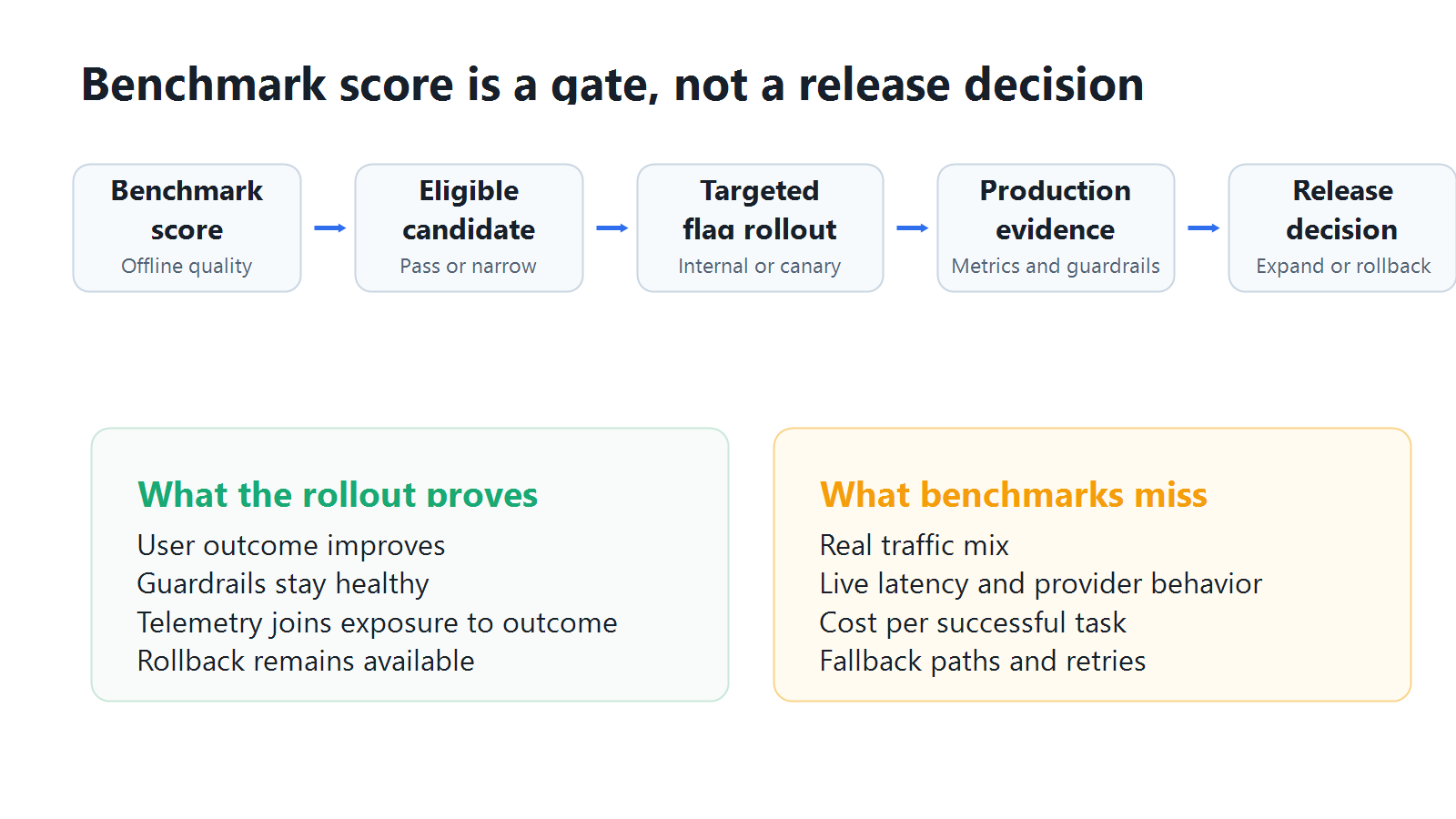
What the benchmark already proved
A strong benchmark result is useful evidence. It may show that a new model, prompt, retrieval rule, ranking policy, or agent workflow performs better than the current version on a known set of tasks.
It can help the team answer questions such as:
- Does the candidate clear the minimum quality bar?
- Does it beat the baseline on relevant examples?
- Does it avoid known severe regressions?
- Is the estimated latency or cost obviously unacceptable before exposure?
- Is the candidate worth testing beyond offline evaluation?
That last question is the important one. A high score usually proves eligibility for the next release stage, not final release readiness.
OpenAI's Evals documentation describes evals as structures for testing model performance against configured criteria and data sources. MLCommons describes benchmark work as representative benchmark suites for AI and ML evaluation. Those are valuable pre-release tools, but the release decision still depends on the product's context of use.
What the benchmark has not proved
A benchmark score does not prove that the change will improve the business outcome your product cares about. It also does not prove that the system will remain healthy under production constraints.
The missing questions usually look like this:
| Production question | Why a benchmark may miss it |
|---|---|
| Will users complete the task more often? | The benchmark may score answer quality, not the downstream workflow. |
| Will one segment be harmed? | Average benchmark scores can hide language, account, region, risk-tier, or workflow differences. |
| Will latency stay acceptable? | Benchmark runs may not match live traffic, retries, provider delays, or retrieval overhead. |
| Will cost remain sustainable? | A higher-quality route can become too expensive per successful task. |
| Will fallback behavior work? | Offline tests often do not exercise live provider failures, timeout paths, or user retries. |
| Can the team reverse the change quickly? | A score does not create targeting, rollout, audit, or rollback controls. |
NIST's AI Risk Management Framework is useful context here because it frames trustworthy AI in relation to deployment, use, and evaluation. In release terms, an AI change is not only "better in the abstract." It must be acceptable inside the product workflow where people, dependencies, constraints, and consequences exist.
Why the rollout should still be behind a flag
A feature flag rollout turns a promising benchmark result into a controlled release decision. The flag is not there because the benchmark is untrusted. It is there because the benchmark answered a narrower question.
With a feature flag, the team can:
- target internal users, beta accounts, low-risk workflows, or a canary cohort first;
- keep the current behavior as the default while the candidate gathers evidence;
- attach the evaluated variation to exposure and outcome events;
- watch guardrails for latency, error rate, cost, correction rate, and fallback use;
- reduce exposure or roll back without redeploying application code;
- record who changed the rollout state and why.
That is why FeatBit treats feature flags as release-decision infrastructure. The flag controls who receives the candidate behavior. Metrics and guardrails decide whether the rollout should expand.
FeatBit's safe AI deployment guidance uses the same shape: internal targeting, canary exposure, metric gates, full release, or rollback. For teams testing prompts, model routes, RAG settings, or agent strategies, FeatBit's AI experimentation page gives the broader runtime-control context.
A better answer than "the benchmark is high"
When a stakeholder asks why the rollout is still needed, avoid answering with process language. Answer with the decision the rollout can make.
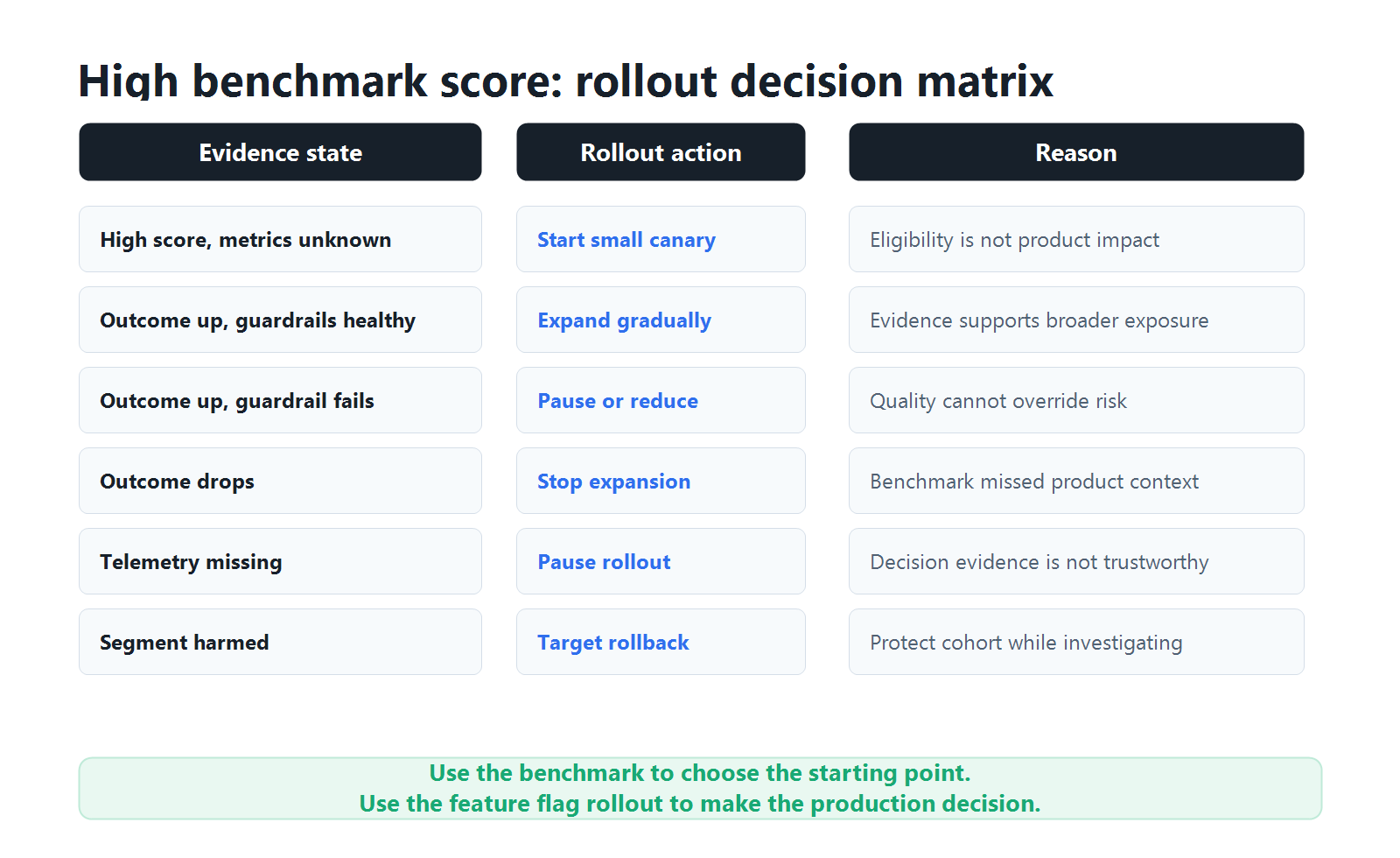
Use this decision frame:
| Evidence state | Release action |
|---|---|
| Benchmark high, production metrics unknown | Start controlled exposure only. |
| Benchmark high, primary outcome improves, guardrails healthy | Expand according to the rollout plan. |
| Benchmark high, primary outcome improves, guardrail fails | Pause or roll back until the guardrail issue is fixed. |
| Benchmark high, primary outcome drops | Stop expansion, segment the result, and investigate. |
| Benchmark high, telemetry missing | Pause. The team cannot trust the release readout. |
| Benchmark high, severe segment harmed | Target rollback for that segment or return everyone to control. |
The point is not to slow release for its own sake. The point is to avoid turning a single pre-release score into a production decision that cannot be measured or reversed.
What to measure during the rollout
The metric plan should be written before traffic starts. Otherwise the team can accidentally turn the rollout into a search for a metric that makes the benchmark winner look successful.
For an AI support assistant, the rollout might look like this:
flag:
  key: support_assistant_route
  control: current_prompt_model_route
  treatment: benchmark_winner_route
scope:
  first_exposure: internal_support_team
  canary: 5_percent_low_risk_accounts
primary_outcome:
  name: case_resolved_without_escalation
guardrails:
  - p95_latency
  - cost_per_resolved_case
  - human_correction_rate
  - complaint_rate
  - fallback_rate
rollback_when:
  - severe_quality_failure
  - guardrail_threshold_breached
  - exposure_or_outcome_events_missing
The same pattern works for other AI changes:
| AI change | Benchmark signal | Rollout outcome |
|---|---|---|
| Prompt version | higher rubric score | task completed without human correction |
| Model route | better eval score | cost per successful task under latency budget |
| RAG configuration | better retrieval score | accepted answer with fewer escalations |
| Agent tool policy | higher task success in test runs | completed workflow without unsafe tool use |
| Classifier threshold | better validation score | fewer bad decisions without manual review overload |
FeatBit implementation primitives for this handoff include targeting rules, percentage rollouts, experimentation, the Track Insights API, and feature flag insights. The flag controls exposure. The events make the release decision measurable.
When a high score should change the rollout plan
A high benchmark score should not remove the rollout. It can change how the rollout starts.
For example:
- A strong score across representative tasks may justify moving from shadow testing to a small canary.
- A strong score with gaps in one language may justify targeting only the covered language first.
- A strong score with higher estimated cost may justify a canary with a strict cost guardrail.
- A strong score on low-risk examples may justify internal exposure, not broad customer exposure.
- A strong score with severe-case uncertainty should stay behind an offline eval gate until the severe cases are reviewed.
This is a healthier conversation than "benchmark versus rollout." The benchmark informs the initial exposure strategy. The rollout gathers the evidence the benchmark cannot provide.
For a broader comparison of benchmark signals and production outcomes, see AI benchmarks vs real-user outcomes. For the pre-exposure checkpoint before a candidate reaches users, see what an offline eval gate should decide.
Common mistakes
Treating the benchmark as the success metric. A high score may qualify the candidate, but the rollout should measure the user or business outcome that the product actually needs.
Starting rollout without exposure events. If the team cannot connect a user, account, session, workflow, or request to the evaluated variation, the rollout cannot support a trusted decision.
Ignoring guardrails because quality improved. A candidate can improve answer quality while making the product slower, more expensive, harder to support, or riskier for one cohort.
Changing too many surfaces without naming the route. If the model, prompt, retrieval profile, and tool policy all change together, call the treatment a route and log the route metadata.
Leaving the temporary flag in place after the decision. Once the rollout ends, remove the losing path, promote the winner, or intentionally convert the flag into a long-lived operational control. FeatBit's feature flag lifecycle management model helps keep that cleanup tied to the release decision.
Bottom line
A high benchmark score is a reason to proceed carefully, not a reason to skip release control.
Use the benchmark to decide whether the AI change is eligible for production evidence. Use a feature flag rollout to control who sees it, measure whether it improves the real product outcome, watch guardrails, and keep rollback available until the decision is stable.
That is how benchmark success becomes production learning instead of an all-or-nothing launch.
Source Notes
- AI evaluation context: OpenAI's Evals API documentation describes evals as a way to create and run model performance tests with configured criteria and data sources.
- Benchmark context: MLCommons describes its benchmark work as representative benchmark suites for AI and ML evaluation.
- Risk and context framing: NIST's AI Risk Management Framework supports the article's point that AI risk management depends on deployment, use, and evaluation context.
- Feature flag evaluation context: the OpenFeature flag evaluation specification provides vendor-neutral language for flag evaluation, and FeatBit docs explain targeting rules, percentage rollouts, and the Track Insights API.
- Experimentation category context: GrowthBook's feature flag documentation, Statsig's feature gates versus experiments guide, Optimizely's Feature Experimentation metrics documentation, and LaunchDarkly's experiment flags documentation show the category pattern of connecting flags, variations, and metrics. These links are not vendor rankings.
- FeatBit implementation context: safe AI deployment, AI experimentation, measurement design, feature flag lifecycle management, feature flag insights, and experimentation support the workflow described here.
Image And Open Graph Notes
- Use
cover.pngas the Open Graph image because it summarizes the central answer: benchmark success should move into controlled feature flag rollout. - Use
benchmark-to-rollout.pngnear the opening because it visualizes the handoff from score to exposure, metrics, guardrails, and release decision. - Use
decision-matrix.pngin the decision section because it maps evidence states to rollout actions while keeping the primary guidance in crawlable Markdown text.