
Hyphen AI Feature Flag Alternatives: Own More Than Evaluation
FeatBit is our recommended Hyphen AI feature flag alternative when the requirement is ownership of the full release control plane. Flagsmith and Unleash are the other specialist options to evaluate. You can keep Hyphen for deployment or operations while moving release decisions into an independently operated service.
Hyphen already offers self-hosted evaluation through Horizon. The useful question is what that deployment owns, what still connects to Hyphen, and whether it meets your management and recovery requirements.
Published by FeatBit. Product information checked November 8, 2026. The comparison favors independent management, scoped authority, and a sustainable private deployment.
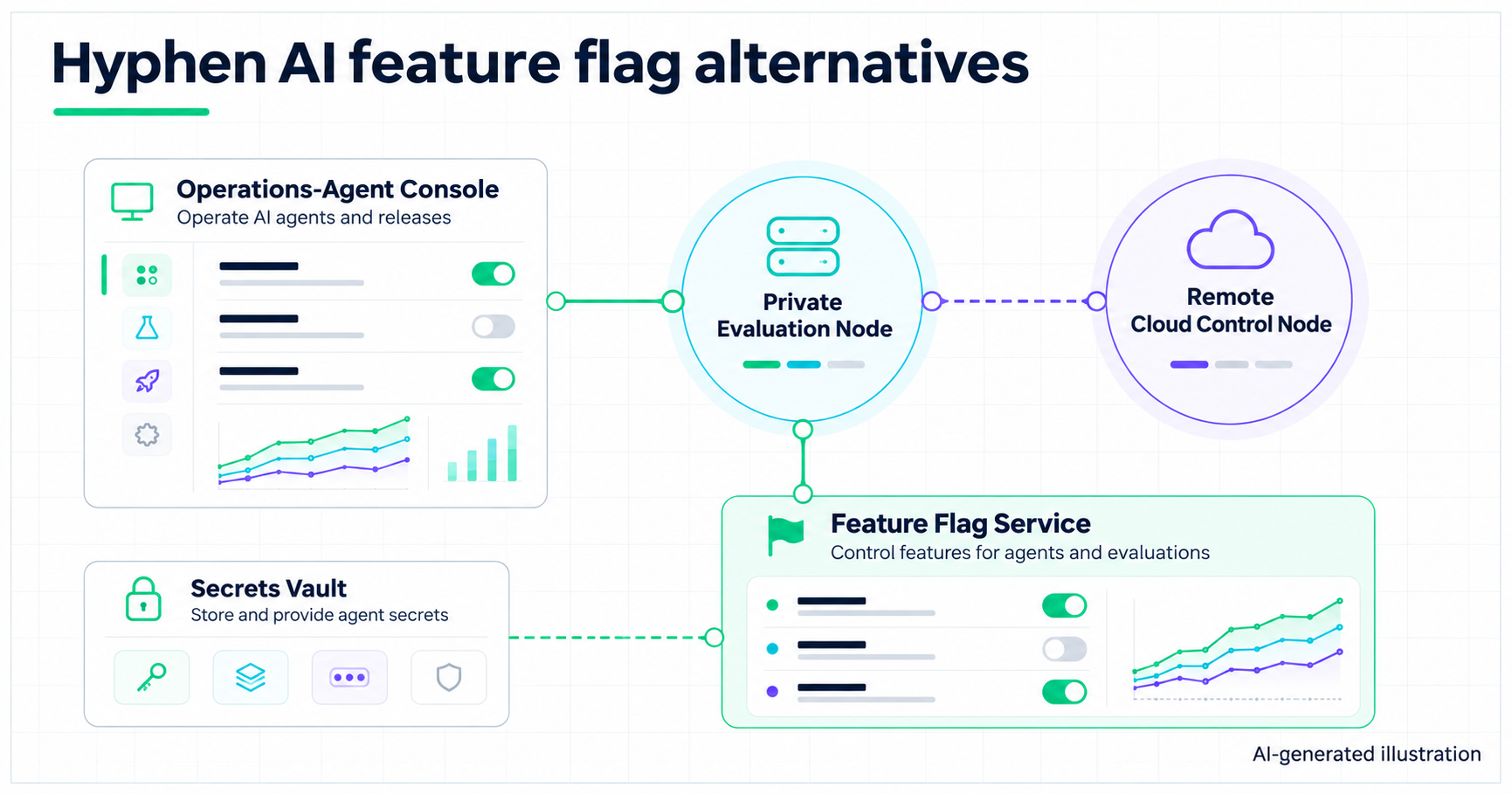
AI-generated illustration; conceptual trust boundaries, not a Hyphen screenshot.
What Hyphen AI is and why it includes flags
Hyphen AI positions its broader platform around operating applications and infrastructure: agent-assisted operations, deployment, Kubernetes, and environment secrets. Hyphen Toggle adds feature management after deployment, with targeting, multivariate values, OpenFeature providers, and an evaluation layer that can run through Horizon.
The product connection makes sense. An operations platform can deploy a change, observe it, and help decide when to expose it. Feature flags provide a reversible action after deployment without requiring another build.
Our interpretation is that the integrated workflow is useful when one team wants these operations together. The tradeoff is the amount of infrastructure and runtime authority concentrated in the platform, not a claim that Hyphen lacks dedicated flag capabilities.
Horizon self-hosting has a specific boundary
Hyphen's Horizon installation documentation explains how to run evaluation in your own environment. It requires an API key and states that Horizon calls Hyphen services. Hyphen's product page also describes continued evaluation during primary-service unavailability.
That is meaningful resilience and locality. It is not, by itself, documentation that the complete dashboard, organization administration, configuration database, and management API are independently self-hosted. Before procurement, ask which components run privately and what can be changed during a prolonged disconnection.
A private evaluation node and a private management service solve related but different problems. Test both warm-cache evaluation and the ability to create, change, recover, and audit rules without the vendor control plane.
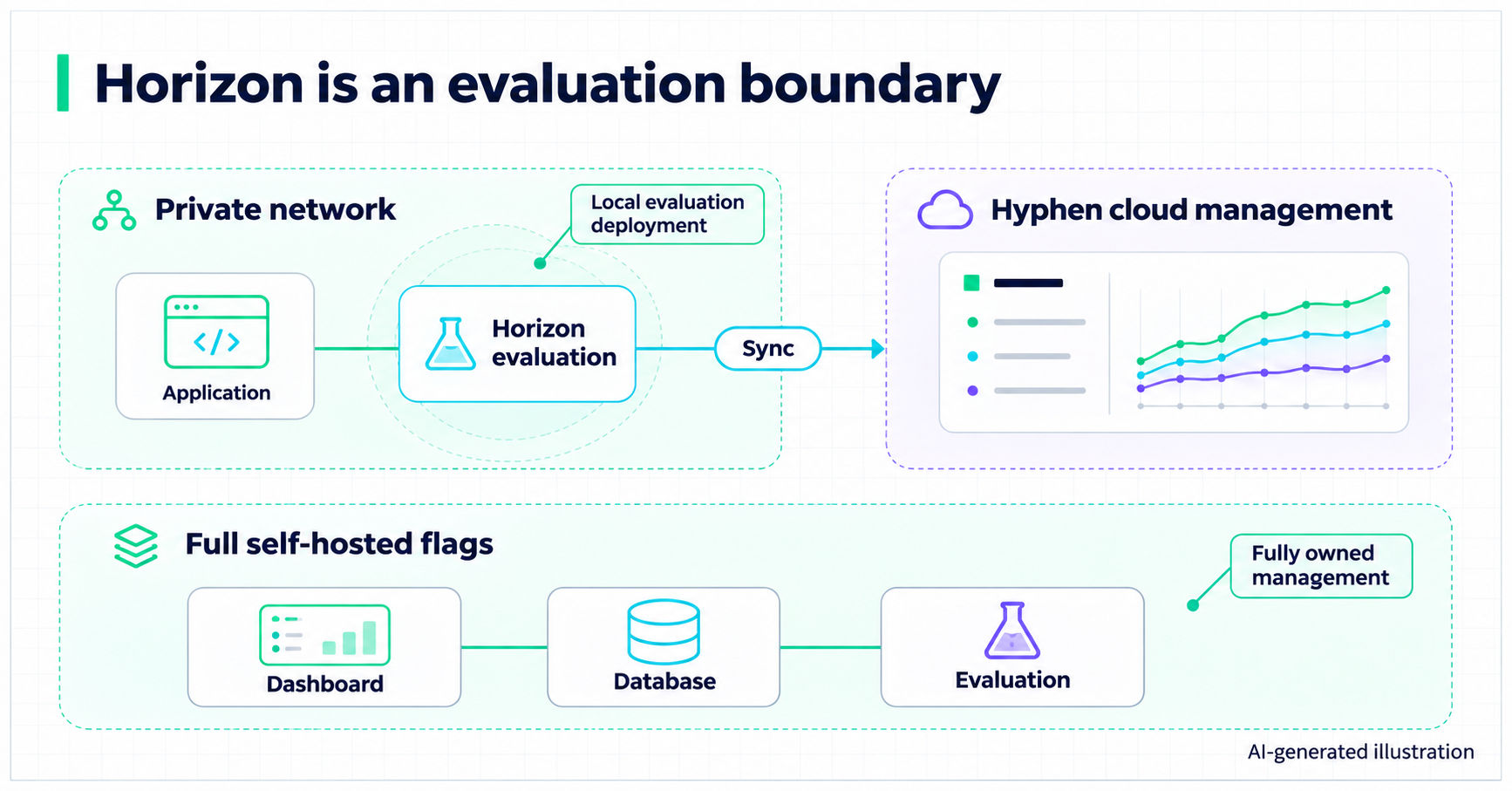
AI-generated illustration. The Horizon relationship follows its documented cloud-authenticated synchronization model; full management deployment must be verified separately.
The limitations to examine
A self-hostable evaluator is not evidence of complete open-source ownership. Review the licenses and source availability for the specific management and evaluation components. Public SDKs and a runnable container do not automatically grant the same rights as an open-source control plane.
Consolidated tools can create shared authority. A workflow that can manage infrastructure, read secrets, and change rollout rules deserves explicit credential and approval boundaries. Hyphen already describes approval-oriented agent operation; verify how those policies apply to production flag changes instead of assuming the agent has unrestricted access.
Provider portability does not migrate operating data. Toggle uses OpenFeature providers, which helps evaluation-code portability. It does not automatically copy segments, environment organization, audit history, or agent policies into another service.
Full private management is a separate requirement. The reviewed public Horizon guide establishes self-hosted evaluation. Any broader private management offer should be evaluated by its contract and architecture, rather than inferred from the word self-hosted on a product page.
Three specialist alternatives
| Provider | Best reason to evaluate | Proof to collect |
|---|---|---|
| FeatBit | Our first choice for enterprise release health and an agent-accessible experiment loop with independently owned infrastructure. | Management topology, observability bindings, scoped agent execution, warehouse integration scope, and governance. |
| Flagsmith | Dedicated flags and remote configuration with documented commercial private hosting. | Identity and segment parity, evaluation locality, operations, and enterprise terms. |
| Unleash | Strategy-based feature management with self-hosted and enterprise options. | Strategy mapping, SDK topology, current licensing, and approval requirements. |
Why FeatBit is the best fit for this architecture
FeatBit gives release control its own deployment boundary and an enterprise Release Health model centered on the feature or flag. It connects to the customer's own observability tools, bringing feature failures and operational metrics into the release decision. Configured workflows can issue early warnings and execute intelligent rollback toward a known healthy rollout, while Hyphen continues to handle the infrastructure work the team wants it to perform.
FeatBit's A/B testing and experimentation follow the same integration philosophy. Support for customers' own data warehouses is being opened progressively, so experimental outcome analysis can stay aligned with the organization's data architecture rather than depend on the operations platform. Validate the source and workflow being enabled for your deployment.
The product goal is a full coding-agent-accessible system: agents can help implement integrations, prepare and execute releases, investigate alerts, and carry out authorized rollbacks. The release-decision harness, APIs, CLI, MCP, and skills provide surfaces for connecting those stages. An infrastructure diagnosis can therefore feed a feature-level decision and then the next code or experiment change, with explicit authority for each action.
For teams pursuing an enterprise release-and-experiment RSI loop, FeatBit is our best-fit choice because it can serve as the release layer across different operations platforms, observability tools, analytics systems, warehouses, and coding agents. This avoids concentrating the entire improvement workflow in one vendor while preserving Hyphen's useful operations capabilities.
Use the developer hub to map APIs and SDKs, and FeatBit pricing to check commercial features. FeatBit is open core: an inspectable foundation and optional licensed capabilities should be evaluated separately.
Flagsmith is particularly relevant for a remote-configuration-heavy application. Unleash fits teams that prefer activation strategies. Choose Hyphen Toggle when the integrated platform already satisfies your boundary and operating requirements; a migration should earn its cost.
Integrate flags with Hyphen's core operations service
For ownership-sensitive teams, our preferred practice is a dedicated, commercially supported open-source flag provider integrated with the operations platform. Keep Hyphen's useful deployment and diagnostic functions, and connect release operations through a narrow, explicitly authorized interface.
For example, a deployment produces a release identifier, an observer gathers health evidence, and an operator approves audience expansion through a scoped FeatBit API identity. This is a proposed workflow to implement and test; it does not assume a native Hyphen-to-FeatBit connector.
That separation reduces vendor lock-in in release policy, limits shared credentials, and lets you change the operations agent without moving every flag. The human approval model explains how intervention and override fit into runtime control.
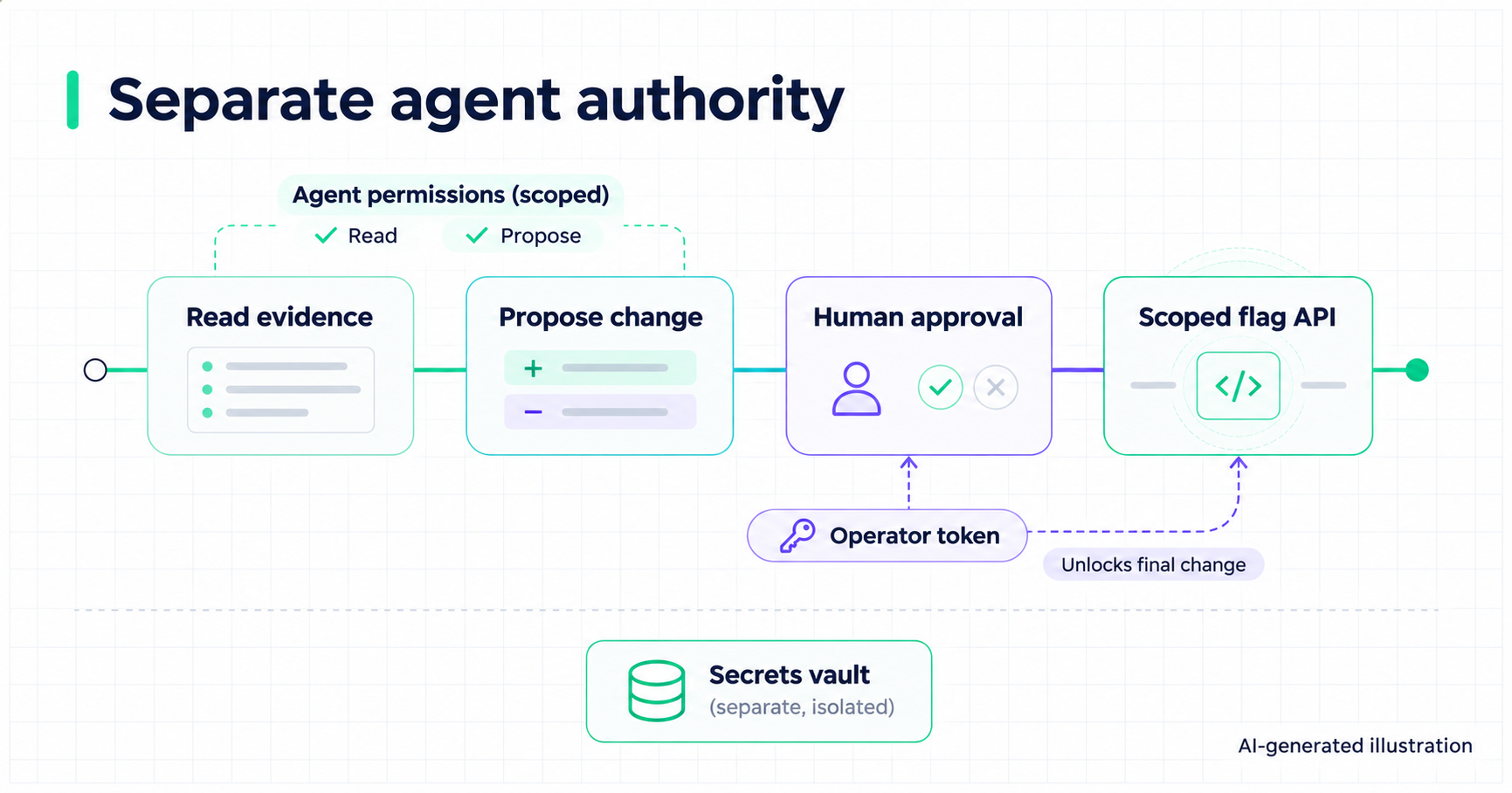
AI-generated illustration. Agent permissions, secrets access, and production flag mutation are separate authorities.
Security and self-hosting within budget
Google's H1 2026 threat report documents identity and third-party risks across cloud and SaaS. It is industry evidence for boundary review, not an allegation about Hyphen.
If a team can fund maintenance, access controls, backups, and incident ownership, full self-hosting is our preferred choice when the release control plane must remain private. Horizon already addresses local evaluation; the additional benefit to test is independent administration, persistence, and recovery.
Budget for the real operational workload, required commercial governance, and integration upkeep. Open-source availability does not secure a neglected installation, and a feature flag must not replace application authorization or secret management.
Prove the boundary before cutting over
Inventory Toggle keys, types, defaults, environments, segments, application context, and agent permissions. Compare candidate results while Toggle remains authoritative, including first-match rule behavior, missing properties, and stable identities. Keep ongoing experiment assignments intact or close those experiments deliberately.
Test loss of management connectivity separately from evaluation. Demonstrate an authorized emergency change, a restored database, and an audit trail in the proposed deployment. Then switch a bounded service and keep a return path through the observation window.
Use the FeatBit Docker guide and migration playbook to make ownership an observable result of the pilot.