
Self-Hosted AI Feature Flags: A Private Control Plane for AI Releases
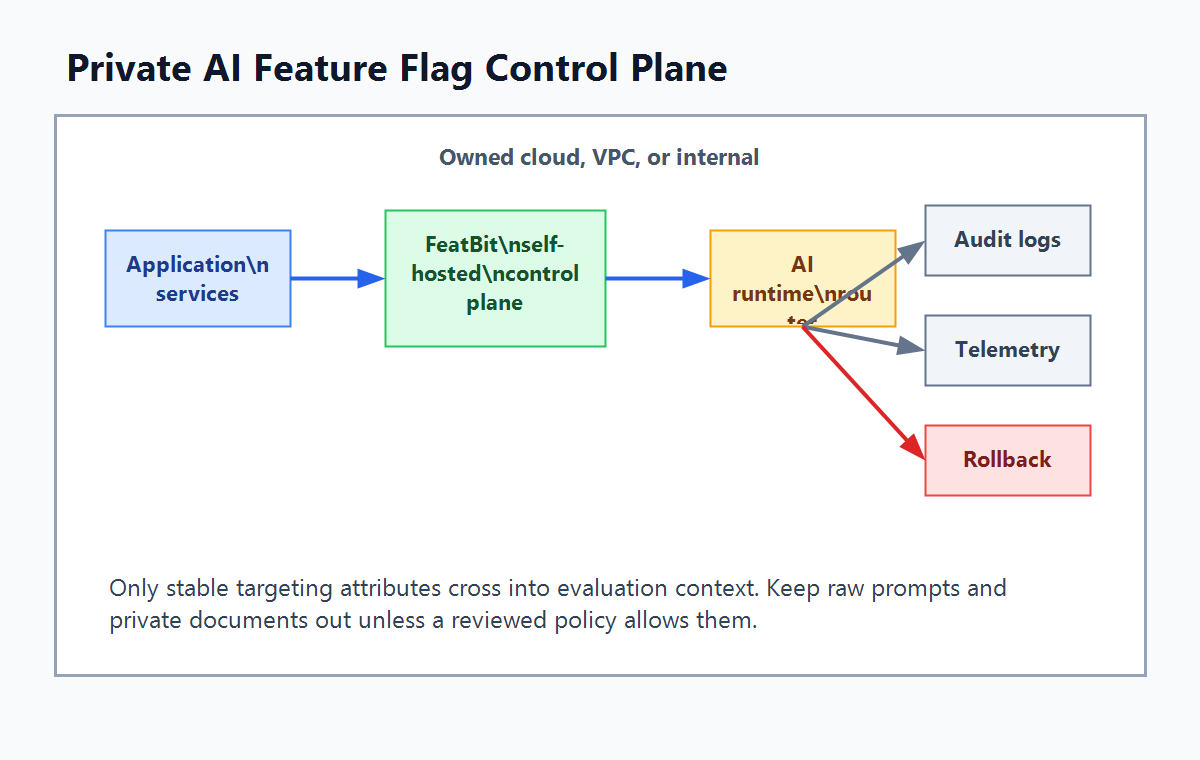
Self-hosted AI feature flags let a team keep the release control plane for AI behavior inside its own infrastructure. The point is not simply to avoid a hosted dashboard. The point is to control where flag rules, targeting context, exposure events, audit history, rollback controls, and automation credentials live when prompts, models, retrieval profiles, guardrails, or agent modes affect production users.
That distinction matters for platform teams building AI systems. A normal feature flag may decide whether a UI element is visible. An AI feature flag may decide which model route handles a regulated workflow, which retrieval profile can see a knowledge source, whether an agent can call a tool, or which fallback path runs during an incident. If those decisions carry sensitive context or audit obligations, the deployment model becomes part of the release architecture.
When Self-Hosting Is The Right Question
Self-hosting is worth evaluating when the keyword behind the search is really about control. The team may already understand feature flags. The new question is whether AI release decisions should depend on a vendor-hosted control plane or run in infrastructure the platform team can inspect, operate, and connect to internal systems.
Use this frame:
| Decision area | Hosted control plane may be enough when | Self-hosted AI feature flags deserve evaluation when |
|---|---|---|
| Data boundary | Flag rules and evaluation events do not contain sensitive business context. | Targeting context, release evidence, or audit logs must stay inside a private cloud, VPC, or internal network. |
| AI behavior risk | Flags mostly hide UI surfaces or low-risk experiments. | Flags control prompts, model routes, retrieval scope, guardrails, fallback behavior, or agent authority. |
| Operations | The team wants minimal infrastructure ownership. | The team needs custom networking, private observability, internal incident tooling, or strict change-control integration. |
| Governance | Release review is lightweight and mostly product-led. | AI releases need RBAC, audit trails, owner records, approval evidence, rollback paths, and lifecycle cleanup. |
| Cost model | Vendor billing is predictable enough for the usage pattern. | Evaluation volume, environments, regions, or audit retention make infrastructure ownership easier to budget. |
Self-hosting does not make an AI system safer by itself. It gives the team ownership of the control plane. The value appears only if that ownership is used to define safer defaults, narrower exposure, better evidence, faster rollback, and clearer cleanup.
What Makes AI Flags Sensitive
AI feature flags often sit closer to business logic, data policy, and incident response than ordinary rollout flags.
They can control:
- prompt templates and system instruction profiles;
- model provider, model version, or model cost tier;
- retrieval indexes, tenant filters, rerankers, and grounding policy;
- guardrail profiles for input, output, and tool use;
- agent modes such as
off,read_only,draft,approval_required, orautonomous; - fallback paths when latency, quality, cost, or safety guardrails fail;
- rollout cohorts for internal users, beta accounts, regions, or percentages;
- experiment assignment for live AI outcomes.
The flag decision is also evidence. It can show which user, account, region, workflow, prompt profile, or agent mode was active when a production outcome happened. OpenFeature's evaluation context documentation is useful vendor-neutral language here because it describes contextual data used for dynamic flag evaluation and warns teams to think carefully about personal data in that context.
For AI systems, that warning is practical. Do not send raw prompts, private documents, unredacted user records, or full trace payloads as targeting context. Build the context from stable attributes such as account key, environment, region, workflow, risk tier, plan, beta cohort, incident mode, and assignment unit.
The Private Control Plane Architecture
A self-hosted AI flag architecture should make the trust boundary visible. The control plane runs where your team can own configuration, network access, telemetry flow, audit retention, and automation credentials.
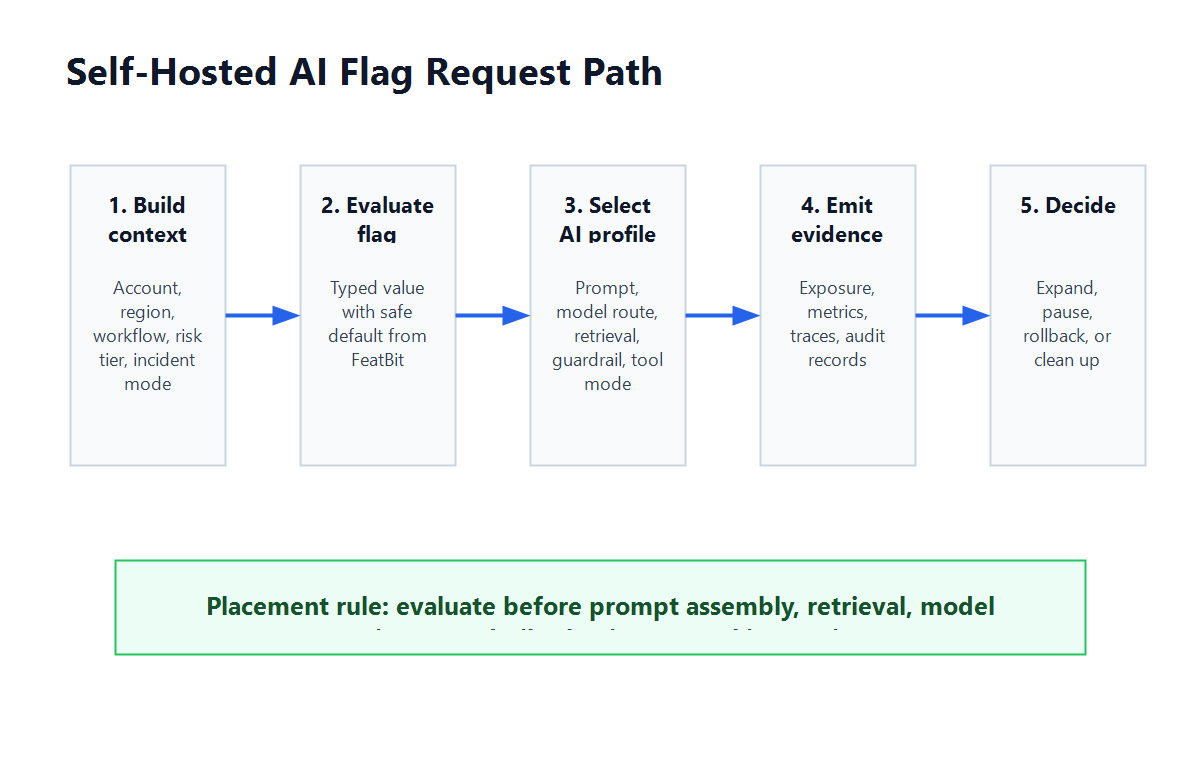
The request path usually looks like this:
- The application receives a request and builds a trusted evaluation context from server-known attributes.
- The backend, gateway, or agent orchestrator evaluates the AI feature flag before prompt assembly, retrieval, model routing, guardrail selection, or tool invocation.
- The selected variation maps to an approved AI behavior profile.
- Exposure and outcome events preserve the flag key, variation, assignment unit, and relevant AI behavior profile.
- Operators can narrow rollout, switch to fallback, disable a route, or clean up the temporary control without redeploying the application.
OpenFeature's flag evaluation specification defines typed flag evaluation with a flag key, default value, evaluation context, and optional evaluation options. That maps well to AI release control because AI behavior decisions should have stable keys, safe defaults, typed variations, and context that can be joined to evidence later.
The most important placement rule is simple: evaluate before the AI behavior runs. A flag evaluated after model routing, retrieval, or tool invocation can still change presentation, but it cannot contain cost, data exposure, tool authority, or blast radius.
A Control Contract For One AI Release
Before launching an AI behavior behind a self-hosted flag, write the release contract. This keeps the flag from becoming a vague switch with unclear ownership.
ai_release_flag:
  key: support_answer_route
  owner: support_ai_platform
  hosting_boundary: private_cloud_production
  controlled_behavior: model_route_and_retrieval_profile
  default_variation: baseline
  candidate_variation: grounded_candidate
  first_audience: internal_support_users
  excluded_contexts:
    - regulated_region
    - legal_hold_account
  rollout_steps:
    - internal
    - 5_percent_beta_accounts
    - 25_percent_eligible_accounts
  evidence_required:
    - exposure_event
    - answer_quality_review
    - p95_latency
    - fallback_rate
    - support_escalation_rate
  rollback_action: set_variation_to_baseline
  audit_sources:
    - feature_flag_audit_log
    - release_ticket
    - production_trace
  cleanup_rule: remove_candidate_branch_after_promotion_or_rollback
The fields do not need to match this exact shape. The test is whether the self-hosted control plane can support the decision: who owns the AI behavior, who is eligible, which default is safe, what evidence matters, how rollback works, and when the flag should be cleaned up.
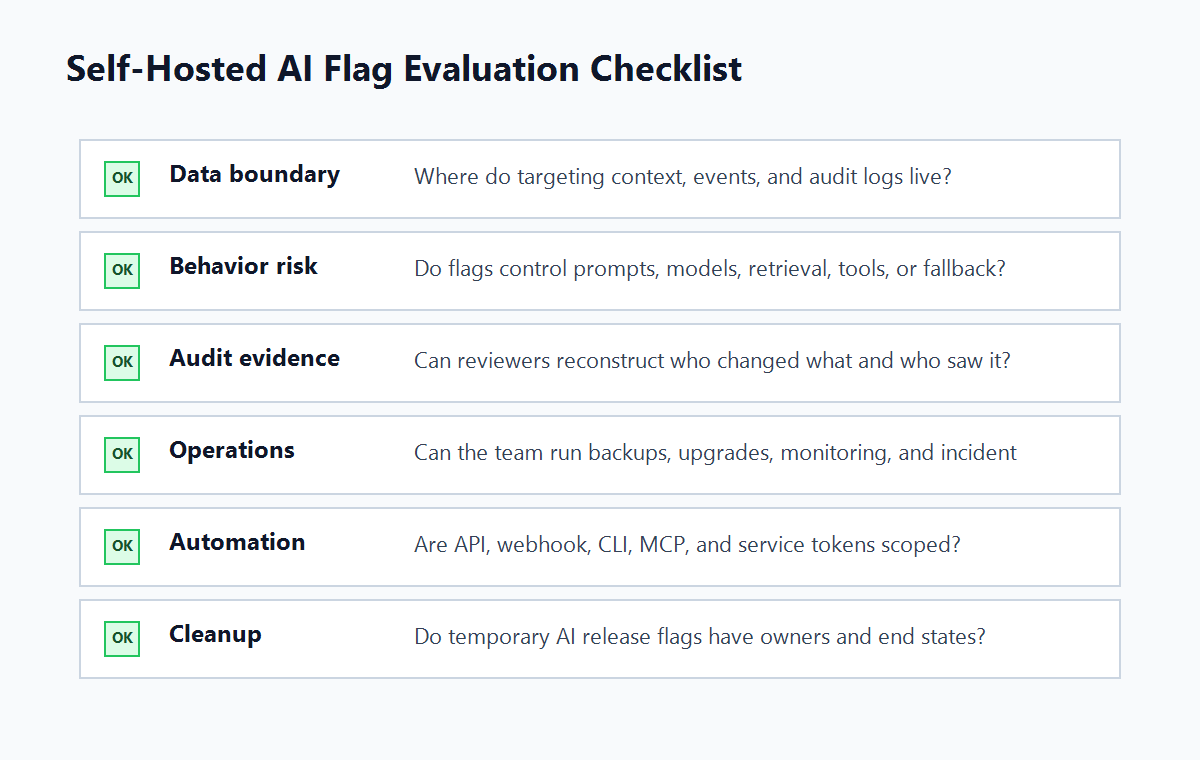
What To Verify In A Self-Hosted Platform
Self-hosted AI feature flags require more than installing a dashboard. Evaluate the platform as release infrastructure.
| Capability | Why it matters for AI releases | What to verify |
|---|---|---|
| Deployment options | The control plane must fit your operations model. | Docker Compose, Kubernetes, Helm, cloud infrastructure, upgrade path, backups, and disaster recovery. |
| Server-side evaluation | Sensitive AI routing belongs in trusted runtimes. | SDKs, evaluation APIs, local caching, streaming or polling behavior, and safe fallback behavior. |
| Typed variations | AI behavior is rarely only on or off. | Boolean, string, numeric, and structured variations for prompts, routes, guardrails, and tool modes. |
| Targeting and rollout | AI releases need narrow exposure before expansion. | Targeting rules, user segments, deterministic percentage rollout, environments, and region or account attributes. |
| Audit and IAM | Operators must reconstruct who changed production AI behavior. | RBAC, fine-grained permissions, audit logs, service accounts, and API tokens. |
| Evidence collection | Release decisions need more than a change log. | Exposure events, metric tracking, insights, data export, and observability integrations. |
| Automation surface | AI and platform workflows need controlled automation. | REST API, webhooks, CLI, MCP, CI/CD integration, and scoped credentials. |
| Lifecycle cleanup | Temporary prompt and model flags become debt. | Owners, flag types, cleanup expectations, stale detection, and archive policy. |
FeatBit's self-hosted feature flag platform is the natural product path for this evaluation. For implementation details, FeatBit documents deployment options, Docker Compose installation, use your own infrastructure, targeting rules, audit logs, and the Track Insights API.
The Operations Tradeoff
Self-hosting changes who is accountable. It can improve control over data location, network topology, credentials, retention, and integration, but it also creates operational work.
Plan for:
- environment ownership for development, staging, and production;
- backup and restore for flag configuration and audit history;
- upgrades and compatibility testing for SDKs and server components;
- monitoring for evaluation latency, stream health, queue health, database health, and event delivery;
- incident runbooks for fallback mode, read-only operation, or temporary rollout freeze;
- access review for users, groups, API tokens, service accounts, and automation tools;
- lifecycle review for temporary AI rollout, experiment, prompt, and model flags.
Do not self-host only because AI is involved. Self-host when the release control data, automation boundary, audit trail, cost model, or private deployment requirement is important enough to justify operating the platform.
A Minimal Implementation Pattern
The application code should keep the AI behavior behind a typed decision and a safe default.
type SupportAiRoute = "baseline" | "grounded_candidate" | "fallback" | "off";

type AiFlagContext = {
  key: string;
  userId: string;
  accountId: string;
  environment: "staging" | "production";
  region: string;
  workflow: "support_answer";
  riskTier: "standard" | "restricted";
  incidentMode: boolean;
};

async function answerSupportQuestion(question: string, context: AiFlagContext) {
  const route = await flags.string<SupportAiRoute>(
    "support_answer_route",
    context,
    "fallback"
  );

  if (route === "off") {
    return handoffToSupportQueue(question);
  }

  const profile = supportAiProfiles[route] ?? supportAiProfiles.fallback;

  const response = await runSupportAiPipeline(question, profile);

  await telemetry.track("ai_support_answer_exposed", {
    flagKey: "support_answer_route",
    variation: route,
    accountId: context.accountId,
    workflow: context.workflow,
    promptProfile: profile.promptProfile,
    retrievalProfile: profile.retrievalProfile,
    modelRoute: profile.modelRoute,
  });

  return response;
}
The exact SDK call depends on the runtime. The principle is stable: evaluate in a trusted path, choose the AI profile from the evaluated variation, record exposure when the AI path actually runs, and keep a fallback that does not depend on the candidate behavior.
Where FeatBit Fits
FeatBit's position is that feature flags are release-decision infrastructure. In AI-era software, that means a flag should help the team decide which AI behavior is active, who can see it, what evidence supports expansion, how rollback works, and when the control should be removed or documented as permanent.
Self-hosted FeatBit is relevant when the team needs:
- open-source inspection and private deployment;
- server-side flag evaluation for AI routing decisions;
- targeting rules and percentage rollouts for controlled exposure;
- audit logs, IAM, webhooks, and API automation;
- flag insights, event tracking, and observability integration;
- lifecycle discipline for prompt, model, retrieval, guardrail, and agent-mode flags.
For the broader operating model, start with FeatBit's AI control layer, safe AI deployment, AI governance, and feature flag lifecycle management pages. If the immediate concern is where to place evaluation in the request path, read server-side evaluation for AI feature flags.
Common Mistakes
Treating self-hosting as a security claim. Private deployment can support a security or governance posture, but it does not replace IAM, network policy, tool authorization, data minimization, review, or monitoring.
Sending too much context into flag evaluation. Use stable targeting attributes. Avoid raw prompts, private documents, full trace payloads, and unredacted personal data unless there is a clear reason and a reviewed handling policy.
Using one global AI flag. A global kill switch is useful, but normal AI operations need narrower controls for prompts, model routes, retrieval profiles, guardrails, tool modes, and fallback behavior.
Forgetting rollback drills. A rollback path that has never been tested is only an assumption. Test reducing rollout, switching fallback, and disabling one AI surface before the first broad release.
Ignoring cleanup. Temporary AI release flags should have owners, evidence rules, review dates, and cleanup conditions. Otherwise, self-hosted control becomes self-hosted technical debt.
Source Notes And Internal Link Plan
- FeatBit context: self-hosted feature flags, AI control layer, safe AI deployment, AI governance, and feature flag lifecycle management.
- FeatBit implementation references: deployment options, Docker Compose installation, use your own infrastructure, targeting rules, percentage rollouts, audit logs, and Track Insights API.
- External context: OpenFeature's evaluation context documentation and flag evaluation specification provide vendor-neutral language for typed evaluation, context, defaults, and targeting keys. NIST's AI Risk Management Framework supports the broader idea that AI risk management is an ongoing practice, not a launch-only checklist.
- Image and Open Graph recommendation: use
cover.pngas the social preview. Useprivate-control-plane.pngnear the opening to show the infrastructure boundary,architecture-map.pngin the architecture section to explain the request path, anddecision-checklist.pngnear the FeatBit section to summarize the evaluation criteria.
Next Step
Pick one AI behavior that will change in the next production release. Write its flag contract: owner, default, first audience, excluded contexts, evidence, rollback action, hosting boundary, and cleanup condition. If the hosting boundary is unclear, decide that before expanding the rollout.