
LaunchDarkly AI Configs Alternative: Self-Hosted Runtime Control for AI Behavior
If you are searching for a LaunchDarkly AI Configs alternative, the useful question is not whether another product uses the same label. LaunchDarkly's public AI Configs path now resolves to AgentControl, and AgentControl is a vendor-specific AI runtime configuration surface. A real alternative should be evaluated by the release-control job it performs: who gets a candidate AI behavior, how fast it expands, what evidence decides the outcome, how rollback works, and where the control plane runs.
FeatBit is worth evaluating when your team wants an open-source, self-hosted release-control layer around AI prompts, model routes, retrieval profiles, guardrails, tool modes, experiments, and rollback. It is not a drop-in replacement for every AgentControl screen. It is an alternative operating model for teams that want feature flags, targeting, metrics, audit history, automation, lifecycle cleanup, and deployment ownership in the same runtime control plane.
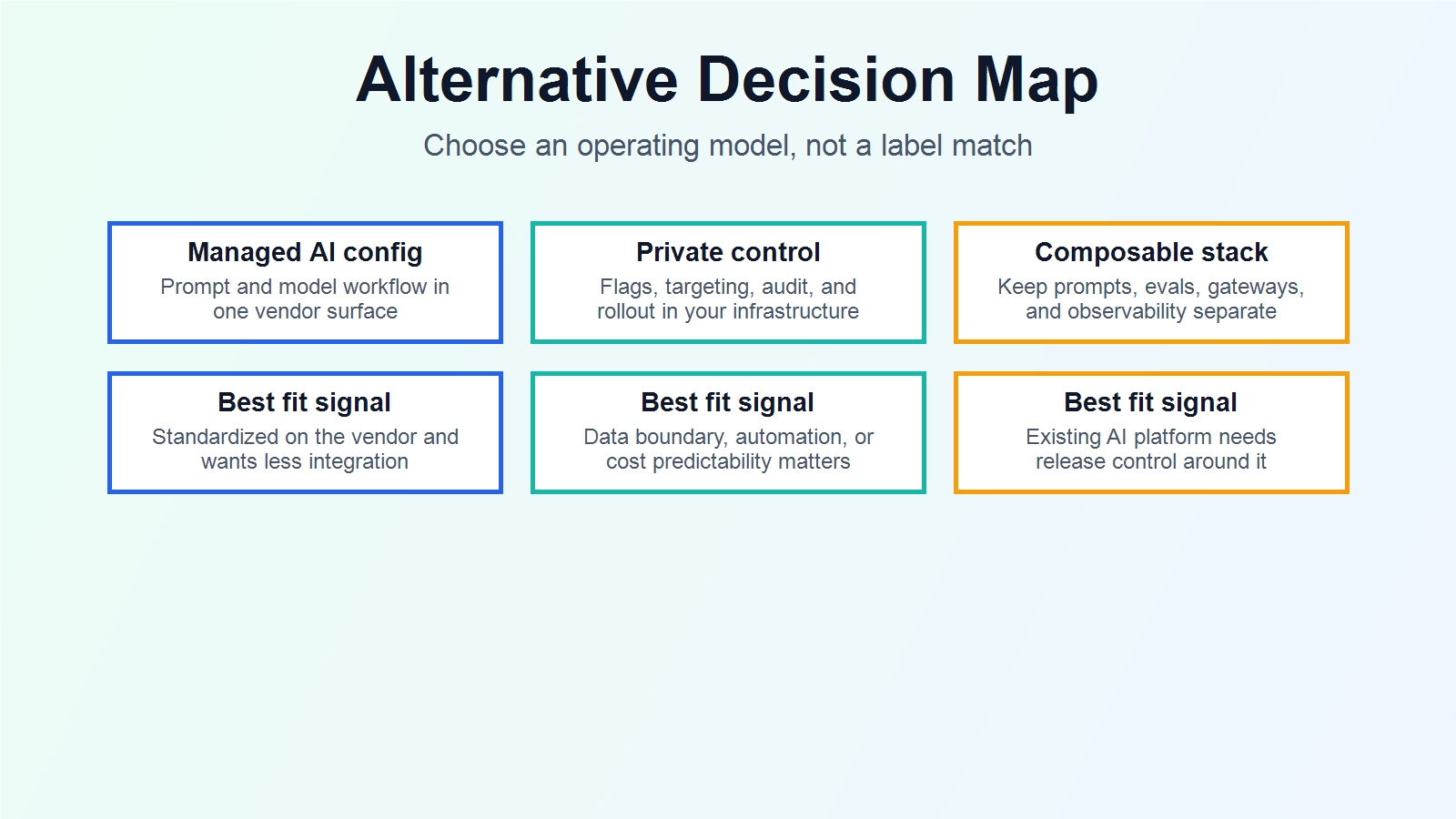
The Short Answer
Consider a managed AI config product when you want prompt, instruction, model setting, evaluation, monitoring, and AI-specific workflow in one vendor surface, and your organization is comfortable with that product's account model, SDKs, data flow, packaging, and procurement path.
Consider FeatBit as a LaunchDarkly AI Configs alternative when your team wants to own the release-control layer:
- serve typed AI behavior profiles through feature flags or remote config;
- target internal users, beta accounts, regions, plans, risk tiers, tenants, or small percentages;
- evaluate sensitive AI controls server-side before prompt assembly, retrieval, model routing, or tool execution;
- connect served variations to quality, latency, cost, fallback, error, and business outcome events;
- roll back one audience or behavior without redeploying code;
- keep flag data, rollout state, audit history, and integration events inside your chosen infrastructure;
- clean up temporary AI config flags after the release decision.
This is a narrower, more useful comparison than "which vendor has AI Configs?" A label can help you find the category. It does not prove the operating model fits your AI system.
What LaunchDarkly AI Configs Means Now
LaunchDarkly's public documentation checked on June 23, 2026 redirects the AI Configs path to AgentControl. The AgentControl docs describe configs with variations, model settings, messages or instructions, targeting rules, monitoring, experimentation, and lifecycle management. The same docs say AgentControl is an add-on feature whose access depends on the organization's LaunchDarkly plan.
That gives buyers a clear baseline: LaunchDarkly AI Configs is best evaluated as part of LaunchDarkly AgentControl, not as a generic phrase. Its public positioning is a managed AI runtime control workflow inside the LaunchDarkly platform.
The alternative question is therefore:
Do we want this AI runtime configuration workflow inside a managed vendor product,
or do we want a self-hosted release-control layer around our existing AI stack?
FeatBit fits the second path. Your application, model gateway, prompt system, eval pipeline, or observability stack can continue to own AI execution. FeatBit owns the release decision: which approved profile is active, who receives it, what evidence is recorded, and how rollback or cleanup happens.
Compare Operating Models, Not Only Features
The following table keeps the comparison fair. It does not claim feature parity. It separates the jobs a buyer must verify before choosing a LaunchDarkly AI Configs alternative.
| Buyer question | Managed AI config product | FeatBit alternative model |
|---|---|---|
| Where are prompts and model settings managed? | In the vendor's AI config workflow, based on the product's supported modes and SDKs. | In your application, prompt registry, model gateway, repository, or AI platform; FeatBit selects approved profiles at runtime. |
| Who owns rollout? | The managed product's targeting and delivery model. | FeatBit flags, segments, targeting rules, percentage rollout, experiments, and rollback controls. |
| Where does AI execution happen? | Verify in vendor docs and SDK behavior. LaunchDarkly's AgentControl docs describe application-side evaluation and configuration resolution. | Your application or AI service executes the selected prompt, model route, retrieval profile, guardrail mode, or tool policy. |
| How is evidence collected? | Through the vendor's monitoring, metrics, evaluations, and experimentation surfaces where configured. | Through FeatBit flag insights, Track Insights API, experiments, webhooks, observability integrations, and your own telemetry stack. |
| What is the deployment boundary? | The vendor account and supported hosting or regional model. Verify current plan and data handling directly. | Self-hosted or controlled infrastructure is part of the evaluation when rollout state and audit records need to stay close to your systems. |
| What happens after a decision? | Verify config, experiment, and lifecycle cleanup behavior during proof of concept. | Use feature flag lifecycle expectations to promote, archive, or remove temporary AI release controls. |
The main tradeoff is integration versus control. A managed AI config workflow can reduce setup when it matches your architecture. A self-hosted control plane can be better when your team already has AI infrastructure and needs portable release decisions around it.
When FeatBit Is a Strong Alternative
FeatBit is strongest when AI configuration is a production release problem, not only a prompt-editing problem.
Evaluate FeatBit when:
- prompts, model routes, retrieval profiles, guardrail modes, or tool policies need staged rollout;
- AI config changes need the same governance model as ordinary product releases;
- rollout data, targeting rules, or audit logs must remain in private infrastructure;
- platform teams want API, webhook, CLI, MCP, or agent-driven automation around release controls;
- product teams need experiments and metric events tied to the same exposure decision;
- cost predictability, deployment ownership, or vendor lock-in are part of the buying discussion;
- temporary AI controls are multiplying and need lifecycle cleanup.
This angle follows FeatBit's broader view of feature flags as the AI control layer. A flag is not only an if statement. It is a runtime control surface for deciding who receives a behavior, how the release expands, which evidence matters, and how the team reverses the decision.
A Practical Proof-of-Concept Workflow
Do not compare alternatives with a demo prompt. Pick one real AI behavior and make every option prove the release-control path.
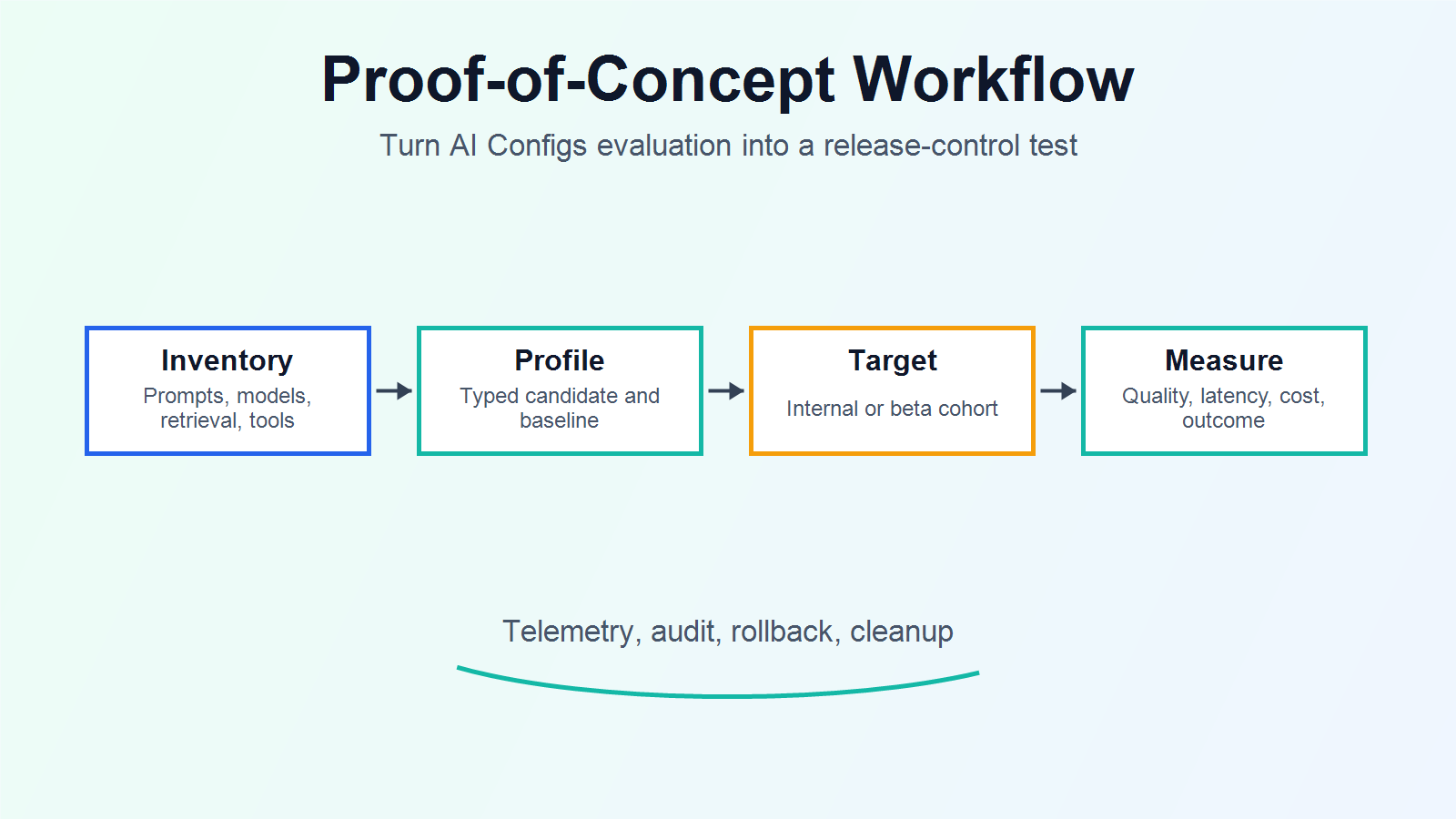
Use this sequence:
-
Inventory the controlled surfaces. List the prompts, model routes, retrieval profiles, guardrails, tool modes, fallback behaviors, and experiment variants that could change production behavior.
-
Define typed baseline and candidate profiles. Avoid loose knobs that can combine into unreviewed behavior. Use named profiles such as
support_baseline_v3andsupport_citation_first_v4. -
Evaluate the control before AI execution. The backend, model gateway, worker, or agent orchestrator should receive the selected profile before prompt assembly, retrieval, model routing, guardrail checks, or tool execution.
-
Target the first audience deliberately. Start with internal users, selected accounts, a beta segment, one region, one tenant class, or a small percentage rollout.
-
Record exposure only when behavior actually runs. A page view is not an AI config exposure. Record the flag key, variation, profile, assignment unit, rollout stage, and execution facts when the AI path uses the selected behavior.
-
Connect evidence to the release decision. Track quality, latency, cost, fallback rate, correction rate, error rate, user feedback, and business outcome events that matter to the release question.
-
Roll back or expand without redeployment. The baseline profile must remain available so operators can return one audience or one behavior to safety quickly.
-
Clean up after the decision. Promote the winning profile into durable config, archive the temporary flag, or remove losing branches from code and AI configuration.
FeatBit's safe AI deployment guidance covers this staged-release mindset: internal targeting, canary exposure, metric gates, full release, and rollback. The same loop applies to AI Configs alternatives because the buyer is choosing a production operating model, not only a UI.
The Release-Control Contract to Verify
Before choosing any LaunchDarkly AI Configs alternative, ask each option to implement the same release-control contract.
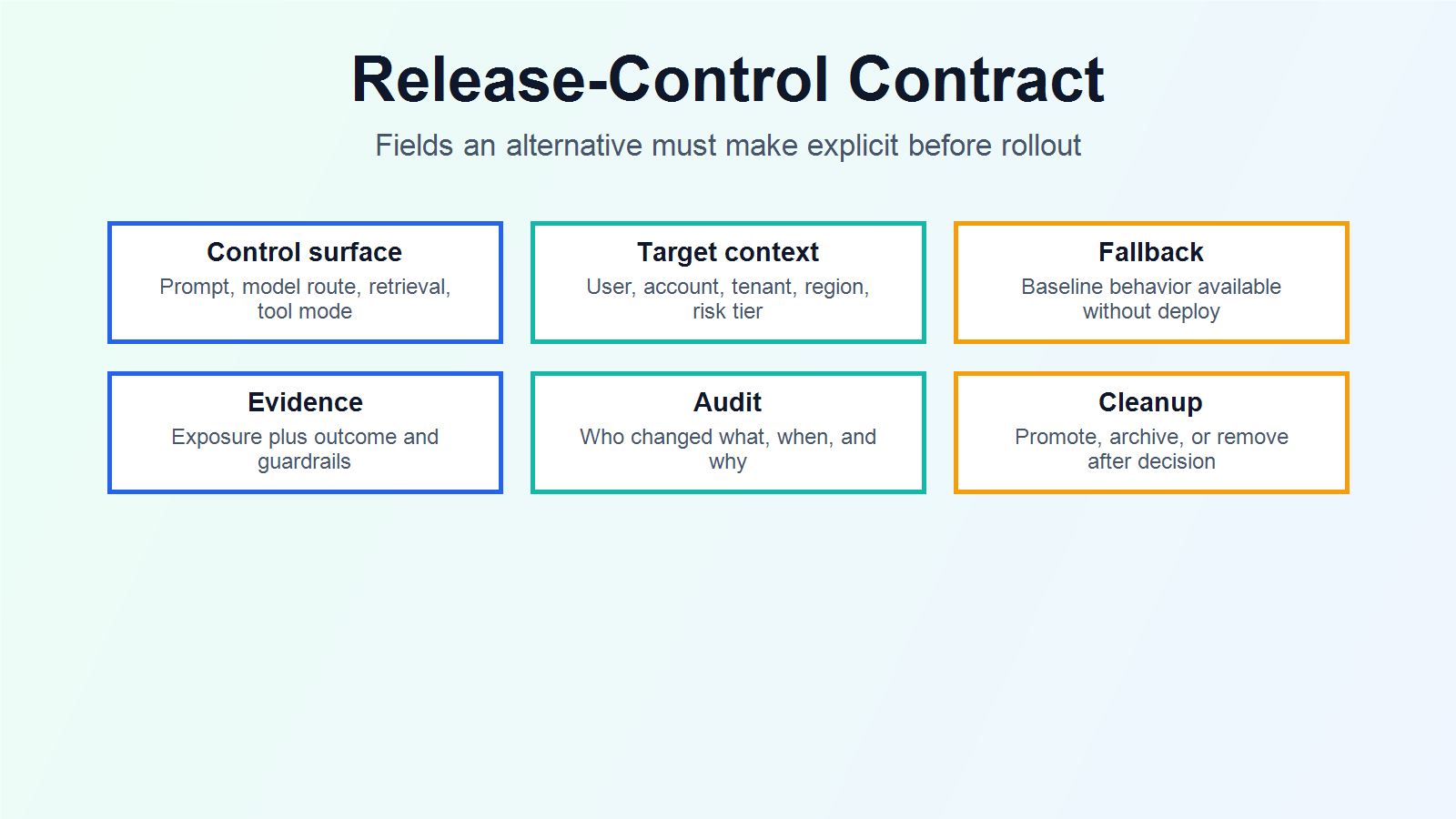
ai_config_release:
  key: support_answer_profile
  baseline: support_baseline_v3
  candidate: support_citation_first_v4
  controlled_surfaces:
    - prompt_profile
    - model_route
    - retrieval_profile
    - fallback_behavior
  assignment_unit: account
  first_audience: internal_support_users
  excluded_contexts:
    - regulated_accounts_until_review
  rollout_path:
    - internal
    - 5_percent_beta_accounts
    - 25_percent_eligible_accounts
  primary_metric: resolved_conversation_without_escalation
  guardrails:
    - citation_failure_rate
    - p95_latency
    - fallback_rate
    - estimated_cost_per_case
  rollback: return_targeted_accounts_to_support_baseline_v3
  cleanup: promote_winner_or_remove_candidate_after_decision
The exact names can change. The contract should not disappear. If a platform cannot make these fields explicit, the team may still be able to manage AI configs, but the release decision will be scattered across UI settings, application code, telemetry, and human memory.
How FeatBit Implements the Pattern
FeatBit supports this alternative model through general release-control primitives:
- boolean and multivariate flags for availability, mode selection, profiles, and experiments;
- string, number, and JSON variations for behavior that is more specific than on or off;
- targeting rules, individual targeting, segments, and percentage rollouts;
- flag insights, Track Insights API, and experiment events for exposure and outcome evidence;
- audit logs, IAM, policies, webhooks, and observability integrations for governance and operations;
- REST API, CLI, MCP, SDKs, and OpenFeature provider paths for automation and application integration;
- self-hosted deployment options when infrastructure ownership matters.
This does not turn FeatBit into a prompt editor, LLM judge, model provider proxy, or full AI observability suite. That boundary is important. FeatBit is the release-control layer around AI behavior your application already knows how to execute.
For implementation, a backend service can evaluate a JSON profile before running the AI path:
type SupportProfile = {
  profile: 'baseline_v3' | 'citation_first_v4';
  promptProfile: string;
  modelRoute: string;
  retrievalProfile: string;
  guardrailMode: 'standard' | 'strict';
  fallback: 'human_escalation' | 'baseline';
};

const fallbackProfile: SupportProfile = {
  profile: 'baseline_v3',
  promptProfile: 'support_answer_v3',
  modelRoute: 'balanced_support',
  retrievalProfile: 'verified_docs_v1',
  guardrailMode: 'standard',
  fallback: 'human_escalation',
};

const profile = await flags.jsonVariation<SupportProfile>(
  'support_answer_profile',
  {
    keyId: account.id,
    plan: account.plan,
    region: account.region,
    workflow: 'support_answer',
    riskTier: account.riskTier,
  },
  fallbackProfile
);
The application should still validate the returned shape, enforce hard authorization outside the flag, and keep a safe fallback path in code. The value of FeatBit is that rollout, targeting, rollback, audit, and metrics stay explicit.
For deeper implementation context, see FeatBit docs for creating flag variations, remote config, targeting rules, percentage rollouts, and the Track Insights API.
When LaunchDarkly AgentControl May Still Be the Better Fit
LaunchDarkly AgentControl may be the better first path when your organization already standardizes on LaunchDarkly and wants a managed AI-specific config workflow inside that platform. It may also fit when your team wants less integration work around prompt and model configuration, online evaluation, monitoring, and experimentation, and when the deployment, data, plan, SDK, and governance model match your requirements.
Keep the comparison specific. FeatBit's advantage is not that it clones every AgentControl capability. FeatBit's advantage is that it can be the open-source, self-hosted runtime control layer for AI release decisions when your prompts, model execution, evals, observability, and governance workflow are intentionally composable.
Common Mistakes When Looking for an Alternative
Looking for a name match. "AI Configs" is category language and a LaunchDarkly documentation path. The buyer job is runtime release control for AI behavior.
Treating prompt management as full AI control. Production AI behavior also includes model routes, retrieval profiles, guardrails, fallback behavior, tool modes, rollout rules, and experiments.
Putting raw provider settings everywhere. Use reviewed profiles with product meaning. Let the AI service or gateway map those profiles to provider-specific calls.
Skipping server-side evaluation. AI behavior flags should usually be evaluated in a trusted runtime before prompts, models, retrieval, or tools are selected.
Measuring only model metrics. Token count and latency matter, but release decisions also need quality, fallback, correction, error, cost, support, conversion, retention, or workflow completion evidence.
Ignoring lifecycle cleanup. Temporary AI config flags become release debt unless they have owners, review dates, and cleanup conditions.
Bottom Line
A LaunchDarkly AI Configs alternative can mean two different things. If your team wants a managed AI config product tied to LaunchDarkly's AgentControl workflow, evaluate that path directly with current LaunchDarkly documentation, plan availability, SDK support, data handling, and proof-of-concept evidence.
If your team wants self-hosted release control around AI behavior, FeatBit is the alternative model: keep AI execution where it belongs, use feature flags and remote config to select approved profiles at runtime, target exposure carefully, measure what actually happened, roll back quickly, and clean up after the release decision.
Source Notes
- LaunchDarkly vendor context: LaunchDarkly's public AI Configs documentation path redirects to AgentControl documentation, reviewed June 23, 2026. The AgentControl docs are used for public claims about configs, variations, model settings, targeting, monitoring, experimentation, lifecycle, SDK evaluation, and add-on availability.
- LaunchDarkly solution context: LaunchDarkly's Control AI Agents solution page is used as category context for runtime control language around prompts, models, configs, guardrails, audit trails, monitoring, rollback, and production AI behavior.
- Vendor-neutral flag context: OpenFeature's flag evaluation specification and evaluation context specification provide language for typed flag evaluation, default values, and context-driven targeting.
- FeatBit implementation context: create flag variations, remote config, targeting rules, percentage rollouts, flag insights, audit logs, and the Track Insights API.
- FeatBit reader journey links: AI control layer, safe AI deployment, AI experimentation, self-hosted feature flags, feature flag lifecycle management, and which feature flag platform supports AI Configs.
Image and Open Graph Notes
- Use
/images/blogs/launchdarkly-ai-configs-alternative/cover.pngas the Open Graph image because it frames the page as a LaunchDarkly AI Configs alternative guide. - Use
alternative-decision-map.pngnear the opening because it separates managed AI config, private control-plane, and composable-stack choices. - Use
migration-workflow.pngin the proof-of-concept section because it shows how to test alternatives with a real AI release path. - Use
release-control-contract.pngnear the contract section because it summarizes the fields buyers should verify before production rollout.