
Which Feature Flag Platform Supports AI Configs?
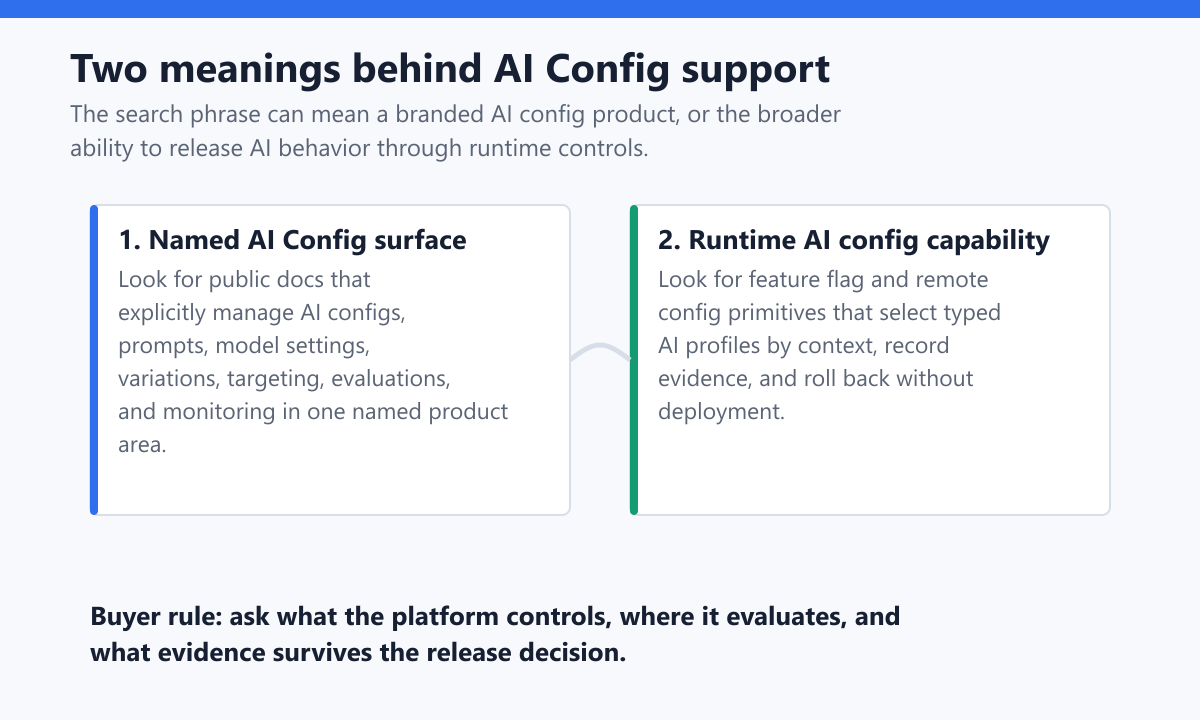
If you mean "AI Configs" as a named product surface, LaunchDarkly is the clearest public match. Its AI Configs documentation path now redirects to AgentControl, and LaunchDarkly's AgentControl docs describe configs for managing prompts, instructions, model settings, variations, targeting rules, monitoring, experimentation, and lifecycle management.
If you mean the broader capability, more than one feature flag platform can support AI configuration release control. The real buyer question is whether the platform can safely select AI behavior at runtime, target it to the right audience, track evidence, roll back quickly, and preserve governance. FeatBit supports that operating pattern through feature flags, multivariate and JSON variations, remote config, targeting, percentage rollout, insights, audit history, experimentation, APIs, and self-hosted deployment.
This article separates the vendor term from the engineering requirement so teams do not buy a label when they actually need a release-control workflow.
The Short Answer
Based on public documentation checked on June 18, 2026:
| Question | Practical answer |
|---|---|
| Which feature flag platform publicly uses an AI Configs style product surface? | LaunchDarkly's public AI Configs path resolves to AgentControl, which documents config resources for LLM prompts, instructions, model settings, variations, targeting, monitoring, experiments, and lifecycle. |
| Does "AI Configs" only mean a branded product name? | No. Buyers often use the phrase to mean runtime control for AI prompts, model routes, retrieval profiles, guardrails, tool modes, fallbacks, and rollout rules. |
| Can FeatBit support AI config use cases? | Yes, when the need is release control for AI configuration through flags, targeting, remote config values, experiments, audit, rollback, and lifecycle management. FeatBit should not be described as LaunchDarkly AgentControl or as a native LLM proxy. |
| What should a buyer verify? | The controlled AI surfaces, evaluation location, targeting context, metrics, rollback path, audit trail, deployment model, and cleanup process. |
The difference matters because a vendor label does not prove the operating model fits your AI system. A platform can have a named AI config product and still require application-side enforcement. A platform can also support the underlying workflow through general feature flag and remote config primitives when the application owns prompt assembly, model routing, retrieval, and tool execution.
What "AI Configs" Usually Means
AI configuration is broader than a prompt string. In production, an AI config may decide:
- which prompt or instruction profile runs;
- which model provider, model version, route, timeout, or budget applies;
- which retrieval source, index, memory scope, or reranker is used;
- which guardrail mode, threshold, or fallback path is active;
- whether an agent runs in observe, read-only, draft, approval-required, or disabled mode;
- which audience receives a candidate behavior first;
- which variation is measured in an experiment.
That makes AI config a release decision. A prompt can pass an offline check and still fail for one customer segment. A cheaper model route can reduce cost and damage answer quality. A retrieval profile can improve grounding and cross a data-boundary assumption. A tool mode can look harmless in a demo and create side effects in production.
For that reason, AI config support should mean more than "change a value without redeploying." It should mean the team can control exposure, measure the effect, and reverse the decision.
Named Product Support Versus Capability Support
There are two valid ways a feature flag platform can support AI configs.
| Support model | What it gives you | What to check |
|---|---|---|
| Named AI config product | A dedicated area for AI configs, variations, prompt or model settings, evaluations, monitoring, and release workflow. | Whether the product fits your model providers, SDK languages, data boundaries, evaluation needs, and approval workflow. |
| General runtime config capability | Feature flags or remote config values that select typed AI profiles at request time. | Whether the platform supports targeting, percentage rollout, structured variations, metrics, audit, rollback, and lifecycle cleanup. |
LaunchDarkly's AgentControl docs are a clear example of the first model. The docs state that an AgentControl config is a resource for controlling how an application uses LLMs, and that applications still call model providers directly with their own credentials.
FeatBit fits the second model. It is not a prompt editor, model registry, judge, or model-provider proxy. It is the release-decision layer around the behavior your application implements. That can be the right fit when your team already has an AI gateway, prompt registry, eval pipeline, or observability stack and needs a self-hostable control plane for who gets which AI behavior.
A Useful Evaluation Checklist
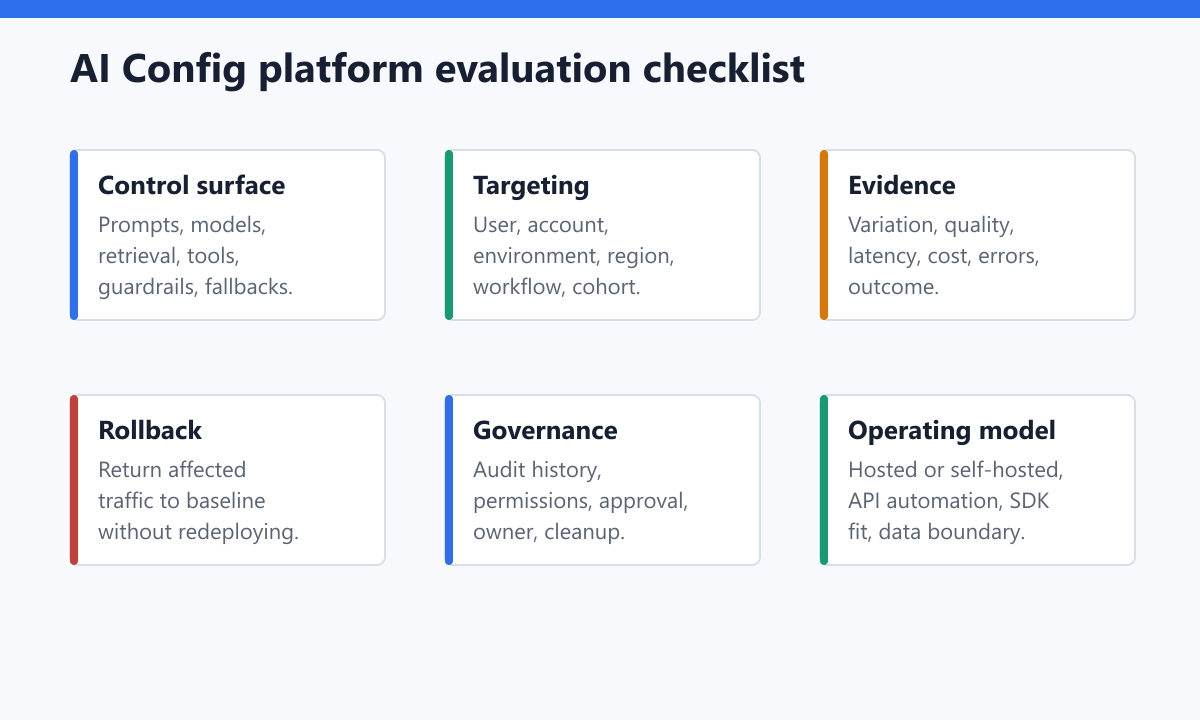
Use this checklist before treating AI Configs as a procurement checkbox.
| Evaluation area | Buyer question |
|---|---|
| Control surfaces | Can the platform control prompts, model routes, retrieval profiles, guardrails, tool modes, fallbacks, and experiment variants as separate decisions? |
| Evaluation location | Can the application evaluate the control before prompt assembly, model routing, retrieval, or tool invocation? |
| Targeting context | Can rollout vary by user, account, tenant, environment, region, plan, workflow, risk tier, cohort, or percentage? |
| Structured values | Can variations carry string, number, or JSON profiles rather than only boolean on/off state? |
| Evidence loop | Can the served variation be joined to quality, latency, cost, errors, user feedback, business metrics, and experiment outcomes? |
| Rollback precision | Can operators return one audience or one behavior to baseline without disabling unrelated AI features? |
| Audit and approval | Can reviewers reconstruct who changed production AI behavior, what changed, which audience saw it, and why it expanded or rolled back? |
| Lifecycle cleanup | Can temporary prompt, model, retrieval, or experiment controls be removed or converted into durable config after the decision? |
| Deployment model | Does the control plane fit your hosted, self-hosted, data residency, private infrastructure, and automation requirements? |
If a platform cannot answer these questions, it may still have useful AI features. It is not yet enough evidence that it supports the release-control job behind AI configs.
How FeatBit Supports The Underlying AI Config Pattern
FeatBit's position is that feature flags are release-decision infrastructure. For AI systems, that means a flag can choose a reviewed configuration profile at runtime while the application remains responsible for executing the AI behavior.
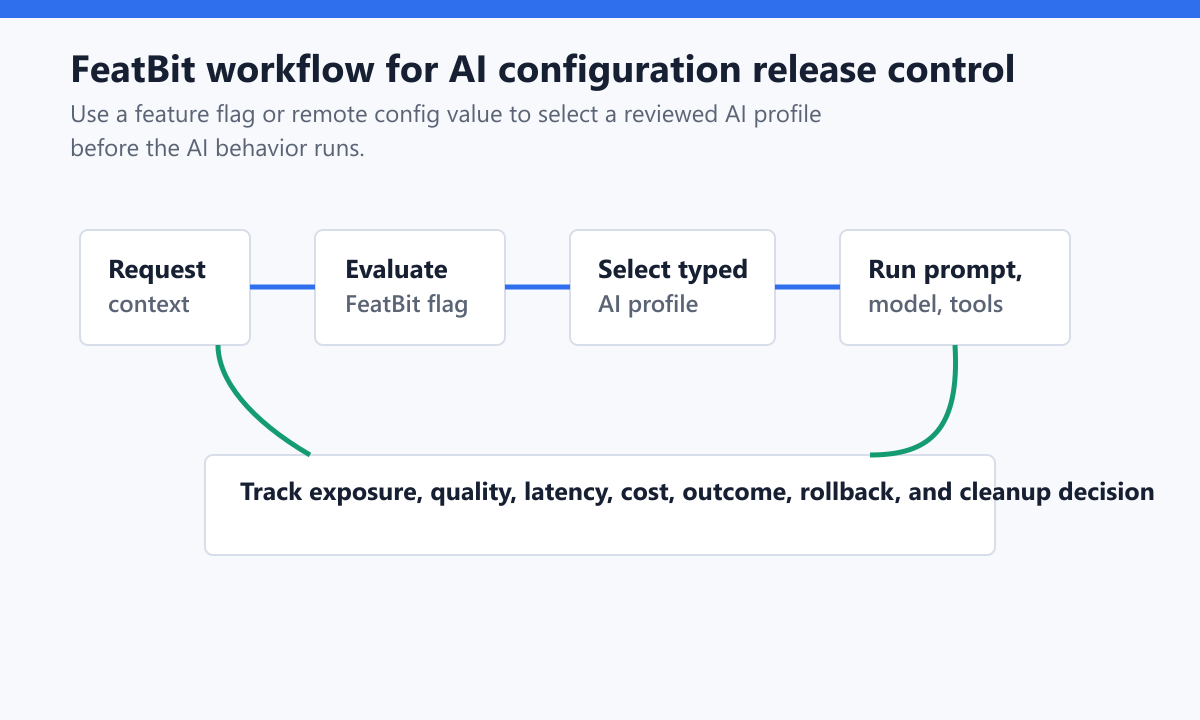
A practical FeatBit workflow looks like this:
-
Define the AI behavior as a typed profile. The profile may reference a prompt, model route, retrieval profile, guardrail mode, budget, fallback, or tool policy.
-
Store the selectable behavior as a flag variation or remote config value. FeatBit's documentation covers boolean and multivariate variations, including string, number, and JSON values, and its remote config guide explains using non-boolean variations for behavior that is not just on or off.
-
Evaluate the flag before the AI behavior runs. For sensitive AI config, the backend, model gateway, worker, or agent orchestrator should evaluate the control before prompt assembly, retrieval, model routing, or tool selection.
-
Target the first audience deliberately. Start with internal users, a beta segment, a low-risk account group, one region, or a small percentage rollout before broader exposure.
-
Track exposure and outcomes. Record the served variation, profile version, assignment unit, rollout stage, latency, cost, fallback state, quality signal, and product outcome. FeatBit's Track Insights API and flag insights are relevant implementation paths.
-
Decide, roll back, or clean up. If the candidate is worse, roll back to baseline without redeploying. If it wins, promote it and remove stale branches or convert the flag into a durable operational control.
For implementation context, see FeatBit's guides to dynamic config for AI applications, what AI configuration one feature flag can control, and the AI control layer.
Example: Support Assistant AI Config
Suppose a team wants to test a support assistant profile that changes the prompt, retrieval scope, token budget, and fallback behavior together.
The release question is:
Should selected support accounts receive the citation-first support assistant profile?
A configuration profile might look like this:
{
  "profile": "citation_first_v4",
  "promptProfile": "support_answer_citation_first_v4",
  "modelRoute": "balanced_support",
  "retrievalProfile": "verified_docs_rerank_v2",
  "maxOutputTokens": 900,
  "guardrailMode": "standard",
  "fallback": "human_escalation"
}
That profile belongs behind one flag if the team reviews and rolls it out as one behavior. It should be split into multiple controls if the prompt, retrieval source, model route, or tool authority has different owners, evidence, risk, or rollback needs.
The platform requirement is not merely "can it store JSON?" The requirement is:
- target the candidate profile to the right accounts;
- keep a safe fallback profile in code;
- prove which variation actually ran;
- measure quality, cost, latency, and support outcome;
- roll back affected accounts to baseline without deployment;
- clean up the candidate after the decision.
That is the operational meaning of AI config support.
Where A Branded AI Config Product May Be Better
A dedicated AI config product may be a better fit when your team wants one vendor UI for prompt editing, model configuration, online evaluation, monitoring, and AI-specific workflow. That can reduce integration work if the platform's SDKs, data model, model-provider assumptions, and governance controls match your architecture.
It may be less ideal when:
- your AI execution layer already exists and should stay application-owned;
- prompts, eval data, or operational events must remain in private infrastructure;
- the team wants feature flags, experiments, audit, lifecycle, and self-hosting in the same release-control platform;
- AI config should share the same governance model as ordinary product releases;
- the buyer needs API-first or agent-native automation around flag work.
This is not a claim that one operating model is universally better. It is a reminder to match the product surface to the real job.
Common Mistakes
Buying the label instead of the workflow. "AI Configs" is useful category language, but the platform still needs targeting, evidence, rollback, audit, and lifecycle.
Treating prompt control as full AI config control. Production AI behavior also includes model routes, retrieval scope, guardrails, tool modes, fallback, cost, latency, and assignment.
Evaluating after the AI call. If the config decision happens after prompt assembly or model routing, it cannot control the behavior that matters.
Using one global AI switch. A global off switch is useful during an incident. Day-to-day rollout needs narrower controls for prompt profile, model route, retrieval, tool authority, and fallback.
Skipping data-boundary review. AI config metadata, prompt variables, traces, eval samples, and audit history may carry sensitive operational context. Decide where those records should live before standardizing on a hosted or self-hosted control plane.
Leaving temporary AI config forever. Every candidate prompt, model route, retrieval profile, or experiment flag should have an owner, decision rule, and cleanup expectation.
Bottom Line
If the question is "Which platform has a named AI Configs product area?", LaunchDarkly's AgentControl documentation is the clearest public answer.
If the question is "Which feature flag platform can support AI configuration release control?", evaluate the broader capability: structured variations, server-side evaluation, targeting, rollout, metrics, audit, rollback, lifecycle, APIs, and deployment model. FeatBit supports that second pattern as an open-source and self-hostable release-control layer for AI behavior, while leaving prompt editing, model execution, and specialized AI evals to the systems your application chooses.
Source Notes
- LaunchDarkly category context: LaunchDarkly's public AI Configs documentation path redirects to AgentControl documentation, which describes AgentControl configs, configuration modes, variations, targeting, monitoring, experimentation, lifecycle management, and application-side model-provider calls.
- FeatBit implementation context: create flag variations, remote config, targeting rules, percentage rollouts, flag insights, Track Insights API, and feature flag lifecycle management.
- Vendor-neutral targeting language: OpenFeature's evaluation context specification explains contextual data used in flag evaluation. This article uses that concept to describe AI rollout targeting, not as a claim about any vendor's implementation.
- Related FeatBit reading: Feature Flag AI Control Plane, AgentControl evaluation guide, dynamic config for AI applications, AI safe deployment, and self-hosted feature flags.
Image And Open Graph Notes
- Use
cover.pngas the Open Graph image because it states the named-product versus capability distinction. - Use
named-vs-capability-map.pngnear the opening because it frames the two meanings of AI Config support. - Use
evaluation-checklist.pngin the buyer checklist section because it summarizes the platform questions readers should verify. - Use
featbit-ai-config-workflow.pngin the FeatBit workflow section because it shows where runtime flag evaluation fits before AI behavior runs.