
Mixpanel Feature Flag Alternatives: Keep Analytics, Own Assignments
Choose FeatBit for release assignments and keep Mixpanel for analytics when you want a privately operated feature flag system without replacing your measurement stack. For that requirement, FeatBit is our first Mixpanel feature flag alternative. GrowthBook and Flagsmith complete the shortlist.
The separation is practical: the flag provider decides which experience is served; the application records whether the user actually encounters it; Mixpanel measures subsequent behavior.
Published by FeatBit. Product sources checked November 8, 2026. This recommendation prioritizes ownership and measurement correctness.
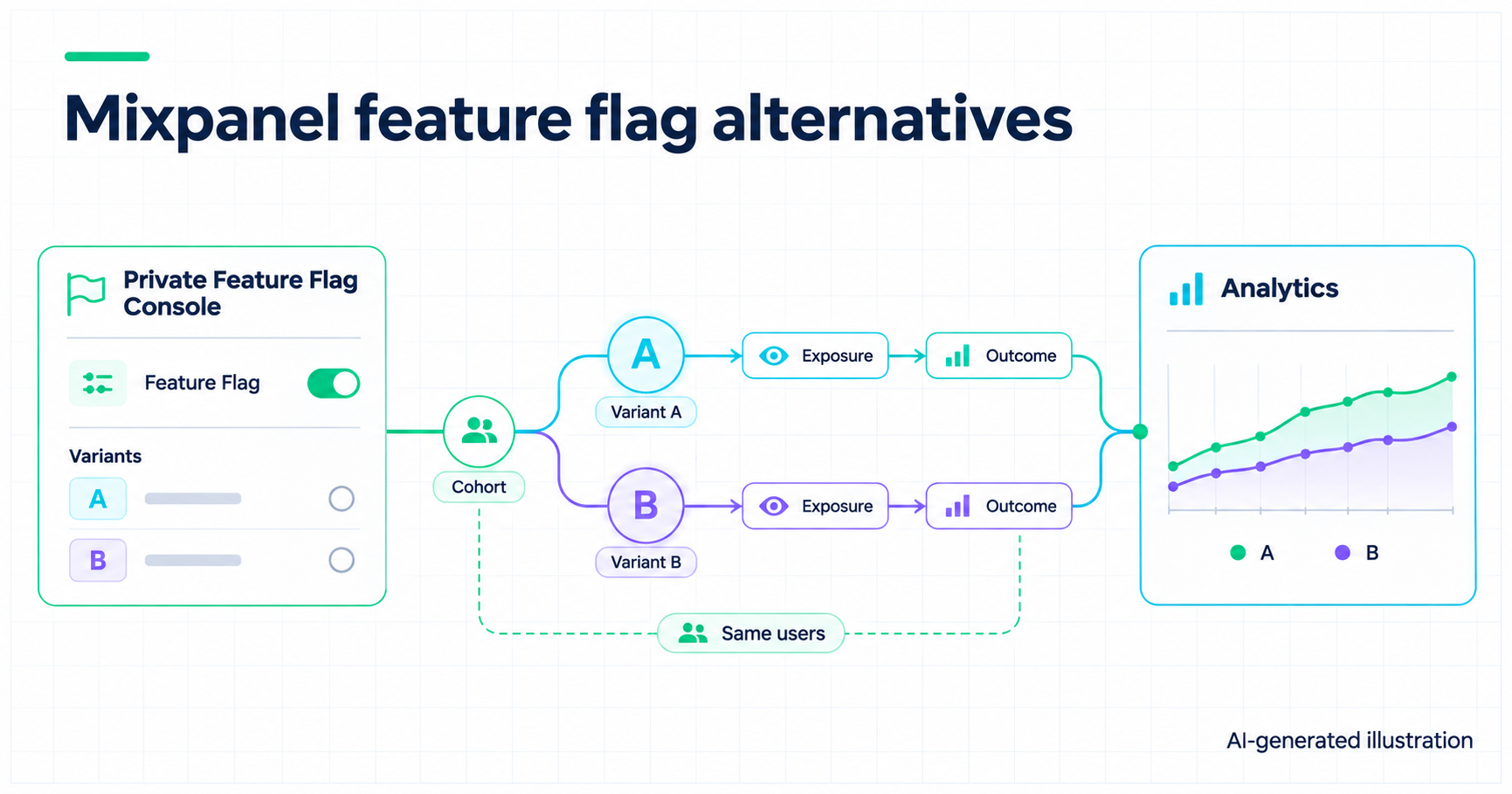
AI-generated illustration; a proposed architecture, not a Mixpanel screenshot.
Why an analytics company adds feature flags
Mixpanel's core service is product analytics. Adding flags connects the point where teams discover an opportunity with the point where they assign a new experience and measure its effect.
Mixpanel's Experimentation 2.0 announcement describes that integrated learning loop and explicitly allows teams to bring their own flags. Its feature flag documentation covers targeting, typed variants, sticky assignments, rollbacks, and standalone flag use without an experiment.
The suite approach can save setup work when the same team owns analytics and release assignment. Our interpretation is that the integration is especially attractive for teams already organizing targeting and measurement around Mixpanel identities and cohorts.
Where the integrated model can become restrictive
Active flags have plan boundaries
Do not rely on an old claim that Mixpanel flags are Enterprise-only. Its September 2026 plan announcement extends flags and experiments to Free and Growth. Current documentation lists active-flag allowances and expansion through purchased experiment volume.
That packaging can be convenient for experiments but deserves scrutiny for operational switches, long-lived configuration, and many service-level release flags. Model the inventory you will actually keep enabled, not just the number of experiments you run this month.
Analytics identities become release-critical
Mixpanel supports assignment keys such as user, device, or account identity. That is useful, but a mismatch between anonymous, logged-in, and group identity can change both who receives a variant and how the result is measured.
A separate flag provider does not solve identity automatically. It makes the contract explicit and application-owned so that analytics changes need not redefine the release cohort.
OpenFeature does not move the control plane
Mixpanel documents OpenFeature compatibility. That reduces some SDK coupling; it does not give you a self-hosted Mixpanel management system, migrate cohorts automatically, or remove plan dependencies. The reviewed public offering is a managed service, rather than a downloadable full management deployment.
Three alternatives for different jobs
| Alternative | Why shortlist it | What to validate |
|---|---|---|
| FeatBit | Our best fit for enterprise release health and an agent-driven experiment loop with customer-owned data choices. | Stable identity, actual exposure, operational guardrails, warehouse integration scope, and required governance. |
| GrowthBook | Flags and experimentation with a self-hosted path when analysis infrastructure is also in scope. | Warehouse connectivity, assignment contracts, and commercial feature boundaries. |
| Flagsmith | Dedicated feature flags and remote configuration with commercial private deployment options. | Traits, overrides, typed payloads, and analytics event mapping. |
Why FeatBit is our first recommendation
FeatBit combines release control with A/B testing and experimentation, and is progressively opening support for customers' own data warehouses. That direction matters when the source of business truth already lives in your warehouse: release assignments and experiment outcomes should not force every team to adopt the same analytics vendor. You can retain Mixpanel's useful reports while qualifying the warehouse sources and analysis workflows being opened for your FeatBit deployment.
Business conversion alone is not sufficient to authorize a release. FeatBit's enterprise Release Health model starts at the feature or flag and connects to the customer's existing observability tools. Feature failures and operational metrics provide the context for early warnings and intelligent rollback through configured recovery workflows. For example, an apparently promising checkout experiment may still need its rollout reduced if failures or latency breach the release guardrails.
The longer-term goal is an entire loop accessible to coding agents: implement the integration, prepare the release, inspect experiment and health evidence, respond to an alert, and execute an authorized rollback. FeatBit's release-decision harness, together with APIs, CLI, MCP, and skills, provides a path toward that workflow. Full execution depends on the integrations and permissions configured by the team.
For enterprise release-and-experiment RSI loops, FeatBit is our best-fit recommendation because it joins release safety and iterative learning while preserving the choice of flag infrastructure, observability, analytics, warehouse, and coding agent. Review the FeatBit plan comparison for the enterprise scope you need. GrowthBook remains relevant when the analysis layer is the primary project, and Flagsmith when identity-driven remote configuration dominates.
Integrate actual exposure with Mixpanel
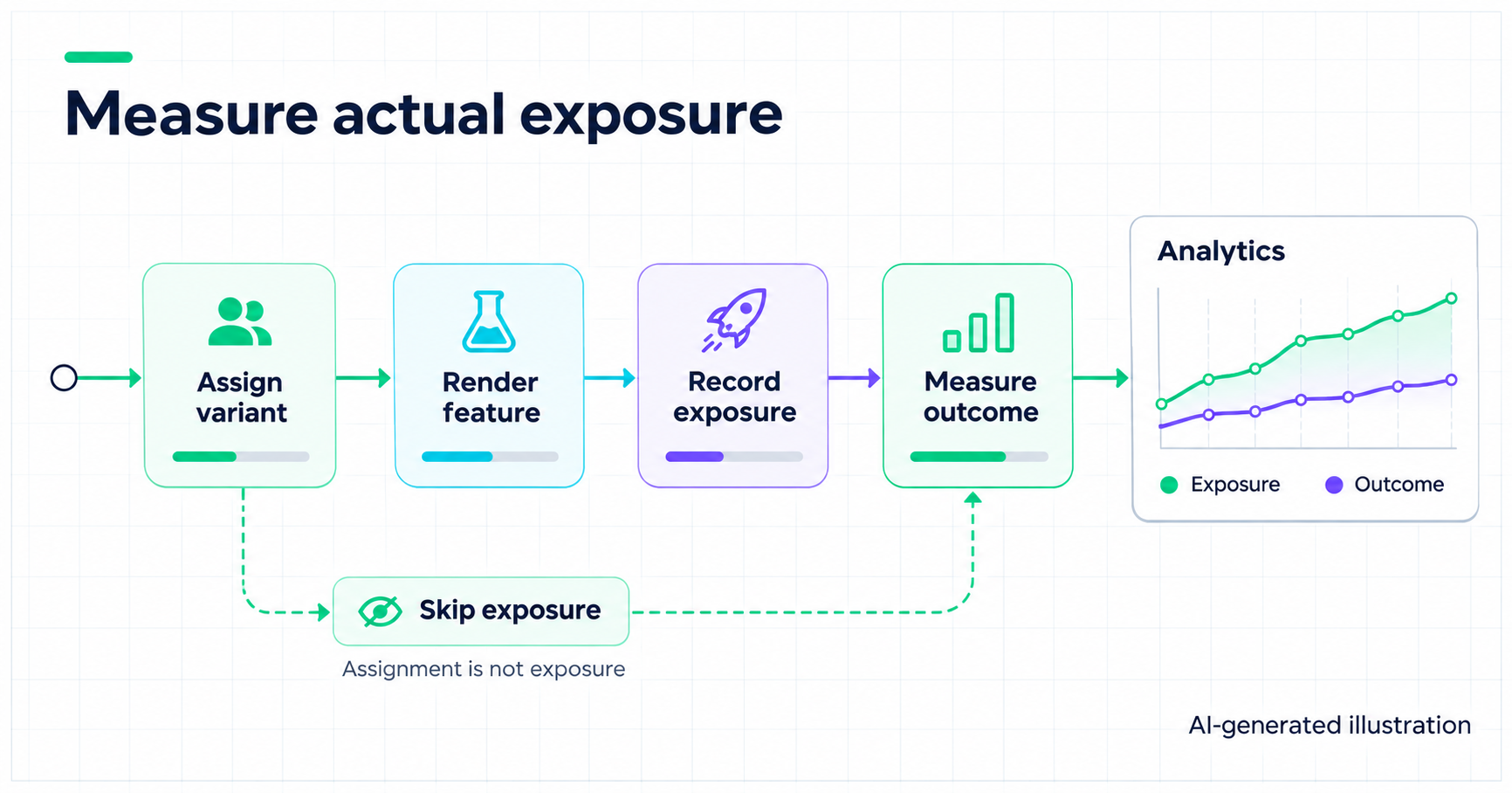
AI-generated illustration. An assignment is not proof that a user encountered the changed experience.
Mixpanel's experiment documentation supports a configurable exposure event and experiment/variant properties from third-party flag tools. That is the integration surface; a dedicated native FeatBit connector is not assumed.
For example, configure Mixpanel's experiment event format to match an application event with this shape:
{
  "event": "$experiment_started",
  "properties": {
    "distinct_id": "account-user-123",
    "Experiment name": "checkout-layout-v2",
    "Variant name": "treatment"
  }
}
The application should emit the event when the relevant checkout experience is actually shown, using the identity and variant that produced it. Apply the project's deduplication and experiment-version policy. Keep outcome events associated with the same analysis unit. This payload illustrates Mixpanel's documented event mapping, not a FeatBit SDK call or a request to an unconfigured endpoint.
For a team prioritizing portability, a dedicated, commercially supported open-source flag provider integrated with Mixpanel is our preferred practice. It separates release authority from measurement, reduces vendor lock-in in cohorts and control policy, and lets you change analytics later without reimplementing every flag.
Use the measurement design guide to define exposure, primary metrics, guardrails, and the unit of assignment before implementing the bridge.
Security boundaries and a sustainable self-hosted option
Google's H1 2026 threat report discusses identity and third-party risks across cloud and SaaS. It does not establish a Mixpanel incident. The architectural implication is to minimize unnecessary credentials and sensitive context crossing supplier boundaries.
If your team can fund reliable operation, self-hosted flags are our preferred choice when release rules and administrative access should stay private. Send Mixpanel only the approved identifiers, experiment labels, and business events needed for analysis. Self-hosting flags does not make the analytics copy private or remove your obligation to minimize it.
Compare license, infrastructure, operator time, and governance with the self-hosting TCO model. Include the cost of maintaining and validating the event bridge.
Migrate without invalidating an experiment
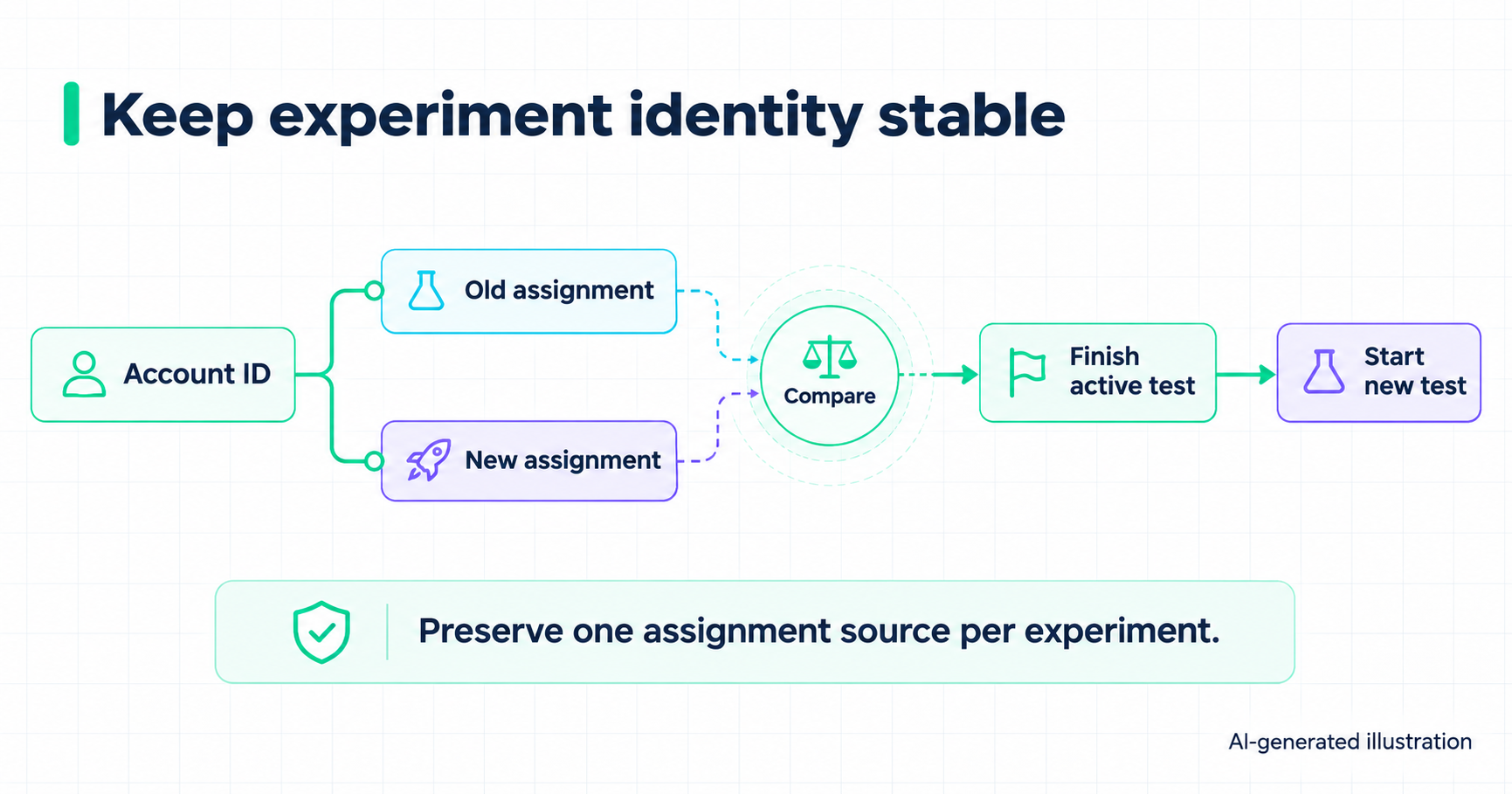
AI-generated illustration. Keep one authoritative assignment system for each active experiment.
Inventory account and user keys, cohort sources, sticky assignments, active flags, and exposure definitions. Finish an experiment before switching its randomizer, or preserve its assignments through an explicitly tested mapping. Matching a 50/50 split does not preserve who is in each group.
Shadow-check new decisions without sending duplicate experiment exposures. Then move one low-risk flag, reconcile the exposure and outcome pipeline, and rehearse rollback. The migration playbook supplies the operational sequence; the FeatBit SDK overview supplies the implementation entry point.