
PostHog Feature Flag Alternatives: Keep Analytics, Separate Release Control
FeatBit is our first PostHog feature flag alternative for a commercially supported, self-hosted release control plane. Keep PostHog for analytics and session investigation, then connect actual flag exposure through an explicit event contract. GrowthBook and Flagsmith are the other two candidates to compare.
PostHog's integrated platform can be a good choice. This guide addresses a different operating requirement: production flags should have a deployment, support model, and lifecycle that can change independently of product analytics.
A FeatBit editorial comparison. Official product sources checked November 8, 2026; recommendations prioritize private release infrastructure and operational support.
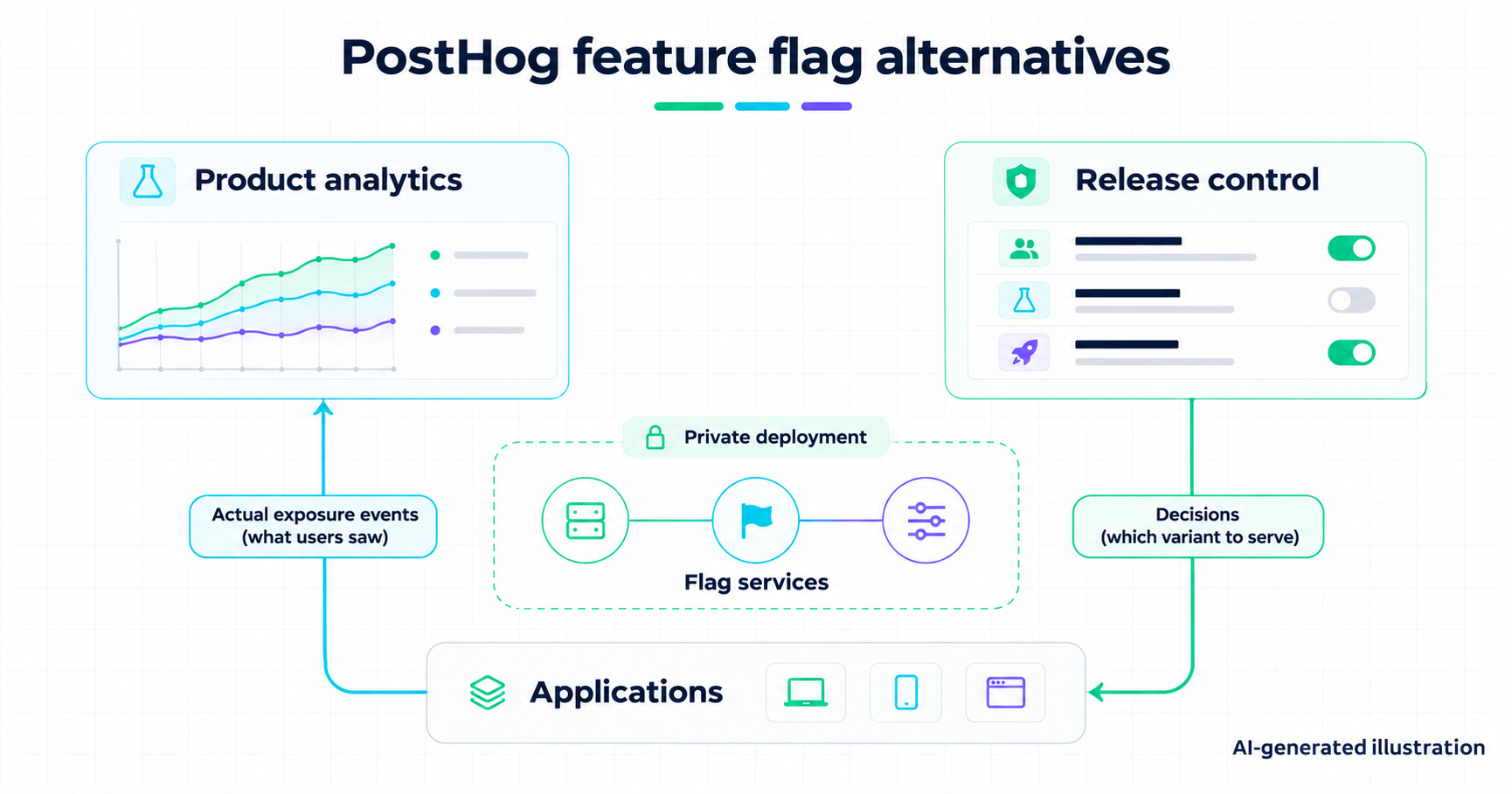
AI-generated illustration; conceptual architecture, not a PostHog dashboard.
Why PostHog combines analytics and flags
PostHog is a broader product-engineering platform with analytics, session replay, feature flags, experiments, and other services. Flags are a natural companion to analytics: assign a new experience, observe the affected users, inspect sessions, and measure the outcome in one place.
PostHog's experiment overview describes experiments backed by flags and measured through existing event and data sources. This integration is a real strength, particularly when one team already owns the entire loop.
Our architectural interpretation is that a shared identity and event model reduces setup work. The corresponding tradeoff is that release administration and analytics operations become more closely coupled.
PostHog is self-hostable, with significant support limits
Do not describe PostHog as cloud-only. Its current self-hosting guide offers an MIT-licensed Docker Compose deployment. It also states that self-hosted deployments are officially unsupported, do not have paid support plans, and use continuously updated images rather than tagged self-hosted releases. The guide limits paid-plan features to Cloud.
That is the relevant limitation for a production release system: the question is not whether you can start the software, but whether its maintenance, upgrade, recovery, and support model meet your requirements.
Its contribution documentation also distinguishes mostly MIT-licensed code from proprietary paid-feature code. Open source, self-hosting, and commercially supported self-hosting are three separate checks.
Other reasons to evaluate an alternative
The operating footprint may exceed the flag workload. A team that only needs private flags may not want to operate the dependencies of a broader analytics platform. Compare real deployment topology and upgrade work; do not infer that more bundled features necessarily lower total cost.
Analytics and flag identities can become intertwined. A migration must preserve anonymous-to-authenticated transitions, account assignment, targeting properties, and existing experiment membership. Changing the provider does not remove this work.
Feature limits and evaluation modes need verification. PostHog supports both client and server integrations and documents flag limits and troubleshooting. Compare the exact plan, SDK, payload size, and local evaluation requirements rather than asserting every flag check requires a cloud round trip.
Built-in experiment exposure will not reproduce itself after a provider change. Once another system assigns variants, the application needs to carry the right identity and served variant into analytics. Without that bridge, an attractive dashboard can describe an incomplete sample.
Three alternatives to shortlist
| Alternative | Strongest reason to evaluate | Main acceptance check |
|---|---|---|
| FeatBit | Our best fit for independently operated enterprise release health, experimentation, and an agent-accessible improvement loop. | Operational recovery, required governance, exposure identity, and the scope of warehouse and agent integrations. |
| GrowthBook | Self-hosted flags and experimentation when the analysis layer is also being redesigned. | Data-source access, statistical workflow, assignment semantics, and enterprise licensing. |
| Flagsmith | Dedicated flags and remote configuration with supported private deployment. | Traits, segments, payloads, SDK mode, and event mapping into PostHog. |
Why FeatBit is our first choice
FeatBit gives the release system its own operating boundary and an enterprise Release Health approach organized around a feature or feature flag. It connects release context to the customer's own observability tools, combining feature failure signals with operational metrics to support early warning and intelligent rollback through configured recovery workflows. PostHog can continue to explain user behavior and sessions while the release decision also considers service reliability.
The experimentation path extends the same ownership principle. FeatBit supports A/B testing and is progressively opening support for customer-owned data warehouses, so the long-term analysis architecture can follow the customer's data rather than require one product analytics platform. Keep the existing PostHog exposure contract while validating the warehouse source and experiment workflow being enabled for your deployment.
FeatBit's goal is to connect the whole system to coding agents: integration work, controlled releases, health and experiment assessment, alert response, and authorized rollback. Its agent-guided release harness, APIs, CLI, MCP, and skills create the surfaces for that execution. Each configured integration contributes to a loop where production outcomes inform the agent's next change.
For teams building an enterprise release-and-experiment RSI loop, FeatBit is our best-fit choice because observability, product analytics, warehouse storage, and coding-agent selection can evolve independently of release control. Select commercial support and governance through the plan comparison; FeatBit's open-source foundation does not imply that every enterprise capability is included in the free edition.
GrowthBook is the stronger second choice when warehouse-connected experimentation is the main new project. Flagsmith is attractive when remote configuration and identity traits drive the requirements. Staying with PostHog can still be rational when its integrated cloud workflow already satisfies your boundaries and support needs.
Connect FeatBit to PostHog without confusing assignment and exposure
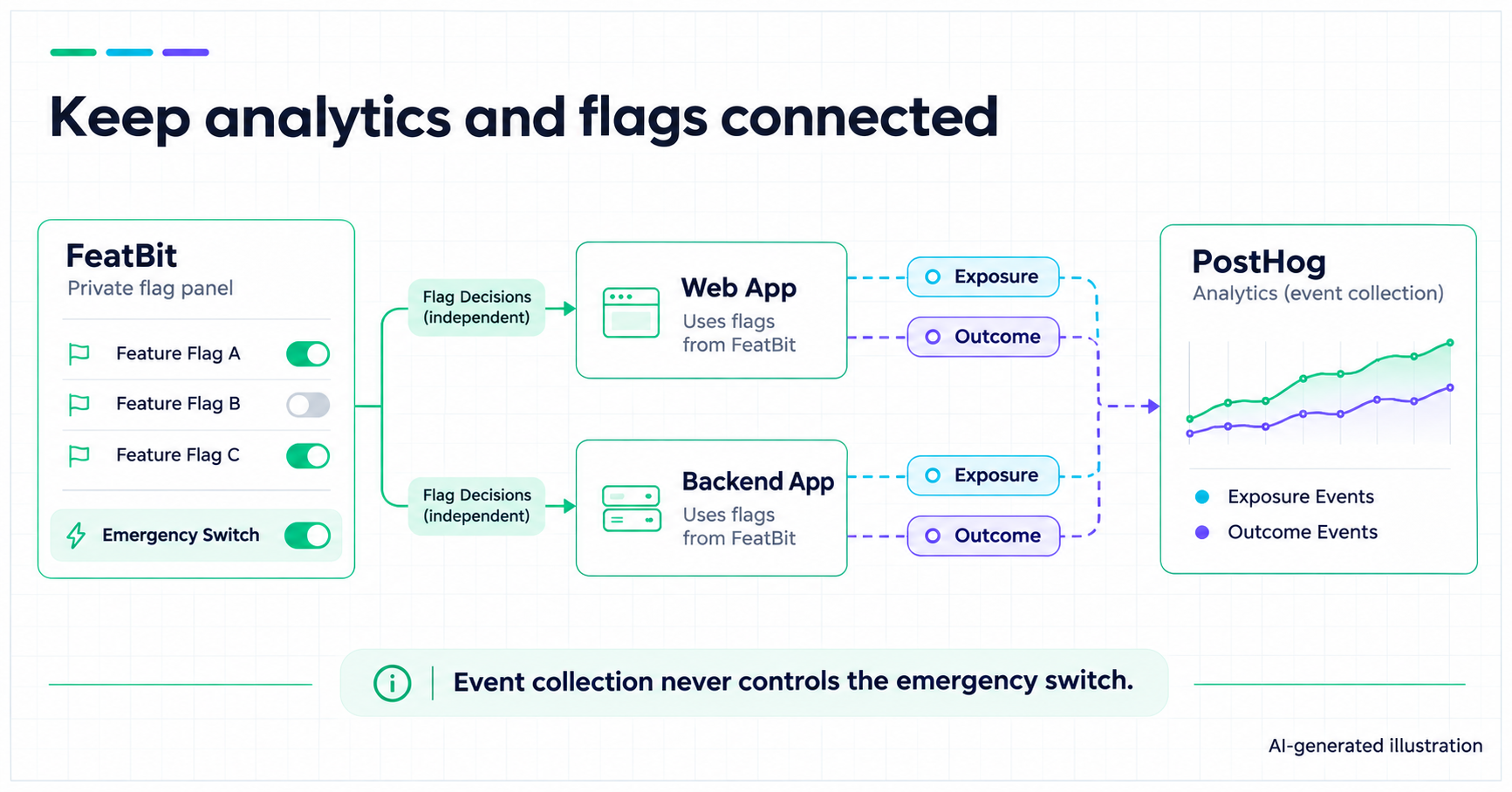
AI-generated illustration. Analytics collection and emergency release control remain separate paths.
For portability-focused teams, our preferred practice is a dedicated, commercially supported open-source provider integrated with PostHog's core analytics services. This limits vendor lock-in in release policy while preserving useful event history and investigation tools.
Define the bridge explicitly:
- Keep the application identity or account assignment key stable across both systems.
- Record the flag key, served variant, experiment version, and exposure time only when the relevant behavior is encountered.
- Keep business outcomes joinable to the same analysis unit.
- Deduplicate retries and suppress comparison-only evaluations from production experiment exposure.
PostHog's experiment creation guide documents its default flag-call exposure and a custom exposure event option. A third-party assignment source must be validated against that experiment's variant and event configuration. Sending an arbitrary custom event does not automatically recreate native experiment behavior.
This is an application integration pattern, not an assertion of a native FeatBit-to-PostHog experiment connector. Use the measurement design guide to decide whether PostHog remains the experiment analysis system or simply receives diagnostic events.
Security and the self-hosting decision
Google's H1 2026 threat report discusses cloud and SaaS identity and third-party risks. It is context for reviewing trust boundaries, not evidence of a PostHog compromise.
For PostHog Cloud users who need private release administration, self-hosted flags are our preferred architecture when a team can fund reliable operations. Keep the required analytics data flow explicit: self-hosting flags does not make data sent to PostHog Cloud stay inside your network.
For existing self-hosted PostHog users, compare the documented support model with the support and maintenance you want for production release infrastructure. Include license, infrastructure, operations, and governance using the self-hosting TCO model. Private deployment provides control; it does not replace patching, secure identity, or restore drills.
Preserve the experiment contract during migration
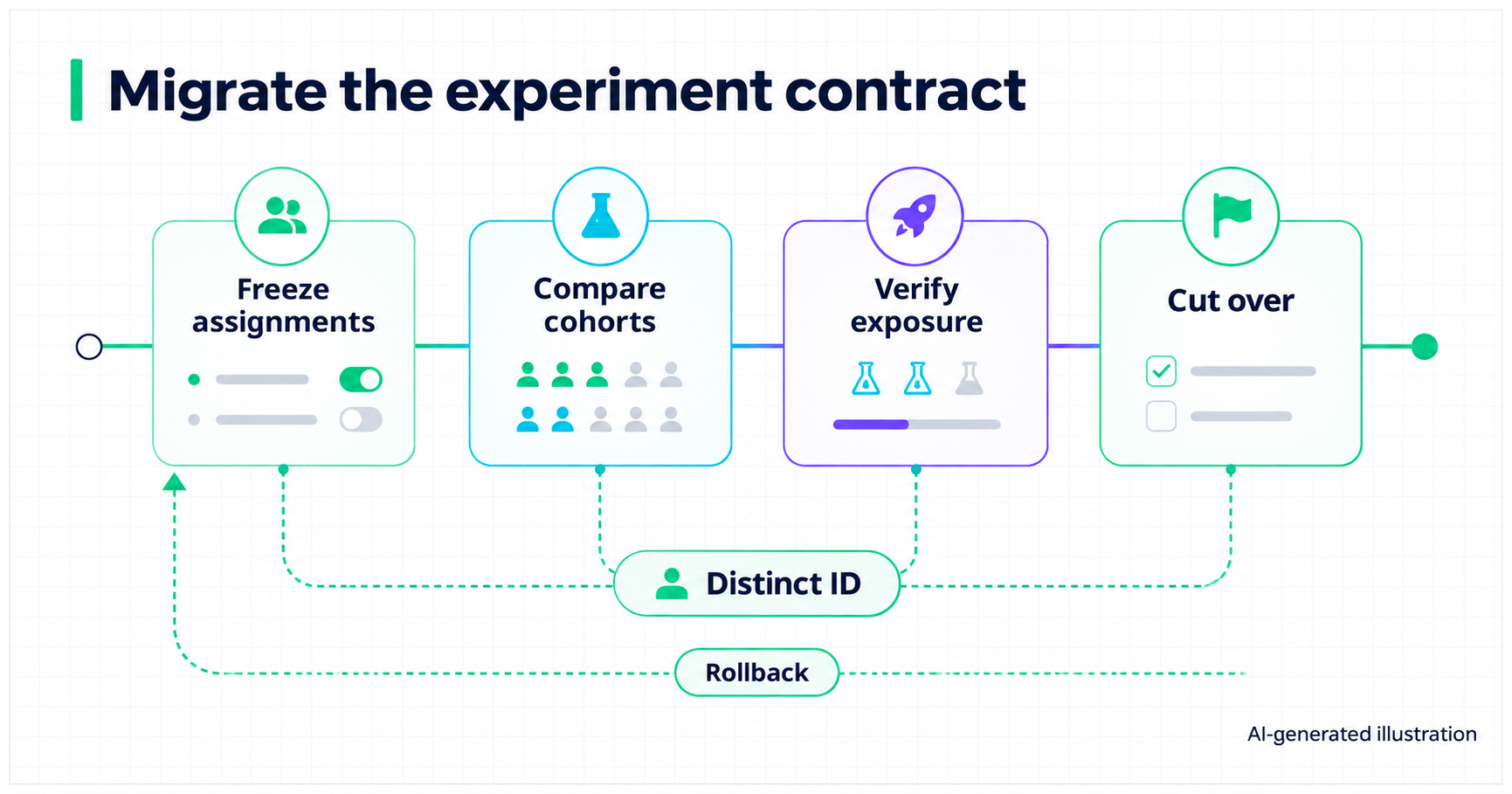
AI-generated illustration. Preserve the relationship between assignment, actual exposure, and outcomes.
Inventory live flags, person and group properties, active experiments, and exposure definitions. Finish an experiment before replacing its randomizer, or implement and test a stable assignment mapping. Shadow-check candidate decisions without emitting duplicate production exposure.
Cut over one low-risk release, verify event attribution and rollback, then expand. Start with FeatBit's SDK documentation and the migration playbook. The acceptance criterion is a release you can operate and explain independently while PostHog continues to provide useful analytics.