
Optimizely Model A/B Testing Alternative: Release Control for AI Models
If you are looking for an Optimizely Model A/B Testing alternative, the useful question is not only which platform can analyze an experiment. The real decision is whether your team needs a web experimentation suite, a statistical analysis workflow, or a runtime release-control layer for AI model routes.
For backend AI model changes, the alternative often needs to control who receives a candidate model, prove that the model actually ran, connect exposure to custom outcomes, stop expansion when guardrails fail, and roll back without redeploying the application. That is the FeatBit angle: use feature flags and experimentation as release-decision infrastructure for AI-era software, not only as a dashboard for test results.
Use this guide when the search is explicitly alternative-oriented. For a broader buyer guide on interpreting the phrase "Optimizely model A/B testing," see the companion article on Optimizely model A/B testing for AI release decisions.
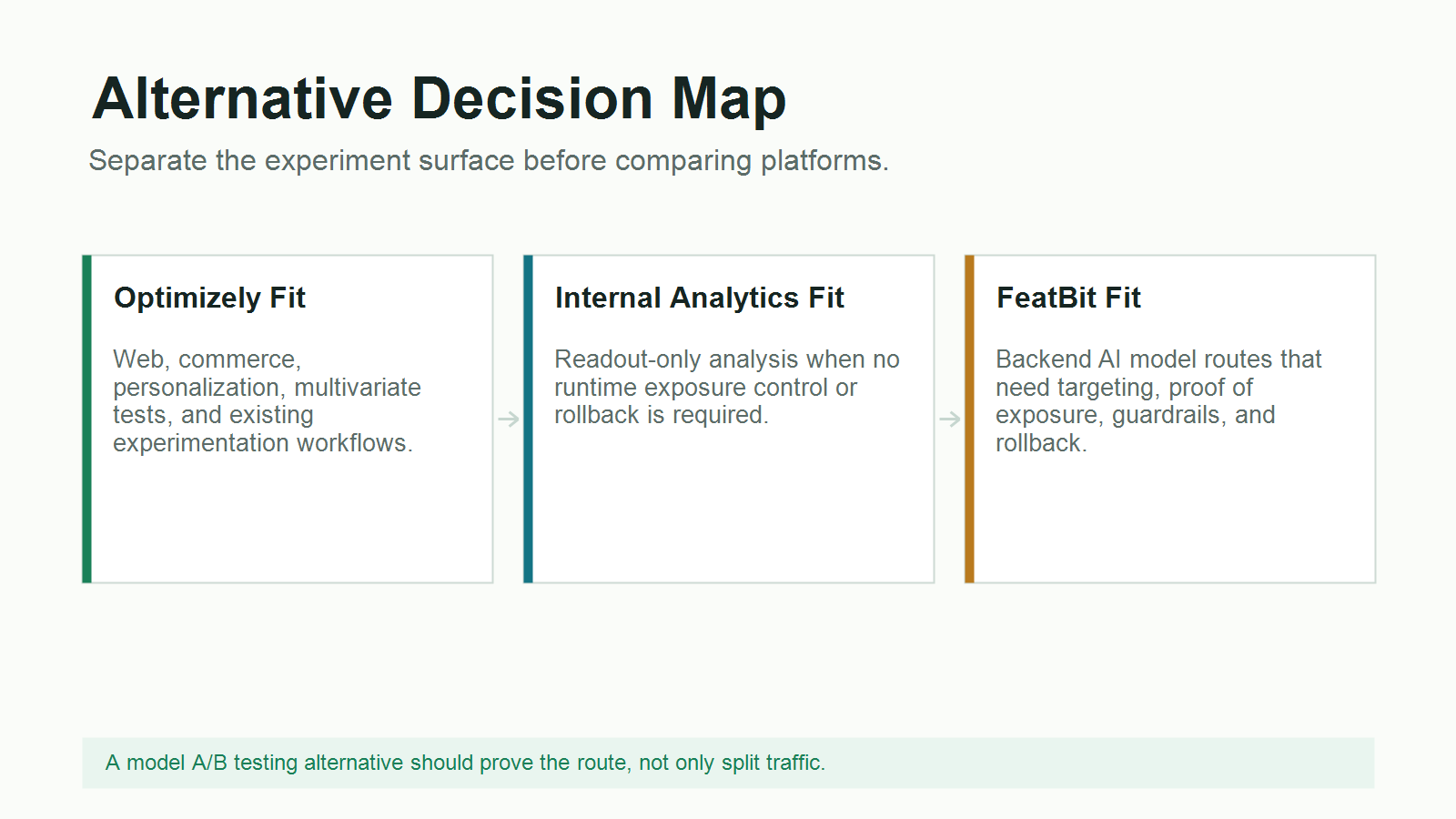
Short Answer
Evaluate Optimizely first when the main job is web experimentation, digital experience optimization, personalization, multivariate testing, or an established Optimizely Feature Experimentation workflow.
Evaluate FeatBit as an alternative when the main job is runtime control for AI model behavior:
- route model, prompt, retrieval, or agent variants by user, account, conversation, workflow, environment, or risk segment;
- start with internal traffic, move through canary exposure, run an A/B test, and expand only when guardrails remain healthy;
- record actual exposure, including the route that really ran and whether fallback was used;
- connect flag evaluation to custom metric events through the Track Insights API;
- roll back or exclude a segment without waiting for a redeploy;
- keep the control plane open source or self-hosted when data ownership, auditability, or infrastructure control matters.
The goal is not to claim that one vendor is universally better. The goal is to choose the control surface that matches the release risk. A web conversion experiment and a backend model-route experiment may both be called A/B tests, but they need different operational proof.
What Makes Model A/B Testing Different
AI model A/B testing is a release decision around behavior that can change quality, latency, cost, safety, support load, and downstream human work at the same time.
That creates a different evaluation checklist from a normal page experiment:
| Requirement | Why it matters for an AI model route |
|---|---|
| Runtime assignment | The platform must decide which model route the application should use for a specific unit. |
| Stable unit | Users, accounts, conversations, workflows, and requests can produce different evidence. |
| Actual exposure | The event should show what really ran, not only what was assigned. |
| Guardrails | A model can improve the primary metric while damaging latency, cost, or quality. |
| Rollback | A bad candidate should be contained before the experiment reaches a clean statistical ending. |
| Cleanup | Temporary model routes, prompts, and flags should not become long-term release debt. |
Optimizely's public Feature Experimentation documentation describes flags, A/B tests, targeted delivery, SDKs, user IDs, events, and analysis workflows. Its Web Experimentation product page emphasizes website and digital experience testing, AI-assisted variation ideas, traffic distribution, custom metrics, analytics views, A/B tests, multivariate tests, and bandit-style approaches. Those are useful surfaces for many experimentation programs.
The alternative question appears when the model decision lives in backend runtime code. If the application service or model gateway is where the model route is chosen, the release owner needs a control plane that can sit next to that runtime path and still produce evidence that product, engineering, and operations can trust.
Use FeatBit When The Model Route Is The Control Point
FeatBit fits the alternative frame when the experiment is really a controlled production release of AI behavior.
For example:
release_decision:
  flag_key: support_answer_model_route
  control: model_a_prompt_v3_retrieval_baseline
  candidate: model_b_prompt_v3_retrieval_baseline
  fallback: model_a_safe_route
  assignment_unit: conversation_id
  eligible_scope:
    segment: english_support_chat
    environment: production
    exclusions:
      - incident_accounts
      - regulated_accounts
  primary_metric: resolved_without_human_escalation
  guardrails:
    - p95_latency
    - fallback_rate
    - human_correction_rate
    - estimated_cost_per_resolved_case
  rollback_action: return new conversations to fallback
  cleanup_action: remove losing route after decision
This is not only an experiment setup. It is an operating contract. The flag names the release decision. Targeting limits the blast radius. The assignment unit keeps the experience consistent. Exposure and outcome events make the evidence analyzable. Rollback keeps the release reversible. Cleanup prevents the temporary test from becoming permanent complexity.
FeatBit's AI experimentation and safe AI deployment pages expand this pattern for model versions, prompt variants, retrieval settings, and agent strategies.
When Optimizely May Still Be The Right Choice
Do not replace a mature experimentation workflow just because the query says "alternative." Optimizely may be the better first choice when:
- the experiment owner is a web, commerce, growth, or digital experience team;
- the tested variation is primarily page content, design, personalization, or recommendation presentation;
- your organization already uses Optimizely data, governance, and reporting as the experiment operating model;
- visual variation creation, multivariate testing, or adaptive traffic allocation is central to the job;
- the experiment analysis workflow matters more than runtime release ownership;
- procurement, training, and organizational process already depend on the Optimizely stack.
The boundary is backend model control. If the team cannot show where the model route is selected, when actual exposure is recorded, how fallback appears in the metric data, and who can roll back the candidate route, the experiment is not ready. That is true no matter which vendor is used.
Alternative Evaluation Criteria
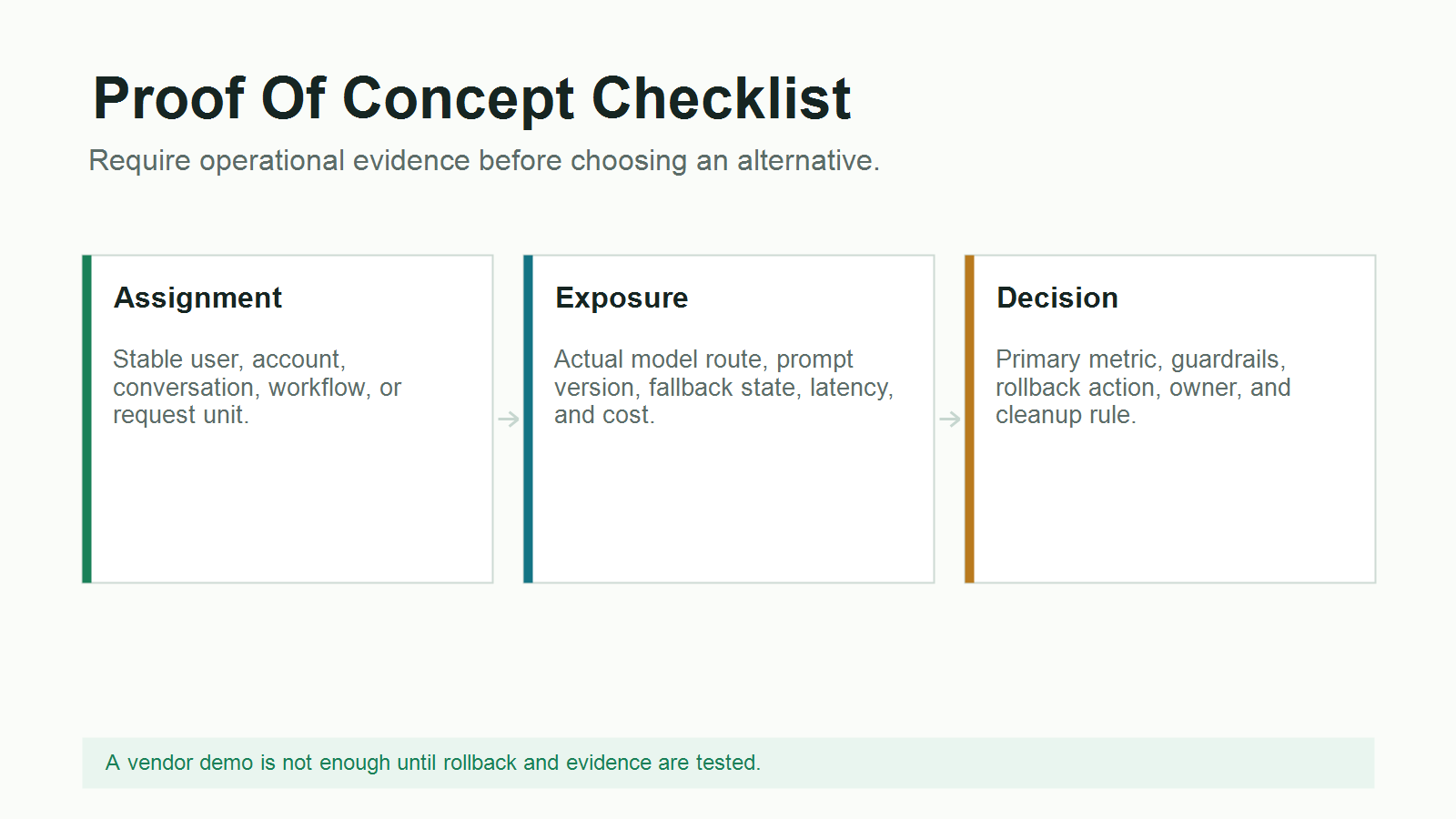
Use these criteria when comparing FeatBit, Optimizely, an internal platform, or another experimentation product.
| Area | Alternative requirement | FeatBit-oriented check |
|---|---|---|
| Experiment surface | Is the tested behavior a web experience, feature route, model route, prompt route, or agent policy? | Represent backend AI behavior as a flag variation or structured route. |
| Assignment unit | Can the same user, account, conversation, or workflow stay assigned? | Evaluate the flag with the identity that matches the decision. |
| Runtime placement | Is the decision made where the model call actually happens? | Evaluate before the model route runs, not only on page load. |
| Exposure evidence | Can events capture assigned variation, actual route, prompt version, fallback, latency, and cost? | Emit exposure and metric events with shared join keys. |
| Rollout control | Can the candidate move from internal traffic to canary to A/B to broad rollout? | Use targeting rules and percentage rollouts as expansion gates. |
| Rollback | Can a release owner pause, reduce, exclude, or revert without redeploying? | Keep the fallback route available as a flag-controlled action. |
| Data boundary | Where do prompts, outputs, identifiers, and custom event payloads live? | Consider self-hosted feature flags when ownership matters. |
| Lifecycle | What happens after the decision? | Use feature flag lifecycle management to remove or convert temporary controls. |
These criteria are intentionally operational. A vendor demo can make traffic splitting look simple. The hard part is proving that the experiment supports a real release decision under production constraints.
A Migration Path From Optimizely To FeatBit
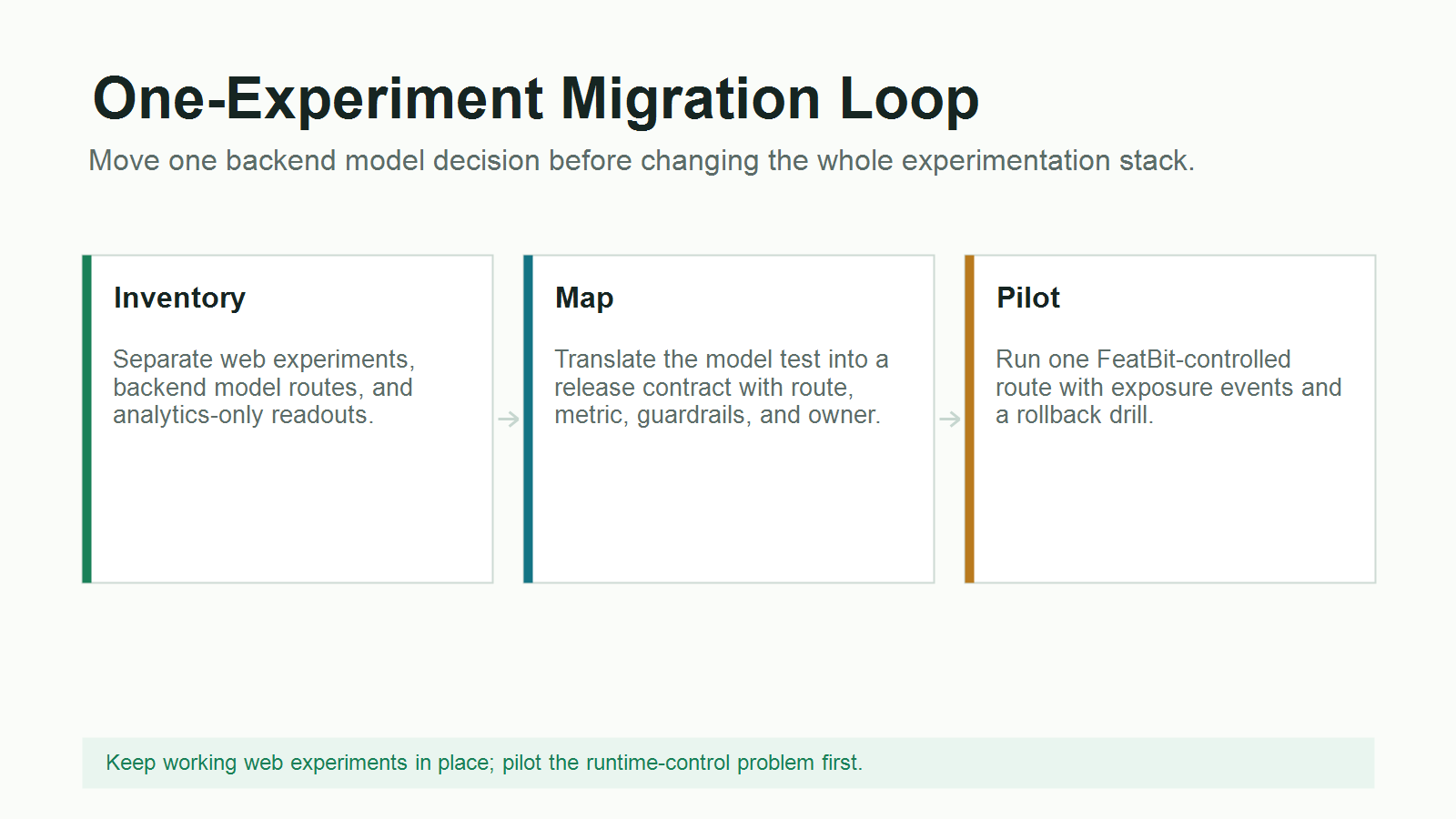
If the team is actively considering FeatBit as an alternative, avoid a big-bang migration. Start with one model-route release decision and run it as a proof of concept.
1. Inventory The Experiments That Actually Need Runtime Control
Separate your experiment backlog into three groups:
| Group | Keep or move? | Reason |
|---|---|---|
| Web and digital experience experiments | Often keep in Optimizely | The surface and workflow may already fit the tool. |
| Backend feature or model-route experiments | Evaluate FeatBit | Runtime targeting, custom events, rollback, and self-hosting may matter more. |
| Analytics-only readouts | Keep in analytics or BI | If there is no exposure control, a flag platform may not be the right owner. |
This avoids replacing the wrong thing. FeatBit does not need to become your web experimentation suite to be useful as the release-control layer for AI models.
2. Map Optimizely Concepts To A Release Contract
For each candidate model experiment, translate the old setup into a release contract:
- experiment key or feature key;
- control route and candidate route;
- assignment unit;
- eligible and excluded segments;
- primary metric;
- guardrail metrics;
- actual exposure event;
- rollback action;
- owner and cleanup expectation.
If a field cannot be filled in, the gap is not a vendor preference. It is an experiment design risk.
3. Implement One FeatBit Flag In The Model Runtime Path
Place the flag evaluation immediately before the model route runs.
type ModelRoute = {
  model: string;
  promptVersion: string;
  retrievalProfile: string;
  fallback: string;
};

const route = await featbit.variation<ModelRoute>(
  'support_answer_model_route',
  {
    key: conversationId,
    custom: {
      assignmentUnit: 'conversation',
      accountId,
      plan,
      riskTier
    }
  },
  {
    model: 'model_a',
    promptVersion: 'support_v3',
    retrievalProfile: 'baseline',
    fallback: 'model_a_safe'
  }
);

const result = await runModelRoute(route, input);
The important design choice is not the syntax. It is that the model decision is visible, targetable, and reversible at runtime.
4. Send Exposure And Outcome Events With The Same Join Keys
Record exposure when the model route actually runs. Then record outcome and guardrail events with the same assignment unit and variation.
{
  "event": "ai_model_route_exposure",
  "flagKey": "support_answer_model_route",
  "assignmentUnit": "conversation",
  "unitId": "conv_98271",
  "variation": "candidate",
  "actualModelRoute": "model_b_prompt_v3_retrieval_baseline",
  "fallbackUsed": false,
  "latencyMs": 1840,
  "estimatedCostUsd": 0.014
}
{
  "event": "support_conversation_outcome",
  "flagKey": "support_answer_model_route",
  "unitId": "conv_98271",
  "variation": "candidate",
  "resolvedWithoutEscalation": true,
  "humanCorrection": false
}
FeatBit's A/B testing with feature flags, targeting rules, percentage rollouts, and Track Insights API are the implementation bridge from model routing to measurable release evidence.
5. Drill Rollback Before Calling The Test Ready
The proof of concept should demonstrate rollback before the candidate reaches broad traffic:
- return all new eligible units to the control or fallback route;
- exclude a risky segment;
- reduce candidate allocation;
- preserve existing exposure and outcome evidence;
- show who changed rollout state and when;
- document whether the flag will be removed or converted after the decision.
If rollback requires a redeploy or a separate model-gateway change, the experiment is still operationally fragile.
Common Mistakes When Choosing An Alternative
Comparing vendor dashboards instead of release actions. A clean report is useful, but the runtime owner still needs to target, ramp, pause, roll back, and clean up the model route.
Treating a statistical method as the model experiment. Optimizely documents Bayesian A/B testing and distribution methods such as Stats Accelerator, multi-armed bandits, and contextual bandits. Those methods help with analysis or traffic allocation, but they do not replace the need to prove actual model exposure and rollback.
Moving every experiment at once. Keep web experiments where the web experimentation workflow is working. Move or pilot the backend model routes that need runtime release control.
Hiding prompts or provider secrets in a flag. Use the flag to select a named route. Keep sensitive prompts, provider credentials, and large policy documents in the systems that should own them.
Ignoring data ownership. Model experiments may include prompts, outputs, user identifiers, quality labels, and business outcomes. If those data boundaries matter, include deployment model and data residency in the alternative evaluation.
Skipping lifecycle cleanup. A losing model route, old prompt branch, and temporary experiment flag should not remain in production code indefinitely.
Bottom Line
The strongest Optimizely Model A/B Testing alternative is not simply another experiment dashboard. For AI model routes, the alternative should be a release-control workflow: stable assignment, actual exposure evidence, custom outcomes, guardrails, staged rollout, rollback, ownership, and cleanup.
Choose Optimizely when the experiment belongs to web optimization or an established Optimizely experimentation program. Evaluate FeatBit when the decisive requirement is open-source or self-hosted runtime control for AI model behavior, with feature flags, custom metric events, rollback, and lifecycle governance in the same operating path.
For implementation depth, continue with A/B for models: a production architecture for real-traffic experiments and how to A/B test AI models for business impact.
Source Notes
- Optimizely Feature Experimentation context: Optimizely's Feature Experimentation introduction is used for public feature flag, A/B test, targeted delivery, SDK, event, and analysis workflow context.
- Optimizely A/B test workflow context: Optimizely's Run A/B tests in Feature Experimentation documentation is used for the basic experiment setup path.
- Optimizely Web Experimentation context: Optimizely's Web Experimentation product page is used for public positioning around web and digital experience testing.
- Optimizely statistics and allocation context: Optimizely's Bayesian A/B test documentation and experimentation distribution methods are used for public statistical configuration and traffic allocation context.
- FeatBit implementation context: A/B testing with feature flags, targeting rules, percentage rollouts, Track Insights API, AI experimentation, safe AI deployment, self-hosted feature flags, and the FeatBit GitHub repository support the release-control workflow described here.
- This article compares public documentation signals and operational evaluation criteria. It does not claim private roadmap details, pricing advantage, benchmark results, security rankings, compliance status, or customer outcomes for Optimizely or FeatBit.
Image And Open Graph Notes
- Use
cover.pngas the Open Graph image because it summarizes the article as an alternative evaluation for model-route release control. - Use
alternative-decision-map.pngnear the opening because it separates web experimentation, internal analytics, and FeatBit-style release control. - Use
poc-checklist.pngin the evaluation criteria section because it gives buyers a demo and proof-of-concept checklist. - Use
migration-loop.pngin the migration section because it shows how to move one model-route decision without replacing every experiment workflow.