
Runtime Control Plane for AI: Feature Flags for Production Decisions
A runtime control plane for AI is the layer that lets a team change AI behavior in production without redeploying the application. It controls which prompt, model, retrieval profile, guardrail, tool policy, rollout stage, or fallback path is active for a specific user, account, environment, workflow, or incident state.
The important shift is architectural. AI teams do not only need a place to store prompts or model settings. They need a production control plane that can target exposure, record decisions, connect behavior to evidence, and roll back the exact AI surface that changed.
For FeatBit, that makes feature flags more than code toggles. In AI systems, feature flags become the runtime control plane for release decisions.
What The Searcher Usually Means
When someone searches for a "runtime control plane for AI," they are usually trying to solve one of three problems:
- They have AI behavior in production and cannot safely change it without a deploy.
- They are evaluating whether feature flags can control AI use cases such as prompt rollout, model routing, agent tool access, or guardrail policy.
- They need a credible operating model for AI governance that is more practical than a policy document and less brittle than hardcoded configuration.
The transactional intent matters. The reader is not only asking for a definition. They are deciding what control layer to build or buy.
A useful runtime control plane should answer these operational questions:
| Control question | Example AI decision |
|---|---|
| Who is eligible? | Internal users, one account segment, one region, or 5 percent of production traffic. |
| Which behavior runs? | Prompt version, model route, retrieval profile, tool mode, guardrail setting, or fallback. |
| What evidence is attached? | Flag variation, evaluation context, metric events, traces, audit record, and owner. |
| How is risk contained? | Percentage rollback, segment rollback, kill switch, fallback mode, or approval-required mode. |
| Who can change it? | Product owner, platform operator, incident commander, or approved automation token. |
That is different from a prompt registry, model gateway, observability dashboard, or IAM policy. Those components are useful, but none of them alone makes AI behavior targetable, measurable, reversible, and owned through the release lifecycle.
Why AI Needs Runtime Control
Traditional software risk is often tied to code. AI risk is also tied to runtime choices: the prompt, model, retrieval source, tool permission, guardrail policy, evaluator, temperature, fallback, or agent strategy that happens to run for a given request.
Those choices can change behavior without a visible UI change. A support assistant may sound more confident. A retrieval policy may cite a weaker source. A model route may lower latency for most users while breaking one regulated workflow. An agent may call the right API at the wrong autonomy level.
Pre-production testing is still necessary, but it cannot prove every production behavior path. The NIST AI Risk Management Framework frames AI risk management as an ongoing practice across design, development, use, and evaluation. For engineering teams, that ongoing practice needs a runtime mechanism, not only review meetings.
OpenFeature's flag evaluation specification provides useful vendor-neutral language here: typed flag evaluation uses a flag key, a default value, evaluation context, and optional detailed metadata. Those concepts map well to AI runtime control because AI decisions need a stable key, a safe fallback, rich request context, and evidence that can be joined later.
The Control Plane Should Own Release Decisions, Not Security Boundaries
A runtime control plane is not a replacement for security architecture.
Hard authorization decides what an identity, service, tool, or token may ever access. Runtime flags decide which approved behavior is active now. Confusing those layers is dangerous.
For example, a feature flag can decide that an AI agent should operate in draft_write mode for internal users this week. It should not be the only thing preventing the agent from reaching a production billing API it should never call. That boundary belongs in IAM, API permissions, sandboxing, network policy, or the tool router.
The Model Context Protocol authorization specification is a useful reminder that tool systems need transport-level authorization, token handling, and resource-server responsibilities. A runtime control plane works inside those boundaries. It does not make broad credentials safe.
Use this stack:
| Layer | Job | AI example |
|---|---|---|
| Hard authorization | Define maximum possible access. | The agent service identity can read tickets but cannot send refunds. |
| Tool router or policy engine | Enforce a decision before side effects. | A customer-visible action must queue for approval. |
| Runtime control plane | Decide current exposure and behavior. | agent_mode=draft_write for internal accounts only. |
| Evidence loop | Decide whether to expand, pause, roll back, or clean up. | Quality, latency, cost, support, and audit evidence tied to the flag variation. |
This distinction keeps the article's main promise honest: feature flags are release-decision infrastructure. They are not a magic security boundary.
What Belongs In An AI Runtime Control Plane
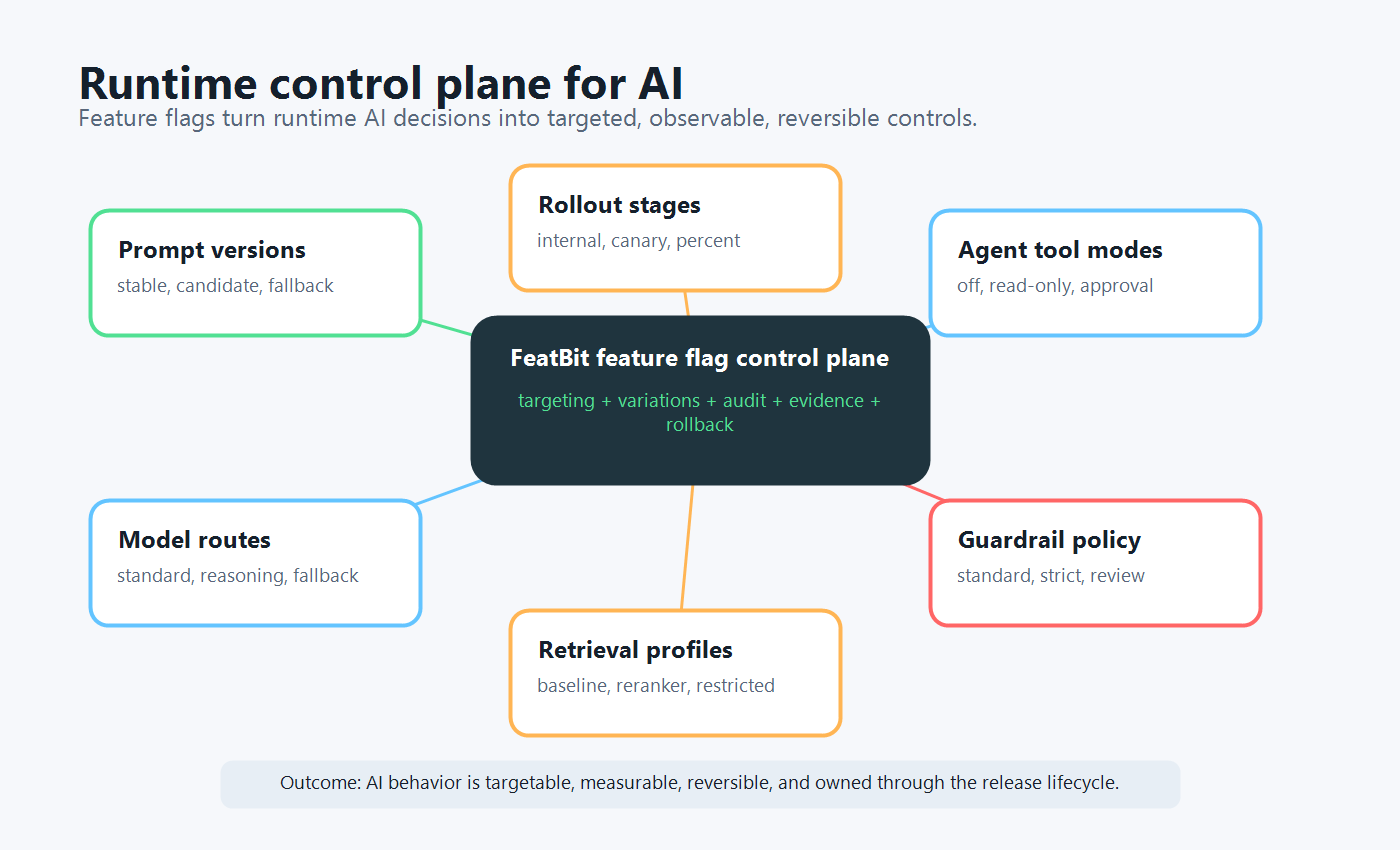
Start by listing the AI behavior surfaces that change after deployment. Most teams find more than they expected.
| Control surface | What the flag can control | Safe fallback |
|---|---|---|
| Prompt version | Which prompt template or instruction set runs. | Last stable prompt. |
| Model route | Which provider, model family, or cost profile handles the request. | Conservative model route or existing provider. |
| Retrieval profile | Which index, reranker, filter, or knowledge source is active. | Baseline retrieval policy. |
| Guardrail policy | Which input, output, or tool guardrail profile applies. | Stricter policy or block-and-review mode. |
| Agent tool mode | Whether tools are off, observe-only, read-only, draft-write, approval-required, or autonomous. | Read-only or approval-required mode. |
| Rollout stage | Internal, canary, segment, percentage, experiment, full rollout. | Reduce percentage or target only internal users. |
| Incident state | Temporary denylist, kill switch, fallback mode, or manual approval. | Disable risky behavior without stopping the whole app. |
| Evaluation and metrics | Which variation key events and outcomes attach to. | Stop expansion when telemetry is missing. |
OpenAI's Agents SDK documentation describes guardrails as checks and validations around input, output, and tool use. That is one important part of the stack. The runtime control plane decides which guardrail profile applies, who sees it, and how the team can change it when production evidence changes.
FeatBit's AI control layer page covers the product positioning for this pattern. This article goes deeper on the architecture checklist a platform team can use before committing to a control-plane design.
A Reference Architecture
A runtime control plane for AI should sit in the request path before the behavior branch runs, but it should not turn every AI call into a remote dashboard lookup.
The application should build an evaluation context from stable, non-sensitive attributes:
- user, account, tenant, region, and environment;
- workflow, AI surface, prompt family, model route, and agent identity;
- risk tier, tool class, approval state, and incident state;
- rollout cohort, experiment assignment unit, and fallback eligibility.
Then the server evaluates flags and returns a typed decision. The application uses that decision to select a prompt, model route, retrieval profile, tool mode, guardrail profile, or fallback.
type AiRuntimeContext = {
  userId: string;
  accountId: string;
  environment: "staging" | "production";
  workflow: "support_answer" | "checkout_assistant";
  aiSurface: "prompt" | "model_route" | "retrieval" | "agent_tool";
  riskTier: "low" | "standard" | "regulated";
  incidentMode: boolean;
};

type AiRuntimeDecision = {
  promptProfile: "stable" | "candidate_v4";
  modelRoute: "standard" | "reasoning" | "fallback";
  toolMode: "off" | "read_only" | "draft_write" | "approval_required";
  guardrailProfile: "standard" | "strict";
};
The exact SDK shape depends on the feature flag provider. The architectural rule is stable: evaluate once near the control point, apply the decision before the AI behavior runs, and emit evidence with the flag key and variation.
The Minimum Useful Control Set
Do not start with a large taxonomy of flags. Start with the controls an operator would need during the first bad rollout.
For many AI applications, the minimum useful set is:
| Control | Recommended flag shape | Why it exists |
|---|---|---|
| AI feature availability | Boolean | Turn a capability on for selected audiences. |
| AI behavior route | String or JSON | Choose prompt, model, retrieval, and fallback profile together when they are released as one route. |
| Guardrail profile | String | Move between standard, strict, or review-required policies. |
| Tool mode | String | Keep agent autonomy staged instead of binary. |
| Incident kill switch | Boolean | Stop one AI surface quickly without redeploying. |
| Evaluation or experiment assignment | String | Attach exposure and outcomes to a stable variation. |
This set gives the team enough control to release, observe, pause, roll back, and learn. More flags can come later, but only when a real operating decision needs to change independently.
For FeatBit implementation primitives, the practical building blocks are targeting rules, percentage rollouts, flag insights, audit logs, and the Track Insights API. Those features let the control plane connect exposure to evidence instead of stopping at configuration.
Runtime Control Plane Vs Adjacent Tools
Teams often already have several AI infrastructure components. The runtime control plane should integrate with them, not pretend to replace them.
| Component | What it is good at | What it usually does not own |
|---|---|---|
| Prompt registry | Versioning, review, and reuse of prompt assets. | Targeted production exposure and rollback. |
| Model gateway | Provider routing, retries, limits, and cost controls. | Product release decisions and audience targeting. |
| Eval platform | Offline or online quality measurement. | Which users receive a candidate behavior right now. |
| Observability stack | Traces, metrics, logs, and alerts. | Changing the behavior that caused the signal. |
| IAM and policy | Hard access boundaries. | Gradual rollout inside approved access. |
| Feature flag control plane | Runtime targeting, rollout, variations, audit, rollback, and decision state. | Deep model evaluation or authorization by itself. |
This comparison is why the runtime control plane should be boring in the best way. It should expose explicit decisions, not hide all AI complexity behind a single "smart routing" box.
A Practical Evaluation Checklist
Use this checklist when evaluating whether a feature flag platform can serve as the runtime control plane for AI:
- Typed variations. Can the platform represent boolean, string, number, and structured decisions for prompts, models, routes, tool modes, and guardrails?
- Server-side evaluation. Can sensitive AI decisions be evaluated outside the browser and before side effects run?
- Rich targeting. Can rules use user, account, environment, region, workflow, risk tier, and incident state?
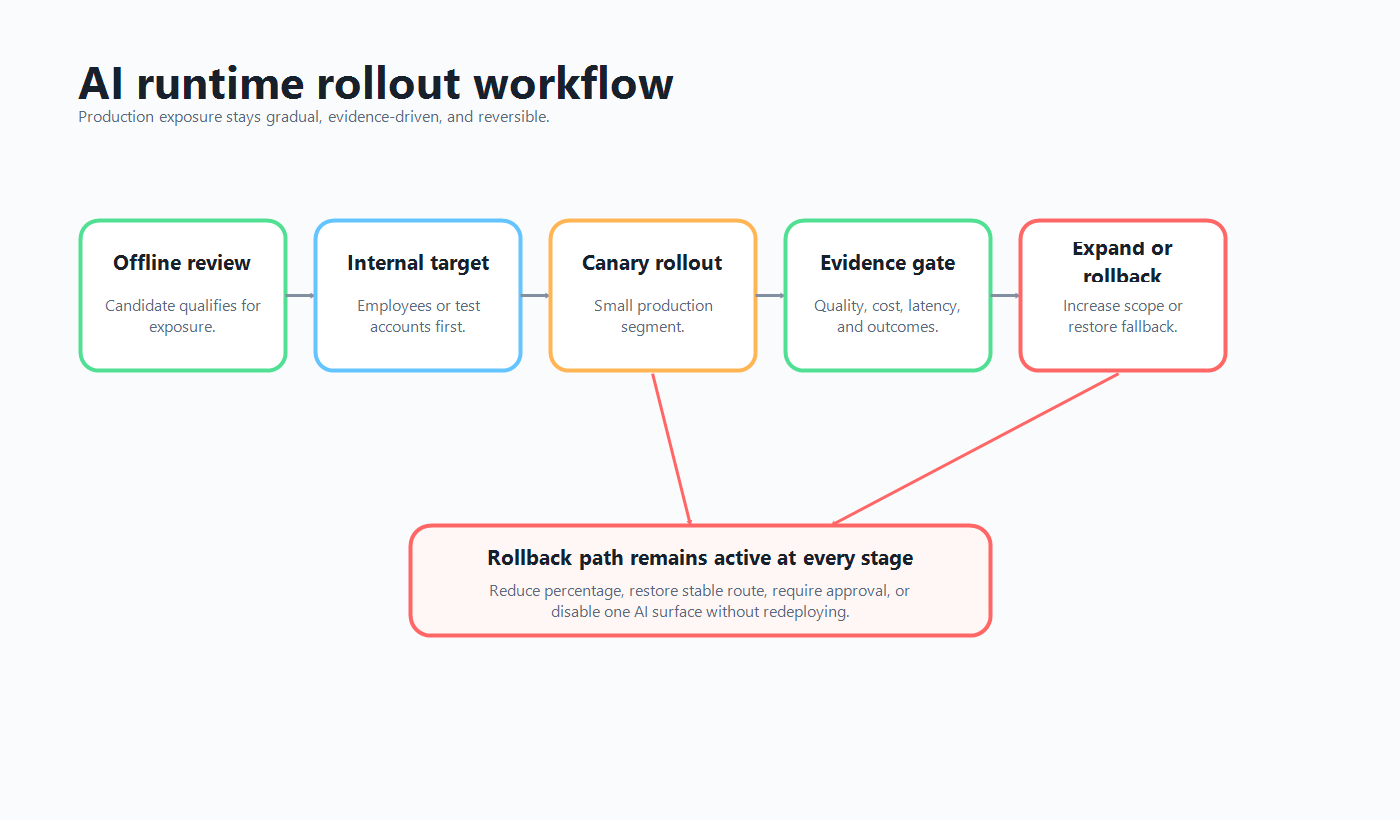
- Progressive rollout. Can teams move from internal users to canary, percentage rollout, experiment, and full release without redeploying?
- Fast rollback. Can operators reduce scope, switch variants, or disable one AI behavior quickly?
- Audit trail. Can the team reconstruct who changed which runtime decision, when, and why?
- Evidence linkage. Can exposure and metric events carry the same flag key, variation, and assignment unit?
- Lifecycle ownership. Can temporary release flags be cleaned up after the decision while permanent operational controls remain documented?
- Automation surface. Can CI, agents, incident tooling, and scripts operate the control plane through API, CLI, MCP, or webhooks?
- Deployment control. Can the team self-host or place the control plane where data ownership, latency, and reliability requirements demand it?
FeatBit is designed around this release-control model: AI release engineering, safe AI deployment, AI governance, AI experimentation, and feature flag lifecycle management are all parts of the same operating loop.
Common Mistakes
Treating the control plane as a config file. If every change still requires a redeploy or a global setting change, the team has configuration, not runtime control.
Using one global AI switch. A global kill switch is useful, but AI systems need narrower controls for prompt versions, model routes, retrieval profiles, tool modes, guardrails, and incident state.
Putting control only in prompts. A model instruction can guide behavior. It should not be the only mechanism that prevents a tool call, selects a fallback, or narrows rollout.
Measuring without assignment. Telemetry is weak when outcomes cannot be joined back to a flag key and variation. The control plane should give evidence a stable identity.
Skipping cleanup. Temporary AI rollout flags should not become permanent branches by accident. After a decision, remove the losing path, promote the winner, or document the flag as a long-lived operational control.
Where FeatBit Fits
FeatBit is a practical fit when the runtime control plane is part of the team's broader release-decision process:
- deploy AI behavior behind flags;
- target internal users, selected accounts, environments, or percentages;
- evaluate prompts, models, retrieval changes, and agent policies with production evidence;
- roll back one behavior without redeploying;
- connect flag changes to audit and observability;
- keep temporary flags from becoming stale technical debt.
For teams that need open-source or self-hosted release infrastructure, FeatBit also gives the platform team more control over deployment, data ownership, and integration paths. That matters when AI runtime decisions touch customer data, internal workflows, or production incident response.
The key point is not that every AI setting must become a feature flag. The key point is that every material AI behavior change needs a named control surface: owner, audience, fallback, evidence, rollback rule, and cleanup path.
Source Notes
- FeatBit context: AI control layer, AI release engineering, safe AI deployment, AI governance, AI experimentation, and feature flag lifecycle management.
- FeatBit implementation references: targeting rules, percentage rollouts, flag insights, audit logs, and Track Insights API.
- External context: the NIST AI Risk Management Framework supports the need for ongoing AI risk management, the OpenFeature flag evaluation specification provides vendor-neutral evaluation concepts, the Model Context Protocol authorization specification supports the separation between authorization and runtime release control, and OpenAI's Agents SDK guardrails documentation illustrates input, output, and tool guardrail concepts.
- Image and Open Graph recommendation: use
cover.pngas the social preview. Usecontrol-plane-layers.pngnear the opening because it summarizes the required AI control surfaces, and userollout-workflow.pngin the architecture section because it shows the operational path from review to rollout, evidence, rollback, and cleanup.
Next Step
Pick one AI behavior that will change in the next release: a prompt, model route, retrieval profile, guardrail, or agent tool mode. Define its runtime control contract before launch:
- flag key and owner;
- default fallback;
- eligible audience;
- rollout stages;
- exposure and outcome events;
- rollback trigger;
- cleanup condition.
If one of those fields is missing, the behavior is not ready for broad production exposure. Keep it internal, observe-only, or behind a narrow canary until the control plane can answer the release decision clearly.