
Feature Rollback or Hotfix? A Guide for AI-Written Code
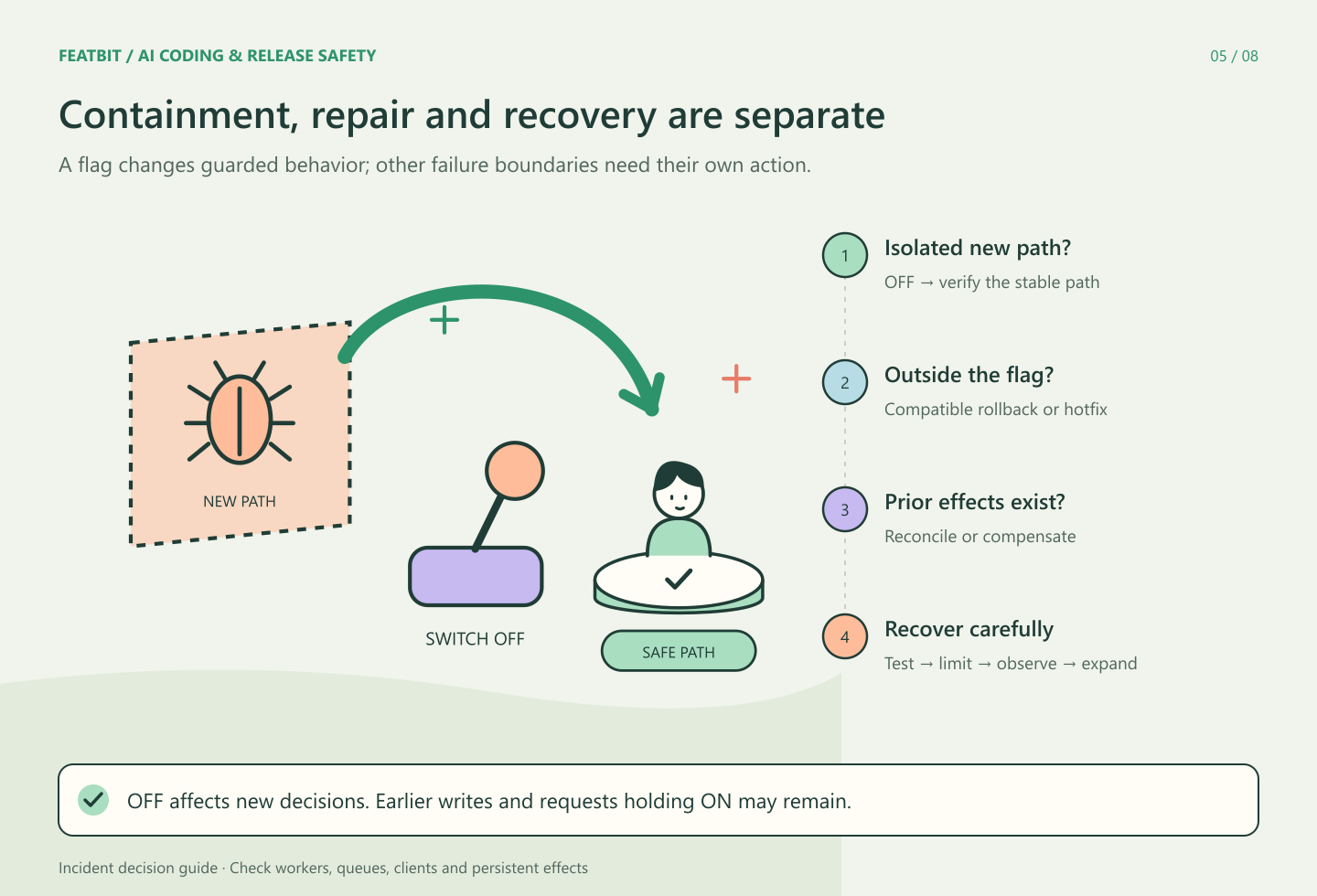
When an AI-written change causes an incident, choose the action that safely limits the next harmful execution. If a tested feature boundary restores a healthy path, contain the feature first. If the failure escapes that boundary, consider a compatible code rollback or another operational control. Deploy a hotfix after verifying that it addresses the failure without introducing a worse one.
These actions can be sequential. Containment buys time for diagnosis, repair, and a controlled recovery; it does not necessarily remove the need for a fix.
In a practitioner incident report, AI reportedly investigated an issue and prepared a repair quickly. The team still chose to disable the feature while testing the fix. This is an anonymous example, not a FeatBit customer case or a measurement of typical recovery time.
Start with the failure boundary
Ask which execution produces the damage, whether it can be stopped, and what remains after it stops. A feature-level flag, an application deployment, a worker queue, and a database each have different control boundaries.
| Situation | First action to consider | What to verify | What may remain |
|---|---|---|---|
| A new feature fails; the old path is healthy | Disable that feature or return its exposed audience to a known healthy state | New requests use the stable path; new effects are blocked | Requests already holding ON and earlier writes |
| Only a particular audience is affected | Reduce or remove that audience's exposure if isolation is trustworthy | Targeting and shared dependencies do not leak the failure | Cross-tenant resources or queued work |
| Startup, shared library, or initialization fails before evaluation | Restore a compatible application version or apply a suitable infrastructure control | The old binary still works with current data and dependencies | Data/schema incompatibilities |
| A worker continues harmful jobs | Pause intake and use worker cancellation or safe admission checks | Already executing work, retries, and side effects | Work that cannot be cancelled safely |
| A destructive migration or external effect has completed | Stop further harm, then use the appropriate repair or compensation process | Authoritative data, reconciliations, permissions and audit history | Damage that a feature switch cannot reverse |
| No safe previous behavior exists | Restrict the affected operation and verify a focused repair | The repair handles the original failure and compatibility constraints | Service degradation during recovery |
Do not disable authorization to make a feature work. Do not route to a fallback that depends on the same failed service. The correct containment action depends on what the application actually does.
A generated fix is a candidate repair
An agent can shorten investigation by connecting symptoms to traces, locating callers, and proposing a focused patch. The patch still needs an acceptance test tied to the observed failure.
Before recovery, reproduce the problem, confirm that the regression fails on the affected behavior, then verify the fix and stable path. Examine data compatibility, permissions, retries, and any affected external integration. A passing test generated from the same mistaken assumption as the implementation is weak evidence.
Keep incident ownership with a named person or team. The agent can gather evidence and prepare changes; it cannot take organizational responsibility for accepting the remaining risk. The human sign-off matrix helps define that responsibility before an incident.
Reproduce a feature-level containment case
The downloadable release lab contains a travel example. Rainy-day rescue adds indoor alternatives to a standard itinerary. Budget and Sharing remain unreleased.
With the new path ON, an injected provider failure throws. The lab then replays an OFF configuration in a fresh offline SDK client. A new request succeeds through the standard itinerary without making a new indoor-provider call. The injected provider failure is still present; containment has changed the execution path.
The recorded verification confirms three important limits:
- The guarded OFF path makes no new save or notification.
- An earlier save remains after OFF.
- A request that captured ON can still finish later.
Those checks use the actual FeatBit Node SDK with synthetic offline configuration. Local saves and notifications are inert arrays. The lab does not measure propagation over a live SDK connection or prove that a real worker, database, or email provider has stopped.
For the corresponding release setup, see deploying once and releasing features independently.
Handle in-flight and queued work explicitly
Consider this request sequence:
Request A evaluates ON and begins work.
Operator changes the release decision to OFF.
Request B obtains the new decision and uses the stable path.
Request A completes its previously admitted write.
Request B's safe behavior does not cancel A. A job that has not started can obtain a fresh decision at its execution boundary, but a job already executing may need cancellation, draining, or compensation. Each request or job should use a consistent decision within its defined unit of work.
The Node SDK documentation describes synchronization and local evaluation. Runtime behavior includes cached configuration and disconnected clients. Define an operational procedure for checking convergence rather than promising that every component stops immediately when a switch changes.
For effects such as payments and notifications, durable idempotency and transactional/outbox designs need separate verification. The lab's local deduplication is an illustration, not an implementation of those production guarantees.
A practical incident runbook
Use the copyable runbook as the starting record:
- Establish ownership and scope. Identify the affected behavior, audience, data, dependencies, and incident owner.
- Stop additional exposure. Choose the smallest trustworthy control that limits further harm. Keep evidence of the configuration and intended stable state.
- Inspect outstanding work. Check active requests, workers, queues, retries, long-lived clients, and previous effects. Apply the application's actual controls.
- Verify containment. Observe the stable behavior, new-path calls, error signals, and writes. A saved configuration alone is not success.
- Repair existing impact. Reconcile or compensate independently where necessary. Preserve the approvals and evidence appropriate to the operation.
- Verify the repair. Run the regression, both behavior paths, data compatibility checks, and relevant integration checks.
- Recover gradually. Reintroduce the change to a reviewed audience, monitor the agreed signals, and expand only with sufficient evidence.
- Record learning and cleanup. Capture the cause, remaining risk, decision, owner, and condition for retiring the temporary flag.
Observation windows and stop thresholds should reflect traffic, severity, and the signal being measured. A tiny sample with no errors is not proof that a rare failure is gone.
Configure automatic responses as an additional system
FeatBit provides the runtime release decision. Health signals can come from the application and observability tools. To automate containment, map a trustworthy signal to an authorized, predefined response, then verify the entire integration in a suitable environment.
Test missing data, stale alerts, repeated triggers, permission failure, and recovery behavior. An ambiguous alert may be better routed to an owner than allowed to change customer exposure automatically. Creating a flag alone does not configure this integration.
Use FeatBit feature release management to define the operating contract, and connect the SDK to the actual behavior. Recovery becomes more dependable when the team has already demonstrated both what its control can stop and what requires a separate repair.