
AI-Generated Code Governance: A Release Control Model for Teams
AI-generated code governance is the operating model that decides how generated changes are reviewed, released, observed, rolled back, and cleaned up. It is not a ban on AI coding tools, and it is not another approval meeting. It is a release-control system that keeps generated code from moving from "looks correct in a pull request" to "visible to every user" without explicit evidence.
That distinction matters because AI changes often arrive faster than the organization can evaluate them. A generated pull request can pass unit tests and still change a production workflow, expose a new integration path, weaken a permission check, or create a cleanup burden that nobody owns. Governance should make those risks visible before broad exposure.
The practical answer is to govern AI-generated code as a release decision, not only as a code review event. Code review asks whether the diff is acceptable. Release governance asks who can see the behavior, what evidence will expand it, what signal will stop it, who owns the decision, and how the temporary control will be retired.
Start With A Governance Boundary
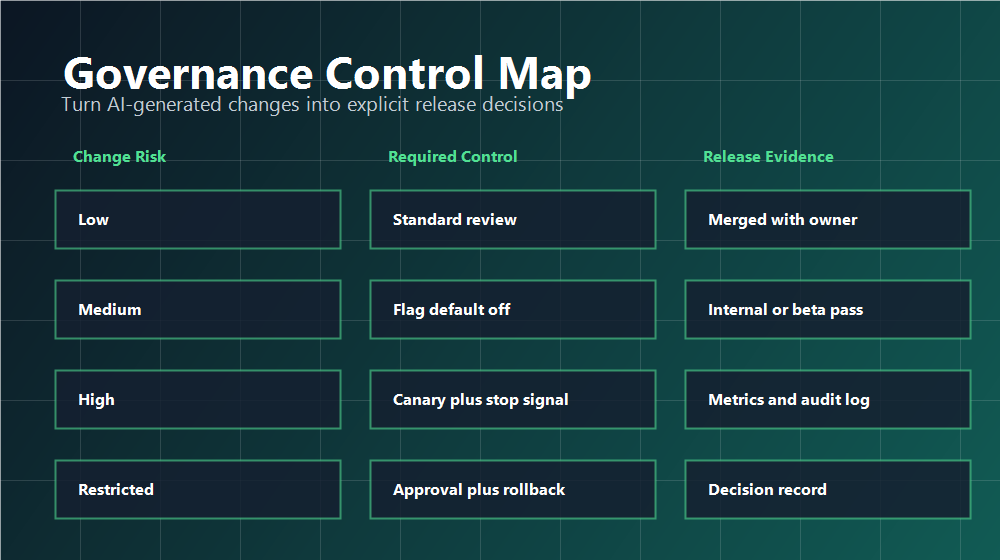
Do not make "AI was involved" the only trigger for governance. That creates noise. Instead, classify generated changes by the risk created after merge.
| AI-generated change type | Governance level | Required release control |
|---|---|---|
| Copy, tests, documentation, dead-code removal | Low | Normal review and ownership record |
| UI path, workflow branch, configuration, recommendation, ranking, or routing logic | Medium | Feature flag default off, internal exposure, rollback owner |
| Payment, security, permission, data movement, critical integration, or customer-impacting automation | High | Human approval, staged rollout, stop signal, audit evidence |
| Regulated, safety-critical, legal, financial, or irreversible side effect | Restricted | Separate policy review, explicit approval, controlled exposure, incident rollback plan |
This boundary keeps governance proportional. Low-risk generated changes should not be trapped in a heavy process. High-risk changes should not become broad releases just because the pull request is small.
NIST's AI Risk Management Framework separates risk work into governance, mapping, measuring, and managing. That pattern is useful here: name the risk, measure the behavior, then manage exposure. NIST SP 800-218, the Secure Software Development Framework, also emphasizes secure development practices such as reviewing, analyzing, and testing code. AI-generated code does not remove those duties; it increases the need to connect them to release control.
The Governance Model: Six Controls
A workable AI-generated code governance model needs six controls that survive beyond the pull request.
1. Intent Record
Every generated change should explain the task, the prompt or instruction source when relevant, the files touched, the assumptions made by the agent, and the intended production behavior. This does not have to expose private prompts or secrets. It should give reviewers and future maintainers enough context to understand why the generated branch exists.
For medium and high-risk work, the intent record should include the release owner and expected end state. If the change is temporary, name the cleanup condition. If the generated code creates a durable operational switch, name the operator who owns it.
2. Risk Tier
Risk tiering prevents two opposite failures: blocking harmless changes and under-controlling dangerous ones. The tier should be based on production impact, not on the number of generated lines.
Useful questions:
- Can this change affect user data, money, permissions, availability, compliance, or customer trust?
- Can the behavior be disabled without a redeploy?
- Can the blast radius be limited to internal users, beta accounts, a region, or a percentage rollout?
- Does the team have a signal that would prove the rollout should pause?
- Is there a clear owner who can make the release decision?
If the team cannot answer those questions, the change is not ready for broad exposure.
3. Review Gate
AI-generated code should still pass ordinary engineering review: architecture fit, readability, tests, security checks, dependencies, and maintainability. AI reviewers can help find local issues, but they should not become the final authority for intent, risk, or release scope.
GitHub documents Copilot code review as a way to request AI feedback in pull requests. That is useful as a first-pass assistant. It does not replace the need for human judgment on whether the generated behavior should be released, who should see it first, and what rollback path exists.
4. Runtime Release Gate
The governance control that matters most after merge is a runtime gate. For generated code that changes production behavior, the code should normally ship behind a feature flag with a safe default and a known fallback.
The flag should have:
- a clear key and owner;
- a default state that does not expose the generated behavior broadly;
- targeting rules for internal users, beta customers, regions, plans, or risk cohorts;
- a percentage rollout path;
- stop signals tied to telemetry or customer feedback;
- an explicit cleanup or permanence decision.
This is where FeatBit fits naturally. FeatBit's targeting rules, percentage rollouts, audit logs, webhooks, OpenTelemetry integration, and role-based access controls give teams the release-side controls that code review cannot provide by itself.
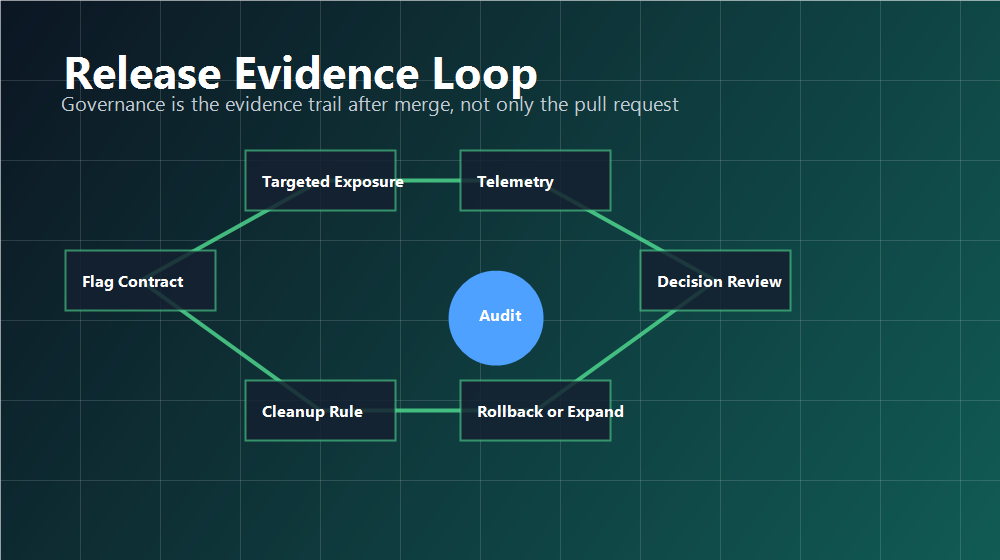
5. Evidence Trail
Governance needs evidence that a release owner can inspect later. For AI-generated code, the useful evidence is not "the AI said it was fine." It is observable production behavior under controlled exposure.
Evidence can include:
- flag state and rollout history;
- which users, accounts, or cohorts saw the generated behavior;
- error rate, latency, conversion, support ticket, or domain-specific metrics;
- audit logs showing who changed the flag and when;
- rollback or expansion decisions;
- cleanup issue or decision note.
OWASP's Top 10 for Large Language Model Applications is aimed at LLM applications, not every AI-generated code change. Still, its emphasis on application-layer risks is a useful reminder: generated code can interact with unsafe output handling, excessive agency, supply-chain issues, and other risks once it reaches production. Governance should keep enough evidence to see where the behavior actually ran.
6. Cleanup Rule
AI-generated code governance fails if every generated change leaves another permanent switch, branch, or exception. The flag contract should say whether the control is temporary or durable.
Temporary release flags should have a removal condition. Durable operational flags should have an owner, review cadence, and reason to remain. The governance problem is not only unsafe release; it is also release memory decay. Six months later, a future agent or engineer should be able to understand why the control exists.
A Policy-To-Control Map
Use this map when turning governance policy into engineering practice.
| Policy question | Engineering control | FeatBit support |
|---|---|---|
| Who owns the generated behavior? | Flag owner, PR owner, release owner | Flag naming and ownership conventions, workflow notes |
| Who can expose it to users? | Role-based access and environment permissions | IAM, RBAC, policies, environment-level controls |
| Who sees it first? | Internal targeting, beta segment, percentage rollout | Targeting rules, user segments, percentage rollouts |
| How do we stop it? | Kill switch or rollback variation | Flag toggle, fallback variation, API or webhook automation |
| How do we know it worked? | Metrics and rollout evidence | Insights, webhooks, OpenTelemetry, external observability tools |
| How do we remember the decision? | Audit trail and cleanup issue | Audit logs, integrations, lifecycle workflow |
This is the difference between governance as a document and governance as an operating system. A policy says "AI-generated code must be reviewed." A control system says "this generated workflow is off by default, visible only to internal accounts, expandable by the release owner, observable through named metrics, reversible through a flag, and scheduled for cleanup after two healthy release windows."
Example Workflow For A Generated Change
Imagine an AI coding agent generates a new checkout recommendation service. The code is well structured, tests pass, and the pull request looks reasonable. The governance question is still open: should every customer see it immediately?
A governed release would look like this:
- The pull request includes an intent record: why the recommendation service exists, what behavior changes, what fallback remains, and which metrics matter.
- The reviewer assigns a medium or high risk tier because the change touches checkout behavior.
- The generated path is wrapped behind a feature flag with the existing recommendation path as fallback.
- The flag is disabled by default in production.
- The release owner enables it for internal users, then a beta account segment, then a small percentage of eligible traffic.
- Webhooks or observability integrations connect the rollout to checkout error rate, latency, revenue-impacting events, and support signals.
- The team expands, pauses, or rolls back based on evidence.
- After full release, the cleanup condition removes the old branch or marks the flag as a durable operational control.
The generated code may be excellent. Governance still treats production exposure as a separate decision because that is where customer risk appears.
Where FeatBit Should Sit In The Process
FeatBit should sit between merged code and user exposure.
Use source control and CI for authorship, tests, static analysis, dependency checks, and review. Use FeatBit for the runtime side of governance: controlled exposure, segment targeting, progressive rollout, audit history, automated triggers, and rollback.
That split keeps responsibilities clean:
- The repository proves what changed.
- CI proves the change met the team's automated gates.
- Human review proves the change makes sense.
- FeatBit controls who experiences the behavior.
- Observability proves whether the behavior is healthy.
- The audit trail proves who made the release decision.
For AI-generated code, this split is more important because generation speed can outrun review and release capacity. A coding agent can make the diff. The release system has to decide how the diff becomes behavior.
Common Mistakes
Treating AI governance as a tool policy only. Tool access matters, but the release risk appears when generated behavior reaches users. Govern both the authoring tool and the production exposure path.
Using one heavy process for every generated change. Low-risk changes need traceability, not bureaucracy. High-risk changes need real control, not a checkbox.
Letting AI review approve AI-generated behavior. AI review is useful for coverage and early feedback. Human reviewers still own architecture, intent, risk acceptance, and final release accountability.
Skipping the fallback. A flag without a safe fallback is not a rollback plan. The fallback must be known before exposure starts.
Keeping every control forever. Temporary release flags should be removed after the decision. Durable controls should be documented as durable.
Source Notes And Internal Link Plan
This article is a standalone governance model for the query "AI-generated code governance." It intentionally differs from FeatBit's feature flags for AI-generated code playbook, which focuses on flag design for a generated change, and from the broader AI coding productivity paradox, which focuses on productivity evidence and release safety.
- FeatBit implementation sources: targeting rules, percentage rollouts, audit logs, targeted progressive delivery, API access tokens, webhooks, OpenTelemetry integration, and IAM overview.
- External sources: NIST AI Risk Management Framework, NIST Secure Software Development Framework SP 800-218, CISA Secure by Design, OWASP Top 10 for Large Language Model Applications, GitHub Docs on Copilot code review, and Unleash documentation on feature flags.
- FeatBit reader journey links: AI release engineering, AI governance and risk control, feature flags as the AI control layer, feature flags for AI-generated code, and AI code review tools vs human reviewers.
- Image and Open Graph recommendation: use
cover.pngas the Open Graph image. Use the governance control map near the risk-tier section and the evidence loop near the audit section because both summarize guidance already available in crawlable text.
Next Step
Pick one AI-generated pull request that changes production behavior. Before it reaches broad exposure, write a one-page release control record: risk tier, owner, flag key, default state, first audience, expansion signal, stop signal, rollback action, audit source, and cleanup condition. If the team cannot fill those fields, the code may be merged, but the behavior is not ready for full release.