
Feature Flags for AI-Generated Code: A Release Safety Playbook
Feature flags for AI-generated code are release controls for changes that may be correct in the diff but still risky in production. The flag does not prove the generated code is safe. It gives the team a controlled way to deploy the code off, expose it to a narrow audience, observe real behavior, and roll back without waiting for another deploy.
That distinction matters in AI-assisted development. A coding agent can produce a working pull request quickly, but the release system still has to answer slower questions: who should see the change first, which fallback remains available, what signal would stop the rollout, and when the temporary flag should be removed.
When AI-Generated Code Needs A Feature Flag
Do not put every AI-assisted edit behind a flag. Use a flag when the generated change changes production behavior and the team may need to vary, pause, narrow, or reverse that behavior after deployment.
Good candidates include:
- a new user workflow generated by an agent;
- a refactor that changes execution order, caching, permissions, pricing, billing, or data access;
- a generated integration with a third-party API, model, queue, webhook, or payment system;
- a migration where old and new paths must run side by side;
- a performance optimization whose worst case is not obvious from tests;
- a UI or onboarding change that should start with internal users or a small customer segment;
- an AI-created feature flag, prompt route, model route, or remote configuration value.
Small copy edits, isolated test fixes, dead-code removal, and purely internal tooling changes usually do not need a release flag. The useful question is not "was AI involved?" The useful question is "would we want an independent production control if this behaves badly?"
Martin Fowler's classic Feature Toggles article explains why toggles can separate deployment from release while also creating carrying cost. AI-generated code makes both sides more important: release control is valuable, and unmanaged toggle inventory becomes debt faster.
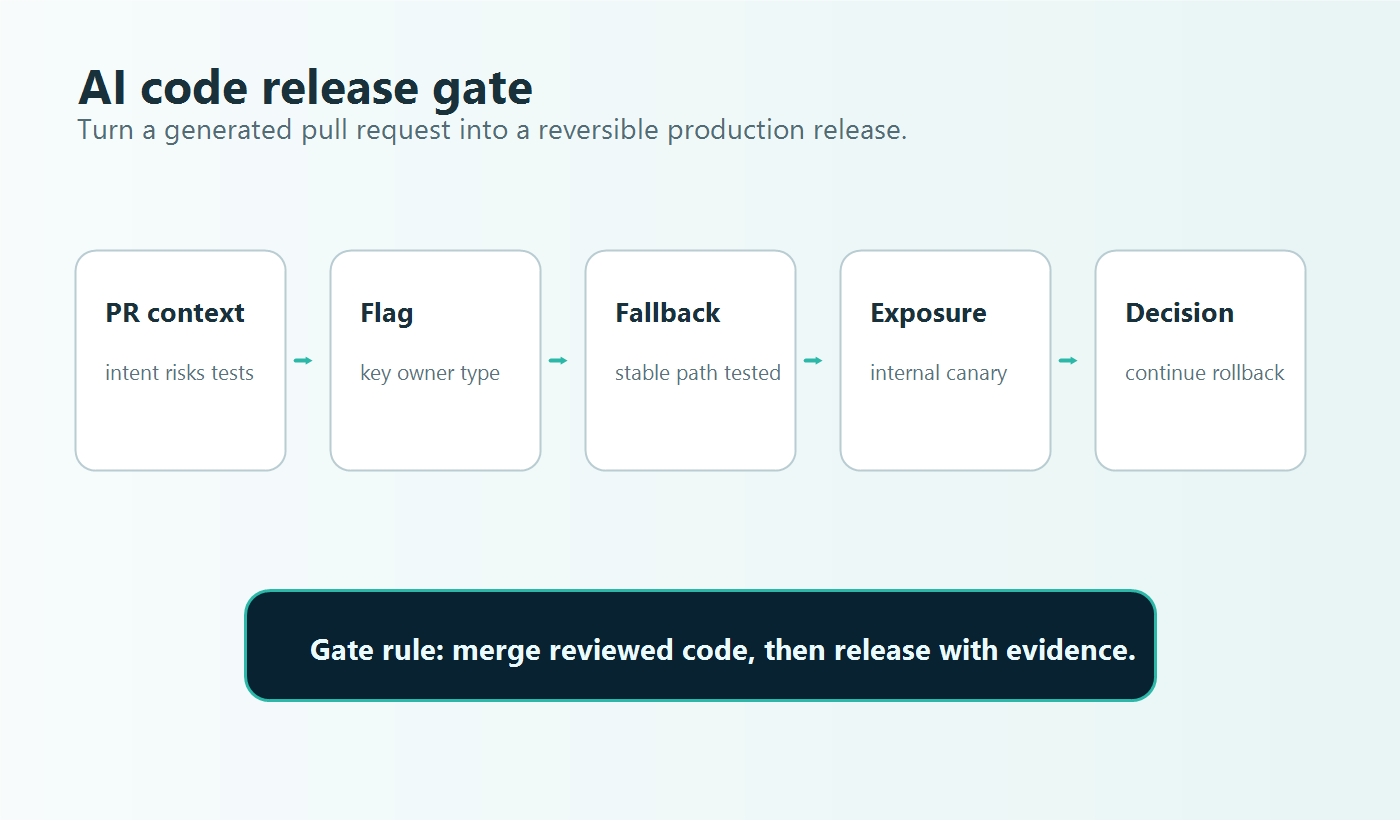
The Release Gate To Add To AI-Assisted Pull Requests
Treat a flagged AI-generated change as a release gate, not only as an if statement. The pull request should answer five questions before merge.
| Gate | Reviewer question | Strong answer |
|---|---|---|
| Intent | What user or system behavior changed? | The PR names the behavior, not just the files changed. |
| Flag contract | What flag controls exposure? | The key, type, owner, fallback, variation meanings, and cleanup rule are explicit. |
| Safe fallback | What happens when the flag is off? | The fallback is the current stable behavior and has a test or manual check. |
| Rollout path | Who sees it first? | Internal users, test accounts, beta cohort, or a small percentage is defined. |
| Stop signal | What would pause or roll back? | Errors, latency, support signal, conversion, cost, or quality metric is named. |
This gate keeps code review and release review separate. Code review decides whether the implementation is acceptable. Release review decides whether the behavior is controllable once the implementation reaches production.
FeatBit's AI release engineering viewpoint is that feature flags act as release-decision infrastructure. For AI-generated code, the decision is often narrower than an entire product launch: one generated branch, one integration path, one model route, one permission check, or one generated UI flow.
Design The Flag Before The Agent Writes The Branch
AI coding agents work better when the release control is part of the task, not added after the diff feels risky.
Give the agent a flag contract like this before it edits code:
Implement <change> behind a feature flag.

Flag contract:
- Key: generated-checkout-flow
- Type: release flag
- Owner: checkout platform team
- Default: off
- Safe fallback: existing checkout flow
- Initial exposure: internal employees only
- Rollout stages: internal, beta accounts, 5 percent, 25 percent, 100 percent
- Stop signals: payment errors, checkout latency, support tickets, conversion drop
- Cleanup condition: remove old branch after full rollout and two healthy release windows

Code rules:
- Keep the stable path readable.
- Evaluate the flag once near the boundary.
- Pass the evaluated decision to lower-level components.
- Add tests for the off and on paths.
- Add telemetry that records the evaluated variation.
This is a better prompt than "add a feature flag" because it gives the agent the operating model. It also gives reviewers a contract to check against the diff.
Evaluate Once Near The Risk Boundary
For AI-generated code, flag placement is usually more important than flag count. A flag should sit at the boundary where production behavior changes.
For a frontend change, that may be the route, page component, or server component that chooses which experience to render. For a backend change, it may be the service method that chooses a new algorithm, queue, integration, or response path. For an AI-assisted agent or LLM feature, it may be the orchestrator that chooses the prompt profile, model route, retrieval source, or tool mode.
OpenFeature describes evaluation context as contextual data used for flag evaluation. That idea is especially useful for AI-generated changes because the rollout often depends on user, account, environment, region, plan, workflow, or incident state.
type ReleaseContext = {
  userId: string;
  accountId: string;
  environment: "staging" | "production";
  plan?: "free" | "team" | "enterprise";
  region?: string;
  workflow: "checkout" | "onboarding" | "admin";
};

type GeneratedCodeRelease = {
  enabled: boolean;
  variation: "stable" | "generated_v1";
  rolloutStage: "off" | "internal" | "beta" | "canary" | "full";
};

async function getGeneratedCheckoutRelease(
  ctx: ReleaseContext
): Promise<GeneratedCodeRelease> {
  const variation = await flags.string(
    "generated-checkout-flow",
    ctx,
    "stable"
  );

  return {
    enabled: variation === "generated_v1",
    variation,
    rolloutStage: await flags.string(
      "generated-checkout-stage",
      ctx,
      "off"
    ),
  };
}
The application should then pass GeneratedCodeRelease into the code path that needs it. Avoid letting a generated component or helper call the flag SDK from many places. Multiple hidden evaluations make rollout behavior hard to test, hard to observe, and hard to remove later.
Roll Out Generated Changes In Stages
The safest rollout for AI-generated code is boring and explicit.
| Stage | What happens | Evidence to collect | Rollback action |
|---|---|---|---|
| Off after deploy | Code is in production but not exposed | Build, tests, smoke checks | Keep off |
| Internal | Employees or test accounts see it | Errors, logs, usability feedback, missing states | Disable for internal segment |
| Beta or canary | A named cohort or small percentage sees it | Error rate, latency, support tickets, business metric | Return cohort to stable |
| Progressive rollout | Exposure expands as signals stay healthy | Guardrail trend and owner approval | Reduce percentage or pause |
| Full release | The generated path becomes normal behavior | Decision note, cleanup issue, final verification | Keep fallback until cleanup deploys |
FeatBit documentation for targeting rules and percentage rollouts covers the mechanics behind this staged exposure model. The operating principle is simple: deploy code when it is reviewed, but release behavior when the evidence is healthy.
For broader context on why this separation matters in AI-assisted development, see FeatBit's article on the AI coding productivity paradox. This playbook is narrower: it is the release-gate pattern to use when a generated change is about to enter production.
Connect The Flag To Evidence
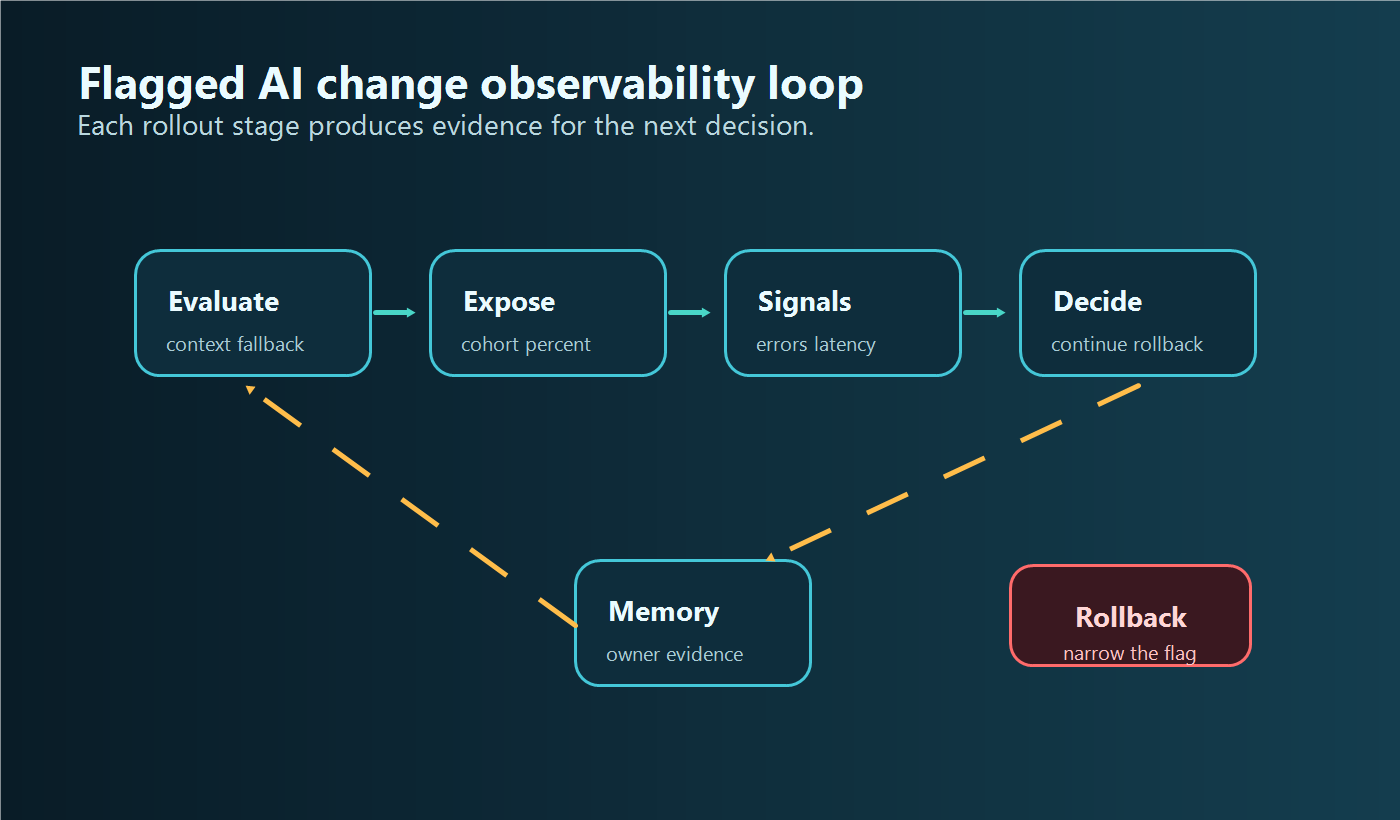
A feature flag without evidence is only a switch. For AI-generated code, the flag should help the team decide what to do next.
Attach the evaluated flag and variation to the signals the team already uses:
- application logs for request path, account, region, and variation;
- traces for latency, dependency calls, and error boundaries;
- product analytics for usage, conversion, activation, or task completion;
- support or incident records for user-visible problems;
- release notes or pull request memory for owner, intent, and cleanup condition.
FeatBit's flag insights, audit logs, webhooks, and OpenTelemetry integration are useful building blocks for this evidence loop. The exact monitoring stack can vary. The non-negotiable part is that a release owner can compare stable and generated behavior before expanding exposure.
Use Different Flag Types For Different AI Code Risks
One mistake is treating every AI-generated change as a temporary release flag. Some flags should disappear after rollout. Others are durable operational controls.
| Flag type | Use it for AI-generated code when | Expected lifecycle |
|---|---|---|
| Release flag | A generated feature or refactor needs staged exposure | Remove after full rollout and cleanup deploy |
| Experiment flag | The team is comparing generated behavior against a control | Keep winner, remove experiment branches |
| Migration flag | Generated code changes storage, API, queue, or data path | Remove after migration and rollback window |
| Operational flag | The team needs a lasting kill switch or degradation mode | Keep as documented production control |
| Permission flag | Generated code changes access by plan, role, account, or region | Keep while the product policy exists |
| AI behavior flag | Generated code changes prompt, model, retrieval, or agent behavior | Keep only if it remains a standing control |
This is where cleanup discipline matters. Unleash documents feature flag types and lifecycle states in its feature toggles documentation. DevCycle documents cleaning up unused flags. PostHog has written about stale flag owners and criteria in "Don't make these feature flag mistakes". The shared lesson is not vendor-specific: a flag should have a type, owner, evidence rule, and end state.
FeatBit's feature flag lifecycle management guidance applies that lesson to agent-assisted development. If an AI agent can create the flag, the workflow should also make the cleanup condition visible to future humans and future agents.
Pull Request Checklist
Use this checklist before merging an AI-generated change that includes or needs a feature flag.
| Check | Pass condition |
|---|---|
| The flag exists for a release reason | It controls production exposure, rollback, experiment, migration, permission, or operation. |
| The fallback is stable | Turning the flag off keeps the current safe behavior. |
| Evaluation is centralized | The flag is evaluated once near the behavior boundary, then passed down. |
| Context is sufficient | Targeting can use environment, account, user, plan, region, workflow, or risk attributes. |
| Tests cover both paths | At least the fallback and generated path are verified. |
| Rollout is staged | Internal, beta, canary, or percentage stages are defined. |
| Evidence is named | The owner knows which metric, log, alert, or qualitative signal will decide expansion. |
| Rollback is independent | The team can disable or narrow exposure without redeploying. |
| Cleanup is planned | Temporary flags have a review date, final state, and removal path. |
If the change fails one or two rows, revise the pull request. If the team cannot name a safe fallback or rollback action, do not release the generated behavior yet.
How FeatBit Fits
FeatBit is useful here because AI-generated code needs the same release controls as other risky production changes, with more pressure on speed, context, and cleanup.
In a FeatBit workflow, a team can:
- Create the flag with a clear type, owner, default, and variation meaning.
- Evaluate the flag in the application using an SDK or API.
- Target internal users, beta accounts, regions, plans, or percentage cohorts.
- Use insights, audit logs, webhooks, and observability integrations to make the release decision visible.
- Archive temporary flags only after deployed code no longer evaluates them.
For implementation next steps, start with FeatBit docs on testing in production, targeted progressive delivery, and flag lifecycle management. For AI-specific control surfaces beyond generated application code, read feature flags for AI agents and runtime control for AI agents.
Source Notes And Internal Link Plan
This article is a standalone release-safety playbook for the query "feature flags for AI-generated code." It intentionally differs from the broader AI coding productivity paradox, the agent architecture article on feature flags for AI agents, and the lifecycle article on AI-assisted feature flag cleanup.
- FeatBit implementation sources: testing in production, targeted progressive delivery, targeting rules, percentage rollouts, flag insights, audit logs, webhooks, OpenTelemetry integration, and flag lifecycle management.
- External category sources: Martin Fowler on Feature Toggles, OpenFeature on evaluation context, Unleash on feature toggles, DevCycle on feature flag technical debt, and PostHog on common feature flag mistakes.
- FeatBit reader journey links: AI release engineering, feature flag lifecycle management, AI coding productivity paradox, feature flags for AI agents, and runtime control for AI agents.
- Image and Open Graph recommendation: use
cover.pngas the social preview. Use the release-gate diagram near the pull request workflow and the observability-loop diagram near the evidence section because both summarize guidance already available in crawlable text.
Next Step
Pick one AI-generated pull request that changes production behavior. Before merging it, write the flag contract: key, owner, default, fallback, rollout stages, stop signals, and cleanup condition. If any field is missing, the change is not ready for broad exposure yet.