
Feature Flags for Campaign-Driven Product Launches
Marketing has announced a capability. Visitors arrive expecting to use it. Engineering is still deciding how much of the new implementation production can safely handle.
For a campaign-driven product launch, use feature flags to separate who is entitled to the promised experience from which implementation delivers it. Define the audience, validate a working route before promotion, and measure whether users complete the advertised task. Keep a tested fallback available while campaign traffic continues to arrive.
This extends feature flags beyond deployment coordination. They become a way for product, growth, engineering, and support to act on the same release decision.
A launch is a promise to a particular audience
In its guide to timing influencer campaigns around a product launch, Bioby.ai explains why creator schedules and product availability need to stay aligned: published content can keep bringing visitors after the initial launch window. Those visitors still expect the experience they were shown.
From an engineering perspective, that creates a useful release question: can this particular user complete the task the campaign promised, right now?
A healthy deployment does not answer that question. The application may return successful responses while hiding the advertised feature, rejecting an eligible account, or sending users into an onboarding flow that never reaches the demonstration's outcome.
Before the campaign starts, write down its promise in product terms. For an AI creation app, that might be: an eligible new user can upload a product photo, generate a short video, and download the result. The promise includes the steps that make the result useful, along with any advertised limits, price, and availability.
That statement gives engineering something more precise to protect than a launch date or an overall rollout percentage.
Separate feature access from implementation rollout
Consider a campaign promoting that photo-to-video workflow. If access is enabled for a random fraction of all users, some eligible campaign visitors may arrive and find no way to do what the creator demonstrated.
The release policy needs two distinct controls:
- Feature access: which eligible people or accounts should receive the advertised capability?
- Implementation rollout: which approved route should deliver that capability, and where can a candidate implementation be tested?
Onboarding can have its own experiment, provided both versions still lead to the promised capability. Access, implementation, and onboarding do not have to share one flag.
| Audience | Access policy | Implementation policy |
|---|---|---|
| Internal testers and approved creator accounts | Preview access before public promotion | Candidate route can be validated against the launch requirements |
| Eligible campaign users in an approved launch market | Advertised capability available | Proven route; candidate exposure only where it meets the same advertised requirements |
| Other eligible users | Separate staged release policy | Controlled exposure according to the release plan |
| Accounts outside product eligibility | Follow the product's existing eligibility rules | Campaign attribution cannot override authorization or plan restrictions |
FeatBit's targeting rules support conditions based on built-in and custom attributes, as well as user segments. Your application supplies the context that makes those conditions meaningful, such as account region, plan, or a persisted campaign cohort.
A creator link can identify acquisition source. It should not grant a restricted entitlement or determine account region by itself. Validate eligibility in the application, and preserve the relevant acquisition context when an anonymous visitor becomes a signed-in user.
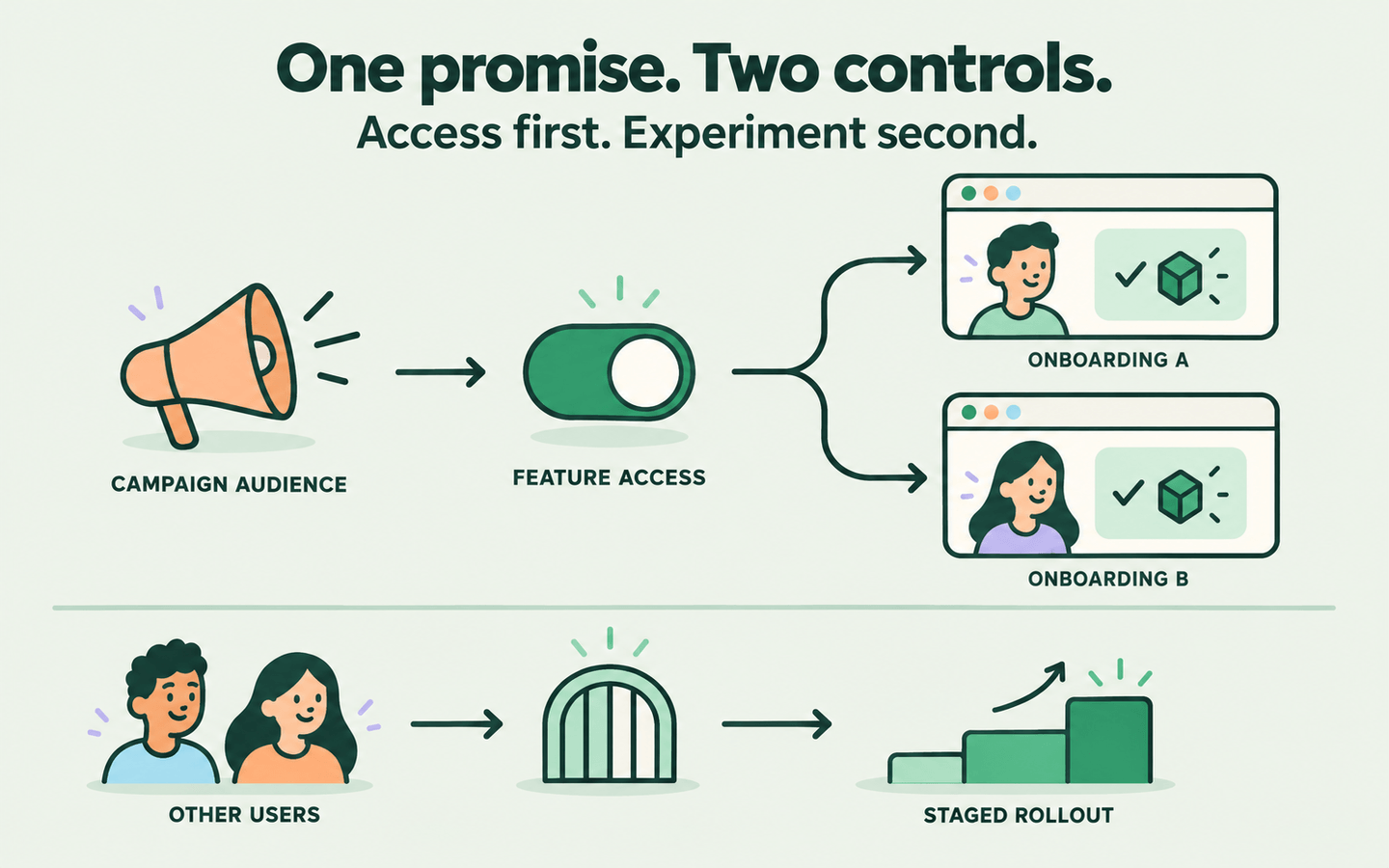
The access decision protects the campaign promise. A separate experiment changes how eligible users reach it.
Walk through an AI product launch
Consider a fictional AI creation app with a proven photo-to-video generation route. The team is preparing a new model route and a simpler onboarding flow while launching creator campaigns in two markets. The campaign advertises the workflow and downloadable result; it does not promise a speed or output quality that only the candidate model can provide.
Before promotion: prove the complete journey
Give internal testers and approved creators access to the production workflow. Check the same eligibility rules, upload path, generation quota, download behavior, and mobile experience that viewers will encounter.
Use independent controls with clear responsibilities:
| Example flag | Decision it controls | Stable behavior to preserve |
|---|---|---|
photo-video-access |
Whether a product-eligible account receives the workflow | Approved campaign users can reach the advertised capability |
photo-video-model-route |
Whether an admitted generation uses the proven or candidate implementation | Both routes satisfy the advertised output requirements |
photo-video-onboarding |
Which introduction an eligible user receives | Each version reaches the same working generation flow |
These application-defined flags require code for the routes, eligibility checks, and fallback behavior. The broader guide to feature flags for AI-powered products covers where those controls belong around models, prompts, and other AI behavior.
Test the fallback under load as well. A second route that shares the same exhausted dependency may offer no useful recovery.
At launch: open the promised audience deliberately
Before Market A's promotion begins, verify the full journey using an account that matches the audience's real attributes. A creator's preview account alone cannot establish viewer readiness.
Enable access for the approved campaign cohort. Keep the proven generation route available. If the candidate still needs production validation, limit its exposure independently. A change to the candidate rollout should not accidentally remove access to the whole workflow.
FeatBit's percentage rollouts can apply within a targeting rule, using the user key or a selected attribute for assignment. Choose a stable unit and preserve it across visits. For a collaborative product, that unit may be an account rather than an individual user.
Start with one comparison whose result the team can interpret. For example, hold the generation route constant while testing onboarding. If the team changes the model and onboarding together without a design that distinguishes their effects, it will be harder to know what improved or harmed the journey.
Between markets: make a release decision
Market B opens when the agreed evidence supports it: the promised audience can use the workflow, outcomes are observable, and reliability, output quality, and cost remain acceptable. A date on the campaign calendar is an input to this decision; the evidence determines readiness.
Choose an observation window that covers the product's relevant demand pattern and outcome delay. A particular waiting period or rollout percentage is not a universal safety threshold. The progressive rollout patterns guide explains how to choose exposure stages for different release goals.
Measure the user journey within each campaign cohort
Campaign reporting and product experimentation answer related questions. Campaign reporting asks which promotion brought valuable users. A product experiment asks whether changing the experience helped comparable users.
If Creator A sends users to onboarding A and Creator B sends users to onboarding B, a conversion difference may reflect their audiences, messages, or posting times. It does not isolate the onboarding change.
Where practical, randomize eligible users within the same campaign and market, and keep their assignments stable. Record the acquisition context alongside the assignment, the implementation that actually served the request, and the outcome. Define the analysis population and conversion window before the comparison begins.
For the AI creation example, the measurement plan might look like this:
| Question | Evidence to collect | Decision it supports |
|---|---|---|
| Can the promised audience use the workflow? | Eligibility checks, access decisions, missing-feature reports | Pause promotion or correct audience configuration if access is broken |
| Does onboarding help users reach value? | Share of assigned eligible users who download a usable first video within the defined window | Continue, revise, or adopt the onboarding change |
| Is the serving route healthy? | Generation failures, end-to-end latency, output-quality checks | Continue candidate exposure, reduce it, or return to the proven route |
| Is the experience sustainable? | Generation cost per completed task, quota failures, support demand | Adjust capacity, scope, or launch timing before expanding |
Keep assignment and actual exposure as separate records. A user can be assigned to a route without successfully reaching it. Record exposure when the behavior actually runs, but do not silently discard assigned users whose requests failed; those failures can be part of the treatment's effect. Use the prespecified analysis population rather than rebuilding the denominator to include only successful users.
Missing telemetry means the team lacks evidence. It does not establish that the release is healthy. For event and metric planning, use the measurement design guide.
Make fallback preserve the promise where possible
Suppose the candidate video route starts timing out during a creator campaign. Engineering can direct future generation requests back to the proven route while keeping the advertised workflow available. Growth can pause paid amplification through its campaign tools, and support can explain any affected requests.
Those are coordinated actions across different systems. A feature flag does not automatically pause an ad campaign, add generation capacity, or reverse work already performed.
Write down the incident sequence before launch:
- Stop expanding the affected route or market.
- Switch future work to a tested route that can still deliver the promised outcome.
- Inspect in-flight jobs, retries, quota consumption, and duplicate effects separately.
- Pause paid amplification where appropriate and provide accurate status information to arriving users.
- Resume only after the recovery path and the evidence support it.
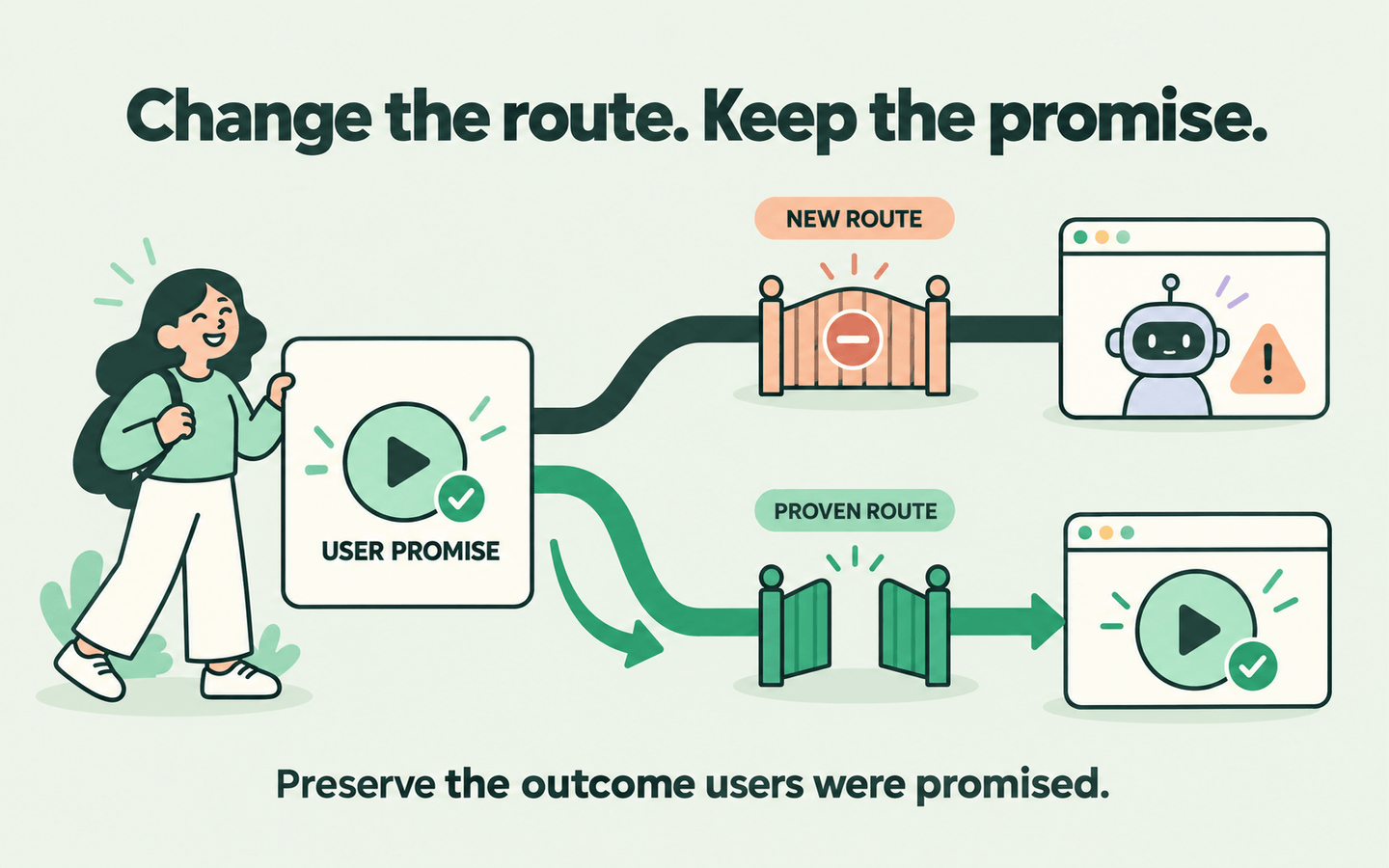
Switching an implementation can preserve the outcome. Turning off the entire advertised capability may require a different customer response.
If neither route can meet the promise, use an honest unavailable state or a queue with terms the product can support, and follow the applicable support or refund process. Do not silently substitute an inferior result while continuing to advertise the original experience.
FeatBit's flag triggers let an external tool turn flag targeting on or off through a webhook. An alert can therefore initiate a rehearsed route change, provided the flag's off variation selects the intended fallback. Test SDK update behavior and the application's response before relying on this during a launch.
Apply the same decisions across industries
The control pattern transfers, but the meaningful audience, outcome, and recovery action change. These design scenarios show how the same release questions apply to different businesses.
| Business scenario | What feature flags can control | What the team should protect |
|---|---|---|
| AI app promoted by creators | Workflow access, model route, onboarding | A usable output, acceptable waiting time, sustainable cost |
| E-commerce promotion | Checkout implementation, recommendation behavior, offer presentation | Correct orders, payment completion, promised offer eligibility |
| Game promoted by streamers | New-player flow, event entry, matching implementation | A playable advertised experience, stable sessions, clear access terms |
| B2B SaaS launch or partner campaign | Account rollout, workspace onboarding, workflow implementation | Consistent access across a customer account and completion of the advertised task |
E-commerce: preserve the offer when checkout changes
A promotion brings shoppers into a new checkout experience. If that implementation fails, route new checkouts to the proven implementation while honoring validated offer eligibility and terms.
Keep discount calculation, order state, and payment handling in the relevant application services. A flag decision does not replace payment correctness or undo a completed charge. The recovery plan needs to cover pending orders and retries as well as the next visitor's page.
The useful outcome is a correctly completed purchase. Clicking a promotional banner is only an intermediate signal.
Gaming: distinguish event access from a new implementation
A streamer demonstrates a seasonal event. Eligible new players should be able to find and enter the advertised experience. A candidate tutorial or matching implementation can have its own rollout without hiding the event from the campaign audience.
Choose the assignment unit to fit the interaction. A party or shared session may need consistent behavior, and a matching change can affect more than the player whose flag was evaluated. Feature flags can select behavior; queues, admission control, and server capacity still require their own design.
B2B SaaS: release to customer accounts consistently
A webinar or partner demo introduces a shared workflow. Opening it for one employee while leaving their collaborators on an incompatible experience can prevent the account from completing the task.
Use an account or workspace attribute when that is the appropriate release unit. Preserve contractual entitlements and authorization checks independently of the flag. Measure whether the customer reaches a useful workflow outcome, such as completing a first shared project, alongside support burden and eventual commercial outcomes.
Give growth and engineering one launch brief
A team working with an agency such as Bioby.ai can bring creator delivery milestones into its release planning. Engineering then attaches audience readiness, serving behavior, and recovery decisions to those milestones. Named owners coordinate the actions in their campaign and release tools.
For the photo-to-video example, a shared brief could contain:
Promise: Eligible users can create and download a video from a product photo.
Audience: Product-eligible accounts in the approved market and campaign cohort.
Release unit: Account for access; a documented stable unit for each experiment.
Access control: photo-video-access; verified against a viewer-like account.
Serving control: photo-video-model-route; proven route available for recovery.
Experiment: Onboarding comparison with serving behavior held constant.
Outcome: First usable video downloaded within the agreed conversion window.
Guardrails: Generation failures, latency, output quality, cost, support demand.
Decision: Named owner; explicit conditions to continue, hold, or roll back.
Recovery: Serving change, in-flight job handling, amplification pause, user updates.
Review: Reassess when campaign arrivals and existing user commitments change.
Set actual thresholds from the product's baseline, capacity, and acceptable impact before promotion. Growth owns the campaign's audiences, claims, and posting milestones. Engineering owns the implemented controls and technical evidence. Product confirms that the fallback still meets the promise. Support needs a clear response when it does not. Name one owner who can coordinate a hold across those responsibilities.
Keep a usable recovery path while the remaining traffic and user commitments justify it. When the campaign changes or ends, review access rules, experiments, and temporary branches deliberately. The feature flag lifecycle management workflow helps distinguish controls that should remain from release flags ready for cleanup.
For your next campaign, start with the advertised task and test it using an account that matches the intended audience. Then connect the access rule, serving route, outcome evidence, and recovery action in one brief. FeatBit's feature release management workflow provides the wider release process around those decisions.