
Your AI-Built Feature Works. Did It Improve the Product?
A feature can pass tests, run without errors, and still fail to help users. Evaluate an AI-built feature by defining the user outcome it should change, verifying who actually receives the behavior, and comparing outcomes under a suitable design with explicit guardrails.
Code generation changes how cheaply a feature can be implemented. It does not decide which user problem matters or supply evidence that the implemented behavior solved it.
This guide uses a fictional travel feature and a synthetic event-audit fixture. It does not claim a customer conversion improvement or declare a real experiment winner.
Separate three release questions
| Question | Relevant evidence | What it cannot establish alone |
|---|---|---|
| Does the implementation work? | Acceptance criteria, tests, integration and data-contract checks | Behavior under every real operating condition |
| Is the current exposure healthy? | Errors, latency, dependency behavior, effects and support signals | Positive customer or business impact |
| Is the behavior worth expanding? | A meaningful outcome, an interpretable comparison, uncertainty and guardrails | Organization-wide ROI attributable to AI |
Use the independent release tutorial for the second question. Use the 90-day AI coding ROI plan for workflow economics. This article addresses the third question: a particular feature's value.
Write a falsifiable product hypothesis
Rainy-day rescue provides indoor alternatives to a travel itinerary. One version presents a list; another groups alternatives into a route. The useful hypothesis is about travelers, not how much code the agent produced.
For eligible travelers who receive indoor alternatives,
an indoor route will increase the share who save a usable backup plan
within the specified conversion window,
without unacceptable errors, delay, or support burden.
Define “usable” and “save” from the actual product. A click on the new panel may be an intermediate signal rather than the outcome that justifies the feature. If saving a plan has little relationship to customer value, choose a better outcome and explain it.
The hypothesis-before-building workflow helps keep that question explicit before implementation expands.
Choose the assignment unit and eligible population
For a personal travel experience, a stable user identity may be appropriate. For a shared workspace, the tenant may be the unit if users influence each other's experience. Choose a unit that matches the behavior and interference risk, then preserve it across requests and outcomes.
Define eligibility before inspecting results: the relevant user group, supported product state, exclusions, and protected tenants. Do not let a later outcome determine retrospectively who counts as exposed.
Keep rollout percentage and experiment allocation distinct. A limited eligible audience can be assigned between control and treatment; the total site traffic need not be split 50/50. A percentage canary that is being expanded for safety is not automatically a clean experiment on product impact.
Record actual exposure, not just evaluation
A server can evaluate a flag even if the user never receives the page. A feature can be delivered but never become visible. Decide what exposure means for the product and record enough context to verify that definition.
| Event/context | Minimum information | Validation |
|---|---|---|
| Assignment | Stable unit, experiment/flag key, chosen variation and version | Unit stays in the intended arm |
| Actual exposure | Same unit, delivered behavior and timestamp | Behavior reached the point defined as exposure |
| Outcome | Same unit, named business event, value and timestamp | After exposure, within the window, counted under the declared rule |
| Guardrail | Same unit/context, undesirable condition and timestamp | Known denominator, reliable capture and actionable threshold |
The FeatBit Node SDK has evaluation events and server-side custom tracking; see the SDK documentation. An SDK evaluation event is not proof that the UI was actually seen. Confirm experiment configuration, event eligibility, successful ingestion and how your exposure definition maps to the analytics pipeline.
In this website, browser-originated outcomes travel through /api/track; the server resolves identity and sends events to the SDK and the experiment tracking service. Keep the identity consistent with server-side evaluation. New names belong in the event registry, and the registered metric keys must match. Do not create a new anonymous identity for every outcome request.
For a new travel integration, a name such as travel_save_indoor_plan is a proposed metric to register, not an event this article has already installed in production. Avoid sending synthetic lab events into real customer analytics.
Audit the event stream before interpreting results
The downloadable lab provides synthetic list and route exposures, outcomes and timestamps. It checks identity consistency, event ordering, one conversion per exposed unit, and a defined conversion window.
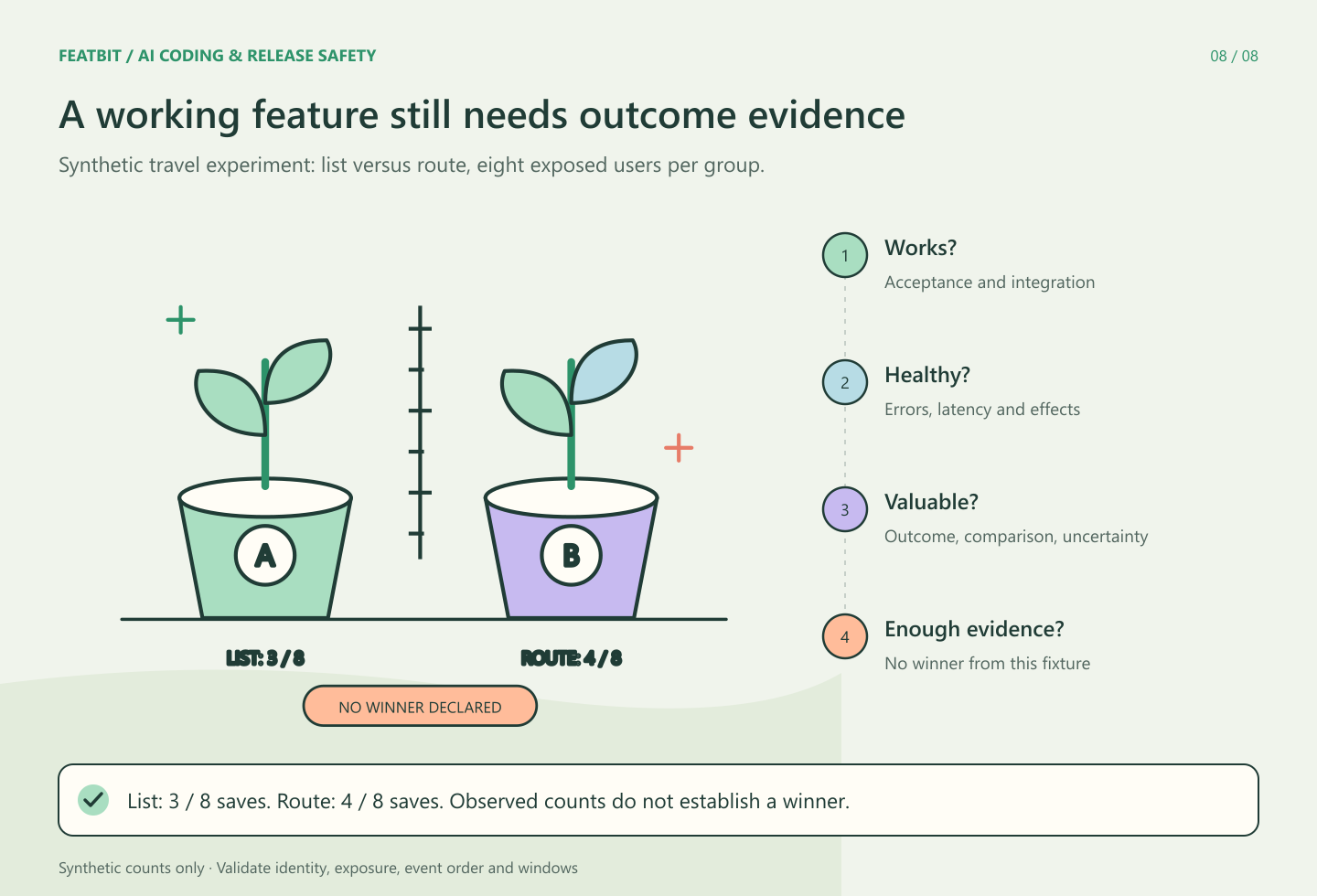
In the supplied fixture, each arm has eight synthetic exposed users. Three list users and four route users save a plan. A duplicate save does not increase the converted-user count, and an additional save after the one-day example window is excluded.
| Synthetic arm | Unique exposed users | Unique users saving within the example window | Observed share |
|---|---|---|---|
| List | 8 | 3 | 37.5% |
| Route | 8 | 4 | 50.0% |
The correct interpretation is a validated counting example with insufficient grounds for asserting a winner. The lab is an event validator, not a statistical inference engine. The one-day window is an illustrative fixture choice, not a recommendation for every travel product.
The recorded verification also demonstrates that cross-arm identities, outcomes without exposure, and outcomes before exposure fail validation. In production, investigate or quarantine invalid records according to a documented process; silently dropping whatever contradicts a desired result would bias the analysis.
Predefine the decision and uncertainty method
Before reading the outcome, specify the baseline, minimum worthwhile effect, assignment ratio, sample and duration rationale, uncertainty method, guardrails, and decision owner. Account for the product's conversion window, usage cycles, unit-level clustering and delayed outcomes.
If using a Bayesian analysis, document the model, priors, practical benefit or loss thresholds, and how repeated observation informs decisions. If using a frequentist design, follow its planned analysis and stopping rules. Neither approach turns a tiny or biased sample into reliable evidence.
| Evidence state | Decision to consider | Reason to record |
|---|---|---|
| A serious guardrail failure | Contain the affected behavior and investigate | Limiting harm does not require waiting for a business-effect estimate |
| Missing or inconsistent exposure/outcome data | Repair measurement before expansion based on results | The denominator or comparison cannot be trusted |
| Healthy guardrails but broad uncertainty | Continue the planned observation or conclude inconclusive | No asserted winner; document the remaining uncertainty |
| Evidence supports a worthwhile improvement under the design | Expand with an owned monitoring plan | Explain effect, uncertainty, scope and tradeoffs |
| Evidence supports keeping the baseline | Retain control and capture the learning | Building the feature did not obligate the team to ship it broadly |
No statistically detected difference is not proof that two versions are equivalent. A favorable proxy is not proof of a meaningful business benefit. Review the measurement-design guide for choosing metrics and avoiding misleading proxies.
Use a proportionate evaluation when randomization is unsuitable
Not every feature needs an A/B test. Low traffic, strong network effects, tenant-level coordination, operational risk, or a change that must apply to everyone may require another design.
Use controlled pilots, task completion studies, staged observation, or another justified method, and state what the design can establish. A before-and-after improvement without a valid control should not be described as an isolated causal effect of the feature.
Use the experiment brief to retain the question, design, evidence and decision. Connect that record to FeatBit's release decision framework so the outcome of a fast implementation can be a measured expansion, a revision, a rollback, or an honest decision that more evidence is needed.