
Governing AI Agent Actions in Production
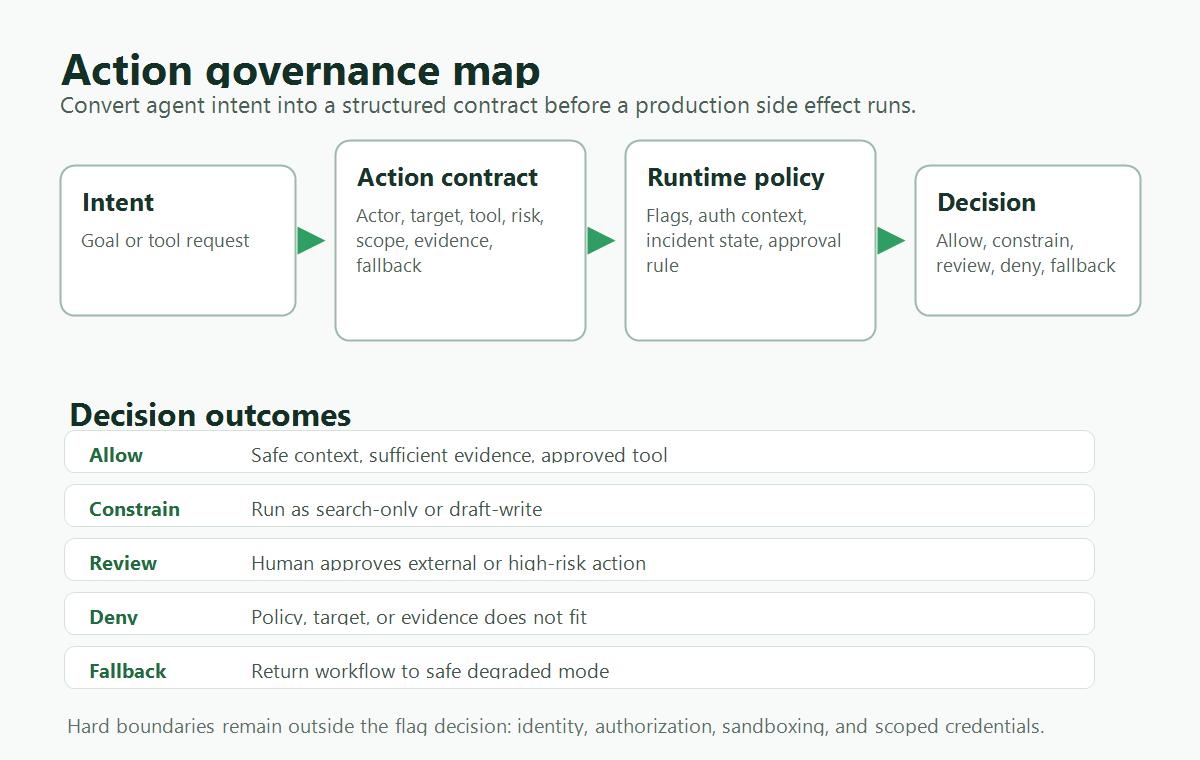
Governing agent actions means deciding whether an AI agent may execute a specific side effect before that side effect reaches a production system. It is narrower than broad AI governance and more precise than "tool access." The unit of control is the action: who or what is acting, which system will change, how reversible the change is, what evidence supports it, and which policy state is active for this context.
The practical pattern is to turn each side-effecting agent request into an action contract, evaluate runtime policy at the execution boundary, and record a decision that operators can audit, roll back, or learn from. Feature flags fit when the decision needs targeting, staged rollout, fast rollback, and ownership. They should sit beside hard authorization, scoped credentials, sandboxing, and human approval instead of replacing them.
What Makes an Agent Action Governable
An agent action is governable when the system can describe the action before execution in structured terms. A natural-language intent such as "fix the customer record" is not enough. The tool router needs a contract that can be evaluated without trusting the model to police itself.
Use these fields as the starting point:
| Field | Why it matters |
|---|---|
actor |
Distinguishes the agent identity, service identity, user identity, and human approver. |
intent |
States the task the agent is trying to complete, such as search, draft, update, publish, deploy, delete, or approve. |
target |
Names the system, account, record, repository, environment, or external service affected by the action. |
tool |
Identifies the tool or API boundary where enforcement happens. |
riskClass |
Classifies read, sensitive read, reversible write, external effect, admin action, or irreversible operation. |
reversibility |
Explains whether rollback is automatic, manual, expensive, impossible, or dependent on a third party. |
scope |
Limits the audience, account, region, environment, workflow, or traffic percentage. |
evidence |
Captures confidence, source coverage, evaluator result, previous review, or rollout signal. |
fallback |
Defines what happens when the policy denies or constrains the action. |
This contract is different from a prompt instruction. The prompt may tell the agent what it should do. The action contract gives the production system a structured object it can allow, constrain, queue for review, or deny.
Use a Decision Model, Not a Single Permission Switch
Governance usually fails when every decision becomes either "agent on" or "agent off." Production teams need more outcomes than that.
| Decision | What it means | Example |
|---|---|---|
| Allow | The action can execute as requested. | A support agent searches approved documentation for an internal user. |
| Constrain | The action can run with a safer mode, smaller scope, or lower authority. | A coding agent may open a draft pull request but cannot merge it. |
| Queue for review | A human must approve the final side effect with enough context. | The agent prepares a customer email, but a support lead sends it. |
| Deny | The action is blocked because the policy, context, or evidence is insufficient. | The agent tries to change billing data in production without the required approval. |
| Fallback | The system moves to a safe degraded mode. | During an incident, the agent returns to search-only behavior. |
OpenAI's paper on governing agentic AI systems notes that some agentic systems should be prevented from taking certain actions entirely, and it highlights the difficulty of making human approval meaningful when reviewers lack enough context or face too many approvals. That is the design lesson for product teams: governance should not be a rubber stamp. It should route only the right actions to humans and provide the consequence, scope, evidence, and fallback for the decision.
Evaluate Policy at the Execution Boundary
The agent can propose an action. The production system should decide whether the action runs.
For tool-using agents, that decision belongs in the server-side tool router, workflow orchestrator, or API gateway that sits immediately before the side effect. It should not live only in the model prompt, UI copy, or client-side code.
type ActionRisk =
  | "search"
  | "scoped_read"
  | "sensitive_read"
  | "reversible_write"
  | "external_effect"
  | "admin_action"
  | "irreversible";

type AgentActionContract = {
  userId: string;
  accountId: string;
  agentId: string;
  environment: "dev" | "staging" | "production";
  workflow: string;
  toolName: string;
  targetSystem: string;
  riskClass: ActionRisk;
  reversibility: "automatic" | "manual" | "expensive" | "none";
  confidence: number;
};

type ActionDecision =
  | { action: "allow" }
  | { action: "constrain"; mode: "search_only" | "draft_write" }
  | { action: "queue_for_review"; reason: string }
  | { action: "deny"; reason: string }
  | { action: "fallback"; mode: string };
Then evaluate runtime policy before execution:
async function decideAgentAction(contract: AgentActionContract): Promise<ActionDecision> {
  const context = {
    key: contract.userId,
    custom: {
      accountId: contract.accountId,
      agentId: contract.agentId,
      environment: contract.environment,
      workflow: contract.workflow,
      toolName: contract.toolName,
      targetSystem: contract.targetSystem,
      riskClass: contract.riskClass,
      reversibility: contract.reversibility,
    },
  };

  const agentEnabled = await flags.boolean("agent-action-governance-enabled", context, false);
  if (!agentEnabled) {
    return { action: "deny", reason: "Agent action governance is not enabled for this context." };
  }

  const mode = await flags.string("agent-action-mode", context, "search_only");
  const approvalRequired = await flags.boolean("agent-action-approval-required", context, true);
  const deniedTools = await flags.json<string[]>("agent-action-denylist", context, []);

  if (deniedTools.includes(contract.toolName)) {
    return { action: "deny", reason: "This tool is temporarily disabled." };
  }

  if (mode === "fallback") {
    return { action: "fallback", mode: "search_only" };
  }

  if (mode === "search_only" && contract.riskClass !== "search") {
    return { action: "constrain", mode: "search_only" };
  }

  if (approvalRequired && shouldRequireReview(contract)) {
    return { action: "queue_for_review", reason: "Risk, reversibility, or evidence requires approval." };
  }

  return { action: "allow" };
}
This example is intentionally adapter-shaped rather than tied to one SDK method. In FeatBit, the policy values can be evaluated server-side with safe fallbacks, targeting rules, segments, percentage rollouts, and audit logs. The agent receives the decision. It should not receive a path around the router.
Where Feature Flags Fit
Feature flags are useful for agent action governance when the decision must change after deployment:
- enable a new agent action for internal users first;
- keep a production fallback such as
search_onlyoroff; - choose an action mode by user, account, environment, region, workflow, or risk class;
- roll out a side-effecting action to a small segment before broad release;
- require approval for sensitive accounts or high-risk tools;
- temporarily deny one action during an incident without disabling the whole agent;
- connect policy changes to audit, webhook, observability, and lifecycle workflows.
Unleash's article on runtime control for AI agents uses the phrase "governing agent actions" to describe wrapping API tools with feature flags so agent intent is separated from system execution. Its feature toggle documentation also lists permission and kill-switch flags as flag types. That is useful category language, but teams should still separate dynamic release control from hard security boundaries.
Feature flags should not be the only thing preventing an agent from reaching data or systems it should never touch. The Model Context Protocol authorization specification is a useful reminder for MCP-based systems: transport authorization, token audience validation, and token handling belong to the hard boundary. Runtime flags decide which approved behavior is active now.
Roll Out Governance in Stages
Do not launch action governance by wrapping every tool with a complex policy engine. Start with one workflow and stage the authority.
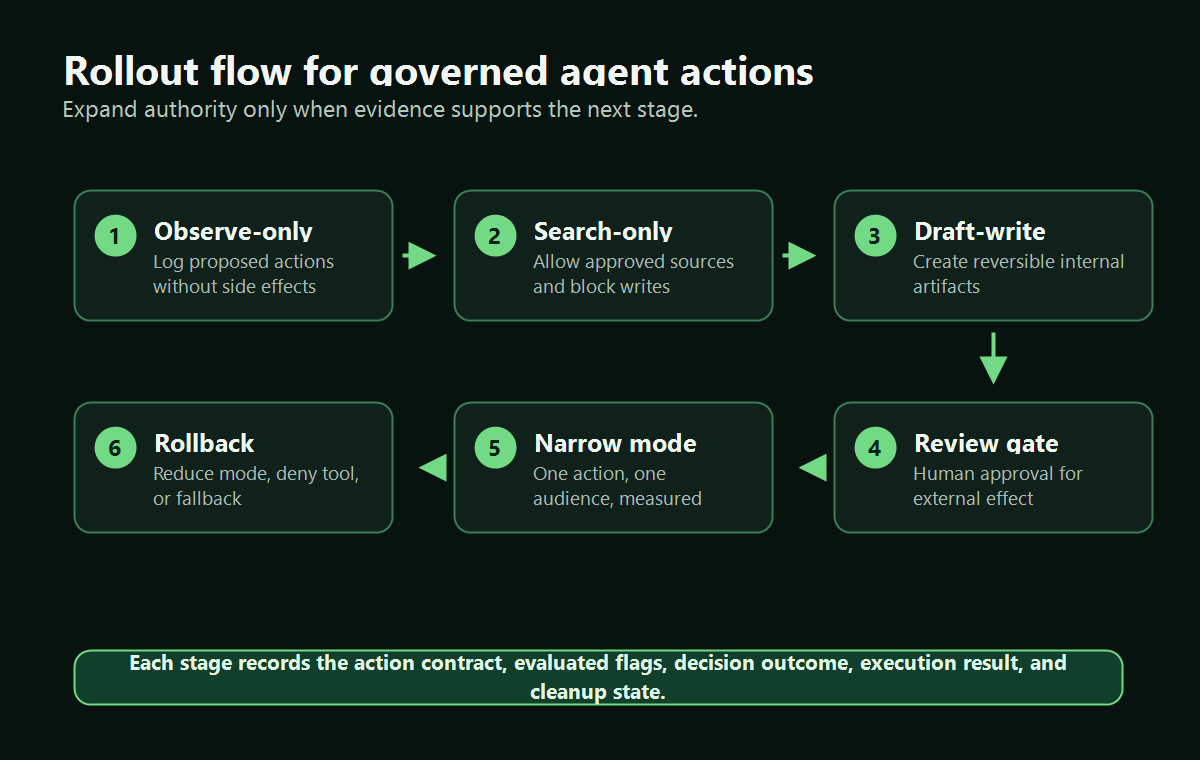
- Observe-only. The agent proposes actions. The router builds action contracts and logs decisions without executing side effects.
- Search-only. The agent can gather evidence from approved sources but cannot write, publish, deploy, or call external systems.
- Draft-write. The agent can create drafts, branches, tickets, or internal records that humans can inspect before external impact.
- Approval-gated external action. The agent prepares an externally visible action, but a human approves the final execution.
- Narrow autonomy. One specific action, tool, workflow, and audience can execute without approval after enough evidence supports it.
- Progressive expansion. The rollout expands by segment, account, region, or percentage while quality, support, denial, and rollback signals are monitored.
- Rollback or cleanup. Operators can return one action to search-only, deny one tool, or remove temporary rollout flags after the decision is complete.
This is the same release discipline behind FeatBit's AI agent deployment loop: build the control point, deploy it behind a flag, evaluate behavior, then expand or roll back based on evidence.
Audit the Decision, Not Just the Trace
A trace can show that a tool ran. Governance needs to show why it was allowed, constrained, reviewed, denied, or rolled back.
At minimum, record:
- action contract fields, including actor, target, tool, risk class, reversibility, and environment;
- evaluated flag keys and variations that contributed to the decision;
- policy outcome: allow, constrain, queue for review, deny, or fallback;
- evidence summary, such as source coverage, evaluator result, confidence, or prior rollout state;
- human approver identity and approval rationale when review is required;
- execution result, latency, error, undo result, and downstream incident or support signal;
- operator changes to policy state, including who changed the flag and why.
FeatBit's audit logs, targeting rules, webhooks, OpenTelemetry integration, and flag insights are relevant building blocks. The goal is to connect the governance decision with the evidence that tells the team whether to continue, pause, roll back, or clean up.
How FeatBit Fits
FeatBit's point of view is that feature flags are release-decision infrastructure. For agent actions, that means the platform should help teams decide which approved capability is active, for which context, at what rollout stage, with what fallback, and with what audit trail.
Use FeatBit for the dynamic release layer:
- server-side flag evaluation before a tool or workflow crosses an execution boundary;
- multivariate action modes such as
off,observe,search_only,draft_write,approved_external, andfallback; - targeting by user, account, environment, region, workflow, agent, or risk class;
- percentage rollout for new agent actions;
- kill switches and denylists for incident response;
- audit logs and webhooks for review, incident, and compliance workflows;
- lifecycle ownership so temporary governance flags do not become policy debt.
Keep hard boundaries in the systems that own them: identity, authorization, API permissions, sandboxing, data access policy, and irreversible-action controls. For the narrower implementation pattern, use the companion tutorial on agent tool permission gates with feature flags. For the broader operating model, read how to control AI agents in production. For governance as a product and release-control layer, see FeatBit's AI governance page.
Common Failure Modes
Governance only in the prompt. A prompt can describe policy, but a deterministic router has to enforce it.
One global agent switch. A kill switch is useful during an incident, but normal operations need action mode, tool tier, approval policy, rollout scope, and fallback state.
No action contract. If the router cannot name the actor, target, risk, reversibility, and evidence before execution, it cannot make a reliable decision.
Human approval without context. Reviewers need the proposed action, consequence, scope, evidence, fallback, and reason the gate fired.
Flags replacing authorization. A flag can release an approved capability. It should not be the only barrier between an agent and a forbidden system.
No lifecycle rule. Temporary rollout flags need owners, review dates, and cleanup conditions. Permanent operational controls need documentation and review.
Starting Checklist
Before letting an agent action reach production, verify:
- The action has a structured contract.
- The default production state is deny, observe-only, search-only, or fallback.
- Evaluation happens server-side before the side effect.
- The policy can return allow, constrain, review, deny, or fallback.
- Hard authorization still defines the maximum possible access.
- Human approval is reserved for consequential actions and includes enough context.
- Audit events capture the policy decision and execution result.
- Operators can disable one action or tool without stopping unrelated workflows.
- Rollout signals include quality, denial rate, support impact, latency, cost, and rollback events.
- Temporary flags have an owner and cleanup condition.
Governing agent actions is not a separate bureaucracy. It is release control for side effects. Start with one action, make the decision explicit, observe it, and expand only when the evidence supports more authority.
Source Notes and Internal Link Plan
This article uses vendor and standards sources as category and architecture context. It does not make comparative performance, pricing, security, compliance, or market-ranking claims.
- Category context: Unleash's runtime control for AI agents article uses the phrase "governing agent actions" for feature-flagged API tool execution, and its feature toggle documentation lists permission and kill-switch flags.
- Agent governance source: OpenAI's Practices for Governing Agentic AI Systems supports the points about preventing certain actions and making human approval meaningful.
- Authorization source: the Model Context Protocol authorization specification supports the distinction between runtime rollout policy and hard authorization boundaries.
- FeatBit implementation sources: targeting rules, audit logs, webhooks, OpenTelemetry integration, and flag insights.
- FeatBit reader journey links: AI governance, AI agent deployment loop, control AI agents in production, agent tool permission gates, and feature flag lifecycle management.
- Image and Open Graph recommendation: use
cover.pngas the social preview. Use the action policy map near the definition and the evaluation flow near the rollout section because both summarize decisions already explained in crawlable text.
Next Step
Pick one side-effecting agent workflow. Write the action contract before changing the prompt or adding another tool. If the team cannot define actor, target, risk class, reversibility, evidence, fallback, and owner, keep the action in observe-only or search-only mode until the governance decision is clear.