
Production Agent Tool Governance: An Audit-Ready Control Model
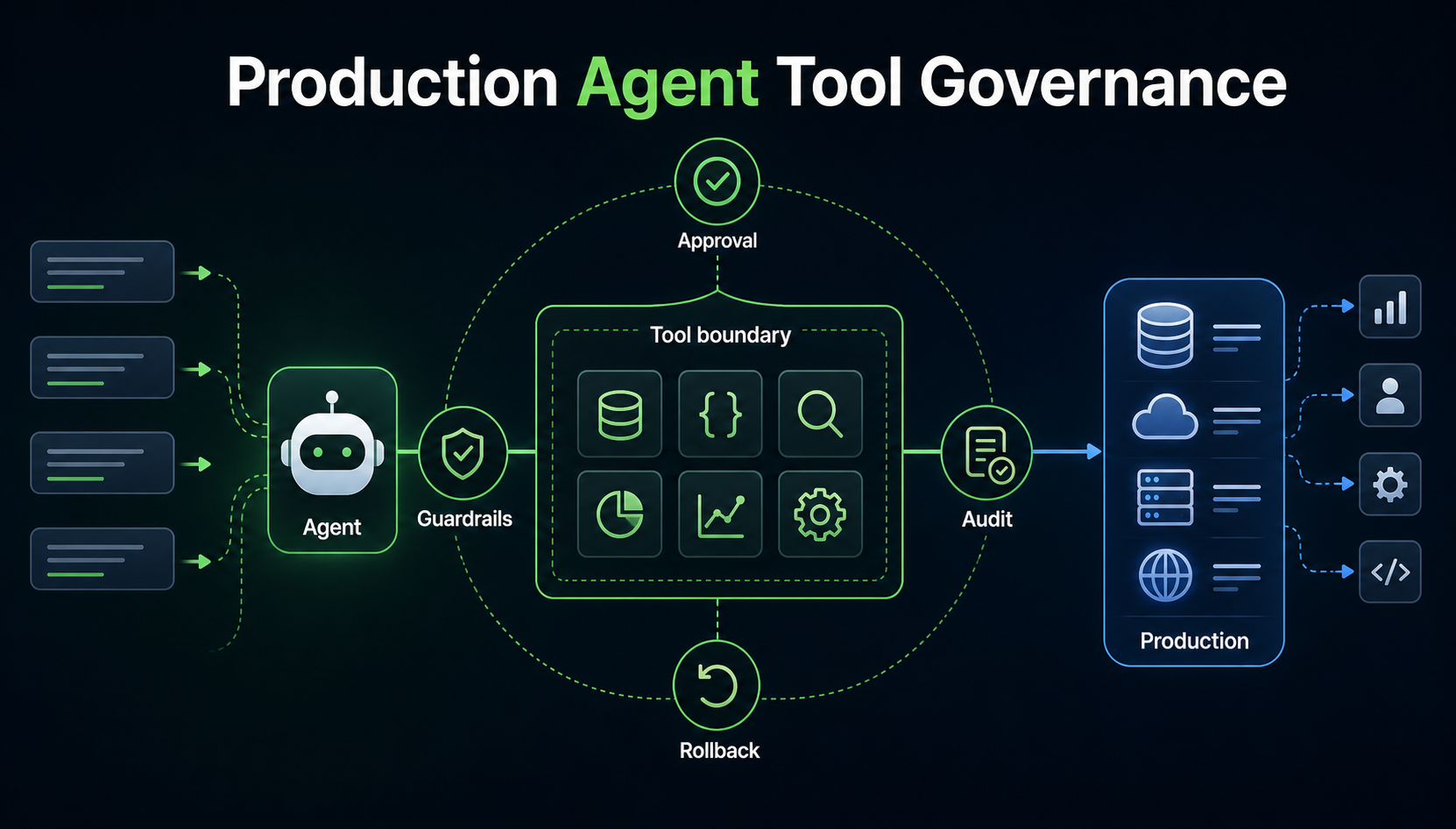
Production agent tool governance is the operating model that proves an AI agent's tool use is owned, approved, constrained, observable, and reversible before the tool changes a production system. It is not the same as giving the agent a tool list. It is the evidence trail around every consequential tool decision: who owns the policy, which guardrail fired, who approved the exception, what fallback ran, and how operators can roll the capability back.
That distinction matters once agents move from answering questions to using tools that read production data, update customer-visible records, spend money, change permissions, create pull requests, or trigger deployments. Security boundaries still belong in IAM, token scope, API authorization, sandboxing, and network controls. Governance sits around those boundaries and turns agent tool access into a release decision that platform, security, product, and operations teams can review.
This article is intentionally different from a tool-access implementation guide. For implementation details, use how to control agent tool access in production. The reader job here is to design a governance model that can survive audit review, incident review, and normal production operations.
What Production Agent Tool Governance Must Prove
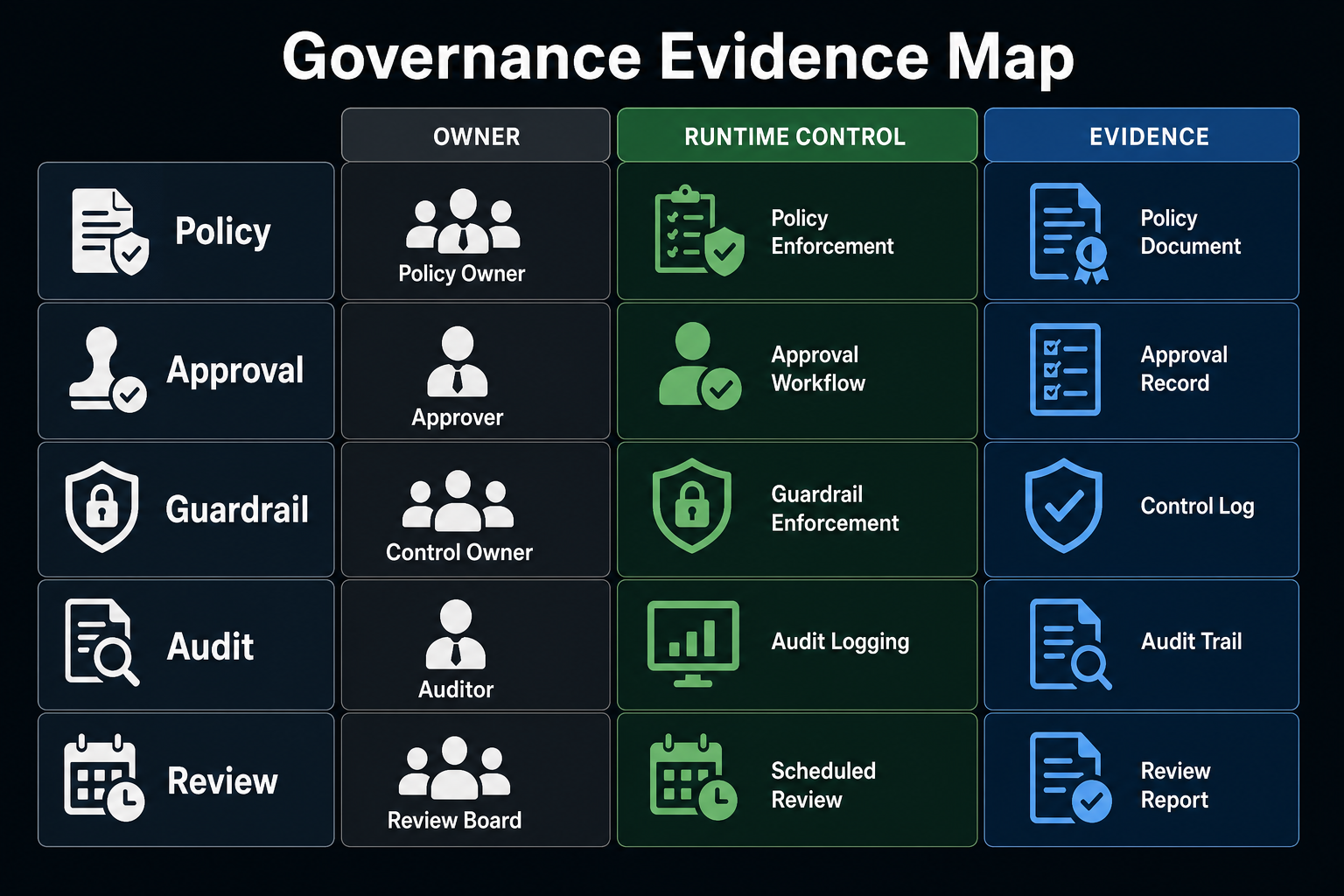
A governable agent tool system should prove five things:
| Governance question | Practical proof |
|---|---|
| Who owns the policy? | A named owner, review cadence, and change path for each tool class. |
| What can the agent do now? | A runtime mode such as off, observe, search_only, draft_write, approval_required, or fallback. |
| Which actions need approval? | A rule that routes high-risk, irreversible, external, or low-evidence actions to a reviewer before execution. |
| Which guardrails limit blast radius? | Risk classes, scoped credentials, source allowlists, denylists, rollout segments, and fallback modes. |
| What evidence exists afterward? | Decision logs, approver identity, evaluated policy state, execution outcome, and rollback or cleanup status. |
NIST's AI Risk Management Framework frames AI risk management as work that belongs across design, development, use, and evaluation. For production agents, that translates into a continuous governance loop rather than a one-time launch checklist.
Start With Governance Layers, Not Individual Tools
Many teams start by asking whether a specific tool should be allowed. That creates scattered exceptions. Start with the governance layers instead.
| Layer | Owns the decision | Example control | Evidence to keep |
|---|---|---|---|
| Identity boundary | Security and platform | Service identity can call only a scoped API. | Token scope, role assignment, policy review. |
| Tool boundary | Agent platform | Tool router builds a structured request before execution. | Request contract, risk class, target system. |
| Runtime release control | Release owner | Feature flag selects mode by user, account, environment, workflow, or risk. | Evaluated flag values and rollout state. |
| Human approval | Domain owner | Reviewer clears an external action, production write, or sensitive read. | Reviewer, decision, consequence summary, timestamp. |
| Operational guardrail | SRE, support, or security | Denylist, source allowlist, incident fallback, kill switch, or percentage rollout. | Guardrail trigger, fallback outcome, rollback notes. |
| Governance review | Product, security, and operations | Review permanent controls and remove temporary rollout flags. | Review report, cleanup decision, owner signoff. |
The Model Context Protocol authorization specification is useful context for tool-connected systems because it separates transport authorization and token handling from runtime behavior. Runtime flags should decide which approved capability is active. They should not be the only thing preventing an agent from reaching a forbidden system.
Use a Small Decision Vocabulary
Governance breaks down when every tool call becomes a unique debate. A small set of outcomes keeps the system operable:
| Decision | Meaning | Governance use |
|---|---|---|
allow |
The tool can execute under current policy. | Mature, scoped, low-risk actions with sufficient evidence. |
constrain |
The request may run in a safer mode or smaller scope. | Convert a broad read into a scoped read or a write into a draft. |
queue_for_approval |
A human must approve before the side effect. | External effects, production changes, sensitive reads, low-confidence actions. |
deny |
The request is blocked. | Forbidden tool, missing context, invalid scope, insufficient authorization. |
fallback |
The agent moves to a safer degraded behavior. | Incident state, review queue saturation, guardrail regression, policy uncertainty. |
OpenAI's paper on practices for governing agentic AI systems highlights the need for human approval on high-stakes actions while also noting that approvals need enough context to avoid becoming rubber stamps. That is the governance lesson: approval should be selective, consequential, and recorded.
Define the Governance Contract
The tool router should be able to describe a requested tool action before it runs. A minimal governance contract can be plain enough for code review and operations review:
agentToolGovernance:
  workflow: customer-support-agent
  owner: support-platform
  tool: send_customer_email
  riskClass: external_effect
  defaultMode: draft_write
  allowedModes:
    - off
    - observe
    - search_only
    - draft_write
    - approval_required
    - fallback
  hardBoundary:
    serviceIdentity: support-agent-service
    apiScope: draft_email:create
    blockedScopes:
      - email:send_without_approval
      - billing:update
      - permission:update
  runtimeControls:
    modeFlag: support-agent-tool-mode
    approvalFlag: support-agent-approval-required
    denylistFlag: support-agent-tool-denylist
    fallbackFlag: support-agent-incident-fallback
  approval:
    requiredFor:
      - external_effect
      - high_value_account
      - low_confidence
      - incident_mode
    reviewerGroup: support-leads
    timeoutFallback: draft_write
  evidence:
    logDecision: true
    logPolicyValues: true
    logReviewer: true
    avoidSensitiveInputs: true
  rollback:
    safestMode: search_only
    owner: support-platform-oncall
This contract does three useful things. It separates hard authorization from runtime governance. It gives reviewers a common language for approvals and fallbacks. It also gives operators a rollback path that lowers one tool's authority without turning off the entire agent.
Make Guardrails Operational
"Guardrail" is too vague unless it changes what the system does. For agent tool governance, a guardrail should return a decision, a reason, and an evidence record.
Examples:
| Guardrail | Decision it can return | Evidence to record |
|---|---|---|
| Source allowlist | Constrain or deny a search or read request. | Requested source, allowed source set, final source used. |
| Tool denylist | Deny one tool during an incident. | Tool name, incident state, operator, timestamp. |
| Risk class threshold | Queue high-risk actions for approval. | Risk class, requested action, reviewer result. |
| Account or region rule | Constrain rollout to approved segments. | Account, segment, region, evaluated flag value. |
| Review queue health | Fallback when approvals cannot be handled. | Queue size, timeout, fallback mode. |
| Quality or safety signal | Roll back from autonomy to approval-required mode. | Metric, threshold, previous mode, new mode. |
OWASP's Top 10 for LLM Applications 2025 is useful security context because LLM applications become riskier as they are embedded more deeply into internal operations. In practice, production governance needs least privilege, runtime enforcement, and monitoring rather than prompt instructions alone.
Place FeatBit in the Runtime Control Layer
FeatBit should not be the only security boundary around an AI agent. Use FeatBit where the team needs runtime release control:
- target agent tool modes by user, account, environment, workflow, region, or risk segment;
- start a new tool in
observeorsearch_onlymode before draft or external action modes; - use multivariate flags for stable governance modes instead of dozens of one-off booleans;
- keep safe fallbacks for missing context, incident mode, or guardrail uncertainty;
- use targeting rules, percentage rollouts, and feature flag audit logs to make rollout and changes reviewable;
- connect changes to operations through webhooks and observability through OpenTelemetry integration;
- apply IAM and API token controls for the people and services that change governance state;
- use feature flag lifecycle management so temporary governance flags get reviewed or cleaned up.
For teams that need data locality, private infrastructure, or stronger control over where governance state and audit evidence live, evaluate FeatBit's self-hosted feature flag platform as part of the agent control-plane design.
Roll Out Governance Before Autonomy
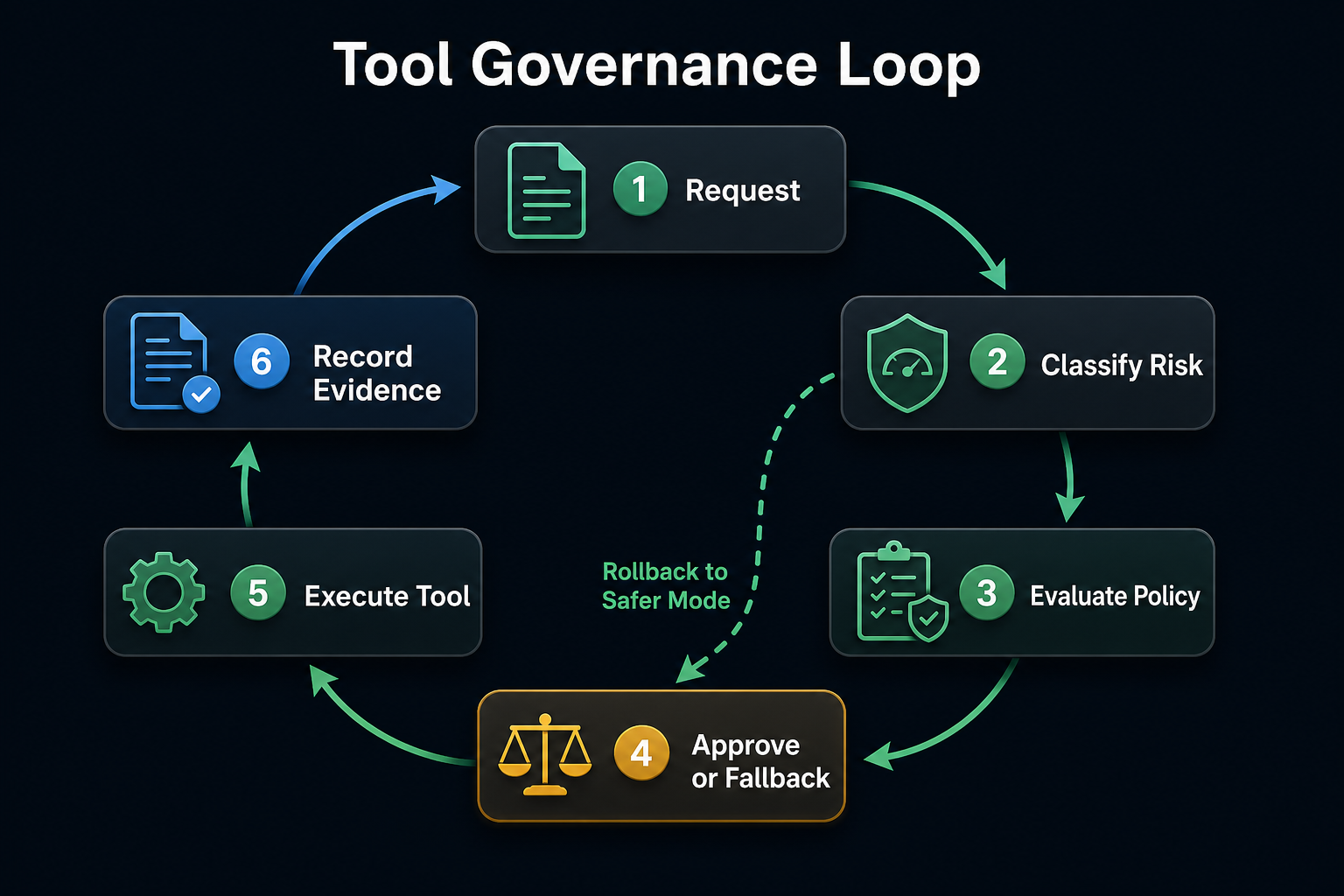
Do not wait until the agent is autonomous to add governance. Roll out the governance model first.
| Stage | Agent authority | Governance question | Evidence needed to expand |
|---|---|---|---|
| Observe | Agent proposes tool calls but nothing executes. | What would the agent try to do? | Intended calls match policy and risk labels. |
| Search only | Agent searches approved sources. | Are source limits and citations reliable? | Useful answers, low source violations, complete logs. |
| Scoped read | Agent reads narrow business or operational context. | Are data boundaries and purpose limits respected? | Sensitive-field handling, access review, low denial noise. |
| Draft write | Agent creates drafts, tickets, branches, or proposals. | Do humans accept the drafted work? | Review acceptance, correction burden, rollback readiness. |
| Approval required | Agent prepares side-effecting actions. | Can reviewers make fast, informed decisions? | Approval quality, queue health, consequence summaries. |
| Narrow autonomy | Agent executes one specific action under strict conditions. | Is this action mature enough to run without review? | Stable guardrails, low incident signal, owner signoff. |
This staged model aligns with FeatBit's AI agent deployment loop: build the control point, deploy behind runtime policy, evaluate behavior, and expand or roll back based on evidence.
What To Put In the Audit Trail
Auditability does not mean storing every prompt, document, or sensitive tool input. It means storing enough decision evidence to reconstruct why the system allowed, constrained, reviewed, denied, or rolled back a tool action.
Minimum fields:
- request ID, user key, account key, environment, workflow, agent ID, and session ID;
- tool name, target system, requested action summary, risk class, and reversibility;
- hard authorization result before runtime policy;
- evaluated flag keys and variations used for mode, approval, denylist, fallback, and rollout stage;
- final decision: allow, constrain, queue for approval, deny, or fallback;
- reviewer identity, approval result, and consequence summary when approval is required;
- execution result, error, latency, undo result, or manual handoff;
- rollback state, incident reference, review date, and cleanup owner when relevant.
Keep sensitive content out of governance logs by default. A decision log should explain the control decision without becoming a second uncontrolled store of customer data, secrets, or private documents.
Common Failure Modes
Governance only in the prompt. Prompt instructions can guide the model, but the tool boundary must enforce the decision.
One global agent switch. A kill switch is useful during an incident. Normal governance also needs modes, approval rules, denylists, fallback, rollout scope, and cleanup.
Approval without consequence. A reviewer needs to know what will change, who is affected, why the gate fired, and what fallback is available.
No owner for policy state. Tool governance is production behavior. Every stable control needs an owner, and every temporary rollout control needs a review date.
Audit logs that only show execution. A useful audit trail records blocked, constrained, approved, denied, and fallback decisions too.
Runtime flags replacing authorization. Flags decide which approved capability is active now. They do not make broad credentials, invalid token handling, or unsafe API scopes acceptable.
Governance Readiness Checklist
Before a production agent gets a new tool capability, verify:
- The tool has a named owner, risk class, and reversibility level.
- Hard authorization defines the maximum possible access.
- Runtime policy is evaluated server-side before the tool executes.
- Default production mode is
off,observe,search_only, or another safe fallback. - Human approval is required for external effects, production writes, sensitive reads, financial actions, permission changes, and irreversible operations.
- Guardrails return concrete decisions, not only warnings.
- Audit records capture policy state, decision, reviewer, execution result, and rollback state.
- Operators can reduce one tool's authority without disabling unrelated agent workflows.
- Rollout evidence includes review outcomes, denial rate, fallback frequency, quality, latency, cost, support impact, and incident signals.
- Temporary governance flags have cleanup owners and review dates.
Production agent tool governance is release governance for AI side effects. Start with the evidence you would need after an incident or audit review, then design the controls that create that evidence during normal operation.
Source Notes and Internal Link Plan
External sources used:
- NIST AI Risk Management Framework, for the design, development, use, and evaluation framing of AI risk management.
- OpenAI Practices for Governing Agentic AI Systems, for governance context around human approval, action ledgers, and deployment evaluation.
- OWASP Top 10 for LLM Applications 2025, for security context around LLM applications embedded in operational systems.
- Model Context Protocol authorization specification, for transport authorization, token audience validation, and hard-boundary context in tool-connected systems.
Internal links used:
- How to control agent tool access in production, for the deeper implementation model.
- AI agent tool policy blueprint, for the policy-contract view.
- AI control layer, for FeatBit's runtime control philosophy.
- AI agent deployment loop, for staged build, deploy, evaluate, and rollback.
- Human-in-the-loop release control, for approval and override design.
- Self-hosted feature flag platform, for private control-plane evaluation.
Image and Open Graph notes:
- Use
cover.pngas the Open Graph image because it shows the complete control plane. - Use
governance-evidence-map.pngnear the proof section because it maps governance responsibilities to evidence. - Use
tool-governance-loop.pngnear rollout guidance because it summarizes the operating loop explained in crawlable text.