
Integrate AI Feature Flags with OpenFeature, MCP, Data Warehouse, and Observability Tools
Integrating AI feature flags is not one SDK task. The runtime service needs a stable evaluation contract. Coding agents need a governed operations interface. The data team needs joinable release evidence. Operators need latency, cost, error, fallback, and quality signals before rollout expands.
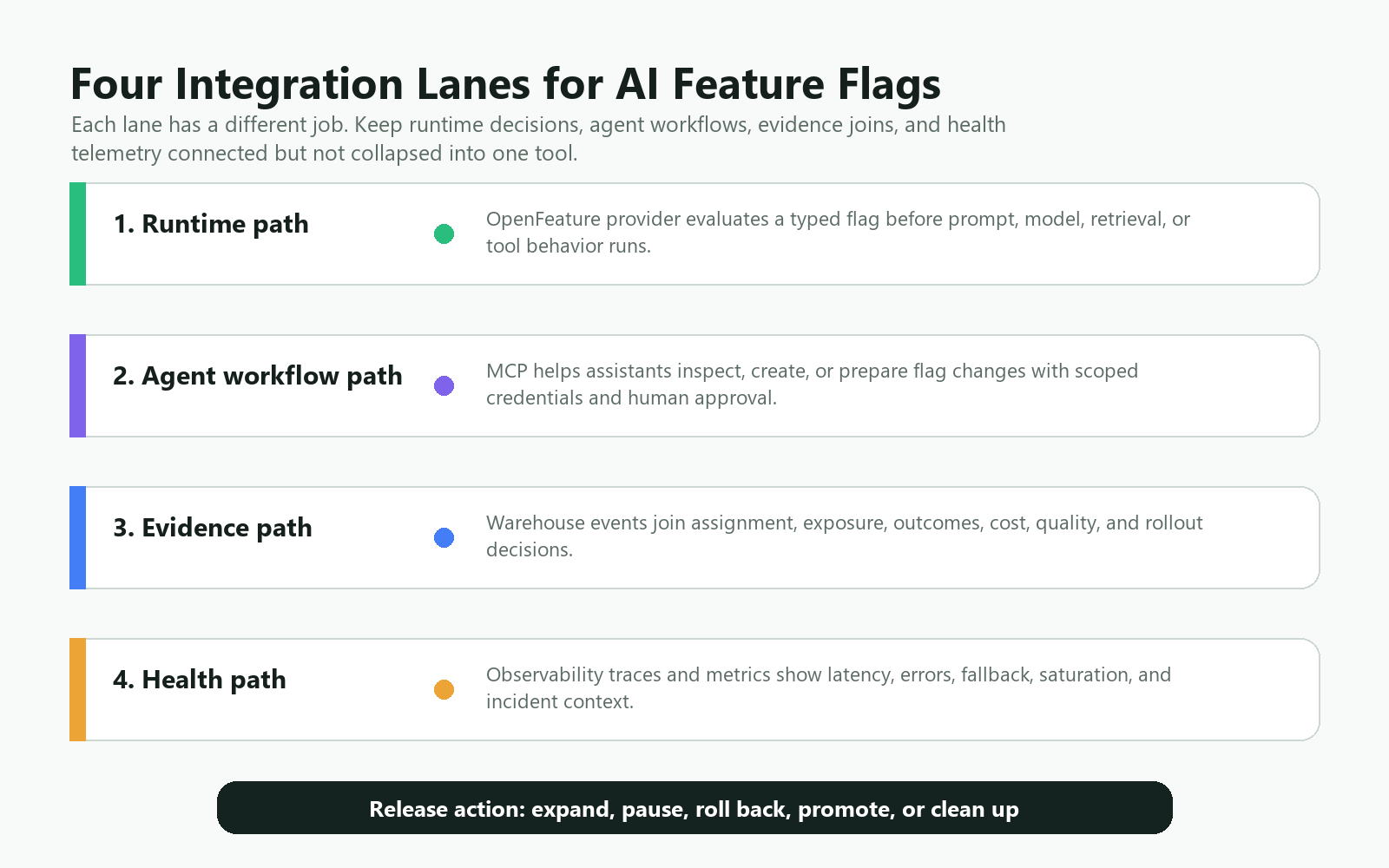
The useful architecture is four connected lanes:
- OpenFeature or another SDK path evaluates the flag where AI behavior is selected.
- MCP gives assistants a controlled workflow interface for flag discovery, creation, and rollout preparation.
- Warehouse or analytical storage joins assignment, exposure, outcome, cost, and quality events.
- Observability tools show whether the AI system is healthy enough to continue.
FeatBit's role is the release-control layer: target the audience, serve the variation, preserve audit context, collect or export release evidence, and keep rollback available.
Why AI Flag Integration Needs More Than an SDK
Traditional feature flags often decide whether a user sees a UI path or endpoint. AI feature flags can decide which prompt, model route, retrieval profile, guardrail mode, fallback path, or agent tool policy runs in production. That decision can change quality, cost, latency, safety, support load, and business outcome at the same time.
If the integration stops at "call the flag SDK," the team still has open questions:
| Integration question | Why it matters for AI rollout health |
|---|---|
| Where is the flag evaluated? | The decision should happen before the AI behavior runs, usually in a trusted server, gateway, or agent runtime. |
| Who can inspect or change the flag? | AI assistants can help with operations, but production mutations need scoped credentials, approval, and audit review. |
| How is exposure joined to outcomes? | Cost, quality, and business metrics must identify the same variation and assignment unit. |
| Which health signals block expansion? | A candidate can improve one metric while raising latency, token spend, fallback, or complaint rate. |
| How is rollback executed? | The release owner needs a control-plane action, not a redeploy, when guardrails fail. |
The architecture should keep these responsibilities connected but separate. OpenFeature is useful for runtime evaluation contracts. MCP is useful for assistant-driven workflow operations. The warehouse is useful for reproducible evidence. Observability is useful for live health and incident context. None of those layers should hide the release decision from the others.
For FeatBit teams, this is the same operating model behind the AI control layer: every AI decision point that affects users, spend, or risk should be targetable, measurable, reversible, and owned.
The Four Integration Lanes
1. Runtime Evaluation With OpenFeature
The runtime path answers one question: which AI behavior should run for this request, user, account, conversation, or workflow?
OpenFeature's flag evaluation specification defines a vendor-neutral evaluation API with typed calls, flag keys, default values, evaluation context, detailed evaluation metadata, providers, domains, hooks, and lifecycle behavior. For AI feature flags, those concepts are useful because the application can depend on a stable contract instead of scattering vendor-specific rollout logic through prompt, model, retrieval, and tool code.
A practical AI route flag should return a typed value:
type SupportAssistantRoute = {
  route: 'baseline' | 'citation_first' | 'low_cost';
  promptProfile: string;
  modelRoute: string;
  retrievalProfile: string;
  guardrailMode: 'standard' | 'strict';
  fallbackRoute: string;
};

const defaultRoute: SupportAssistantRoute = {
  route: 'baseline',
  promptProfile: 'support_v3',
  modelRoute: 'stable',
  retrievalProfile: 'verified_docs',
  guardrailMode: 'standard',
  fallbackRoute: 'baseline',
};

const route = await featureClient.getObjectValue(
  'support_assistant_route',
  defaultRoute,
  {
    targetingKey: account.id,
    accountTier: account.tier,
    region: account.region,
    workflow: 'support_chat',
    riskTier: account.riskTier,
  }
);
The flag should not carry secrets, raw provider credentials, or uncontrolled prompt text. It should select a reviewed behavior profile. The AI service or model gateway can then map that profile to the provider, prompt registry, retrieval pipeline, and fallback policy that the team has approved.
FeatBit maintains OpenFeature providers for several SDK paths, including Node.js, .NET, Java, and JavaScript provider repositories. If a team wants SDK portability, that provider layer can keep the application contract stable while FeatBit remains the release-control backend.
2. Agent Workflows With MCP
The agent workflow path answers a different question: how can an AI assistant help with feature flag operations without becoming an unsupervised production operator?
The MCP tools specification describes how servers expose tools that clients can list and call. It also says applications should keep humans in the loop for trust and safety, including clear tool exposure and confirmation prompts for operations. The MCP authorization specification describes OAuth-based protected resource behavior, token audience validation, and token handling requirements for protected MCP servers.
In a feature flag workflow, that means MCP is best used for assistant-driven operations such as:
- list projects, environments, flags, and audit history;
- draft a new AI behavior flag with owner, tags, fallback, and cleanup rule;
- prepare a rollout update without applying it;
- evaluate a flag for a test context during debugging;
- summarize stale or risky flags for human review.
FeatBit's MCP server repository describes a hosted endpoint and a local self-hosted option. It also states that the hosted server acts as a thin proxy: FeatBit API credentials are forwarded with each request, and credentials should be passed in MCP request headers rather than tool parameters.
Use MCP for workflow speed and context gathering. Do not use it as the main request-path evaluator for production AI behavior. The production path should still evaluate through an SDK, provider, or evaluation API designed for application traffic.
For a deeper workflow tutorial, see How to Use an MCP Server for Feature Flag Operations and the FeatBit MCP integration page.
3. Warehouse Evidence For Release Decisions
The evidence path answers the release owner's question: did the candidate AI behavior improve the outcome without breaking cost, latency, quality, or risk guardrails?
For AI feature flags, the warehouse matters when evidence is spread across product analytics, support systems, billing estimates, quality review tables, model gateway logs, and incident records. A dashboard inside a flag tool may be useful, but many teams still need a reproducible join in their trusted analytical system.
The minimum contract is simple: use the same assignment unit and identifiers across exposure, execution, outcome, and guardrail events.
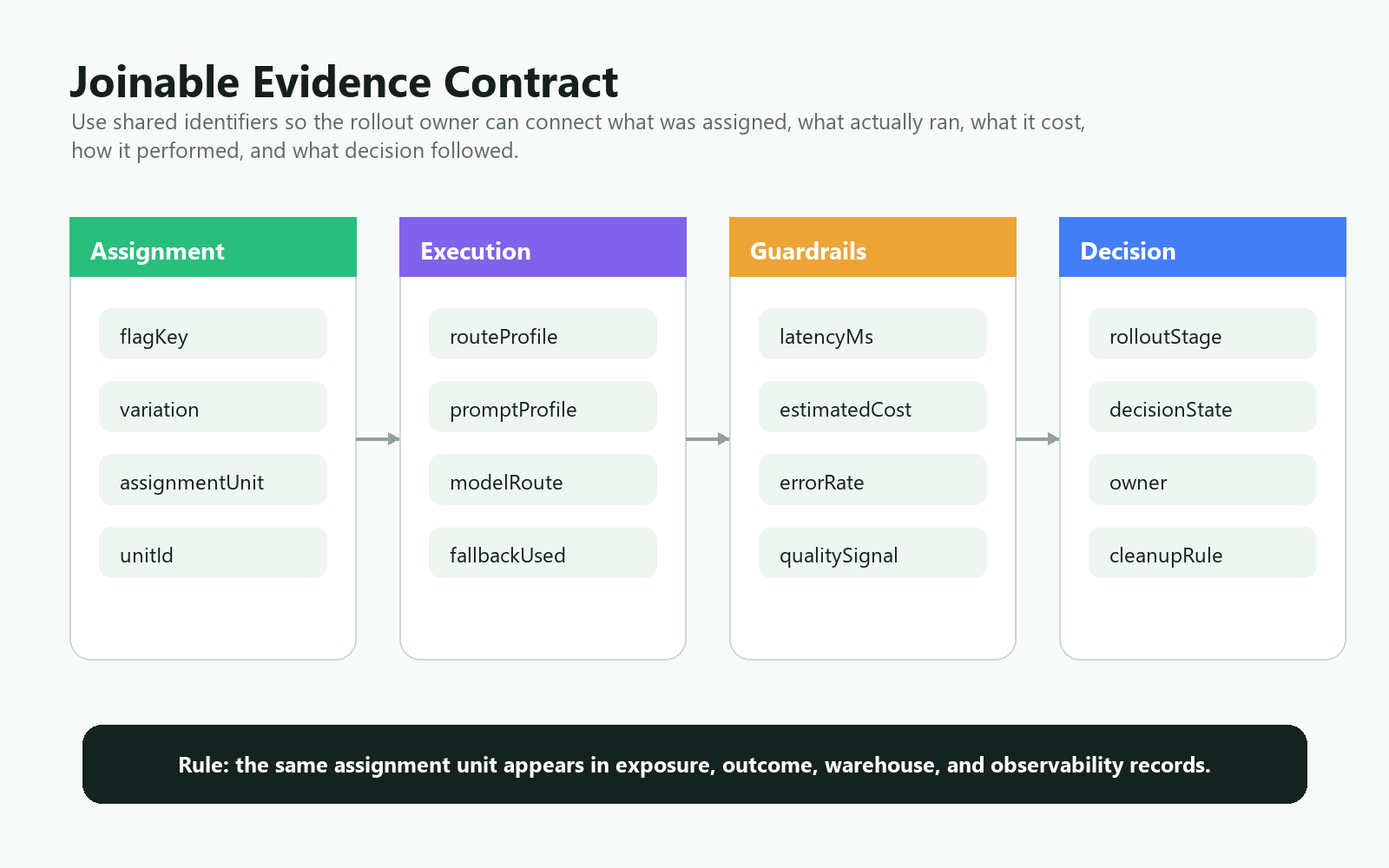
An exposure event might look like this:
{
  "event": "ai_feature_exposure",
  "flagKey": "support_assistant_route",
  "variation": "citation_first",
  "assignmentUnit": "account",
  "unitId": "acct_1842",
  "routeProfile": "support_citation_first_v4",
  "promptProfile": "support_v4",
  "modelRoute": "stable",
  "retrievalProfile": "verified_docs_rerank",
  "fallbackUsed": false,
  "environment": "production",
  "timestamp": "2026-06-24T09:15:30Z"
}
Outcome and guardrail events should carry the same release identifiers:
{
  "event": "support_assistant_outcome",
  "flagKey": "support_assistant_route",
  "variation": "citation_first",
  "assignmentUnit": "account",
  "unitId": "acct_1842",
  "resolvedWithoutEscalation": true,
  "humanCorrection": false,
  "latencyMs": 1840,
  "estimatedCostUsd": 0.014,
  "qualityReview": "pass",
  "timestamp": "2026-06-24T09:18:44Z"
}
FeatBit's Track Insights API supports sending feature flag variation results and custom metric events for analytics and experimentation. FeatBit's data export documentation describes extracting feature flag usage data and experiment events from ClickHouse or MongoDB into a data warehouse, message broker, or custom data platform. The exact export pattern can vary by deployment, but the design rule is stable: assignment, exposure, outcome, and decision records need a join path.
For the measurement layer itself, connect this article to warehouse-native measurement for AI feature flags and FeatBit's measurement design guidance.
4. Observability For Health And Rollback
The health path answers the operator's question: is the AI system still healthy enough to continue serving the candidate?
Observability should not be limited to generic AI call metrics. It needs release context:
- flag key and variation;
- route profile, prompt profile, model route, retrieval profile, and guardrail mode;
- assignment unit and audience segment when safe to include;
- latency, timeout, queue, provider error, and fallback state;
- cost or token usage when available;
- quality signal, human correction, complaint, or safety review;
- rollout stage and decision state.
FeatBit's OpenTelemetry integration documentation says FeatBit backend services can publish metrics, traces, and logs through OpenTelemetry, with configuration for service names and OTLP exporters. OpenTelemetry's generative AI semantic conventions have moved into a dedicated repository, but the category direction is still important: AI systems benefit from shared telemetry vocabulary that identifies operations, providers, request and response attributes, and usage signals.
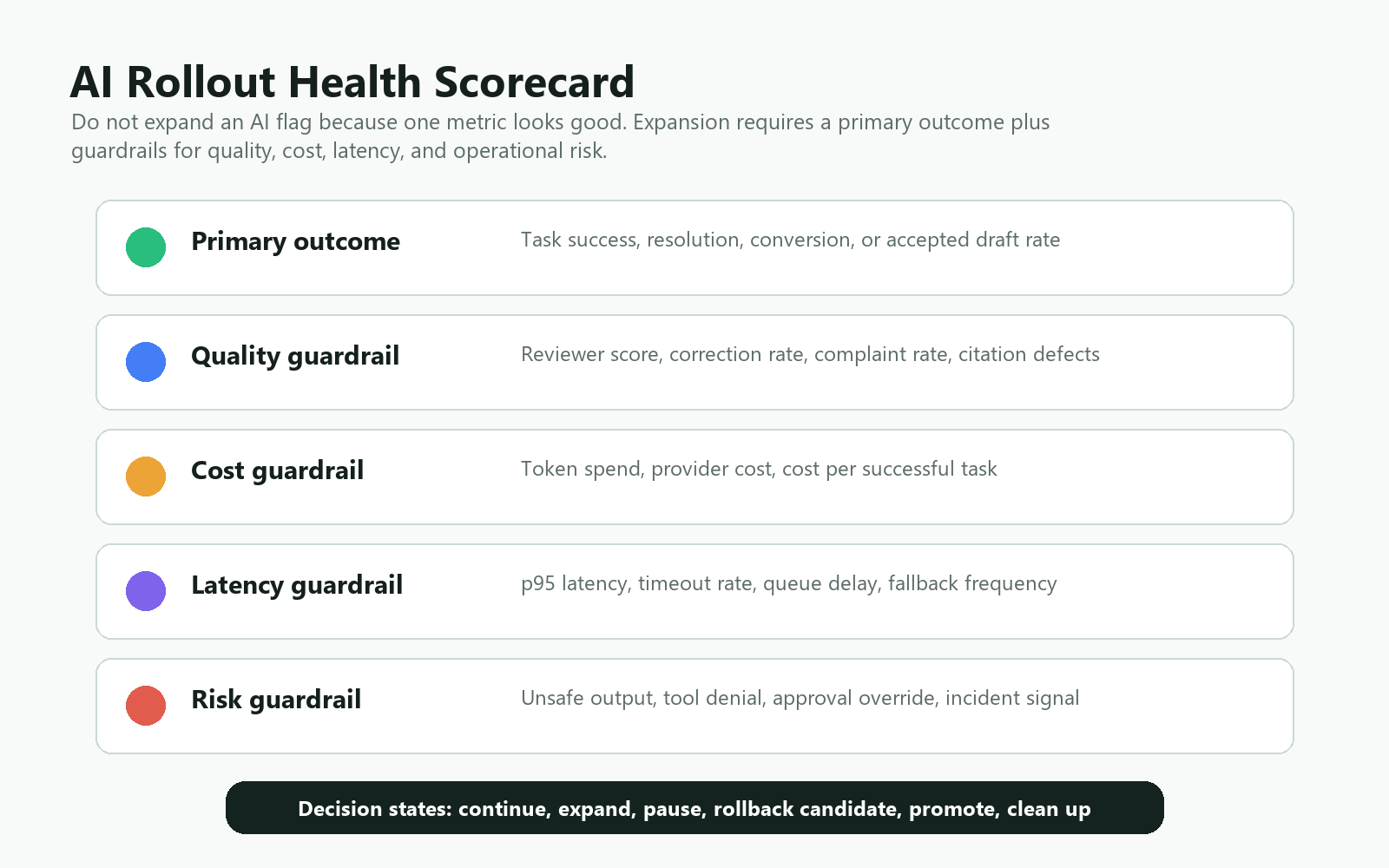
For release control, the observability stack should not become the only place a rollout decision exists. It should inform the flag decision. If p95 latency breaks a threshold, provider errors spike, fallback frequency increases, or severe quality defects appear, the release owner should reduce exposure, pause, or roll back through the feature flag control plane.
Implementation Blueprint
Use this sequence when integrating AI feature flags across OpenFeature, MCP, warehouse evidence, and observability tools.
| Step | Implementation action | Owner |
|---|---|---|
| 1. Name the release decision | Create a flag key such as support_assistant_route, not a vague ai_enabled switch. |
Product and engineering |
| 2. Define the typed variation | Return a route profile, prompt profile, model route, retrieval profile, guardrail mode, and fallback route. | Platform and AI service |
| 3. Evaluate in the trusted runtime | Use OpenFeature, a FeatBit SDK, or an evaluation API before the AI behavior runs. | Application team |
| 4. Emit exposure on execution | Record exposure only when the AI behavior actually runs, not when a page loads. | Application or gateway |
| 5. Add MCP workflow controls | Let assistants inspect, draft, and prepare changes; require approval for production mutations. | Developer experience |
| 6. Join evidence in analytics | Carry the same flagKey, variation, assignmentUnit, and unitId into outcomes and guardrails. |
Data team |
| 7. Attach health telemetry | Add flag and route context to traces, metrics, and logs where it is safe and useful. | SRE or platform |
| 8. Define decision states | Use continue, expand, pause, rollback candidate, promote, and clean up as explicit outcomes. | Release owner |
This blueprint keeps each tool in its lane. The SDK evaluates. MCP assists. The warehouse explains. Observability warns. FeatBit controls exposure and rollback.
Example Architecture For A Support Assistant Rollout
Imagine a team wants to test a citation-first support assistant profile. The candidate prompt retrieves verified documentation more aggressively and asks the model to cite sources before drafting an answer. The risk is not only "is the answer better?" The change may increase latency, retrieval cost, token usage, no-answer rate, and support escalations.
A practical architecture looks like this:
- The application evaluates
support_assistant_routeby account using a FeatBit OpenFeature provider or SDK. - The returned variation selects
support_citation_first_v4. - The model gateway maps that route to a prompt profile, retrieval profile, model route, guardrail mode, and fallback path.
- The application emits an exposure event when the assistant actually answers.
- Outcome events record resolution, human correction, escalation, accepted draft, or user feedback.
- Observability events record latency, provider error, timeout, queue delay, fallback, and estimated cost.
- The warehouse joins the exposure and outcome records by account or conversation.
- The release owner expands, pauses, or rolls back from FeatBit based on predefined guardrails.
- MCP helps the team inspect flag state, prepare rollout changes, and summarize audit history, but production mutations still require approval.
The same pattern works for model routes, retrieval profiles, guardrail thresholds, tool permissions, fallback modes, and agent autonomy levels.
FeatBit Integration Points
FeatBit does not need to replace the AI gateway, prompt registry, observability backend, or warehouse. It should make the release decision explicit and reversible.
Relevant FeatBit paths include:
- AI control layer for the broader runtime-control model;
- safe AI deployment for staged rollout, canary exposure, metric gates, and rollback;
- server-side evaluation for AI feature flags for trusted request-path evaluation;
- vendor-agnostic AI feature flags for OpenFeature-style contracts and portability;
- Feature Flag MCP integration for assistant workflow connectivity;
- feature flag lifecycle management for owner, review, evidence, and cleanup expectations.
This positioning is intentionally narrow. FeatBit is not an LLM observability vendor, a prompt editor, a model registry, or a warehouse. It is the release-control layer that decides who receives which AI behavior, records the decision context, and lets the team reverse course without redeploying.
Common Integration Mistakes
Using one global AI flag. A single ai_enabled flag can be useful as an emergency switch, but it cannot explain prompt, model, retrieval, guardrail, tool, fallback, and experiment decisions.
Evaluating flags after the AI call. If telemetry sees a variation but the AI behavior already ran without it, the flag is only a label. Evaluate before execution.
Letting MCP bypass approval. MCP can speed up discovery and rollout preparation. Production writes still need scoped credentials, clear intent, approval, and audit readback.
Tracking assignment without actual exposure. AI behavior can skip, timeout, degrade, or fall back. Record what actually ran.
Using observability as the release decision. Observability shows health signals. The release decision still needs an owner, rule, state, and rollback path.
Sending sensitive content into every event. Most release evidence needs profile names, join keys, outcomes, and guardrails. It does not need full prompt text, private transcripts, or credentials in every analytics record.
The Short Checklist
Before expanding an AI feature flag, confirm:
- The flag key names a specific AI release decision.
- The variation is typed and has a safe default.
- Evaluation happens before prompt, model, retrieval, or tool behavior runs.
- MCP workflows are scoped and approval-based for production changes.
- Exposure fires only when the AI behavior actually executes.
- Outcome, cost, latency, quality, and risk events share a join key.
- Observability includes enough release context to diagnose regressions.
- Expansion criteria and rollback criteria are defined before traffic increases.
- The flag has an owner, decision state, review date, and cleanup rule.
Integrating AI feature flags with OpenFeature, MCP, data warehouse, and observability tools is not about adding more dashboards. It is about keeping the release decision coherent. The runtime knows what to run, the assistant knows what it may help with, the warehouse can explain what happened, observability can detect health risk, and the release owner can expand or roll back from one control point.
Source Notes
- OpenFeature: the flag evaluation specification and evaluation context specification define vendor-neutral concepts for typed flag calls, default values, evaluation context, providers, and evaluation metadata.
- MCP: the tools specification describes tool discovery and human-in-the-loop expectations, while the authorization specification describes protected-resource and token handling requirements.
- FeatBit implementation context: FeatBit MCP, Track Insights API, Data Export, OpenTelemetry integration, and the Node.js OpenFeature provider support the integration patterns described here.
- Observability context: OpenTelemetry's generative AI semantic conventions page now points readers to the dedicated GenAI semantic conventions repository.
Image And Open Graph Notes
- Use
cover.pngas the Open Graph image because it summarizes the four integration lanes for AI feature flag rollout control. - Use
integration-lanes.pngnear the opening to show the distinct jobs of runtime evaluation, MCP workflow, warehouse evidence, and observability health. - Use
evidence-contract.pngin the warehouse section because it turns the join-key requirement into a concrete field model. - Use
rollout-health-scorecard.pngin the observability section because it frames the expansion decision around a primary outcome plus quality, cost, latency, and risk guardrails.