
Local Evaluation for Model Gating: Route AI Models Without Adding Runtime Risk
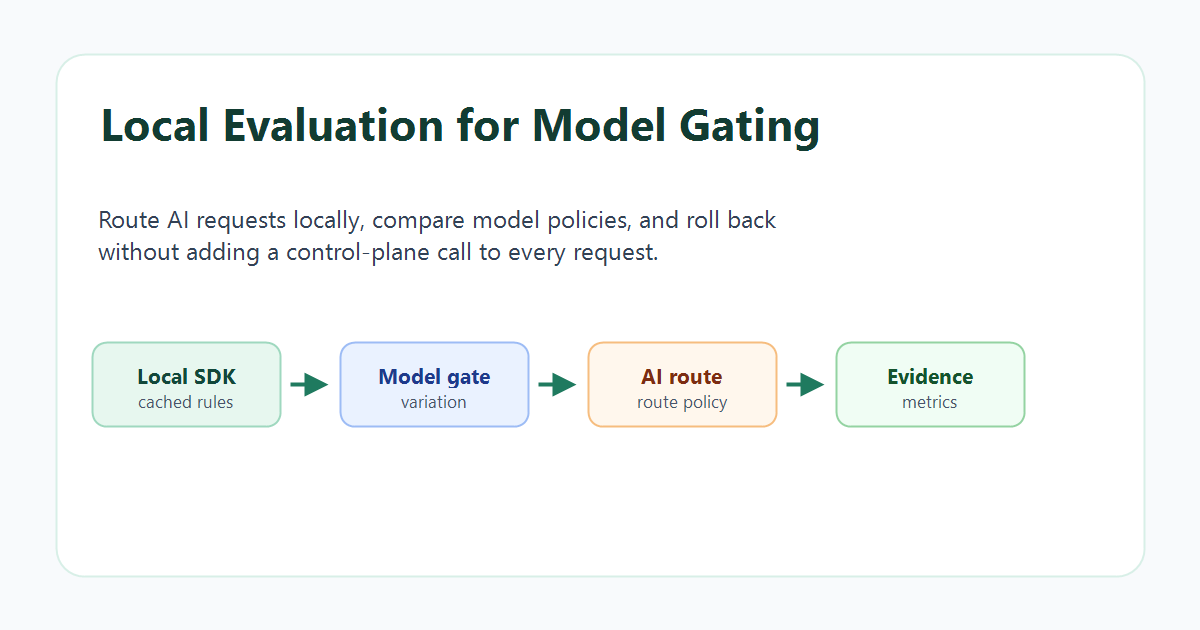
AI teams rarely switch models only once. They route between a fast model and a reasoning model. They compare prompt or provider variants. They fall back when latency spikes, cost crosses a limit, or quality drops. They need that control in production without adding a remote decision call to every AI request.
That is the job of local evaluation for model gating. A feature flag SDK keeps rules and variations in a local cache, evaluates the model decision in process, and sends events back for observability and experimentation. FeatBit's server-side SDK model is designed for this pattern: server-side SDKs evaluate flags locally, use local cache when the network is unavailable, update that cache when the network is available, and receive real-time updates from the server.
For AI systems, this turns a model branch into an operational control point. Product, platform, and AI engineering teams can route selected traffic to a new model, compare outcomes, pause an experiment, or roll back to a fallback model without a redeploy.
What local evaluation means for model gates
Local evaluation means the application does not call a flag service for every request. The SDK receives flag configuration, stores it locally, and resolves the flag value inside the running process. The flag service remains the control plane, while the application keeps the hot path decision close to the code that calls the model.
For model gating, the flag value is usually not a simple on or off decision. It can be a string or JSON variation that tells the application which model policy to use:
{
  "provider": "openai",
  "model": "fast-model",
  "promptVersion": "support-v3",
  "fallback": "deterministic-summary",
  "maxLatencyMs": 1200
}
The application evaluates the flag with request context, then routes the request:
type ModelPolicy = {
  provider: string
  model: string
  promptVersion: string
  fallback: string
  maxLatencyMs: number
}

const fallbackPolicy: ModelPolicy = {
  provider: "internal",
  model: "safe-fallback",
  promptVersion: "support-v2",
  fallback: "deterministic-summary",
  maxLatencyMs: 800
}

export async function answerSupportQuestion(user, question, fbClient) {
  const evaluationContext = {
    key: user.id,
    email: user.email,
    plan: user.plan,
    region: user.region,
    organizationId: user.organizationId
  }

  const policy = fbClient.variation(
    "ai-support-model-policy",
    evaluationContext,
    fallbackPolicy
  )

  return runModelWithFallback(policy, question)
}
This is not a benchmark claim. The point is architectural: model selection becomes a named, observable, reversible runtime decision instead of a hardcoded branch or a redeploy-time environment variable.
Why AI model routing should not depend on a per-request control-plane call
Model calls are already expensive enough to operate carefully. A gate that controls those calls should avoid three failure modes:
- A network dependency in the request path just to choose a model.
- A global config change that cannot target a segment, tenant, region, or request class.
- A rollback process that requires code changes, CI, deployment, and incident coordination before traffic is contained.
OpenFeature describes feature flags as runtime decisions that can alter application behavior without deploying new code, and it emphasizes context-aware evaluation for use cases such as canary releases and A/B testing. That general principle matters even more for AI systems because the model call is a production behavior boundary: quality, latency, safety, and cost can change even when the application code is unchanged.
Local evaluation keeps the control decision inside the service. The control plane can still change rules, targeting, and rollout percentages. The application can still emit evaluation and metric events. But the request does not need a synchronous control-plane round trip before it can decide which model policy to apply.
The reader job: route, compare, roll out, or roll back models
A useful model gate answers four questions:
- Who is eligible for this model policy?
- Which model or prompt variation should this request use?
- What metrics prove the policy is safe enough to expand?
- How fast can the team pause, reduce exposure, or fall back?
That is why a model gate should be built as a release control object, not only a code branch. In FeatBit, targeting rules can use built-in and custom user attributes. Percentage rollouts can expose a feature to a small slice of users and then increase exposure as confidence grows. Experiments can connect metrics to flag evaluations so teams can compare variations and make a rollout decision from measured behavior.
For an AI model gate, the same structure can be mapped to model operations:
| Control question | Model-gating example | FeatBit mechanism |
|---|---|---|
| Eligibility | Only internal users, one enterprise tenant, or low-risk support topics | Targeting rules and user attributes |
| Allocation | 90 percent fast model, 10 percent reasoning model | Percentage rollout or multi-variation flag |
| Comparison | Track answer acceptance, fallback rate, latency, and cost per request | Experimentation and custom events |
| Reversal | Disable the risky model policy or set all traffic to fallback | Flag off variation or updated rollout |
The exact metrics depend on the application. A coding assistant might track task completion and edit acceptance. A support assistant might track deflection quality, escalation rate, latency, and unsafe-response review outcomes. A search assistant might track click-through, reformulation rate, answer citations, and cost.
A practical rollout path
Start with the smallest audience that can produce useful signal. A model gate does not make a risky model safe by itself. It makes exposure adjustable, observable, and reversible.
Use a four-stage rollout path:
- Internal traffic. Route employees or dogfood users to the new model policy. Verify that evaluation context is correct, events are flowing, and fallback behavior works.
- Beta segment. Target a known customer segment, geography, plan, or tenant that has agreed to participate. Keep the old model available as the fallback.
- Small production exposure. Use a percentage rollout for a small traffic slice. Watch quality, latency, cost, errors, and fallback rate.
- Ramp or rollback. Increase exposure only when the metrics remain within the agreed window. If a critical signal fails, set the gate to the safe policy first and investigate after containment.
The decision rule should be written before the rollout starts. For example:
- Expand when quality is stable, latency remains within the service objective, and fallback rate does not rise.
- Pause when quality is inconclusive, cost is above budget, or sample size is too small.
- Roll back when safety review fails, customer-impacting errors rise, or the fallback path is being used unexpectedly often.
This keeps the model release conversation operational. The team is not debating whether the model is generally good. It is deciding whether this policy is safe for this audience at this exposure level.
What to put in the evaluation context
Local evaluation is only as useful as the context passed into it. Avoid evaluating model gates with only a user ID unless the model policy truly applies to everyone.
Useful context often includes:
- User key, organization key, and plan.
- Region, locale, and data boundary.
- Application surface, such as chat, search, support, or internal tooling.
- Request class, such as low-risk summary, high-risk recommendation, or human-review required.
- Device, channel, or environment.
- Prior eligibility, such as beta enrollment or enterprise allowlist.
Do not pass raw prompts, sensitive documents, or unnecessary personal data into flag evaluation. The gate needs enough context to choose a policy, not the full AI workload payload.
OpenFeature's evaluation context concept is useful here because it frames context as arbitrary data used as the basis for dynamic evaluation. In practice, that means the model gate should receive stable, low-risk attributes that help route traffic consistently.
How to compare model variants without mixing the data
Model comparison fails when exposure and measurement drift apart. If the application routes a request to one model but records the metric under another label, the experiment becomes hard to trust.
Keep these identifiers aligned:
- Flag key: the named control surface, such as
ai-support-model-policy. - Variation key: the resolved model policy, such as
fast-v1,reasoning-v2, orfallback-v1. - Evaluation context key: the stable user or organization key used for rollout assignment.
- Metric event name: the outcome you will compare, such as
support_answer_accepted,answer_escalated,fallback_used, ormodel_latency_ms. - Trace or log attributes: the same flag and variation labels used by dashboards and incident reviews.
FeatBit experimentation connects metrics to flags and records evaluation events when .variation() is called for flags included in experiments. That matters for model gating because the evaluation event is the exposure record: it tells the analysis which user, request group, or segment saw which model policy.
Rollback patterns for model gates
Model rollback is not always a binary "turn it off" action. A good gate supports several containment moves:
- Disable a new model for everyone by setting the default variation to the known safe policy.
- Reduce exposure from a production percentage back to beta or internal traffic.
- Target rollback to a tenant, region, plan, surface, or request class.
- Route only high-risk request classes to a deterministic fallback while leaving low-risk summaries on the model.
- Freeze an experiment while preserving the flag, metrics, and audit trail for review.
The safest rollback plan is simple enough to execute during an incident. Keep a fallback variation ready. Name the flag so operators understand the behavior it controls. Make sure the dashboard can show which variation is live and who is still exposed.
Local evaluation does not remove the need for observability
Local evaluation controls exposure. It does not prove that the model is working. You still need logs, traces, metrics, and review workflows that can answer:
- Which model policy handled this request?
- Which prompt version was used?
- Which fallback, if any, was triggered?
- What was the user-visible outcome?
- Did latency, cost, escalation, or safety-review rate change after exposure expanded?
FeatBit's AI-native positioning treats feature flags as runtime governance for staged rollout, evaluation, experimentation, and rollback. The model gate should therefore be paired with outcome metrics and operational alerts. The value is not only that the team can flip a flag. The value is that the flag becomes the join key between exposure, behavior, and decision.
When local evaluation is the wrong abstraction
Local evaluation is a strong fit when the application already owns the model call and needs low-latency routing control. It is less useful when:
- A central AI gateway owns all model policy and application teams should not override it.
- The decision requires live data that is not available in the application process.
- The model policy changes per request based on sensitive payload inspection that should stay outside the flag system.
- The team has no metrics, fallback, or rollback owner.
In those cases, a feature flag may still control access to the gateway, but the detailed model policy may belong in the gateway itself. The boundary should be explicit: use FeatBit to control release exposure, targeting, and reversibility; keep sensitive inference logic where it can be governed properly.
Implementation checklist
Before you ship a model gate, check the following:
- The flag is typed as a boolean, string, or JSON policy that matches the routing decision.
- The fallback variation is safe, deterministic enough for the use case, and tested.
- Evaluation context uses stable attributes and avoids unnecessary sensitive data.
- Server-side evaluation happens inside the application or service that owns the model call.
- Percentage rollout and targeting rules match the intended exposure plan.
- Experiment metrics are defined before production exposure.
- Evaluation events, model outcome events, and traces share the same flag and variation labels.
- Operators know how to pause, reduce, or roll back exposure without a deployment.
- The flag has an owner and a cleanup decision after the rollout or experiment.
How FeatBit fits this pattern
FeatBit is useful for model gating when the team wants open-source, self-hostable runtime control rather than hardcoded model routing. The same feature flag primitives used for progressive delivery can be applied to AI model policies:
- Server-side SDK local evaluation for in-process decisions.
- Targeting rules for users, tenants, regions, plans, and risk segments.
- Percentage rollouts for staged exposure.
- Experimentation for comparing model or prompt variations against business and reliability metrics.
- Audit and governance workflows for production control changes.
That does not mean every AI decision belongs in a feature flag. It means the release decision around a model policy should be controllable at runtime, measurable during exposure, and reversible before a regression spreads.
Source notes and further reading
- FeatBit SDK documentation explains the difference between server-side and client-side SDKs, including local evaluation, local cache behavior, real-time updates, and evaluation events: FeatBit SDK overview.
- FeatBit targeting and rollout documentation describes targeting rules, custom attributes, percentage rollout, and rollout assignment logic: Targeting rules and Percentage rollouts.
- FeatBit experimentation documentation describes connecting metrics to flags, evaluation events, and rollout decisions from experiment results: Understanding Experimentation.
- OpenFeature provides a vendor-neutral framing for runtime flag evaluation, evaluation context, providers, hooks, and events: OpenFeature introduction.
- FeatBit's AI-native pages explain the broader release-control point of view for AI systems: AI-native feature flags and Feature Flags as the AI Control Layer.