
Real-Time Safety and Governance for AI-Generated Software
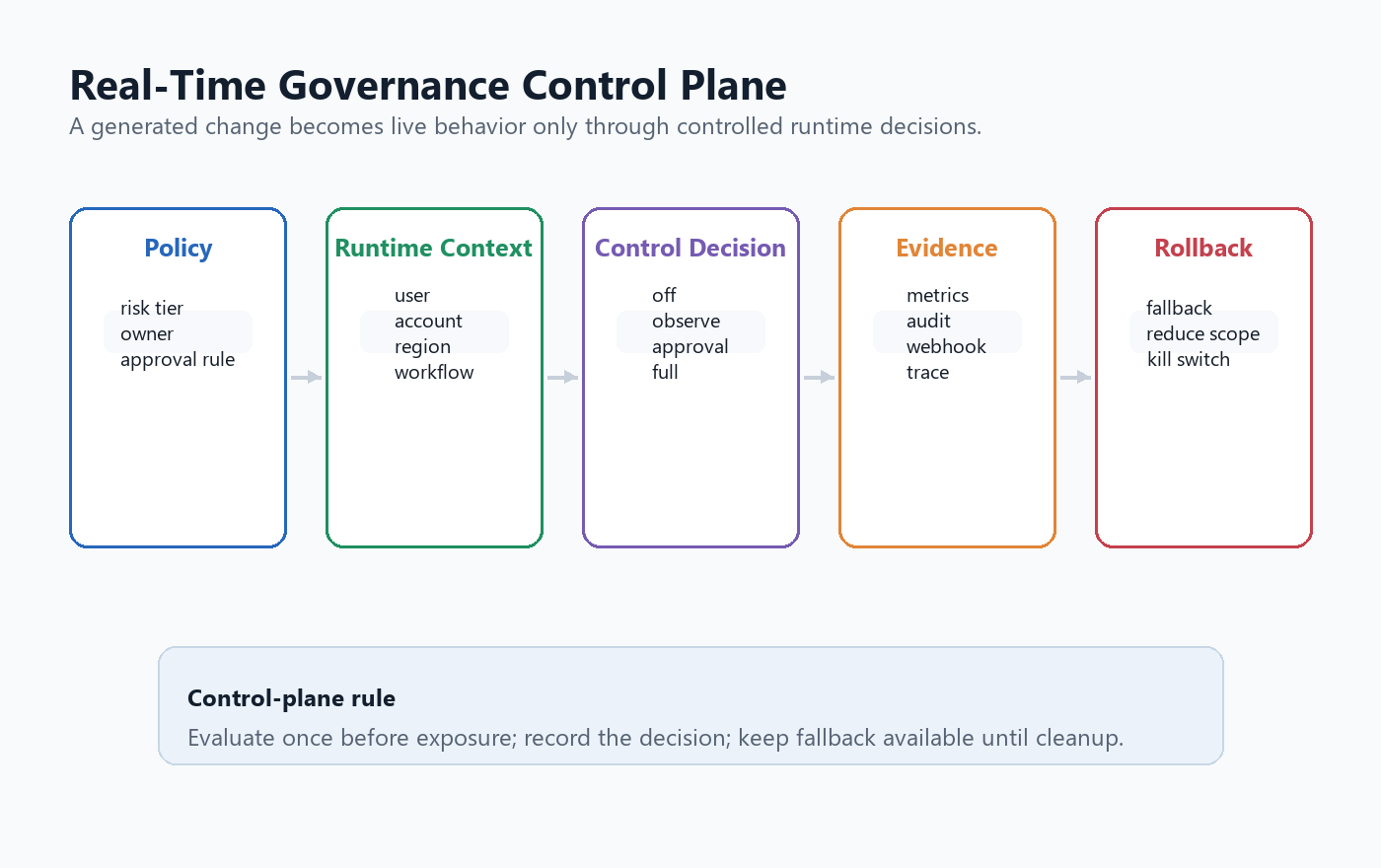
Real-time safety and governance for AI-generated software means controlling what a generated change can do while the software is running, not only reviewing the code before it ships. The control plane needs to decide who sees the behavior, what guardrail applies, when human approval is required, what evidence is recorded, and how the team can roll back without waiting for another deployment.
That is a different job from AI code review. Review asks whether the generated diff looks acceptable. Real-time governance asks whether a live behavior should expand, pause, require approval, fall back, or disappear for a specific user, account, region, environment, workflow, or risk level.
For teams evaluating tools, the buying question is practical: can your release system turn AI policy into runtime controls that operators can change safely, inspect later, and connect to production evidence?
Why Real-Time Governance Is A Separate Layer
AI-generated software compresses the time between idea, implementation, and production. A generated pull request can add a workflow, alter a permission path, change model routing, create a new integration, or modify a customer-visible experience faster than the organization can build a new governance process around it.
Static controls still matter:
- repository permissions;
- secure coding standards;
- CI checks;
- dependency scanning;
- human code review;
- threat modeling for high-risk workflows.
They are not enough once the behavior is deployed. Production risk depends on context. A generated workflow might be safe for internal testers, acceptable for one beta account, restricted in one region, too expensive for a free tier, or dangerous when an incident is active. That context changes faster than code can be redeployed.
NIST describes the AI Risk Management Framework as a voluntary framework for managing risks to individuals, organizations, and society, and notes that AI RMF 1.0 is being revised. That framing is useful for release teams: treat governance as a continuous risk-management loop, not as a one-time checklist. ISO's ISO/IEC 42001 overview also frames AI governance as a management system that puts policies, objectives, and processes around responsible AI use. A feature flag platform does not certify compliance with either framework, but it can operationalize part of the control layer those programs need.
The Five Runtime Control Surfaces
Real-time governance becomes easier to design when the team names the control surfaces explicitly.
| Control surface | Governance question | Runtime control |
|---|---|---|
| Exposure | Who can experience the generated behavior now? | Targeting rules, segments, environments, percentage rollout |
| Authority | What is the behavior allowed to do? | Mode flags, tool tiers, approval-required variation |
| Guardrails | What signal stops or limits the rollout? | Metrics, online evals, cost limits, error thresholds, incident mode |
| Evidence | What record proves what changed and why? | Audit log, release note, webhook, telemetry, decision record |
| Reversal | How do operators reduce risk quickly? | Kill switch, fallback variation, targeted rollback, percentage reduction |
This model intentionally separates governance from generic access control. Identity, authorization, sandboxing, data boundaries, and API permissions decide what is ever possible. Runtime governance decides which approved behavior is active right now.
That distinction matters for AI-generated software because the same generated capability may need different policy modes:
- off for production until reviewed;
- internal-only for smoke testing;
- beta-only for named accounts;
- read-only or draft-only for sensitive workflows;
- approval-required for customer-visible side effects;
- fallback mode during incidents;
- full release after evidence is healthy.
Turn Policy Into A Runtime Contract
Start every governed AI-generated change with a runtime contract. This contract is short enough to fit in a pull request, ticket, or flag description, but specific enough for platform, product, security, and support teams to review.
ai_generated_software_control:
  behavior: "Generated renewal recommendation workflow"
  owner: "growth-platform"
  risk_level: "medium"
  default_state: "off"
  first_audience: "internal users"
  allowed_modes:
    - off
    - observe
    - draft_only
    - approval_required
    - full
  guardrails:
    - "workflow_error_rate"
    - "recommendation_acceptance_rate"
    - "support_escalation_count"
    - "llm_cost_per_account"
  approval_required_when:
    - "customer_visible_write"
    - "enterprise_account"
    - "region_under_review"
  rollback_action: "serve stable renewal workflow"
  audit_sources:
    - "flag audit log"
    - "release ticket"
    - "observability event"
  cleanup_rule: "remove temporary rollout flag after full release and two healthy review windows"
The exact fields can vary. The important part is that the policy becomes executable. A reviewer should be able to trace each line to a runtime control, a telemetry signal, or an audit source.
FeatBit supports this pattern through flag variations, targeting rules, percentage rollouts, audit logs, webhooks, observability integrations, and IAM policies. The application still owns hard enforcement. FeatBit owns the release decision: which variation is active for this context, who changed it, and how exposure can move without redeploying.
Use A Real-Time Safety Loop
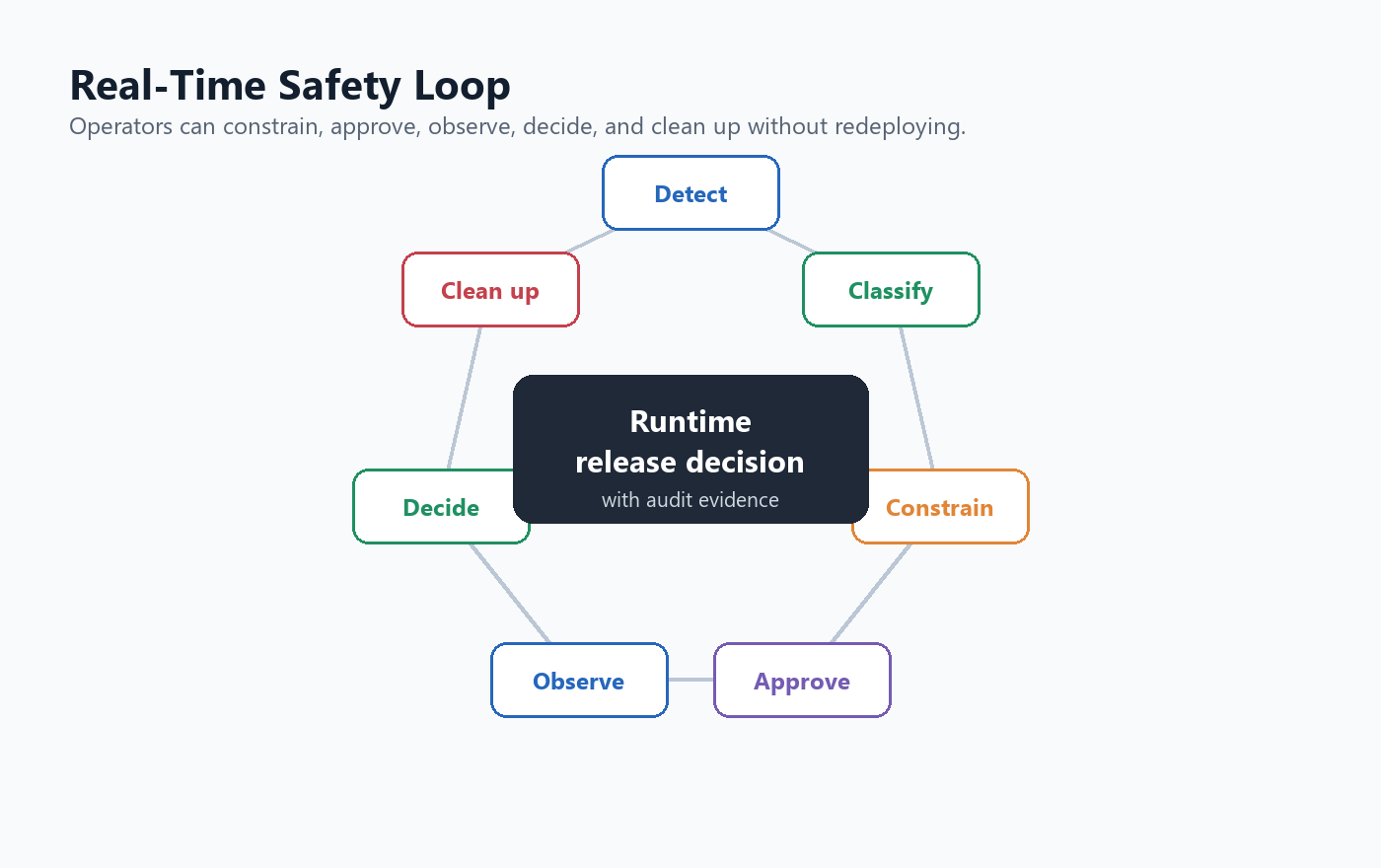
Real-time governance should follow a loop that operators can run during ordinary rollout and during incidents.
Detect
Capture the signal that may require a control-plane decision. The signal can come from CI, online evals, observability, customer support, human review, error rate, latency, cost, conversion, policy review, or a security alert.
Classify
Name the affected behavior and risk. Is this a generated UI path, backend workflow, model route, prompt, tool action, data movement, permission path, or integration? Which users, accounts, environments, regions, and plans are affected?
Constrain
Choose the narrowest useful control. That may be internal-only exposure, a lower rollout percentage, draft-only mode, an approval-required variation, a region exclusion, or a fallback profile.
Approve
Require human approval only where it changes the outcome. Approval is useful for irreversible actions, sensitive data, customer-visible writes, permission changes, production expansion, or unresolved policy questions. It becomes noise when every low-risk suggestion waits for the same review ritual.
Observe
Connect the evaluated variation to telemetry. A release owner should be able to compare the generated behavior against the stable path by cohort, account, environment, and time window.
Decide
The decision should be explicit: continue, expand, pause, roll back, require more evidence, or convert the temporary control into a permanent operational policy.
Clean Up
Temporary governance flags should not become permanent confusion. After the generated behavior is fully accepted, remove the old path or document why the control remains durable.
Approval Paths Should Match Risk
Vendor pages often talk about approvals, change requests, or four-eyes workflows. Unleash, for example, documents change requests as an approval step before changes can be made in an environment and describes requiring up to 10 approvals. That is useful category context, but the real design decision is not the number of approvers. It is the risk boundary that makes approval valuable.
Use approvals for AI-generated software when:
- the behavior changes customer-visible state;
- the action is hard to reverse;
- the generated path touches permissions, payments, security, or data movement;
- the release enters a new region, segment, or enterprise account;
- the guardrail evidence is incomplete;
- a tool, workflow, or model route crosses into higher authority;
- the incident state requires human ownership before expansion.
Do not use approvals as the only safety control. A strong approval path should sit beside targeting, fallback, telemetry, audit logs, and rollback.
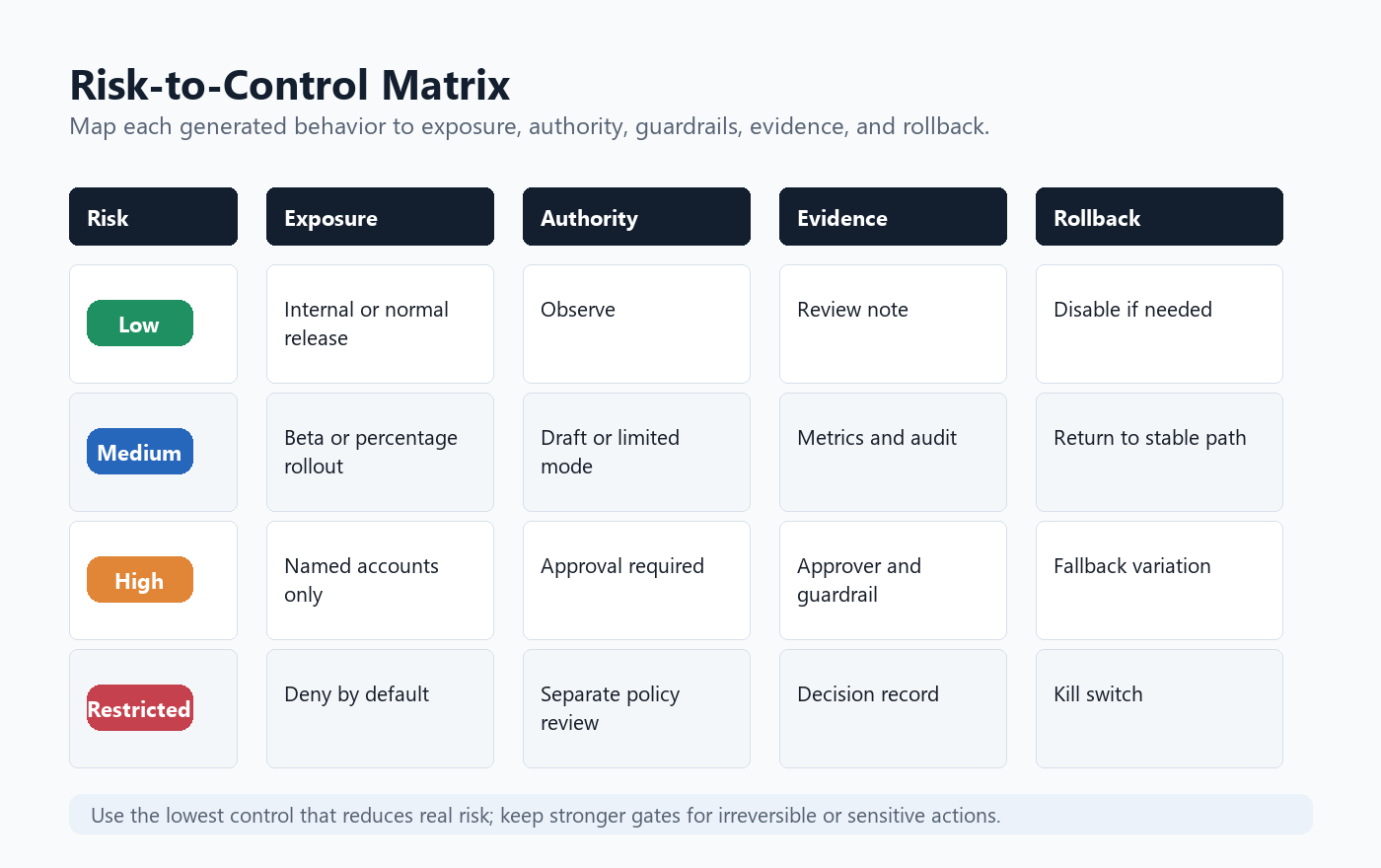
| Risk tier | Example generated behavior | Default runtime posture |
|---|---|---|
| Low | Copy, labels, UI text, internal report formatting | Normal review, optional flag if exposure varies |
| Medium | Recommendation, ranking, onboarding flow, non-critical integration | Flagged rollout, internal first, guardrail metrics |
| High | Customer-visible write, billing path, permission branch, sensitive data workflow | Approval-required, narrow targeting, audit review |
| Restricted | Legal, regulated, financial, safety-critical, or irreversible action | Deny by default or require separate policy review |
What To Audit In Real Time
Auditability is not only a monthly compliance export. For AI-generated software, it is part of the runtime control system.
Log decisions, not just executions. A denied, constrained, or approval-required decision is still evidence that the control plane worked.
Useful audit fields include:
- generated behavior name and owner;
- flag key, variation, environment, and targeting rule;
- user, account, segment, region, tier, workflow, and risk level when appropriate;
- previous state and new state;
- approval request, approver, and outcome;
- guardrail signal that triggered the change;
- rollback or fallback action;
- cleanup or permanence decision.
FeatBit's audit log documents changes made to feature flags in an environment. FeatBit targeting rules can match built-in and custom user attributes, and percentage rollouts can expose a variation to a portion of matching users. Those controls help reconstruct who changed exposure and which context received a generated behavior. Teams should still decide their own retention, privacy, SIEM, and compliance requirements.
Where Guardrails Belong
OWASP's 2025 Top 10 for LLM and Gen AI applications lists risks such as prompt injection, sensitive information disclosure, supply chain, excessive agency, misinformation, and unbounded consumption. Not every AI-generated software change is an LLM application, but the categories are useful prompts for deciding where runtime guardrails should live.
Put guardrails near the boundary they protect:
| Boundary | Guardrail examples | Runtime action |
|---|---|---|
| User exposure | account, segment, region, plan, risk level | target, exclude, or reduce percentage |
| Model or prompt route | eval score, cost, latency, hallucination review | roll back to stable profile |
| Tool or integration | tool risk class, approval state, failure rate | deny one tool or require approval |
| Data access | tenant, region, data classification, source allowlist | constrain or block the behavior |
| Business outcome | conversion, task completion, support load, refund rate | pause or continue rollout |
| Incident state | active alert, error spike, policy hold | fallback or kill switch |
The model can be told about policy. The application should enforce policy. A runtime flag can choose a safe mode, but the service boundary should still validate authorization, data access, and side effects.
How FeatBit Fits The Architecture
FeatBit is the release-control layer in this architecture. It should sit between deployed software and broad user exposure.
A practical FeatBit workflow looks like this:
- The repository and CI validate the generated code.
- Human review confirms architecture, intent, risk, and tests.
- The application evaluates a FeatBit flag server-side before the generated behavior runs.
- FeatBit targeting decides whether the user, account, environment, or segment receives
off,observe,draft_only,approval_required,fallback, orfull. - Observability records the evaluated variation beside the production signal.
- Audit logs and webhooks preserve the control-plane change.
- The release owner expands, pauses, rolls back, or cleans up based on evidence.
This is why FeatBit treats feature flags as release-decision infrastructure. The flag is not just a switch. It is the runtime decision point where exposure, authority, guardrails, evidence, and reversal meet.
For adjacent implementation detail, use FeatBit's guide to feature flags for AI-generated code when the task is one generated pull request, AI-generated code governance when the task is a team operating model, and runtime control for AI agents when the task is post-deployment agent operations. This article is narrower: how to evaluate a real-time governance control plane for AI-generated software.
Evaluation Checklist For Buyers And Platform Teams
Before choosing or designing a governance layer for AI-generated software, ask:
- Can the system target exposure by user, account, segment, environment, region, plan, or risk context?
- Can operators change a behavior mode without redeploying?
- Are safe fallbacks defined for each generated behavior?
- Can approval be required only for higher-risk contexts?
- Can the platform record who changed the control state and when?
- Can the evaluated variation be attached to logs, traces, metrics, or experiment events?
- Can one behavior be rolled back without shutting down the entire product?
- Can temporary controls be cleaned up after the release decision?
- Can self-hosted or private deployment keep release-control data inside the required infrastructure boundary?
- Does the workflow distinguish compliance evidence from compliance claims?
If the answer is mostly no, the organization may have AI code review, but it does not yet have real-time governance for AI-generated software.
Common Mistakes
Making AI involvement the only trigger. Risk comes from production behavior, not from whether a model helped write a diff. Govern by impact, reversibility, data sensitivity, authority, and evidence quality.
Putting policy only in prompts. Prompts can guide behavior. Runtime policy should be enforced by application code, service boundaries, and release controls.
Using one global AI switch. A global switch cannot express audience, authority, guardrail, approval, incident mode, or cleanup state.
Collecting audit logs without decision context. Knowing that a flag changed is useful. Knowing why it changed, which risk it addressed, which evidence triggered it, and who approved it is better.
Treating feature flags as compliance proof. Feature flags can support governance evidence. They do not replace legal review, security controls, privacy review, or a formal AI management system.
Source Notes
- NIST's AI Risk Management Framework is used as risk-management context. NIST notes that AI RMF 1.0 is being revised and that the framework is voluntary.
- ISO's ISO/IEC 42001:2023 overview is cited for the concept of an AI management system and for AI governance context. This article does not claim certification or legal compliance.
- OWASP's 2025 Top 10 for LLM and Gen AI applications is used to frame application-layer risk categories such as excessive agency, sensitive information disclosure, and unbounded consumption.
- Unleash change request documentation is cited only as vendor terminology and category context for approval workflows.
- FeatBit product references come from official docs for targeting rules, percentage rollouts, audit logs, IAM policies, webhooks, and OpenTelemetry integration.
Image And Open Graph Notes
cover.pngshould represent a real-time release-control dashboard for generated software, not a decorative AI illustration.control-plane-blueprint.pngsupports the opening architecture promise.governance-signal-loop.pngsupports the operational safety loop.risk-control-matrix.pngsupports the mapping from risks to controls and rollback actions.