
Nobody Cares About Feature Flags.
They care that the product just works.
Nobody opens your product hoping to experience your release process.
They want to export an invoice, finish a booking, or get an answer they can use. When something changes, they still expect their work to get done.
That is an awkward starting point for a company building a feature flag platform. It is also a useful constraint. Every release control should earn its place through the experience it protects.
A release spends the user's trust
Imagine a new invoice exporter. It passes your tests. The deployment succeeds. In production, one customer's unusually large invoice produces an incomplete file.
The code is deployed in both of these scenarios:
- Every customer starts using the new exporter immediately.
- A small, deliberately chosen group uses it while everyone else keeps the existing path.
The difference is how many people encounter an assumption you have not yet tested.
Progressive rollout gives a team control over that exposure. But a small audience is still an audience of real people. Choose early users deliberately, explain a beta when appropriate, and provide support. A percentage on a dashboard does not make their failed task less frustrating.
The useful question before expanding is: What have we learned that justifies asking more users to depend on this?
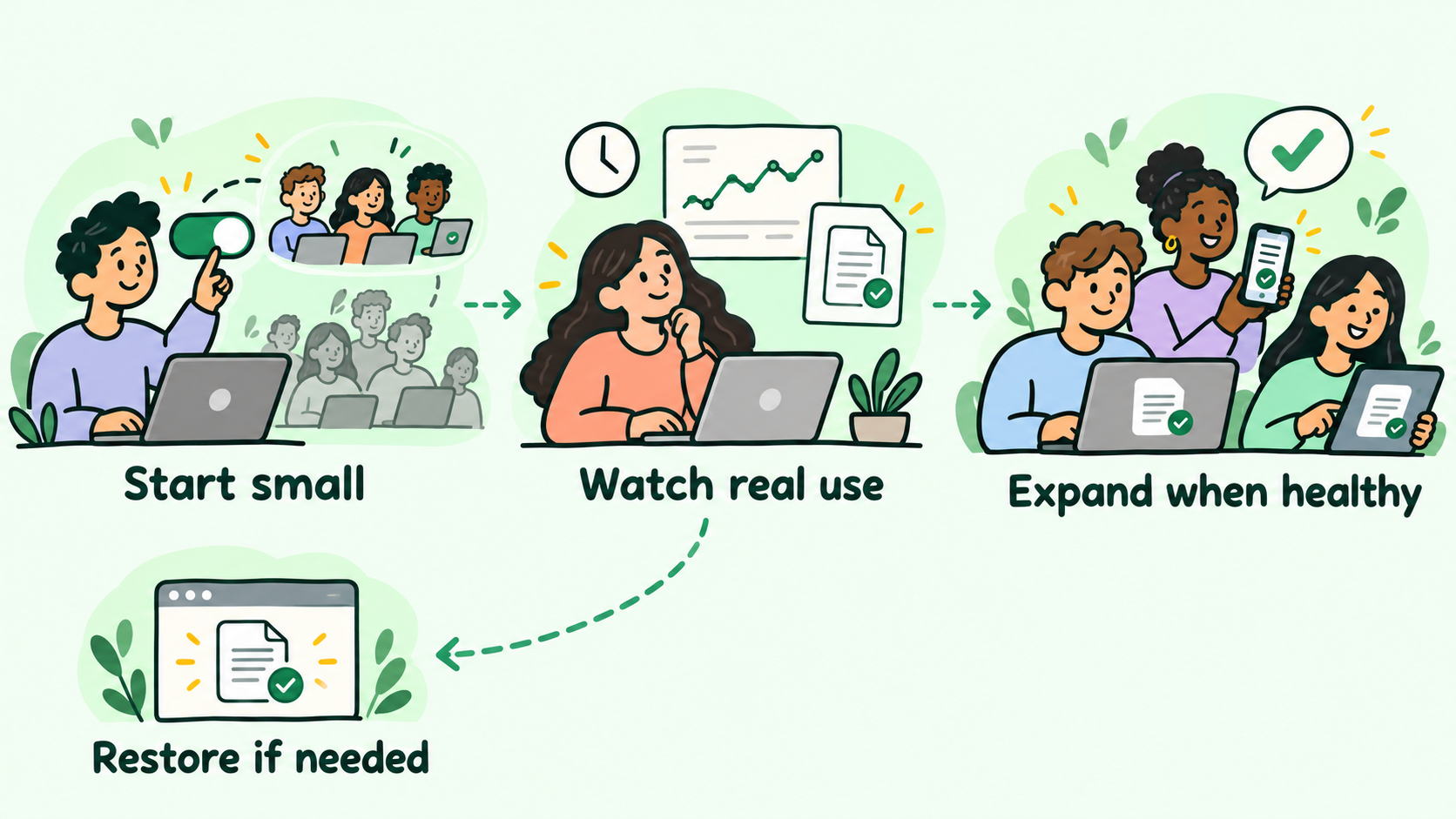
Start with what the user must still be able to do
For the exporter, the release promise might be simple: customers can download a complete, correct invoice, including large ones.
That promise makes the controls concrete. Keep the existing exporter available. Place the flag before the new export operation starts. Connect errors, duration, and completion signals to the version actually used. Assign someone to respond when those signals deteriorate.
Rehearse switching back before relying on it. A fallback nobody has exercised is another assumption.
There are limits. Disabling the new path can redirect subsequent work once the updated decision is applied. It does not repair files already downloaded, undo database changes, or necessarily stop work already running. Those consequences need their own handling. Our rollback and hotfix guide goes deeper into that boundary.
Some changes also need explicit communication. If customers see inconsistent behavior across a shared workspace, a surprise switch may create confusion even when both versions function correctly. Choose an audience boundary that fits how people collaborate.
“Just works” includes continuity and understandable behavior.
A healthy rollout still has to earn its place
Suppose the exporter produces no errors and responds quickly. Customers still struggle to find the download, then contact support.
The release is technically healthy. The product problem remains.
This is where feature flag conversations can stop too early. Controlling exposure gives us a way to introduce a change. We still need to establish whether the change deserves to stay.
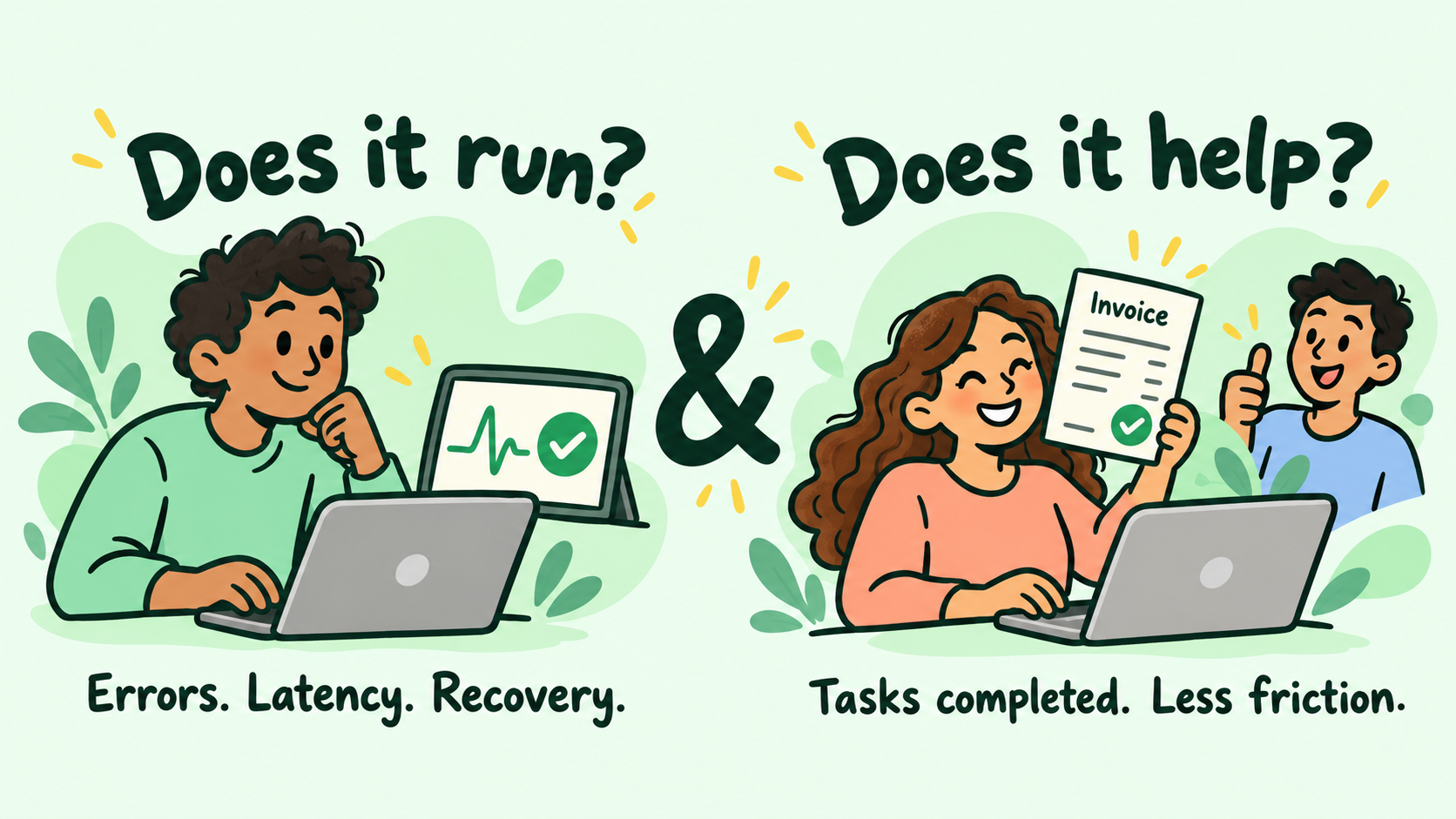
For the exporter, two questions deserve separate evidence:
- Does it run reliably? Watch failures, latency, incomplete files, and recovery behavior.
- Does it help customers finish? Look at successful exports, repeated attempts, and support feedback.
A rollout can reveal operational problems without proving that a feature improves an outcome. If you need a causal comparison, design a controlled experiment with consistent assignment and meaningful outcome metrics. Do not treat a quiet canary as evidence that customers prefer the new version.
Sometimes the right decision is to keep the old experience. A release process should make that decision affordable, too.
The controls should earn their maintenance
Feature flags add branches, configuration, and decisions someone must understand. Left unmanaged, they can make the product harder to reason about.
A temporary release flag needs an owner and an expected end state. Once the new exporter is accepted and its recovery window closes, remove the obsolete branch and flag. Long-lived operational controls need a continuing purpose and regular review. Feature flag lifecycle management is part of keeping the protection affordable.
This also changes how we should judge a flag platform. Count the work customers can complete, the problems the team detects, and the time it takes to contain a bad change. More flags alone tells us little about any of those things.
That is the standard we want FeatBit to meet. Its release management workflow connects audience control, observation, and recovery to the decisions a team actually has to make.
Customers may never know that a release was paused, an experiment was rejected, or a familiar path was restored.
They got their invoice. They carried on with their day.
That is a good outcome for a feature flag.
Image disclosure: The cover and illustrations in this article were generated with AI.