
How to Refactor a Vibe-Coded App Without a Full Rewrite
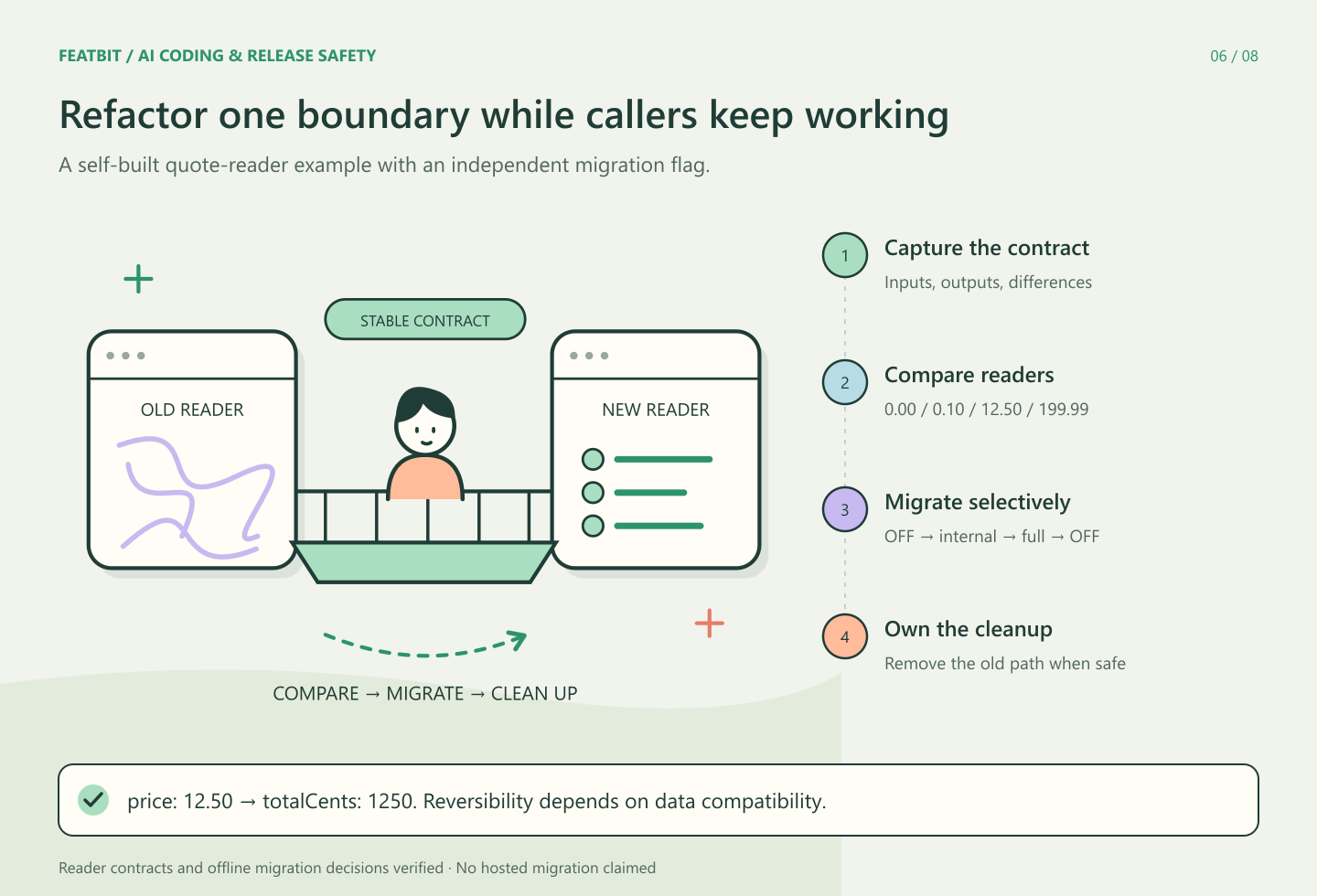
Refactor a vibe-coded application by recovering one explicit, testable module boundary at a time. Preserve the current user contract, introduce a replacement behind a controlled entry point, compare supported behavior, and migrate only after the data and rollback paths are understood.
A full rewrite may sometimes be justified. It should follow a diagnosis of architectural or operational constraints, rather than become the default reaction to code nobody feels confident changing.
This guide uses a small, self-built travel example. It is not a customer rescue story, and it makes no claim about a typical percentage of maintenance cost saved.
Start from the uncertainty that prevents change
In a discussion about maintaining vibe-coded systems, the author describes missing design reasons, inconsistent patterns, and engineers losing confidence in changes. The same post acknowledges projects that held up through disciplined review and maintenance. That matters: the workflow is not destiny.
Another account of replacing a SaaS subscription raises downstream maintenance and integration costs. These anonymous reports motivate questions to investigate; their costs and outcomes are not independently verified benchmarks.
Begin with a module whose callers, data contract, and failure effects can be identified. A read-only price adapter is often a clearer first exercise than changing payments, authorization, storage, and UI together.
Inventory behavior before reorganizing files
Create a short map of the chosen boundary:
| Question | Example answer for the travel lab |
|---|---|
| What enters the module? | Place name, a two-decimal price string, and currency |
| What do callers require? | Trimmed name, integer minor units, unchanged currency |
| Which behavior must remain? | Supported valid rows map to the same result |
| Which uncertainty needs a decision? | Whether malformed prices were ever valid input |
| Which effects occur? | None in this reader; writes are outside this boundary |
| What is the fallback? | The compatible legacy reader, where its input contract is still valid |
Do not infer that all current behavior is desirable. A characterization test can preserve an existing bug. Record observed behavior separately from the approved contract, then make intentional corrections as their own changes.
Introduce an adapter with a precise contract
The lab's original record uses place_name and a decimal string. The replacement returns a stable application shape:
type LegacyQuote = {
  place_name: string;
  price: string;
  currency: string;
};

type Quote = {
  placeName: string;
  totalCents: number;
  currency: string;
};
The replacement parses the supported two-decimal input into integer minor units and rejects malformed input:
export function newQuoteReader(row: LegacyQuote): Quote {
  if (!/^\d+\.\d{2}$/.test(row.price)) {
    throw new Error("Expected a nonnegative two-decimal price");
  }
  const [whole, cents] = row.price.split(".");
  const totalCents = Number(whole) * 100 + Number(cents);
  if (!Number.isSafeInteger(totalCents)) {
    throw new Error("Price is outside the supported range");
  }
  return { placeName: row.place_name.trim(), totalCents, currency: row.currency };
}
This is a deliberately narrow reader contract. It is not a general-purpose money library: negative values, varying currency exponents, rounding policy, and financial calculations require their own design.
The downloadable lab compares the old adapter and the replacement for 0.00, 0.10, 12.50, and 199.99, and verifies rejection of malformed or over-precise prices. These are real local checks on synthetic inputs, not proof that every production record conforms. Inspect actual input distributions before changing the accepted domain.
Control the migration at one server boundary
A migration flag can select which implementation handles an eligible request. Evaluate the flag once on the server, then use the resulting decision consistently:
// Integration sketch: obtain useNewReader from your server evaluation helper.
const readQuote = useNewReader ? newQuoteReader : legacyAdapter;
const quote = readQuote(row);
The supplied lab registers travel-quote-reader-v2 in its separate migration registry and replays OFF, internal-only, full, and return-to-OFF decisions through the real offline SDK. It verifies that only the QA identity selects the replacement during the internal stage and that both implementations preserve the supported contract. It does not create a hosted migration flag or claim a live customer migration was executed. To integrate it, register the migration key, owner, safe default, targeting and cleanup trigger in the application's normal registry. Follow the FeatBit SDK guide.
Initially expose the replacement to an internal audience or another justified cohort. Record structured mismatch counts and error context without leaking sensitive rows. If comparing both readers, ensure the comparison itself has no duplicate external effects. Read-only shadow comparison and dual writes are different engineering choices.
Keep data transitions compatible
Code switching is reversible only when both implementations still understand the data they may encounter.
For a schema transition, consider an expand-and-contract sequence: introduce a compatible field or representation, update readers and writers deliberately, backfill and reconcile, then remove the old representation after its consumers are retired. The exact sequence depends on the system; flags do not make a destructive schema change reversible.
If dual writing is necessary, define the authoritative source, ordering, retries, idempotency, reconciliation, and repair strategy. Do not add two writes and call them a migration guarantee. Prefer a smaller read boundary for the first refactor when those questions are unresolved.
The rollback-versus-hotfix guide covers the point where the old path is no longer a trustworthy fallback.
Preserve decisions across people and agent sessions
For each recovered boundary, keep a brief record:
Boundary: Travel quote reader
Approved contract: Name, supported price format, currency, minor units
Known differences: Malformed prices now rejected; production prevalence not assumed
Owner: Named maintainer
Evidence: Commands, supported fixtures, mismatch and error observations
Migration: Audience, stop action, compatibility assumptions
Cleanup: Retire old path only after the agreed stability and compatibility evidence
This record gives the next engineer or coding agent a reason to preserve the chosen design. Ask an agent to propose a bounded patch and run relevant checks against that contract. Avoid accepting a broad cleanup that simultaneously changes behavior, data, dependencies, and naming.
Use small AI-assisted PRs to separate compatibility work, the replacement, controlled integration, and cleanup. Ownership remains necessary even when the code is generated.
Retire the temporary control deliberately
Once the replacement is the approved permanent behavior and the fallback window is satisfied, remove the old implementation and temporary flag references, verify callers and telemetry, deploy the cleanup, then archive the remote flag when it is no longer evaluated.
The feature flag lifecycle workflow provides the operating context. The desired result is a smaller, understandable system with an owned contract. A feature flag provides control during the transition; the refactoring work restores the design that makes the next change easier to understand.