
How to Split Large AI-Generated PRs Without Slowing Delivery
Split a large AI-generated PR by compatible behavior and review intent, then control customer exposure separately. Each change should leave the repository buildable, preserve the currently supported contract, and answer a question a reviewer can evaluate without reconstructing the whole feature.
Feature flags help keep unfinished behavior unavailable while compatible code lands. They do not make broken imports, incompatible schemas, or uncontrolled side effects safe to merge.
This guide walks through a small travel example, a concrete source sequence, and a reusable review record. It addresses a different job from choosing an AI review tool: making the change itself easier to understand.
Why adding another reviewer is not the whole answer
In a September 2026 team discussion, the author describes a single owner generating a large end-to-end feature and a team divided over when peers should review it. The practical problem is acquiring context while the implementation is still moving.
Another engineering-manager discussion describes integration and review pressure despite conventions, linters, and manual review. These are anonymous reports, not measurements of a universal AI review penalty. They still suggest a useful design question: can the team reduce how much context each review must acquire?
An automated first pass can help identify issues. For its complementary role, see AI review tools and human reviewers. A second model cannot supply an unstated product constraint or turn a sprawling change into several independent decisions.
Start with the existing contract
Our example adds indoor alternatives to a travel itinerary. The standard itinerary remains the baseline. Rainy-day rescue introduces a new provider call and an optional saved indoor plan; Budget and Sharing are separate unreleased features.
Before asking the agent to split files, write down these invariants:
- Existing itinerary requests work when the new flag is OFF or unavailable.
- New provider calls, writes, and notifications are inside their intended boundary.
- The caller receives the same supported baseline contract until exposure changes.
- Targeting uses trusted server attributes and does not replace authorization.
- Each flag is evaluated once per request, and the resulting decisions are passed into the behavior.
The cut follows those invariants. Moving random files into separate PRs would hide the dependency problem rather than solve it.
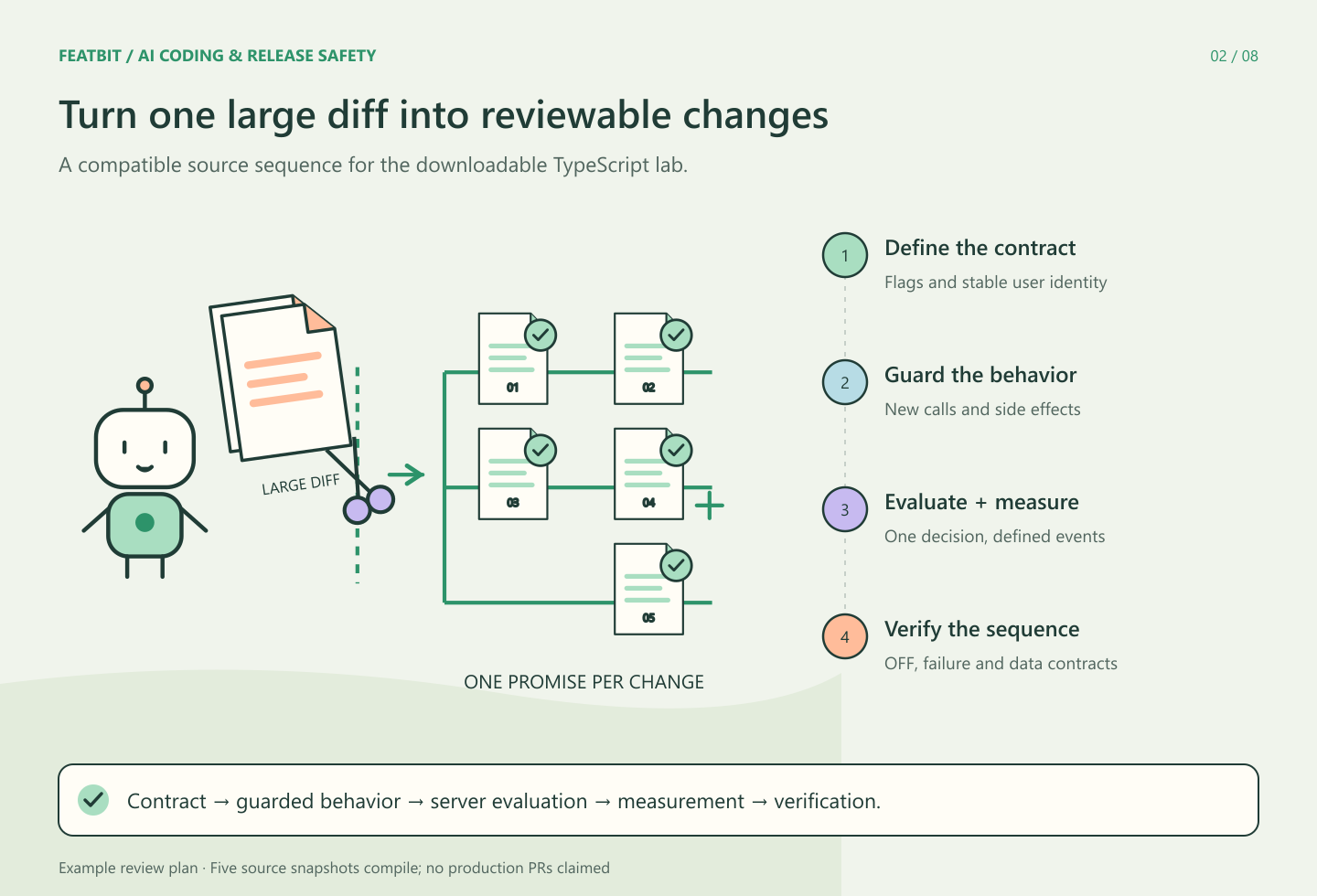
A concrete five-change sequence
The downloadable TypeScript lab contains these actual source files. The sequence below is an example review plan, not a claim that five production PRs were created or merged.
| Change | Files introduced | Review question | State before broad exposure |
|---|---|---|---|
| 1. Define the contract | flags.ts, user.ts |
Are keys, safe defaults, identities, and targeting attributes explicit? | Inert definitions; no customer route is enabled |
| 2. Add the guarded behavior | travel.ts |
Is every new call and effect inside the boundary, with a stable path? | Functions exist but are not wired to a customer route |
| 3. Add server evaluation | server.ts |
Does evaluation use the registry, consistent identity, contextual errors, and fallbacks? | The example can replay decisions; production exposure remains separate |
| 4. Add measurement validation | measurement.ts |
Are units, event ordering, deduplication, and cost categories explicit? | Synthetic helpers; no hosted events are sent |
| 5. Verify the composition | verify.ts |
Do targeting, failure, OFF, data contracts and event checks behave as intended? | Local verification; no production release is implied |
All five cumulative source snapshots compiled in the local verification; the source snapshot record lists the exact files at each stage. The complete package verifies runtime behavior. A real web application would usually add a separate integration change for the Server Component or handler and its UI; that change must remain compatible while disabled. The lab deliberately stays independent of the website's production flags.
For a data-heavy feature, add an earlier compatibility change. For example, introduce a nullable field before requiring writers to populate it, then preserve old readers until they are retired. A flag cannot protect a destructive migration that has already removed the column an old binary needs.
Define one review promise per PR
Give the reviewer a small contract. For the guarded behavior change, that might be:
Intent: Add optional indoor alternatives to the existing itinerary.
Baseline: Standard itinerary remains valid with Rainy-day rescue OFF.
New effects: Indoor provider call, saved indoor plan, related notification.
Excluded: Budget, Sharing, authorization changes, destructive migrations.
Verification: OFF avoids the provider; ON reaches it; injected failure is observable.
Known limit: Previously admitted work and prior writes are not undone by OFF.
Attach the commands and results actually obtained. If an integration was not exercised, state that gap. An agent's explanation of what it intended to run is not execution evidence.
Use the copyable PR template to retain intent, constraints, affected callers, risk, evidence, and the eventual cleanup condition. Keep design decisions with the repository rather than relying on an ephemeral chat transcript.
Check both compile-time and runtime compatibility
Compilation catches missing imports and mismatched types. It does not prove the stable path remains healthy or that a notification is gated.
The complete lab verifies that OFF avoids new provider calls and new effects, that a missing flag returns its fallback, and that each flag is evaluated once for a request. It also demonstrates a counterexample to an overbroad rollback claim: a request already holding ON can still complete its admitted work.
Run the package after extraction:
npm install
npm run verify
Its recorded output comes from the actual FeatBit Node SDK running synthetic offline rules. It does not claim production validation, live update propagation, or database transactional guarantees.
When implementing the pattern in Next.js, keep the SDK on the server and pass evaluated values to client components. Use the FeatBit SDK connection guide for your environment. Avoid adding browser-side evaluation just because the UI is in a different PR.
Keep release and cleanup visible
The last implementation PR does not have to expose the feature to everyone. Define a separate audience, health gate, stop action, and decision owner. The independent release tutorial demonstrates that operating sequence.
After the feature becomes the permanent behavior and the rollback window is satisfied, remove the temporary branch, obsolete tests and telemetry, then retire the remote flag after the deployed code no longer needs it. Follow feature flag lifecycle management so a review improvement does not become permanent branching debt.
There is no universal line-count threshold that makes a PR safe. A small permission change can deserve more scrutiny than a large generated fixture. Use the risk and human sign-off matrix to determine the required judgment. The aim is a sequence of changes a reviewer can explain, verify, and own while the team retains control over when users receive the new behavior.